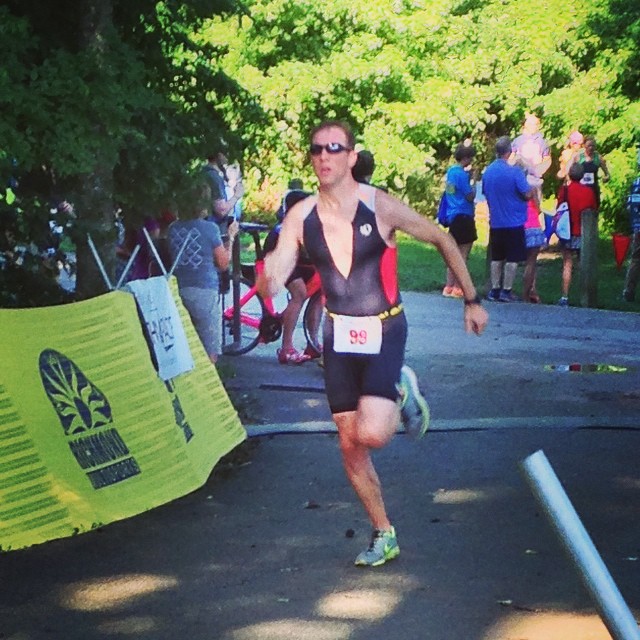
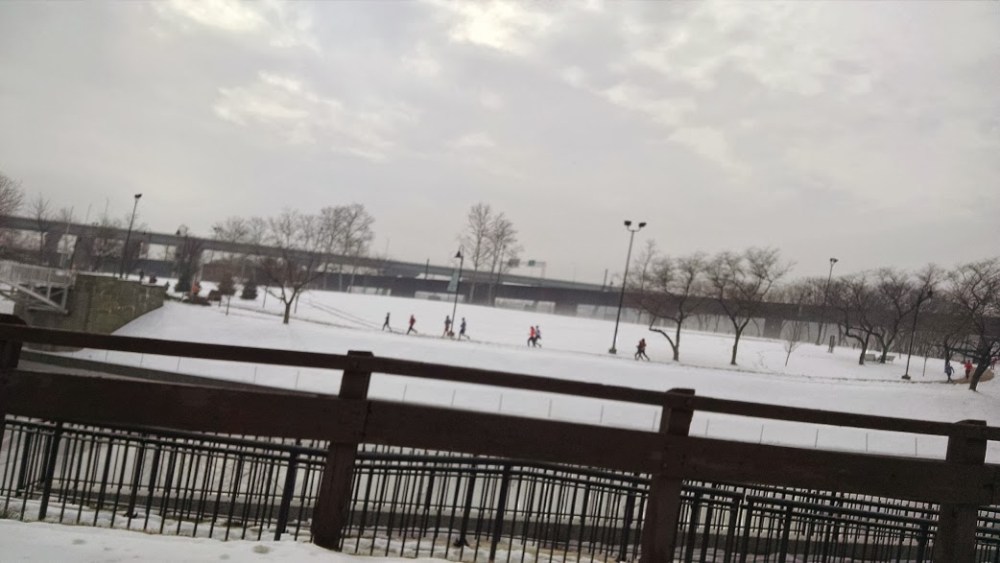
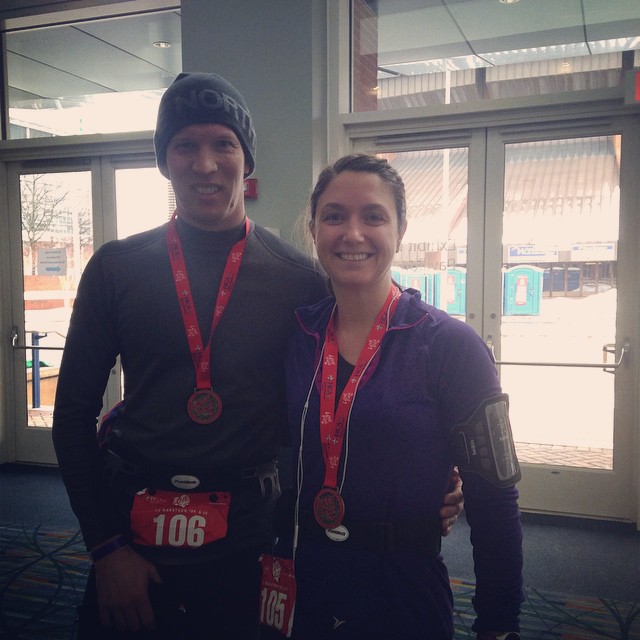
“I’ve got this growl in my tummy, I’m going to stop it today…”

2015 Martinsville Turkey Day 5k

Race Report

22:23     (7:13 min/mile)     2/8 AG     24/269 Overall

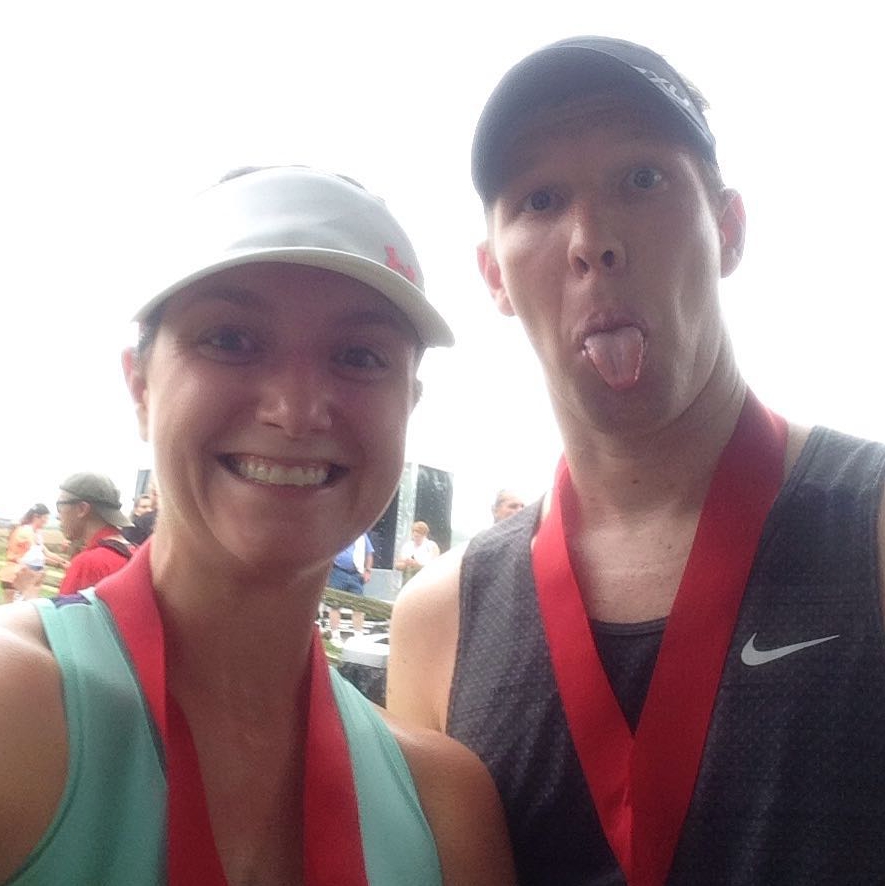
November 26, 2015 – For the second year in a row, Leigh Anne and I decided to participate in the Turkey Day 5k in Martinsville since we were spending the Thanksgiving break there.  We’d both finished second in our age groups in 2014, but she’d decided to run with the kids in the family division.  I was given permission, however, to run as an age group participant to see if I could make the podium again.

Pre-Race

Thanksgiving morning was cold, but not freezing.  We arrived at the Martinsville YMCA about 45 minutes prior to the race, and they have a nice elevated track around the basketball gym inside.  I ran a few laps and did some stretching to warm up, and the kids thought that the track was fantastic.  I kept telling them to stop running or they were going to tire themselves out, but my wisdom was lost on them.  They had never run a 5k, and I think they were unable to grasp the distance that they were about to take on for the first time.

When the race was a few minutes from starting, we all filed outside and into the street.  Even though this is a fairly small race, Miles in Martinsville is still able to close the course to traffic, which is nice – particularly when your young kids are running.  I lined up near the front of the starting pack, with Leigh Anne and the kids towards the back.  The National Anthem was played, and after a few words from the race director, we were off.

Race

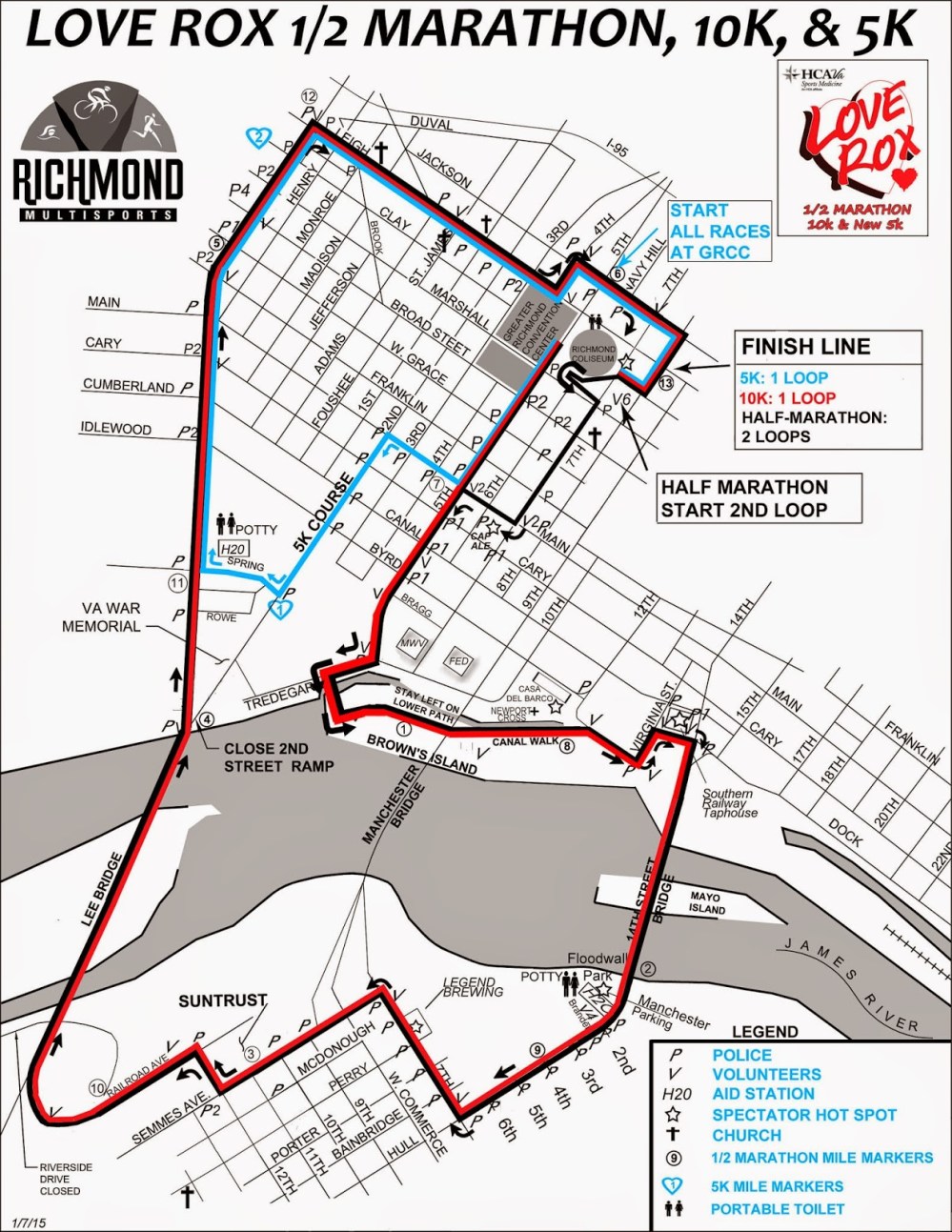
Course Map

Garmin Data

Having run the Richmond Marathon less than two weeks prior, I knew that my legs would not be fully recovered.  Nevertheless, I was still looking to PR in the race if at all possible.  The last standalone 5k that I’d run had been the same race in 2014, and I’d finished in 23:09 – which is a 7:27/mile pace.  I knew that the trick to handling this particular course is cruising downhill in the first mile without losing too much time going back uphill in mile 2.  You still had to leave something in the tank for the last mile, however, since it finishes uphill.

Mile 1 (7:12)

The first half mile was fairly flat on the public roads that wind around the YMCA.  I spent that time avoiding other runners and trying to settle into a good pace.  Unfortunately, there were a fair amount of people who decided to sprint the first few hundred yards and then throw on the brakes, so there was some dodging and weaving early on.

The course then entered a paved nature trail with a very steep downhill portion.  I tried to let my legs go without braking, but it was too steep and crowded to do so safely.  Thus, I had to hold myself back a little.  At the .7 mile point, the course bottomed out and a long uphill portion followed.  I was ready for it, having run the course in 2014, and slowed my pace, but only a little.

Mile 2 (7:38)

The long uphill section continued beyond the nature trail and until the intersection of Franklin and Main.  The course finally flattened out at the 1.5 mile point, which meant that there had been .8 miles of solid climbing.  By that point, my legs were really burning, and I could definitely tell that I was not recovered from the marathon.

After turning right on Main, there was a shallow downhill, so I was able to pick up the pace again.  Nevertheless, my lungs were beginning to burn by that point, and I guess they were jealous of my burning legs getting all of my attention.  Mile 2 was 26 seconds slower than mile 1, but it was mostly uphill, and mile 1 was mostly downhill.  I was happy with the relative consistency.

Mile 3 (7:15)

The final mile of the 5k is undulating, with the last portion uphill to the finish line.  My GPS was telling me that I was slightly ahead of my 2014 pace, and that motivated me to try to speed up even more.  After turning right onto Church Street, I knew that it was a straight shot to the finish line.  The finish is just beyond the crest of a hill, and you can’t see it until you are upon it.  In 2014 that caused some confusion for me, but in 2015 I knew where it was, and thus,  I also knew where I could start my finishing kick.

As I climbed the final hill, the legs and lungs were screaming at me, but I kept pressing on to finish strong.  The inflatable turkeys adorning the finish line were a welcome site, and I finished in 22:23, which was a PR for me by 46 seconds.  Not too bad for having post-marathon legs.

Post Race

After finishing, I walked back down the hill and began looking for Leigh Anne and the kids.  When they finally came into view, Jillian looked like she was doing pretty good, but Jackson was struggling and Leigh Anne looked frazzled.  Apparently, there had been a fair amount of complaining about tired legs, which probably stemmed from all of those laps the kids made around the indoor lap.

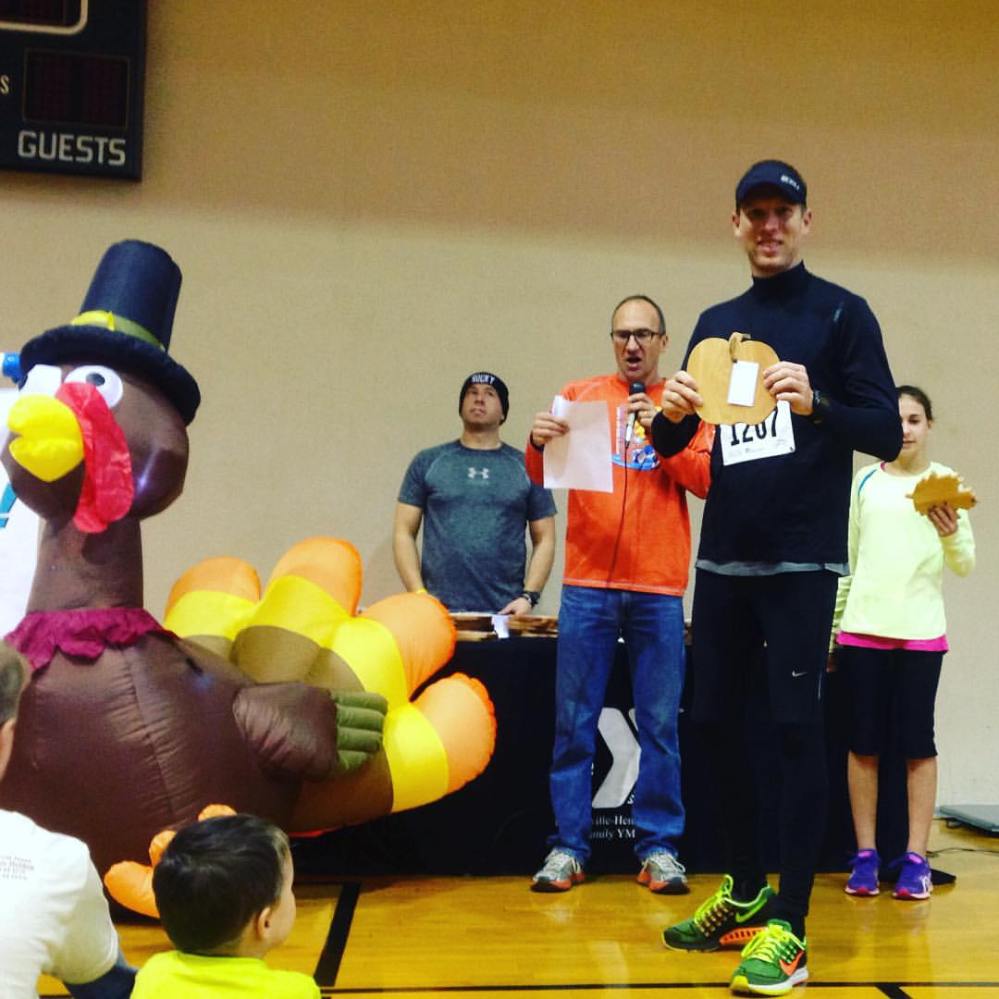
Once the race concluded, the awards ceremony was held on the basketball court.  Sadly, the llamas from 2014 were not present, but I did get second in my age group once again.  The winner of my age group finished in 18:33, so he blew the doors off of me.  Sadly, Leigh Anne’s projected time (if she’d have run solo) would have led her to win her age group, which I ended up hearing a lot about!  Thus, I volunteered to run with the kids in 2016.  Team Gravatt did come in 8/19 in the family division, which was dominated by families with teenaged children.

And with that, my 2015 racing schedule came to a close with another second place age group finish and another pumpkin cutting board to add to my “trophy” case.  It had been a productive year, but it was time to hit up the Biscuitville for some much needed coffee, and then Thanksgiving Day lunch to start putting on my winter weight.

turkey-day

“My head aches, warped and tied up, I need to kill this pain…”

2015 Richmond Marathon Race Report

3:53:12     (8:50 min/mile)     105/302 AG     1130/4523 Overall

November 14, 2015 – The Richmond Marathon was my last major race of the year, but it was never intended to be the pinnacle of 2015 for me.  My primary goal for 2015 was to complete Ironman Raleigh 70.3, and then to try to best my time from Raleigh at the Richmond Rox 70.3 triathlon in early October.  I had focused my training on the Richmond Rox triathlon, but I had extended my long runs beyond what would have been necessary for that race, with an eye towards the November marathon.  Still the marathon was something of an afterthought until after Richmond Rox, which was only was six weeks prior.  I was really using the marathon as a stepping stone for Ironman Maryland in October 2016, whereas I wanted my body to know what running 26.2 miles felt like before tacking the full Ironman.

To make matters more complicated, our family vacation to Disney World came at the end of October, and I basically went a week without any training – just as I should have been peaking in my training.  Thus, I’d say that I was only semi-prepared for the marathon.  I certainly was not out of shape, but I wasn’t in ideal marathon shape, and my longest run had been only 18 miles.  I think most marathon training plans call for a long run of 20-22 miles, but I’d have to do the best I could with the training I’d been able to get through.

One final challenge popped up during race week, when I came down with the illness that Leigh Anne had picked up about a week and a half before race day.  In the days leading up to the race, I felt run down and had a constant headache.  All I wanted to do was sleep.  It had taken Leigh Anne a few days to get over it, and that was going to run me right up against race morning.  I got all of my stuff together early on Friday night and went to bed early, hoping to feel better when I woke up.

Pre Race

Thankfully, my energy levels had returned by race morning, but I still had a pounding headache that wasn’t alleviated by over the counter meds.  I had my normal pre-race breakfast of oatmeal and coffee, followed by a banana.  Leigh Anne and I hit the road early, and picked up her running buddy, Michelle, who was racing with us.  Since parking can be a pain downtown on race day, we parked at my office and walked about eight blocks to the starting area.

It was cold on race morning, so we had all brought some old clothes to shed at the starting line.  I had chosen to run with my four-bottle Fuel Belt filled with Gatorade Endurance, and while it is a bit heavy and cumbersome with all those bottles, I wouldn’t need to slow for the aid stations.  I also had a few GU gels in the pouch for additional nutrition.

Neither Leigh Anne nor I had run a marathon, but Michelle had several under her belt.  We both were aiming at anything under four hours, which is a 9:07 minute/mile pace.  My stretch goal was 3:50, but I was afraid to try too hard for it, with the fear that I’d blow up around mile 23 and end up walking it in.  Michelle had run some 3:40ish marathons, and she and Leigh Anne were going to run together.  I told them that I’d be going my own pace, and we all lined up in the starting corral together, just behind the four hour pace group.  After the National Anthem and a few chilly minutes after shedding our extra clothes, we were off.

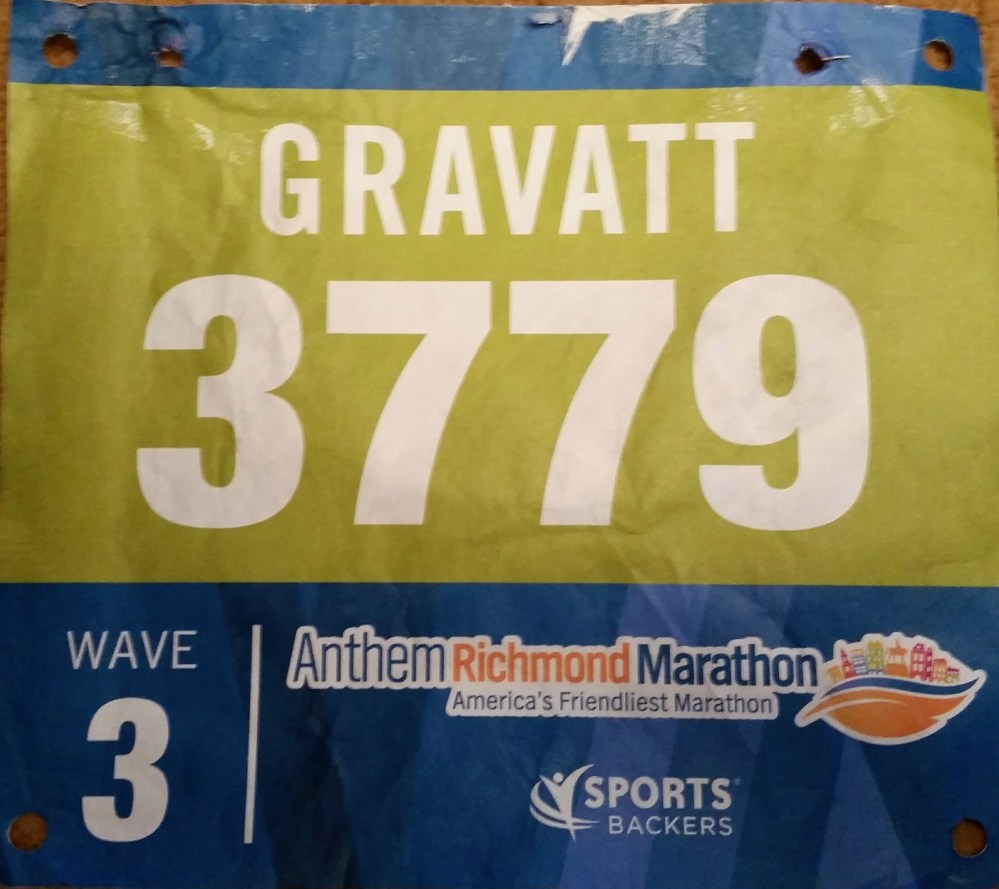
bib

Race

Course Map

GPS Data

Miles 1-3  (8:49)(8:46)(8:41)

My plan was to run a pretty steady pace of around 8:45 minute miles and then see how long I could hold on.  If things still felt good towards the end, I’d speed up.  The course is basically flat for the first six miles, but mile 1 was really congested due to the mass of runners.  I probably should have started a bit slower to warm up, but the 8:45 minute miles felt very easy initially, and the adrenaline makes you want to run even faster.

The first three miles went by quickly, and I felt good with the exception of my pounding headache.  I kept fiddling with my visor because my head felt like it wanted to explode, and the visor felt like a vice grip.  I had started a few seconds ahead of Leigh Anne and Michelle, and had been ahead of them until just past the mile 2 marker, when we turned left onto Boulevard.  They went past me at what seemed like an 8:35 pace.  I wasn’t interested in running that pace, so we said goodbye and off they went.

Miles 4-7  (8:41)(8:33)(8:48)(8:05)

Over the next three miles, I began to settle into the race and I was still feeling good.  There were a few minor hills in miles 4-6, but overall, the course remained pretty flat and easy.  Around mile 6 my head quit pounding, and the headache became less intense.  Leigh Anne and Michelle had gotten far enough ahead of me to where it was beginning to get difficult to pick them out of the crowd.  I kept telling myself to maintain my pacing, but I think subconsciously, I ran a little bit faster to keep them in sight.  Miles 4 and 5 dipped to 8:41 and 8:33 respectively, which took me away from my 8:45 plan.

Mile 7 has the longest downhill portion of the race as you head towards the river on Huguenot Road.  I didn’t increase my effort level on the downhill grade, but I let my feet carry me at the speed that gravity wanted me to go.  Between my increased pace and the fact that I wasn’t slowing for the aid stations, I began passing a few runners.  By the time I reached the bottom of the hill at the first party zone at mile 7 I caught up to Leigh Anne and Michelle.

Miles 8-13  (8:46)(8:32)(8:47)(8:55)(8:49)(8:47)

The three of us ran together for the next three miles, and I couldn’t get past how much talking the ladies were doing.  I understand talking during training runs, but it seemed like a lot of energy being expended by those two.  I’d join their conversation every now and again, but by and large, I just ran beside them and listened to their deep thoughts.

This portion of the course took us east along the river, and there were a few uphill portions that slowed our progress.  If miles 1-7 felt like an easy warmup, miles 8-13 let me know that I was in for a long day.  I wasn’t getting overly tired quite yet, but the miles were no longer coming easily.  After several uphill portions, we turned left onto Forest Hill Avenue, which later became Semmes Avenue.  The Forest Hill Avenue portion was a bit boring, but there were a fair amount of spectators on the Semmes Avenue stretch, which helped with the motivation.

Miles 14-18  (8:37)(8:41)(9:00)(8:58)(8:55)

Around mile 14 I picked up my pace a little bit and pulled away from Leigh Anne and Michelle.  A small downhill stretch helped, but I didn’t know that I was about to hit the toughest portion of the course.  Miles 15 and 16 were north on Belvedere, and straight into the wind across the Lee Bridge.  You then turn left onto Main Street, which is a false flat, and was still somehow into the wind.

I really hadn’t felt the wind much all day until I got near the Lee Bridge.  You were then completely exposed for a mile or so, and the wind was really whipping.  I began seeing running coaches for the first time on the bridge, and they were yelling for people to tuck in behind other runners.  I did the best I could to do so, but my pace ballooned upwards to 9:00 miles.  After crossing the bridge, it felt like we had to continue running north into the wind forever until we finally turned left onto Main Street.  By that point, the suffering had begun.

I thought that heading west on Main Street would be a little easier, and it probably was.  Still, the wind felt like it was against us and it was still uphill towards mile 18.  I did recover a little bit from the bridge experience, but fatigue and bad thoughts were steadily taking over.  When I passed the 18 mile marker I immediately realized that I was running farther than I ever had in my life, and I was wondering how my body was going to respond.

Miles 19-25  (8:49)(9:04)(8:55)(9:07)(9:05)(9:05)(9:42)

I wasn’t in suspense long, because my body began telling me that it was time to stop.  I was still able to hold an ok pace, but the legs were heavy and my feet a bit numb.  After passing the mile 19 marker and heading north on Boulevard towards The Diamond, Michelle pulled up on my left side to say hello.  She was alone, and indicated that Leigh Anne had been forced to walk around mile 17.  I didn’t know how severe Leigh Anne’s condition was at that time, and I was worried that she may have a LONG nine miles ahead of her if she was walking at 17.  Michelle then broke out her headphones, inserted them into her ears and glided effortlessly past me.  I felt like I was working overtime to keep my pace below nine minute miles, but she was pulling away from me and didn’t even look like she was straining.  She has hence been known to Leigh Anne and I as Michelle the gazelle.

Miles 22 to 25 were pretty dark times for me.  Cardiovascularly I was ok, but my body was shutting down and I just couldn’t get my legs to move any faster.  My splits inched up to about 9:05 for three miles, and then jumped up to 9:42 in mile 25 when the wheels really began to come off.  There were a fair amount of spectators during that stretch, but I was unable to take in any encouragement.  I was hurting and angry and felt like I wanted to lash out at anyone who gave me “stupid” encouragement, such as “you’re almost done.”  I was in fact, almost done, but for me, the end was not in sight.  My head had also resumed the pounding.  Thankfully, I didn’t actually lash out at anyone and just kept moving forward through my tunnel of pain and dark thoughts.

Mile 26 (9:15)

After seeing the mile 25 marker, I knew that it was almost over and that I’d make my sub-four hour goal unless I rolled an ankle or totally collapsed.  Being back downtown was a big mental boost, and I was able to pick up my pace a little bit.  There were a lot of spectators as I headed east, and I was finally able to draw on their energy in light of my improved mental state.

The last .4 miles of the race is all downhill towards Brown’s Island, but its pretty steep considering that your quads don’t really want to work anymore.  A lot of people were taking it easy down the hill, but I decided to sprint down it and hope that my legs didn’t give out.  I saw Leigh Anne’s parents with our kids midway down the hill, and was able to run down the remainder of the downgrade to the finish line without incident.

It felt great crossing the finish line, and Michelle was standing there waiting after I got my finisher’s medal.  She’d finished in 3:49:58, and I’d made it in 3:53:12.  I felt like I was going to collapse at any minute, but she looked like she was ready to run again.

At that moment my thoughts turned back to Leigh Anne, wondering where she was on the course.  Michelle seemed less concerned, and told me that Leigh Anne had only been planning to walk a little bit, and didn’t think that she had bonked and was walking it in.  In the midst of our discussion, Leigh Anne crossed the line in 3:57:55.

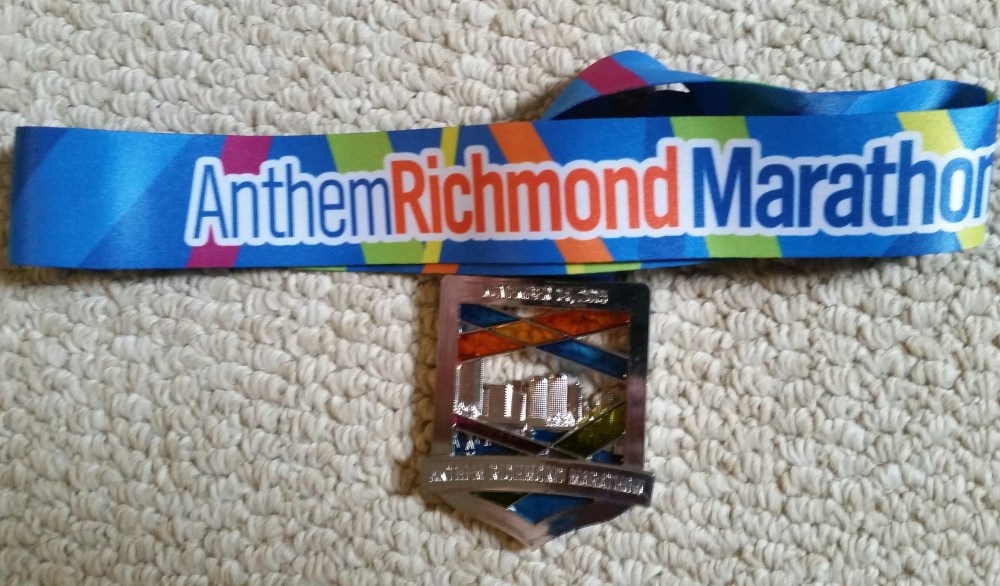
medal

Post Race

We ultimately tracked down Leigh Anne’s parents and the kids, and Leigh Anne and Michelle seemed to be feeling relatively well.  I felt less well, and had to sit down several times.  I don’t know if I was sick, short on calories or sodium, or whether running 8.2 miles farther than I ever had before simply took a toll on me.  It could have been all of the above.  Leigh Anne and Michelle had some 22ish mile long runs under their belts, and perhaps that was the difference in how they felt compared to me when we were done.  That, or they just might be tougher than me.

Overall, I was pleased with my performance, but I really suffered after mile 20.  There is a big difference in training for a half-iron distance triathlon and in training for a marathon, and I certainly was not as fully trained as I would have been if the marathon was my A (or B) race for the year.  With Ironman Maryland less than eleven months away, however, I at least knew how it felt to run 26.2 miles – albeit not after swimming and biking.  Thus, the Richmond Marathon served its purpose, and was another stepping stone towards completing 140.6 miles.

After the race, some Chick-fil-A was in order, but I had to be careful to maintain my race weight – there were less than two weeks until the Turkey Day 5k in Martinsville.  After all, I had a second place AG finish from 2014 to try to defend or improve upon.

marathon

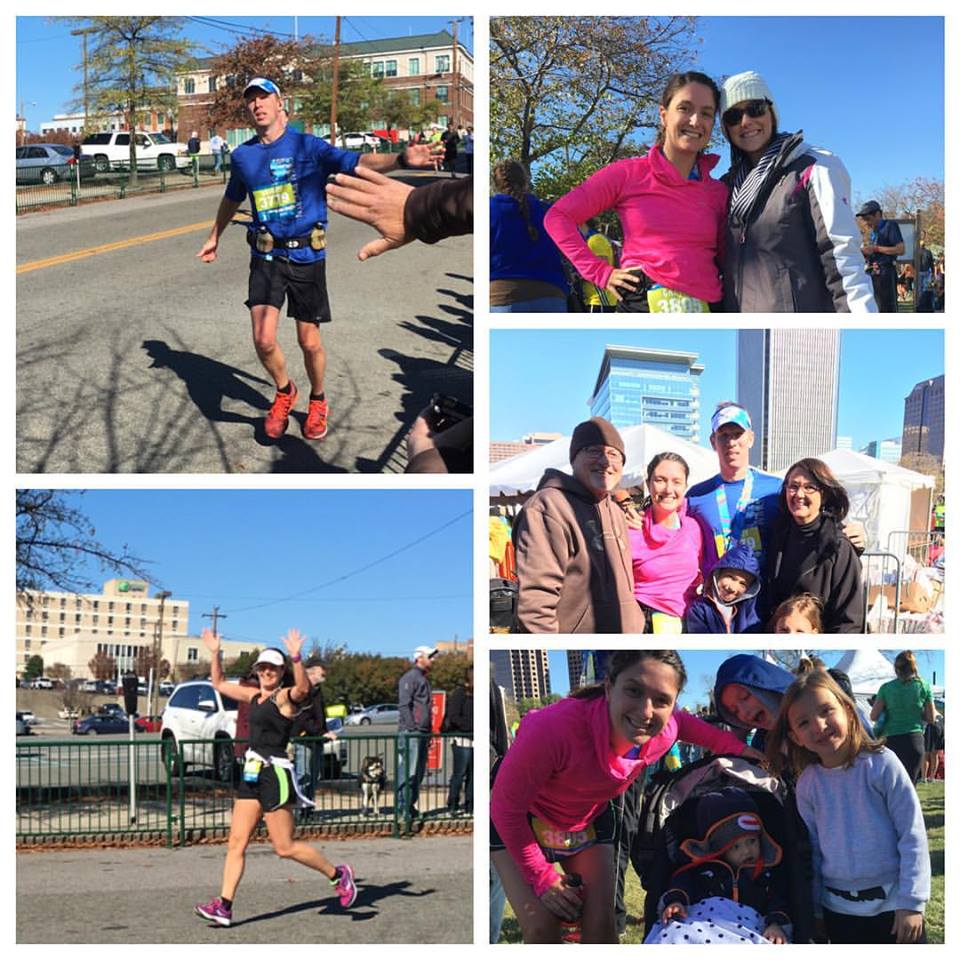
Notice the difference in how Leigh Anne and I look like we feel in the home stretch.


marathon

“And the calm, away by the storm is chasen…”

2015 Richmond Rox Half-Iron Triathlon

Race Report

5:13:33

 6/8 AG     23/73 Overall

October 4, 2015 – The Richmond Rox half iron distance triathlon was my last tri of the year, and was intended to be somewhat of a litmus test for my overall conditioning level.  I had already completed the Ironman Raleigh 70.3 race in May in searing heat, so I was looking to see if I could best my time in cooler conditions.  I had also signed up for the Richmond Marathon in November, and I was trying to train for that in conjunction with the Richmond Rox race.  My primary focus was on the triathlon, but I had been extending my long runs to prepare for the marathon as well.

Unfortunately, Hurricane Joaquin decided to head up the east coast on race week, and I was anxiously watching the weather forecast, fearing that the race would be cancelled.  In fact, Ironman Maryland was scheduled for the same day, and it had to be pushed back two weeks due to excessive flooding.  A day or two before the race it was announced that the triathlon would be turned into a duathlon, whereas the James River was in flood conditions.  Thus, the 1.2 mile river swim would be replaced with a two mile run.

Run 1: 13:20 (6:40/mile) 

With the swim being replaced with a “two mile” run, this would be my first duathlon.  I really didn’t know what the appropriate strategy should be for run 1, and whether I should go easy or hard.  I decided to do something in between, and figured that running near a 10k pace should suffice.  I didn’t want to give up too much time to others in my age group, but I also didn’t know how running instead of swimming was going to affect my half marathon at the end of the race.

Run 1 began from inside an old building outside the transition area, and I was in a group of about 40 that started at the same time.  The run took us away from Rockett’s Landing and back towards Richmond on the Capital Trail, and rain was falling, but the whipping wind was more concerning.

I took off at a good clip, but there were a few guys who looked like they were shot out of a cannon.  I was running along with the first third of the field or so, and even though I had been cold standing around at the starting line, I warmed up pretty quickly once I got going.  Run 1 was a straight out and back, and before I knew it, I hit the turnaround cone beneath the elevated train tracks along Dock Street.  My GPS read a little more than .8 miles, so I knew then that the course measurement was incorrect.  That, or my GPS was off.  This was my first race with my second-hand Garmin 910, so I wasn’t sure whether to believe the GPS or not.

I kept a steady pace on the way back in, and the run took us straight back to the “run in” portion of transition area.  When I hit the lap button on my GPS to signal the start of T1, it showed 1.71 miles – a fair amount short of the 2 miles claimed by the race officials.  Run 1 had taken me 13:20, which equated to a 7:47 pace on my GPS.  That is a little slower than my 10k pace, and I felt slightly winded, but still pretty good.  The race results had me running a 6:40 pace based upon a two mile course, but the course (and not my GPS) was obviously off.  Had I run a 6:40 pace for two miles, I would have been a lot more winded upon entering T1.

T1: 2:45

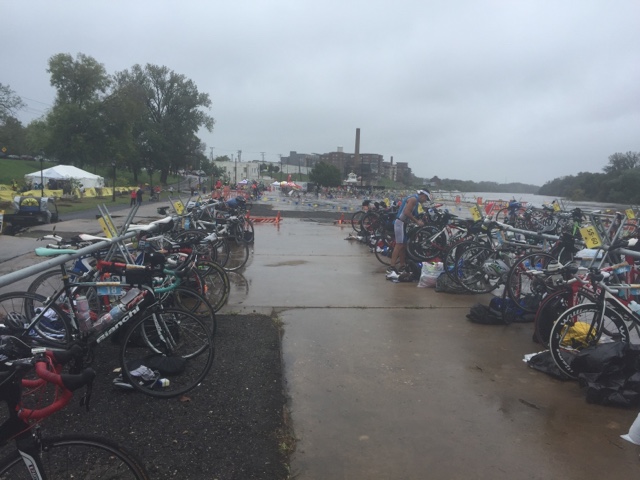
The transition area was fairly large, and was laid out on an elevated concrete slab.  It took me awhile to make it to my bike, and while I didn’t dillydally in transition, I didn’t rush either.  Half Iron distance races are long, and I wanted to make sure that I got everything correct.  Due to the cooler temperatures and the wind, I decided to throw on a short sleeved cycling jersey over my tri suit.  I am cold natured, and the prospect of shivering for 56 miles was not enticing to me.  I saw many people wearing long sleeves, and even rain jackets in transition and during the ride.

After getting situated, I began a long run towards the “bike out” area.  The concrete transition area was wet, and it was difficult to run quickly in cycling cleats without falling.  I finally made it to the timing mat, straddled my bike and took off.

richmond-rox-2015-bikes

 Bike: 2:50:17 (19.8 mph)

Prior to the race, I had purchased a rear disc cover for my Zipp 404s from Wheelbuilders.com.  At $100, it was far cheaper than a full carbon disc, but nearly as aerodynamic.  I had ridden with the disc cover once in a training ride (in calm conditions), but never during a race.  Given the windy conditions expected in the forecast, I was on the fence of whether I should use the disc cover on race day.  Just like a kid with a new toy at Christmas, however, I just had to play with it.

The first two miles out of transition on Route 5 were all uphill, and the going was slow.  I knew that I had a long windy ride ahead of me, and I took those miles to get my legs warmed up and to test out the handling of my bike with the rear disc cover.  The wind was really blowing, and I was concerned about a gust hitting the disc and shoving me off the road.  The wind was coming out of the northeast, and since I was initially heading southeast, it was coming from my left.

Once I climbed away from the river and got moving a little faster on level ground, I really noticed the benefit of the rear disc.  The sound of wind whipping through spokes was replaced with a totally different sound.  Its hard to describe, but I guess its the sound of speed.  I headed southeast for the first 9-10 miles, and even though I had a two mile climb and a cross-wind, I still averaged 20.6 mph for the first five miles and 21.1 mph for miles 6-10.  I was feeling good and loving the disc.  I did have to be careful to maintain a firm grip on the aerobars, however, because I was getting shoved around a bit.

Miles 10 – 25 brought me back down to Earth, and began to challenge me mentally and physically.  After turning left, there was a fifteen mile stretch that was pretty much straight into the wind.  My pace fell to 19 mph, even though I felt like I was pedaling much harder.  It took me approximately forty-seven minutes to make it those fifteen miles, and I was very happy when I finally made a right turn onto Route 106 to head southwest.  That turn finally put the wind at my back.

By this point the rain had begun to pick up, but I felt pretty warm due to my level of exertion, coupled with the double layering of my tri suit and cycling jersey.  Miles 25-34 were largely with the wind, and I averaged around 22 mph during that productive clip.  The only mishap came just after mile 34 during a right turn.  I was going a little too fast and thanks to the wet road, my bike slid out from under me.  I scraped up my rear derailleur and my saddle a bit, but somehow I managed to avoid anything but minor injuries and some wounded pride.  I was back on my bike before I stopped moving, and off once again.

The remaining 20ish miles were tough, and I had a constant head or cross-wind.  The wind also felt as though it was getting stronger, and the rain picked up once again with about ten miles to go.  I remember the last five miles back to transition being particularly windy and rainy, and those were the only miles of the day where I was challenging my decision to go with the disc cover on the rear wheel.  It got to the point where I didn’t feel comfortable in being in the aero position, and put my hands back on the hood for better control and stability.

The final two miles back down towards the transition area were the worst, and I ended up riding the brakes a bit because the wind kept shoving me to my left.  I’m sure that I gave some time back to the field over those two miles, but I really didn’t feel like having a second (and undoubtedly, more severe) spill.  I was very thankful when I got back to the transition area, and after a tough windy and wet ride, I was happy to be getting off the bike with just one minimal crash to my tally.

T2: 3:35

I’m not really sure why I spent so long in T2, because 3:35 is a pretty slow transition, even with a large transition area.  Again, it was tough to run in cycling cleats on the wet concrete, but I should have been able to transition in under three minutes.  I did have to take off my cycling jersey, but my T2s are almost always faster than my T1s.  I guess I was just a bit dazed from all of the wind and rain.

Run 2: 2:03:31 (9:25 min/mile  **official**) (9:03 min/mile  **actual**)

 My goal for the 13.1 mile run was sub two hours, which is a 9:07 min/mile pace or quicker.  I had run a 2:05 half marathon off the bike in Raleigh in 90+ degree temperatures and direct sunlight in May, but I had faded hard during the back half of that run due to the heat.  I felt pretty confident that I could run below two hours in Richmond given the cooler temperatures, even though the wind was blowing pretty hard.  I settled into an 8:45 pace out of transition, and I was hoping to hold that pace for as long as possible.

I am not a fan of the two-loop Richmond Rox run course, and there is a long gradual climb up past Legend’s Brewery on the south side, which seems to go on forever.  You then lose all of your elevation that you worked so long to gain in less than a half-mile, only to have to repeat the long upgrade once again on loop two.  The first portion of half iron run course utilized the Olympic distance course that I had completed in 2014, so I was familiar with it.  That portion of the course was well marked and had one or more volunteers at every turn.  I’d learn, however, that the back half of the course would be a different story.

For the first three miles, I was on the Olympic distance course with a lot of other runners.  After passing the turnaround cone for the Olympic distance runners, however, the crowd thinned out dramatically.  I was doing pretty well with my pacing up to that point, but I had to cross the Lee Bridge to get back to the north side of the James River.  It was about two-thirds of a mile across the bridge, and the wind was blowing right into my face (as it always does when running north on that bridge).  My pacing fell to about 8:58 min/mile, even though my effort level felt like it had increased significantly, and I was thankful when I finally hit solid ground on the far side.

I was in uncharted territory on the run upon returning to the north side, but my memory of the course map made me think that I would be turning right onto Byrd Street.  There was an aid station just across the Lee Bridge, and I asked the volunteers there where the next turn would be.  The response that I received was “somewhere up there.”  I proceeded on up Belvedere, thinking that there would be a sign or a volunteer pointing me in the right direction.

When I reached Byrd Street, there were no signs and no volunteers.  I did see a group of eight or so runners ahead of me, and they were still headed north on Belvedere.  Figuring that they could not all be wrong, and not wanting to get disqualified for cutting the course, I decided to follow them.  They eventually turned right onto Franklin Street, and so did I, even though I still had not seen any course markers.  By that time I was pretty worried about being off course, but I knew for sure that the course headed back down towards Brown’s Island via 5th Street.  We all then hung a right onto 5th Street and headed towards the river.

Just before we reached the intersection of 5th and Byrd, a group of five runners came off of Byrd Street from our right and turned onto 5th Street ahead of us.  I knew then that we’d gone off course, which was quickly confirmed by the other runners.  They indicated that a volunteer with a flag had told them to turn right onto Byrd Street – but that volunteer had not been there when my group had gone by.

It turned out that I had run an extra eight blocks, which sent my mood into a very dark place.  Ultimately I’d learn that I’d gone more than a half-mile out of my way, which cost me about four to five minutes.  I kept telling myself to let it go and to focus on the eight or so miles that remained, but that was easier said than done when I was trying to re-pass a couple of guys that I had overtaken in the first few miles of the run.

From there, the course wound around near Brown’s Island and then back towards the turnaround cone on Dock Stret.  I almost went off course a few more times because there were no volunteers on that portion of the course, and some of the directional signs were literally a few inches across and were stuck at random places on the ground.   I finally hit the turnaround cone at mile 7.20 on Dock Street, and turned around to head back uphill for loop two.

By that point, fatigue was really starting to set in and I knew that I would be positive splitting the run.  There was no respite from the wind, and I was dreading the long steady climb up past Legend’s, followed by the wind tunnel that would be the Lee Bridge.  My pacing began to slip as my body and mental state continued to decline, and I began fading to 9:00 – 9:25 minute miles.

When I got to the intersection of Belvedere and Byrd Street for the second time, there was a volunteer sitting in a lawn chair holding a flag – who had not been there on my first loop.  I resisted the urge to say something impolite to him, and turned right onto Byrd Street and started downhill.  It was mostly downhill back to Brown’s Island, and then the course flattened out on Dock Street on the way back towards Rockett’s Landing.

In looking at my GPS, I knew that a sub-two hour run was no longer in the cards, and the wheels were starting to come off.  I tried to hold it together as best I could down Dock Street, but mile 13 was run at a 9:24 pace.  When my GPS clicked to 13.1 miles I should have been done, but I still had more than a half mile to go thanks to my unfortunate detour.  Sadly, my brain told my body that the race was over since I’d covered a half marathon, and my body started shutting down.  Its a weird feeling, and more than just feeling tired, its a feeling of being physically unable to keep moving forward at anything much more than a walk.

Coincidentally, this was pretty much the same area of Dock Street where my body had shut down during the Olympic distance race a year prior due to my nutrition failure.  I tried to continue running, but every ounce of my body was telling me to walk.  It had simply had enough punishment on a rainy and windy day and was through.  I fought the urge to walk, but was only able to manage a slight jog towards the finish line after my 13.66 mile “half marathon.”

Officially, my run time was 2:03:31, three-and-a-half minutes slower than my goal.  My consolation was knowing that I would have run the half marathon in about 1:58, but for my half mile detour.

Race Link

Garmin GPS Data

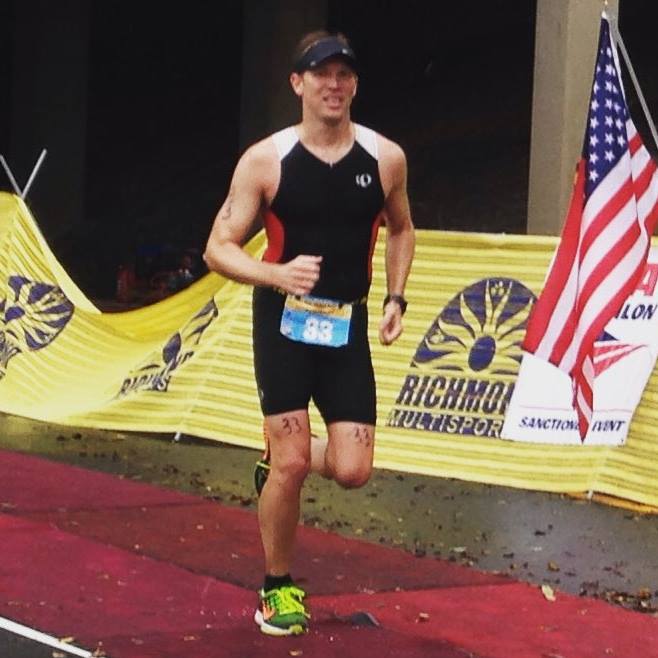
rox-finish

Post Race

Given the weather conditions, I didn’t stick around the race site very long after finishing, having had my fill of rain and wind for the day.  Leigh Anne and the kids had come out towards the end of the race to see me finish, and I was glad that they hadn’t waited around the course for six-plus hours.

The race was fairly bittersweet for me, whereas my bike split was slightly slower than in Raleigh.  I actually felt as though I’d had a stronger bike effort at Richmond Rox, but the crazy amounts of wind and rain had affected my split.  I definitely had a better run (officially and unofficially) in Richmond than in Raleigh, and the cooler temperatures surely helped.  I was still disappointed though, that my official run time still exceeded two hours.

The Richmond Rox half iron distance triathlon marked the end of my 2015 triathlon season.  Nevertheless, I still had the Richmond Marathon on my calendar six weeks later.  I had never run a marathon, and I had been trying to train for it in conjunction with my training for Richmond Rox.  The triathlon was my primary focus during training, so the upcoming marathon was something as an afterthought – as much as a marathon can be an afterthought.  I still had six weeks to finish my marathon preparation, but smack dab in the middle of those six weeks was our family vacation to Disney World.

So…….while Richmond Rox was not a smashing success for me, I felt as though my overall conditioning and racing had improved since Ironman Raleigh 70.3 a few months prior.  Given the cancelled swim and the vastly different racing conditions, however, it was certainly not an apples to apples comparison between those two races.  From a training standpoint, two half iron distance triathlons in 2015, plus the upcoming marathon were going to be a solid base for my 2016 season – which was set to culminate with Ironman Maryland on October 1, 2016.  Nevertheless, there was no time to look that far ahead with 26.2 miles of marathon running coming right around the corner.

“On my way crack lightning and thunder, I hid my head and the storm slipped away…”

2015 Jefferson Sprint Triathlon

Race Report

1:14:04

 2/6 AG     18/136 Overall

July 11, 2015 – Being a UVA grad, Charlottesville is very near and dear to my heart.  Given that I was going to be home alone on the weekend of July 11th, I decided to sign up for the Jefferson Sprint Triathlon there.  This would be my first triathlon in Charlottesville, and it would take place at Fry Spring’s Beach Club via Charlottesville Multisports.  I still cannot grasp the “Beach Club” portion of the name, because, while there is a 50 meter pool, there is no beach anywhere in the vicinity.

In preparation for the triathlon, I had reviewed the course maps and the prior year’s times for the finishers in my age group.  Based upon the bike and run splits, I felt as though I would be competitive for a podium spot.  In particular, there were hardly any 20+ mph bike splits in the entire field.  I noticed that the bike course has some elevation changes, but sometimes its hard to get a good grasp on the topography by simply reviewing course profiles or GPS data.  I knew that Charlottesville had some hills, but I guess I forgot just how hilly it could be in some places.

Pre Race

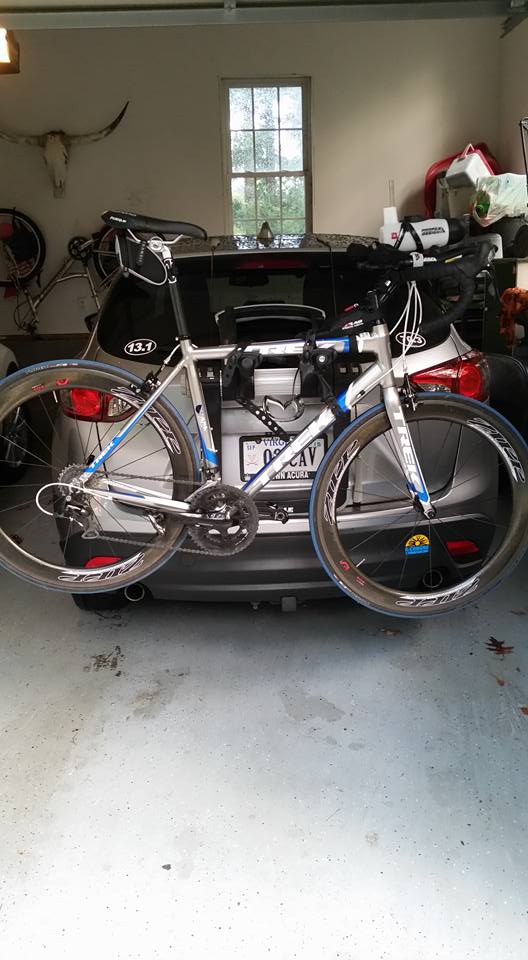
The night before the race, I strapped Blue to the back of my car, equipped for the second time with my new (to me) Zipp 404 wheels.  The weather was nice at that time, but the forecast was calling for storms overnight.  When I woke up the next morning, all hell was breaking loose outside – there were torrential downpours, lots of wind and even thunder.

jefferson

Ready to rock the Zipp 404s for the second time.

As I headed up I-64 to Charlottesville, I continued to go in and out of areas of heavy rain.  At points, I was travelling 45 mph or less just to be able to see the road ahead of me.  By the time that I finally pulled in to the Beach Club the worst of the weather had abated, but steady rain was still falling.  I sat in my car for a few minutes to see if the rain would slow, but since it showed no signs of doing so, I decided to go ahead and get wet while I set up my transition spot.

The transition area was in grass, which had basically turned into a giant puddle.  In certain sections it was a mud pit.  Thankfully, I had the foresight to bring a plastic grocery bag to put my running shoes in, but there was still little hope that they would stay completely dry.  After setting up, I checked in at the main building, which was certainly past its hey-day in terms of age.  The biggest concern for a lot of folks was the bathroom situation, whereas there were no portapotties outside.  The men’s room in the building had two urinals and two normal toilets, but the toilets were not screened off, so privacy was totally lacking.  I was thankful that I did not have a major bathroom situation to attend to on race morning, and the lack of portapotties was inexcusable.

Soon enough, it was time to gather near the pool for last minute race instructions and the National Anthem.  It was pretty chilly standing around in the rain, but the water in the 50 meter pool was pretty warm.  Thus, I was one of several racers who hung out in the pool during the announcements.  By that time, the rain had slowed down, but it was still coming down.

Swim      6:33 (1:52/100 m) 

The 50 meter pool had seven lanes, and participants started from opposite sides of the pool on the same end.  You would then serpentine through three 100 meter laps, moving one lane closer to the middle of the pool at the completion of each lap.  Swimmers from opposite ends would basically meet in the middle lane, and then proceed to the far end, for a total of 350 meters.

We were sorted by even/odd numbers, and since I was bib 55, I was about the 27th person in the water from my side of the pool.  With a pool swim, your bib number is determined by the estimated swim time that you listed when you signed up, and there is always the chance that you will be surrounded by people who seeded themselves poorly, which results in a traffic jam.  Thankfully, the people around me and I had all seeded ourselves correctly, and there was no passing or being passed during my swim.

I had previously encountered issues with my heart rate spiking at the beginning of swims, but I felt calm when I entered the water and tried not to over swim the first half of the course.  I was feeling really good throughout the entire swim, and began swimming harder for the last lap and a half.  Before I knew it, my 350 meters came to a close, and my watch read 6:28 when I hit the end of the final lap.

The timing mat was a few meters beyond the edge of the pool, and it took me a few seconds to get out of the water and to get across it.  My official time was 6:33, which equates to 1:52/100 meters.  I had swam 1:48/100 meters at the Groundforce IT triathlon a month or so prior, but that was a 300 meter course in a 25 meter pool.  Thus, I was very happy with my swim time as I headed away from the pool and up towards the transition area.

T1: 2:21

The transition area was up a long hill away from the pool, and you basically had to run to the far side of transition to get inside.  As such, I had a relatively long T1 of 2:21, but I certainly wasn’t dillydallying.  The run through transition to my bike was essentially like running through a swamp, and I threw on my (already soaking wet) bike shoes without socks.  On went the helmet, and off I went to the Bike Out area.  Just prior to the exit of T1 there was a massive mud puddle, which was impossible to avoid.  Muddy water went everywhere, but it didn’t concern me since the rain that was still falling would wash it off anyways.

 Bike      40:26 (18.5 mph)

After coming out of the Fry Spring’s Beach Club, there was a fairly steep downhill portion to the main road.  There were leaves and small branches everywhere from the storm, and water was actively running down the roadway, which I tried to avoid.  I learned very quickly that the bike ride was going to be precarious because I was losing traction as I pedaled down that first hill.  There were several “pucker” moments during the first descent, and I finally decided that it was too dangerous to pedal hard because I kept losing traction and I didn’t want my back wheel to come around on me.  I basically ended up letting gravity do most of the work, and the course flatted out a bit after turning onto the main road.

The flat portion didn’t last very long, and the out-and-back course was nothing more than one hill after another.  I’d spend a few minutes pumping up a hill, followed by a speedy and dangerous descent down the other side.  Basically it was up-down and then rinse and repeat all the way out to the turn around cone, and then the same thing in reverse order coming back in.

There weren’t a ton of people on the bike course ahead of me, but I did overtake several people.  One or two guys blew past me in the early miles, and they seemed like incredible bikers.  I was up out of my saddle quite a bit going up the hills, and I did my best to gain as much speed as I was comfortable with on the downhill sections.  Again, however, I rode relatively conservatively downhill because I just didn’t want to tempt fate and crash on the wet roads.  The entire bike course was littered with broken branches and leaves, and there were several areas of standing water that had to be avoided as well.

After what seemed like a lot more than 12 miles, I made my way back to the road that led up to the Beach Club.  That road had been scary on the way out/down, and it certainly wasn’t a whole lot of fun to climb back up.  After riding back up the hill, I saw volunteers waving me back towards transition, and then it was off my bike and back into the swamp of the transition area.  My legs were pretty taxed from the constant climbing on the bike course, but I still felt like I had a good run left in me, and I was glad to get off the bike in one piece.

Overall, the 40:26 that I spent on the bike only put me at an 18.5 mph pace.  The pace suffered quite a bit from the hills and my cautious riding on the downhill sections, but was still good enough for the 15th fastest split of the day.

T2: 59

At 59 seconds, T2 was much faster than T1, but primarily since there was no long run up a hill from the pool involved.  My bike was racked, my helmet was removed and I threw on my (soaking wet) shoes sans socks.  My bib was already attached to my race belt, which I grabbed and strapped on during my run out of transition.

Run      23:48 (7:56 min/mile)

 Again, I lived in Charlottesville for four years, but I had completely misremembered how hilly it is.  The first half-mile of the run course was relatively flat on Jefferson Park Avenue as we headed towards the UVA campus.  After turning left onto Stribling Avenue, I ended up on a gravel trail outside of an electrical station.  The trail had a very steep downhill portion, and I had to be mindful of taking it too fast and toppling over.  I remember “braking” all the way down the hill, but once I got to the bottom, the real fun began.

The gravel trail ended and we crossed Route 29 near the Fontaine Research Park.  Mile 2 was pretty much all uphill, and winded around past my old second year residence on Appletree Road, and then up to Stadium Road.  I was determined to maintain a steady pace on the long uphill climb, and I was able to pass a few runners who had slowed to a walk.  By that time, I had mentally set a goal of 24 minutes for myself on the run, which would have been no problem on a flat course.  The hills, however, were definitely slowing my pace.

After reaching the crest of a hill on Stadium Road, I knew that the worst was behind me, and it was downhill to the right turn onto Maury Avenue, which then became Jefferson Park Avenue after crossing Route 29 again.  From the intersection of JPA and Route 29, it was then mostly uphill all the way back to the Beach Club.

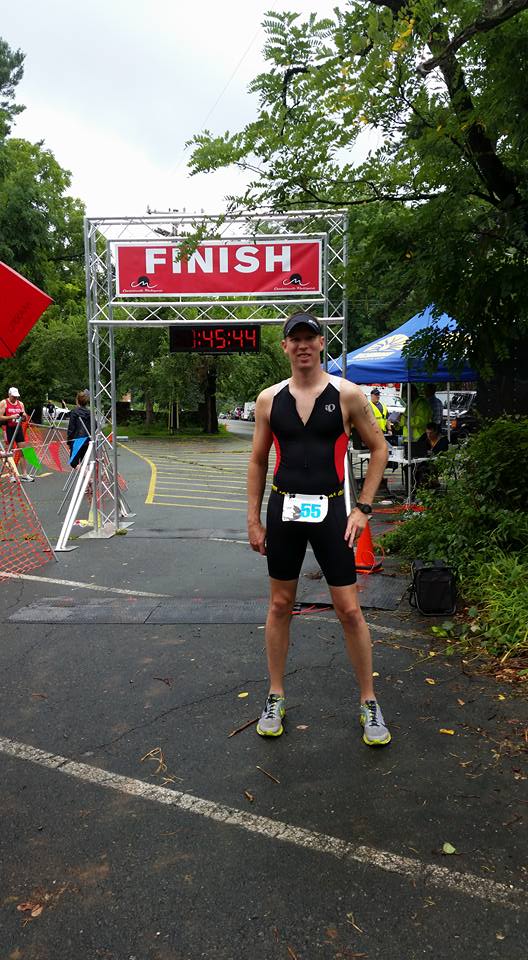
The brief downhill portion had allowed my legs to recover a bit, and I was able to pick up my pace going back uphill towards the finish line.  In looking at my watch, I knew that it was going to be close for a sub-24 minute finish, and by the last few hundred yards I was running as hard as I could.  I turned back into the Beach Club property and finished the run in 23:48 as I crossed the final timing mat – with 12 seconds to spare.

finish-cvill

Post-Race

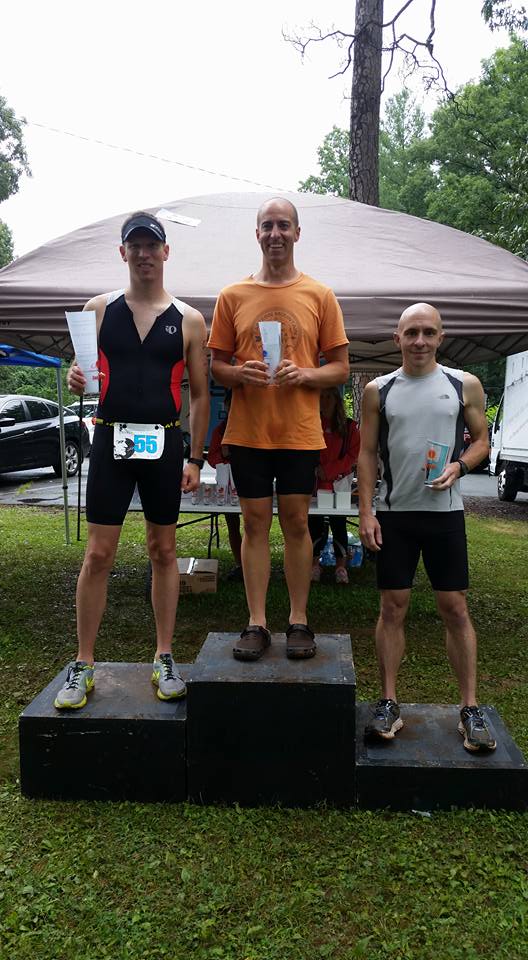
The rain had basically stopped by the time that I finished the run, and I milled around for awhile and waited for the results to start coming up.  As the printouts began to be posted, I noticed that I was being listed as second in my AG.  Since the results were preliminary, I told myself not to get too excited, because they were certainly subject to change.  There could have been someone that started the swim well after me, but who still had yet to finish, and was going to knock me down the AG standings.  After about an hour, however, I was still second in my AG, so I realized that I had actually made podium.

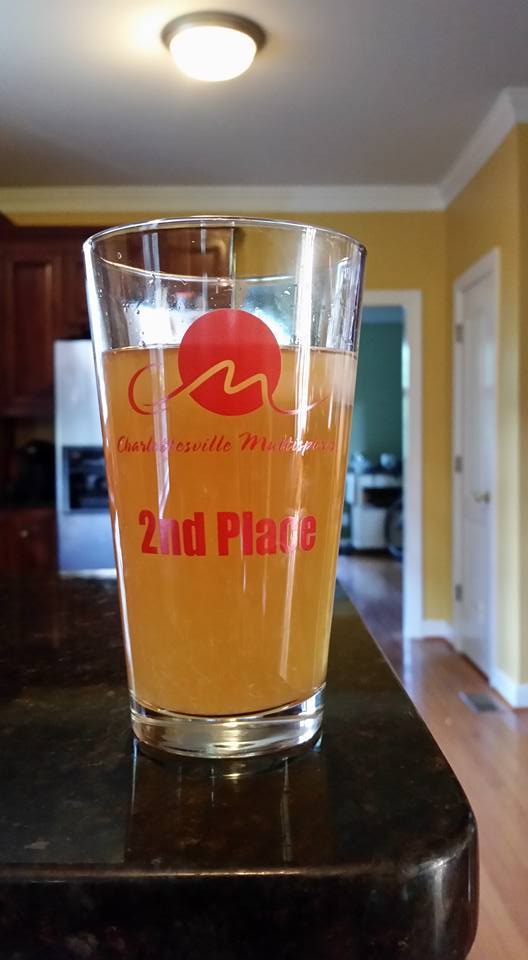
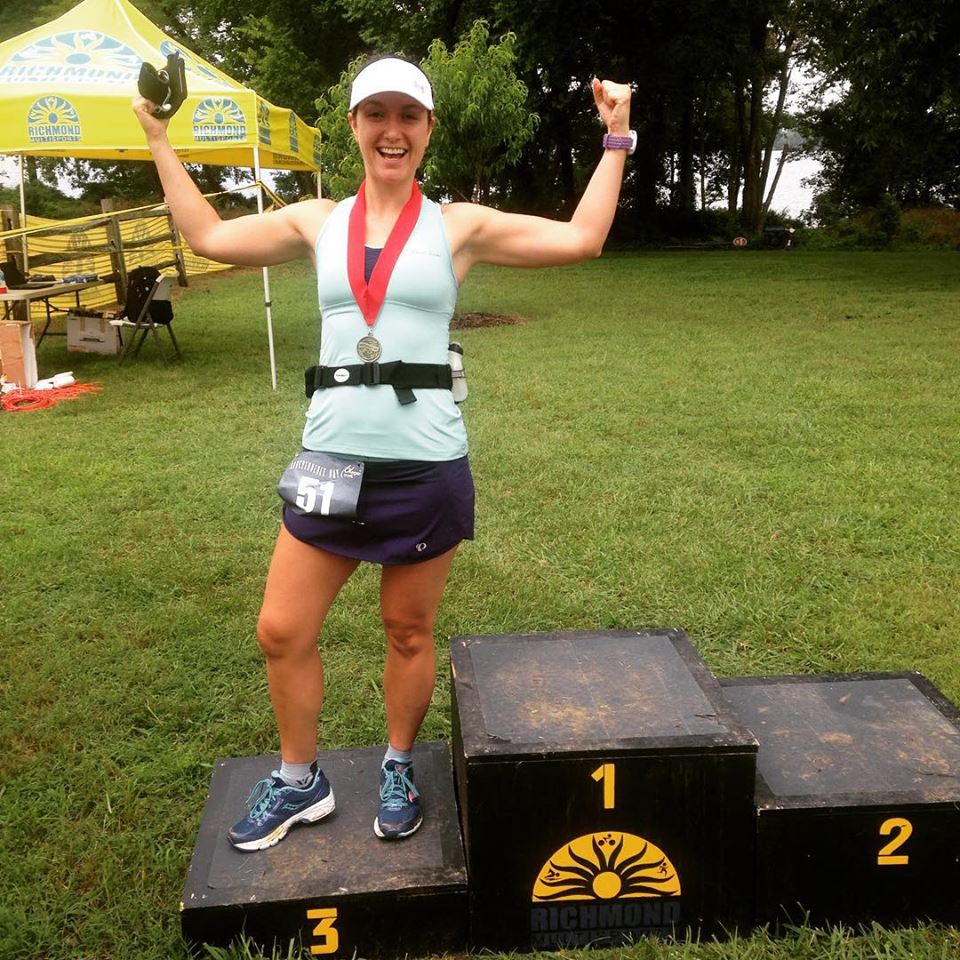
Now, this was obviously a smaller race, which probably had a reduced turnout due to the poor weather.  Still, it was the first time that I’d made a triathlon podium, so I was pretty excited.  In addition, there were several college triathlon club teams present, and my overall finish place of 18th meant that I’d beaten several of the young bucks, which made me happy.  Thus, when the awards were handed out, I made sure to find a kind stranger to take my picture on the podium since I had no support crew.  Not only did I get a cool glass, but I also won a $100 gift card for the 13th fastest bike split – which rolled down to me at 15th since 13 and 14 must have hit the road.

Overall, the Jefferson Sprint was somewhat of a character building event for me with the weather and topography.  I’d had searing heat in Raleigh, followed by a raging river swim at Robious Landing, and now crazy amounts of rain and slick roads in Charlottesville.  Thankfully, the temperature was nice, and even though it was a wet event, the wind had completely died down prior to the start.  Not to worry though, because I had a seriously windy triathlon in my near future.

My final triathlon of the year was going to be the Half Iron distance race at the Richmond Rox triathlon in September.  If the Ironman Raleigh 70.3 was my “A” race for the year, then Richmond Rox was intended to be my “A-” race.  Little did I know, however, that it would be yet another interesting experience – primarily due to Hurricane Joaquin.  That race would involve rain, heavy wind, a bike crash and being directed off course (again!) by race volunteers.  In the short term, I fully intended to test out my second place AG glass.

Results Link


podium

Second racing season – first tri podium.


glass

Beer still tastes better out of this glass.

“Why follow me, lost as you swear I am?”

2015 Independence Day 17.76k

Race Report

1:36:17     (8:43 min/mile)     5/18 AG     23/231 Overall

**actual pace (8:11 min/mile over the 18.89k actually run)


July 4, 2015 – Richmond Multisports decided to begin a 17.76k race celebrating Independence Day in 2015, and since the kids would be out of town, Leigh Anne and I decided to sign up.  17.76 kilometers converts to a little over 11 miles, and we figured that it would be a nice run since we were both training for the Richmond Marathon.  Shirley Plantation in Charles City County was the venue, and even though it was less than an hour from my house, I had never been.  My neighbor, Linda Posey, also chose to run, so there’d be three of us, along with our chauffeur and Sherpa, Alan Posey.

Pre Race

July 4th can be a hot time for an 11 mile race, but it was overcast and drizzly on race morning.  We all piled into Alan’s SUV, but we didn’t make it through Chester before he got pulled over for speeding in a 35 mile per hour zone on Route 10.  There weren’t many people on the road at 5:30 in the morning, and thankfully the cop let us off with a warning once he saw that we were headed to a race – as opposed to driving home drunk from an all nighter.

The gravel/dirt roads into Shirley Plantation were very wet from a lot of recent rain, and it was sort of a maze to find the mansion and starting area.  Linda was very excited to see a couple of goats in a small pen near the parking area, but to her dismay, she had more interest in them than they in her.

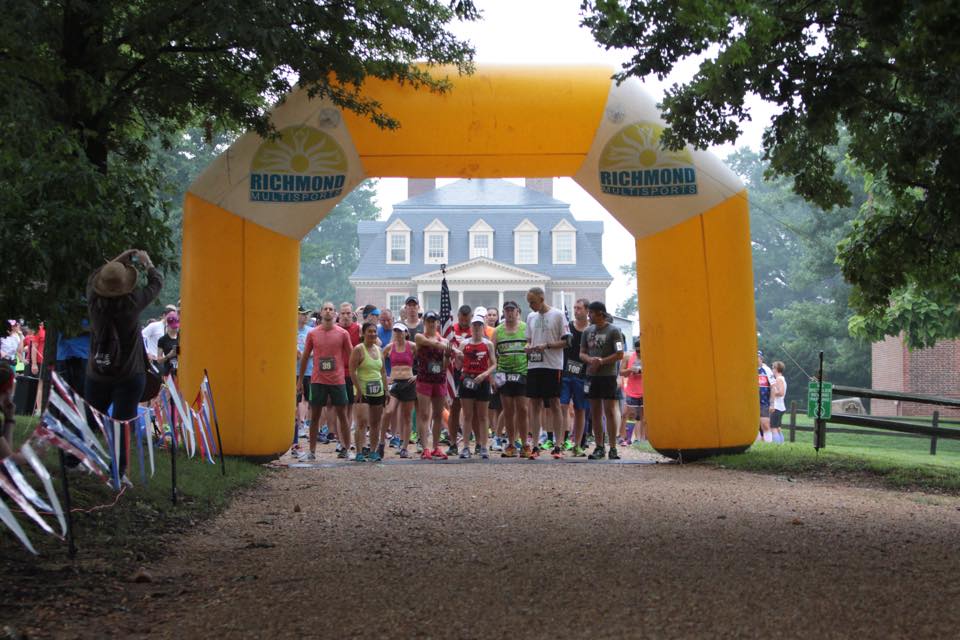
Even though we had all pre-registered, none of us had gone to packet pickup, so we had to grab our race numbers from registration prior to the start.  The inaugural event was relatively small though, so there really was no waiting in line.  Once we had our race numbers, there were the obligatory bathroom stops, and then we were all corralled for a mass start near the inflatable starting arch.

After the National Anthem, the race director instructed all of the runner to “follow the girl on the bike,” who would be leading us out of Shirley Plantation.  She was then going to stay just ahead of the leaders, and we were assured that she knew the course.  I had looked at the course map prior to the race, and most of the race took place on public roads outside the plantation.  There were a couple of turns on unmarked gravel roads before exiting the plantation property, so I guess they chose to have someone lead us out on a bike so that we wouldn’t get lost.

Race

id4-start

My head is sticking up just left of the American flag.

I really didn’t have a specific time goal for this race (who has one for a 17.76k anyways?), but I just wanted to run as close to 8 minute miles as possible.  I still did not own a GPS, so I’d have to pace myself based upon the mile markers.

Once the starting horn sounded, off we all went following the girl on the bike.  I had positioned myself near the front of the mass start, with Linda and Leigh Anne somewhere behind me.  As we got a half mile or so down the gravel road the line of runners began to thin a bit, but everyone was still in pretty much close proximity to one another.

Near the 1 mile point, the bicyclist made a right turn onto another gravel road at a “T” intersection.  By that point there were probably 15-20 people ahead of me, with the remaining 200 or so people in the field behind me.  I was pretty much focused on the people directly ahead of me, but after running several hundred yards, I heard people shouting ahead of me.  Before I knew what was happening, I saw the bicyclist and the runners ahead of me turning around and heading back.  As it turned out, the bicyclist had turned right instead of going straight at the “T” intersection, and only realized her error when she ran out of road due to a fence.

Unfortunately, I was already at the fence by the time that I put everything together, so I turned and followed the leaders back in the opposite direction.  Mass confusion then ensued.  The line of runners headed towards us slowly learned that this was an unscheduled detour and not part of the course.  They began to turn around, but a third of the field had not yet made it to the wrong turn.  Word made it back to the rear of the field to go straight BEFORE the front of the field got back on course, so then, the fastest runners were now all behind the slowest runners on a narrow gravel road.

Confusion turned to anger at this point, and for the next half mile or so the faster runners were doing everything they could to get around the back of the field.  That was not easy given the narrow road.  Overall, the first third of the field got the full detour, the middle third got a partial detour and the last third got no detour.  Based upon Leigh Anne’s GPS after the race, the front third of the field who made it to the fence before turning around had gone .7 miles off course.  At the time, however, I had no idea exactly how far off course I had gone, but I was guessing somewhere between a half mile and a mile.

Given that I had no GPS, I knew that I was going to be unable to accurately gauge my pace, so I would be running by feel.  I figured that the mile markers would still help me to a degree, but once I got out onto the public roadways I quickly learned that there were NO mile markers.  My last option was to ask the volunteers at the aid stations.  When I got to the first one, however, I was told by the volunteers that even they did not know the mileage.  Thus, I was stuck running by feel, which might get tricky over the course of 11 humid miles.

At that point, my mind started going to a dark place.  I am a data nerd, and I like to know exactly how far I’ve run, how long it took me to get there and whether I’m speeding up or slowing down.  The first couple of miles (I think) had me brooding, but then I finally told myself that I needed to get over it and just run.  Everyone who should have been competitive for a podium spot got directed off course, so there was no point in staying angry.  Moreover, I had run by feel in a 15k in Pocahontas State Park a year earlier and actually ran faster than I thought possible.  Maybe I could overachieve once again.  I put on a happy face and decided to focus on the task at hand.

Once the course got onto the public roads, there were only a handful of turns before re-entering the Shirley Plantation property.  There were, however, three LONG stretches of road, with the last being down Route 5 coming back in.  After settling into a comfortably hard pace for a time, I started to get a cramp in my left leg somewhere near the mid-point of the course.  Thankfully, I had brought sodium tablets with me, and after taking a couple of those, the cramp subsided.  Even though the weather was not as hot as it could have been, it was still in the 80’s with nearly 100 percent humidity.  Thus, I was sweating a ton and was losing a lot of salt in the process.

After what seemed like forever on Route 5, I finally got back to the entrance of Shirley Plantation.  This was, however, a different road than the one that we had exited the plantation property from near the beginning of the run.  I had been feeling pretty good overall, but as soon as I got back onto the gravel roads I began hurting.  I knew that there was still some running around the plantation before the finish near the river, but my brain was telling my body that the end was very near.  Once you lose the proper mindset, the body quickly follows.

Unfortunately, the run through the plantation was nearly 2 miles, and it seemed like it would never end.  I kept waiting to see the river or the finish line, or to even just hear the music from the finish line.  Still, every time I made another turn there was nothing to see but more fields and corn.  I finally saw the river, and based upon my recollection of the course map, I thought the end was upon me.  Nope, I then had to make a left and reverse course towards a turnaround cone out in the middle of nowhere.

I hate to admit it, but I was all alone at that point and there was a big part of me that was saying to forget going all the way to the turnaround cone and to just turn around and head back in.  I kept telling myself that they owed it to me after sending me off course to begin with, and that this shortcut would still only get me back a portion of the extra mileage they’d already made me complete.  Leigh Anne tells me that she had the exact same thought, and I’m guessing a lot of others did as well.  In the end though, I couldn’t bring myself to cut the course, and went all the way around the cone and then headed back in my original direction.

By that time I was within a half mile or so of the finish line, but I still had no idea where it was because I couldn’t see or hear it.  The course wound away from the river, then back towards it, and then away from it once again.  It was then that the finish finally came into sight, and I don’t think I’ve ever been so happy to see a finishing chute as I was that day.  After finishing, I waited a few minutes and then came Linda and then Leigh Anne.  I hadn’t seen either of them since passing them on the detour and telling them to turn around.

id4-finish

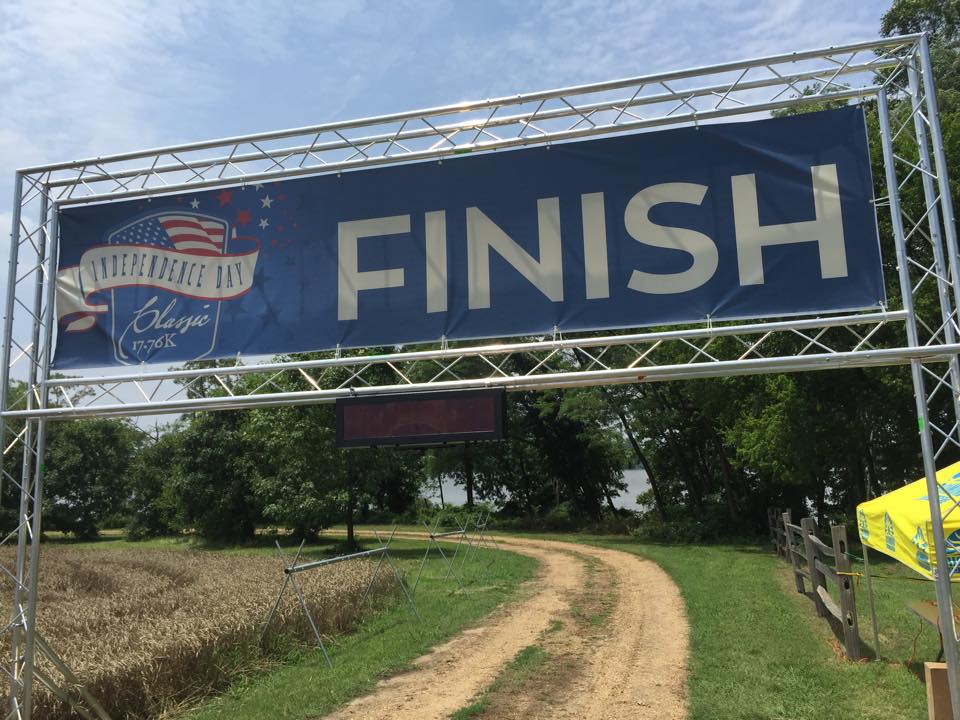
You couldn’t see or hear the finish line until the very end.

Post Race

Officially, I ran a 1:36:17, which equates to an 8:43/mile pace for the designated distance.  After Leigh Anne finished, we confirmed that we’d run 18.89k instead of 17.76k, which is an additional 0.7 miles.  She and Linda had also gone all the way to the fence to turn around during the detour, so we’d all run the same amount off course.  Unofficially, I ran an 8:11/mile pace.  That fell squarely into the pacing range that I was hoping to run, and I felt good about it, especially since it was hot and humid.

Leigh Anne and Linda were not very interested in partaking in the post-race food, but I made a pig out of myself with the hamburgers and hot dogs.  There were a lot of angry people milling around the finish area complaining about the detour, and the bicycle girl made a wise decision in departing early since she seemed to be on everyone’s hit list.  As noted above, the detour probably did not affect the podium spots much, whereas the faster runners pretty much all took the entire detour.

Sadly, I finished 5/18 in my age group (23/231 overall), but Leigh Anne was 3/20 in her age group and made the podium.  Linda is no stranger to the podium, and was 1/10 in her age group.  Thankfully, there were no run-ins with the police on the way back home, but poor Alan had to sit in the car with three very sweaty people.  I’m not sure whatever happened to the girl on the bicycle, but based upon some of the post-race comments that I heard from other participants, she may have entered the witness protection program.

Prior to the Independence Day Classic, I had had nothing but good experiences with Richmond Multisports.  I know that 2015 was the inaugural year for the event, so some growing pains are to be expected, but I was not impressed by the production.  The course was poorly marked (and pretty boring), and even the volunteers were not as helpful as in prior events.  We enjoyed ourselves to a degree, but none of us had any overwhelming desire to run the race again in the future.  The best that we could say is that two-thirds of our group made the podium, and that we burned a lot of calories on July 4th before lunch time.

Next up for me was the Jefferson Sprint triathlon in Charlottesville the following weekend.  That event would be notable for several reasons, and the weather would make it a seriously challenging endeavor.

id l.jpg

id4-medals

“And we can swim as the tide choose to turn you, around and around…”

2015 I Love The Tavern Sprint Triathlon

Race Report

1:23:58

 8/29 AG     40/429 Overall

June 28, 2015 – Less than one month after my first Half-Iron distance triathlon in Raleigh, its time for the I Love the Tavern sprint triathlon at Robious Landing.  This particular race features a river swim, and the 19 mile bike course is a bit longer than the normal 12 mile sprint distance.  I was particularly excited for this race since it is one of the best in Richmond, plus it was my second ever triathlon in 2014.  It would be the first time that I had completed the same race twice, and thus, I would have an apples-to-apples comparison to see how much I had improved since year one.

Pre-Race

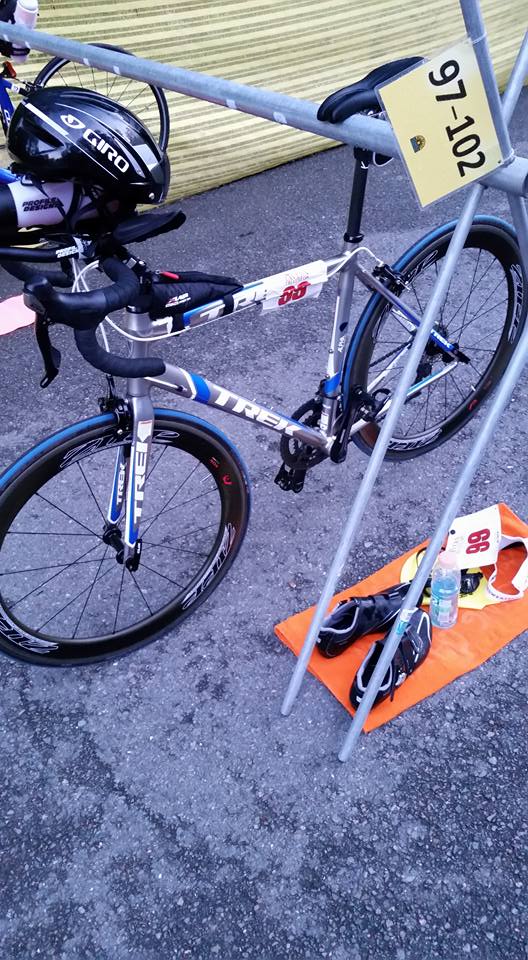
There was nothing out of the ordinary for me on the morning of the race, other than wondering if the swim would be cancelled.  It had rained heavily a few days prior to the event, and the James River was fairly swollen.  I ate breakfast at home and then left around 4:45 a.m. to head to Robious Landing.  I always try to get into the transition area as soon as it opens to try get the spot at the end of the bike rack.  As you can see from the photo below, I was early enough to nab the coveted spot, and set up my transition area.

tavern-rack

Blue – sporting the newly purchased Zipp 404s.

Additionally, I had recently purchased a pair of used Zipp 404 wheels, which have a 58 mm rim depth.  This was going to be my first race with them, so I was excited to see how much they helped my bike split.  I had rented a Zipp 404/808 combo for Ironman Raleigh 70.3, but it was nice to finally have a set of my own.  Many thanks to Holly Olson for selling them to me…with Busher acting as the finding agent and middleman.


The weather on the day of the race was warm but nice, and after setting up, I walked down to the river to take a look at the swim course.  All I can say is that the river was ROLLING!  Everyone was saying to make sure that you didn’t miss the dock at the swim exit because it would be very tough to fight the current to get back to it if you did.  They probably would have been justified for calling off the swim for safety reasons, but I was glad that they didn’t.

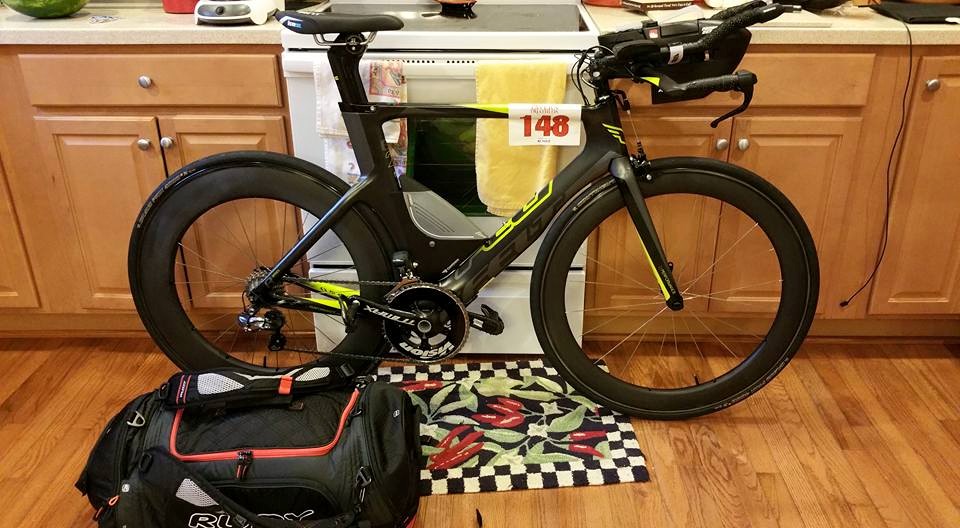
Eventually, Busher showed up and got himself ready to race.  He had just gotten a new Felt tri-bike and was eager to show it off.  When the starting time neared, we walked up the trail to the swim start, and after the National Anthem was played, we got in the James River and waited for the starting horn.

busher-bike

Busher’s new tri-bike sporting Flo 60/90 wheels.


Swim- 7:29 (1:09/100 m) 

Swim Course Map

My swim wave entered the water about two minutes before the start, and it was a major struggle to stay behind the starting buoy due to the strong current.  When the countdown neared ten seconds, I was actually in danger of being swept downstream, so I actually hung onto the first buoy.  The horn finally sounded, and off I went with about sixty other guys in my wave.

Thankfully, I was positioned far enough away from the bulk of the other swimmers to have some clean water, so the punching and kicking was minimal.  The swim is only 650 meters, but it felt more like 450 meters due to the current.  Honestly, by the time I settled into a good groove I noticed the dock rapidly approaching from my right.

When I was about 100 meters from the finish, I made sure that I got as far to the right of the river as possible so as not to miss the dock.  I managed to stand up a few feet before I got there, but nearly toppled over the underwater boulders.  Still, the exiting process was fairly smooth given the speed of the river, and up the ramp I went towards the transition area.

My time of 7:29 was nearly two and a half minutes faster than my 2014 swim time of 9:57.  While some of that was from a full year of swim training, I’d still have to say that the majority of the time gain was based upon the lightning fast river current.

T1- 1:52

Nothing major in T1.  I came out of the river about the same time as Busher and we went our separate ways in transition.  I threw on my sunglasses, helmet and biking shoes, and then ran my bike towards the bike out area, with Busher seconds behind me.

Bike – 52:08 (21.4 mph) 

Bike Course Map

Bike Course GPS

The first half mile or so of the bike course is uphill away from the James River towards Robious Road.  Thus, there is a slight incline at the bike mounting line.  In 2014, I hopped on my bike and took off without incident.  Unfortunately, I could not seem to get my left foot clicked into my pedal.  I lost all of my forward momentum without getting clicked in and almost toppled over.  About that time, Busher took off up the hill in front of me.  I finally got situated on the second or third effort, but lost a good 10-15 seconds struggling with my bike at the mounting line.

I chased Busher up the initial incline and finally caught up to him after making a right on Robious Road.  I passed him, only to have him come by me a mile or so later.  Soon after getting back in front of me, however, he sat up out of his aerobars due to ongoing neck pain from his car accident.  He had a brand new Felt tri-bike, but was in too much pain to ride it correctly.  I leapfrogged him a second time and never saw him again on the bike course.

The course is an out and back, and the elevation peaks right at the turnaround point.  I was able to stay in the aero position pretty much the entire ride, with the exception being the last climb up to the turnaround point.  After rounding the cone, there was a very fast descent before the course flattened out again.  There were a few guys that passed me on the bike, but by and large, I was doing most of the passing.

I felt good coming back up Robious Road towards James River High School, but the last bit on Robious is uphill and slowed my progress.  Once I made the final left turn to head back down towards the river, I eased up a bit and got my legs spinning easily to prep for the run.  There were a fair amount of spectators in the last half mile before transition, and I hopped off Blue at the dismount line and headed back to my transition spot.

My bike split was 52:08, which was four and a half minutes faster than my 2014 time of 56:38.  That was an increase from 19.07 mph to 21.4 mph, so those early morning sessions on the bike trainer in my bonus room were paying dividends.  The race wheels certainly helped as well, but most of those gains were from an improvement in bike fitness.

T2- 1:00

Thankfully, my stomach felt fine after getting of the bike, whereas it felt like I had a load of bricks in it in 2014.  My cycling shoes were swapped for running shoes, and after grabbing my race belt, I was off.

Run- 21:33 (6:57 min/mile) 

Run Course Map

The run course starts off on shaded, winding trails, and then emerges into a neighborhood near the 1 mile marker.  Mile 2 is an out and back in the neighborhood, and then you go back into the trails for final mile.  The run is supposed to be a 5k, but I believe that it is a few tenths short of that – particularly since I can’t run a 21:33 standalone 5k, much less one of those off the bike.

I felt pretty good at the start of the run, but there was still the “heavy leg” feeling for a couple of minutes.  I wound through the wooded trails in the first mile, and I did have a couple of guys that I passed on the bike run by me, much to my dismay.  Unlike 2014, the first mile passed pretty quickly for me, and soon I was out in the sun in the neighborhood.

I really hadn’t felt hot at all during the race, but as soon as I hit the direct sunlight in the neighborhood it got pretty steamy fast.  Thankfully, there was a water stop near the turnaround cone, and I saw Busher running the opposite direction a couple of minutes after passing the turnaround point.  He seemed to be struggling, and he had been about the same distance AHEAD of me at that same spot in 2014.  Thus, our positioning had flip flopped – due in part to my training, and also due in part to Busher’s car accident.

Soon I was back in the shaded area of the trails and winding towards the finish line.  As always, I was struggling in the final mile, but I found a renewed vigor once I heard the music playing near the finish line.  I knew I was only a few tenths of a mile from the end, so I picked up the pace.  After crossing the initial timing mat at the beginning of the finishing chute, I heard the race announcer call out my name.  I sprinted across the line for an 8/29 finish in my age group.

tavern-finish

Official Results Link

Post Race

After the race, there was the obligatory milling around and waiting for the results, along with some post-race food.  Much to my kids’ chagrin, there was no bounce house like there had been the year before, which left them sorely disappointed.

In the end, I finished the race in 1:23:58, which was more than twelve minutes faster than my 2014 time of 1:36:02.  Granted, the abnormally strong river current probably shaved two minutes off of my swim time, but that still left a ten minute improvement, which equates to more than ten percent of the total race time.  I was very happy with my result, and particularly my bike split and my ability to run off of the bike.  There was still a lot of work to do, but the work that I had put in over the past fifteen months were definitely paying off.  I had still yet to make an AG podium in a triathlon, but I was moving up in a very competitive AG, and I was inside the top 10% of the overall standings.

Sadly, Busher had regressed from 1:31:28 in 2014 to 1:34:03 in 2015 – even though he had upgraded to an electronic shifting tri-bike from his Fuji road bike.  Obviously, his car accident had severely impacted his fitness, and even his ability to stay in his aerobars.  While I had come out ahead of him in this race, there were no bragging rights to be had.  Had he been healthy, then I think that we might have had a race to the very end.

Next up on my calendar was the inaugural Independence Day 17.76k run, followed by the Charlottesville Sprint Triathlon.  Both of those races would be memorable, but for vastly different reasons.  In the short term, however, it was time to rehydrate, recover, down a few brews and then hang some new hardware.

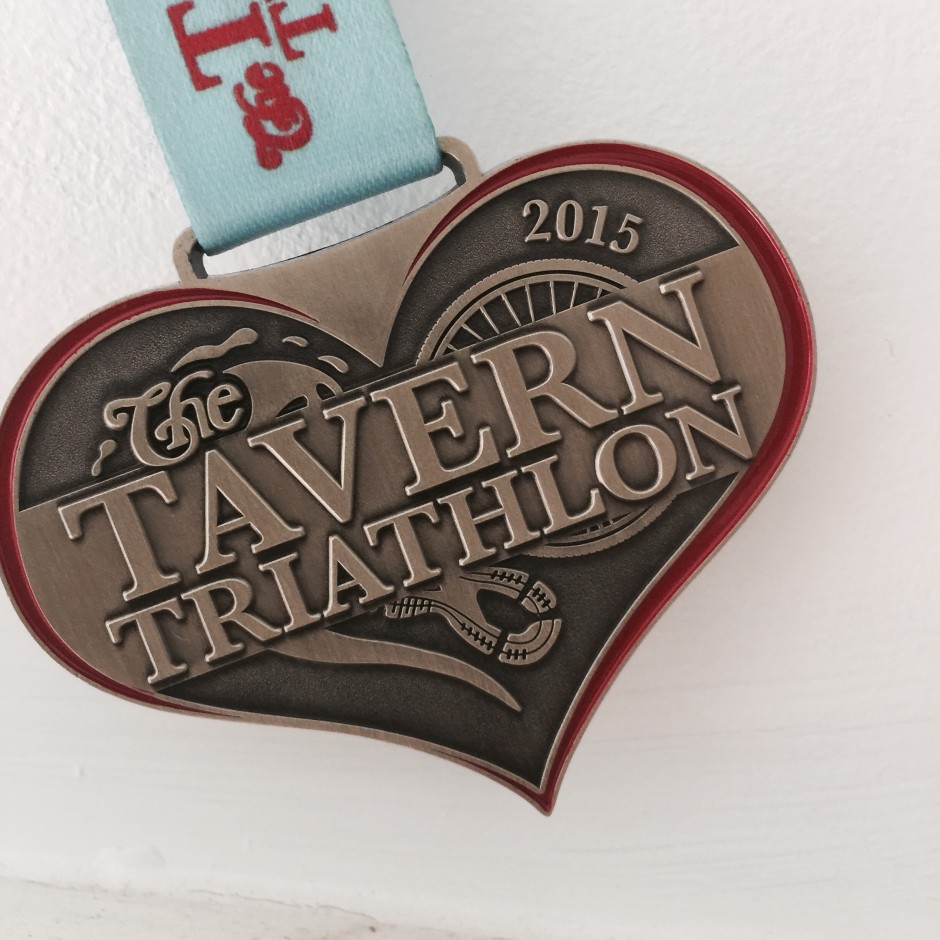
tavern-medal

“It was so hot outside, you could fry an egg…”

2015 Ironman 70.3 Raleigh

Race Report

5:43:44

 80/202 AG     587/1928 Overall

May 31, 2015 – Its finally time for Ironman 70.3 Raleigh.  I’d signed up as soon as the race opened a year earlier, and all of my training for those twelve months had been focused on this particular race.  I had completed several sprint triathlons and one Olympic distance race, but the 70.3 (“Half-Iron”) distance was a big leap up in mileage.  The 70.3 features a 1.2 mile swim, a 56 mile bike and then a 13.1 mile run.  The mathematically inclined will notice that those numbers add up to a nice round 70.3.

In July 2014 I completed my first 50 mile bike ride on a Friday night, and I remember getting off the bike and barely being able to walk.  At that point, I had already signed up for the Raleigh race, and I didn’t think I could run 1 mile, much less 13.1.  I purchased an indoor bike trainer in September 2014, and I had steadily increased my biking volume over the winter.  I’d also come across the Super Simple 70.3 Training Plan online (see the link below), which I followed pretty closely for the fourteen weeks leading up to the race.  Thus, in the two months prior to the race I was averaging 5-7 hours per week of swim/bike/run training, excluding any additional stretching or strength workouts.  That’s not enough to be age group competitive in an Ironman brand race, but it was a step up for me in my training, and certainly enough to get me through the 70.3 miles, barring a fueling catastrophe or injury.

Training Plan

Chris Busher, or “Busher” as he is known, was also participating in the Raleigh race, and we had essentially signed up together.  Unfortunately, he was involved in a car accident on Christmas Day 2014, and due to ongoing neck problems, his training had really been curtailed.  In particular, it was painful for him to run, and his coach Karen really didn’t even want him completing the race.  She wanted him to swim and bike and then withdraw during the run.  Like me, Busher is hard-headed, and couldn’t bear to travel to Raleigh and then pull out of the race without getting a big shiny medal.

The weekend prior to Raleigh, Busher had a party at his house in Goochland, so we strategized our races there.  Karen was present, and was kind enough to give me some pointers even though she was not my coach at that point.  That meeting eventually planted the seeds towards my hiring her as my coach in May 2016 to help prepare me for a full Ironman.

Pre-Race

Originally, I was planning on heading to Raleigh alone, and had a room at the Sheraton all to myself.  Leigh Anne was going to stay at home with the kids, whereas we felt as though a full day affair would be too much for them.  A couple of days before I left, however, Leigh Anne was able to get child-care arranged for Jillian, so she and Jackson decided to make the trip.  Still, they were not coming down until Saturday evening, but I needed to leave Saturday morning to get checked in, so we both had to drive.
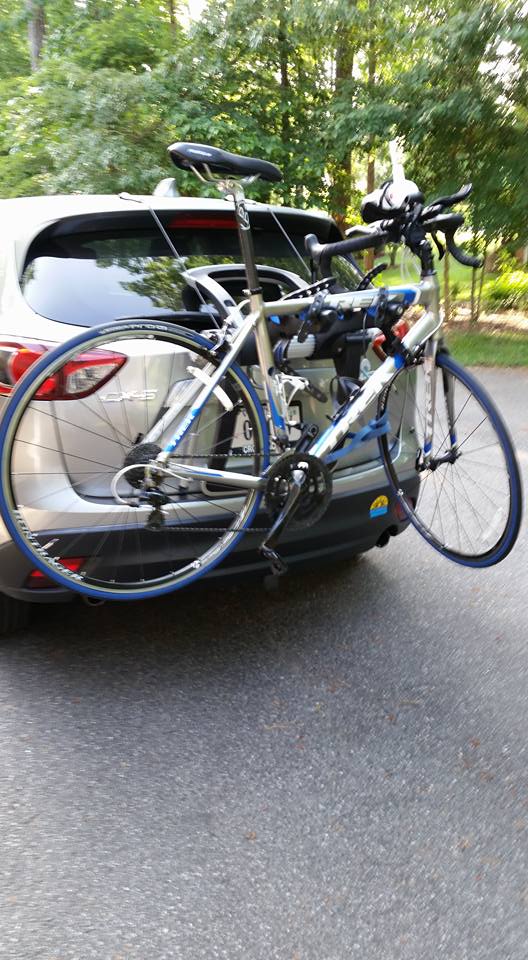
raleigh-bike-rack

Ready to head to Raleigh.

Thus, early Saturday morning I loaded up my car, strapped Blue to the rack on the back and I was off.  It was a little after lunch when I arrived in Raleigh, and I promptly found the race expo and checked in.  There was a thirty minute mandatory race briefing, and once that was over, I needed to drive to Jordan Lake to drop off my bike in T1.  On the way out of the expo I took a picture of the balloons below.
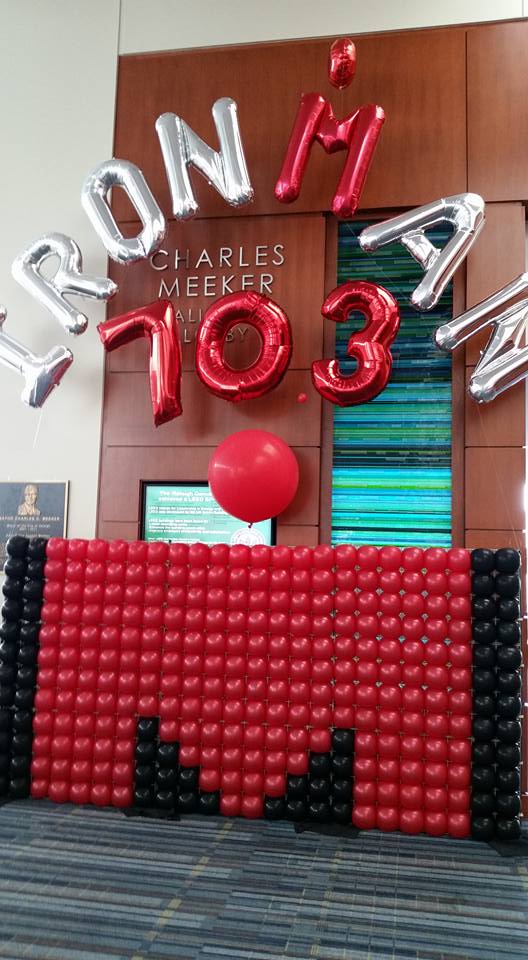
 

balloons

Since the race was a point to point, T1 was in a totally different spot than T2.  In fact, Jordan lake was about a 20 minute drive from downtown Raleigh.  Once I arrived, it was pandemonium on the small road in and out of the transition area, but I finally made it to T1 and racked my bike.  I made sure to deflate the tires a bit, whereas it was really getting warm and I didn’t want the pressure to build up and cause a blowout.  That sounds paranoid, but it is actually a frequent occurrence, and I would not have been happy to arrive on race morning and find two flat tires.

After racking my bike, I took a look at Jordan Lake and familiarized myself with the swim.  The buoys had already been set up and several people were test swimming.  I chose to save my energy, and then headed back to downtown Raleigh to check in to the hotel.  The Sheraton was right next to the finish area, but sadly, my room had no view worth mentioning.  Busher’s room had a perfect view of the finish line, as seen in the photo below.
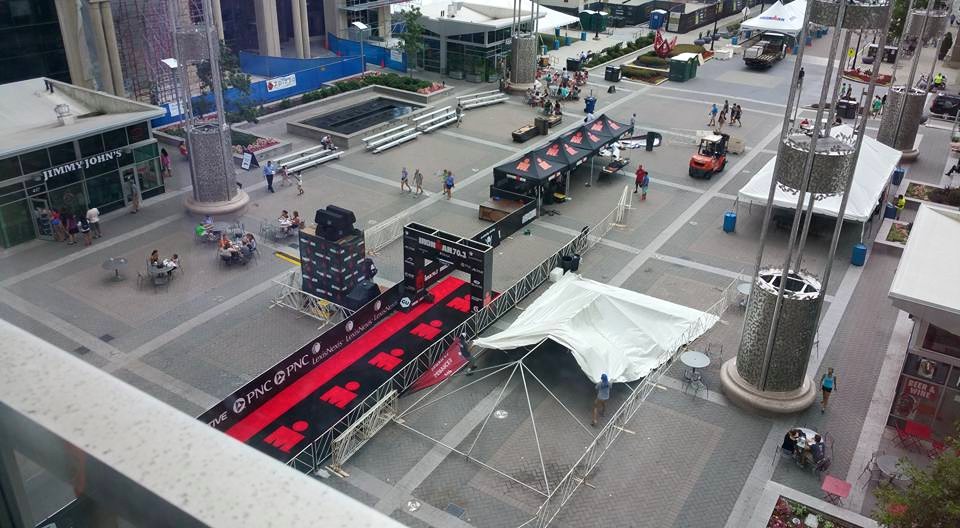
overview of finish

Busher would tell you that he got the better view since he is prettier, I won’t argue…

Leigh Anne and Jackson arrived a bit later, and then a group of us walked to a nearby Italian restaurant for dinner.  Either my nerves began to get to me or something that I ate disagreed with my stomach, because soon after eating I was chewing on Pepto-Bismol tablets.  I was hoping for no GI issues during the race, and after dinner we headed straight back to the hotel and an early turn in.


Multiple alarms woke me at 4:00 a.m. on race morning, and after gathering my gear and grabbing a cup of coffee, I met Busher downstairs and caught the shuttle bus that would take us to Jordan Lake.  Thankfully, all of my gear was accounted for once we reached the lake and the T2 area, and after inflating my bike tires, eating a GU and multiple trips to the porta-potties due to a nervous bladder, it was finally time for the race to begin.

 Swim- 43:15 (2:14/100 m) 

Swim Course Map

The swim was a triangle course in Jordan Lake outside of Raleigh.  My goal for the swim was anything sub-45:00, which I thought was fairly conservative, especially since I had recently purchased a wetsuit.  I had only swam in the wetsuit once prior to the race, which was a test run in the James River at Robious Landing the weekend prior.  Wetsuits help in two ways.  First, they make you more slippery, and thus faster – to the tune of about 10 seconds for every 100 meters.  Over a course of 1900+ meters, that roughly equates to three minutes.  Second, they make you more buoyant.  Thus, drowning in Jordan Lake was far less likely for me.

The downside to a wetsuit is that it traps heat, so wearing one in warm water can dangerously overheat you.  Thus, Ironman restricts the use of wetsuits when the water temperature exceeds 76 degrees.  Due to a heat wave, Jordan Lake was several degrees warmer than the cutoff point on the morning of the race, so the athletes learned at the transition area that the race would not be wetsuit legal.  Technically, Ironman still lets age group athletes wear wetsuits up to 83.8 degrees, but those athletes are ineligible for awards and have to start in the last swim wave.  When I mulled over whether I would still wear my wetsuit, Busher said emphatically, “Karen says if its not wetsuit legal, you DON’T wear a wetsuit.”  The die was then cast, so I prepared myself for the 1.2 mile swim in the lake sans wetsuit.

Due to the number of participants, there were a lot of swim waves, and I was in about the 13th wave to start.  Busher had aged up to the 40-44 year old age group, and he ended up being in a swim wave that started about 15 minutes ahead of me.  We did a quick warm up swim together before the joined his wave, and then I got farther back in line to wait for my wave to start.

When my wave finally got the start signal I was off, and had positioned myself far to the left to stay out of traffic, whereas the first turn buoy had us turning right.  The water temperature felt just about perfect, but there seemed to be a fair amount of chop for a lake.  There were several times that I swallowed lake water and had to pull up to cough and dry heave.  My body still has a violent reaction when I swallow water that is not intended to be drinkable.

Even though my swim technique had improve a lot after a full year of practice, I was still no better than a middle-of-the-pack swimmer for an Ironman race – maybe even the back portion of the middle.  The 35-39 age group is very large and competitive, and as such, there were actually three swim waves for my age group.  I was in the first of the three waves, and a female swim wave started immediately prior to my wave.  Before I hit the first turn buoy I had begun to catch the slower females from the group ahead of me.  About that same time, the really good swimmers from the wave behind me began to catch me.  From that point forward there seemed to be a constant stream of bodies that I was passing and getting passed by, and that resulted in a fair amount of kicking, punching and everything in between.
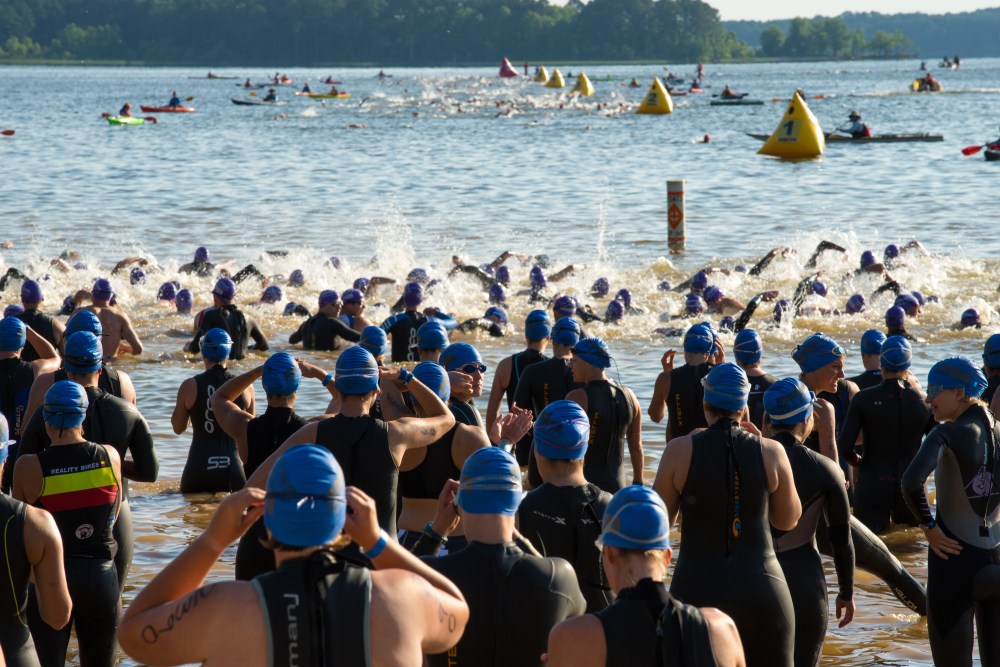
swim start

By the time that I rounded the final buoy to head back to shore, I was really ready to be done with the swim.  The non-stop swarm of bodies was really getting to me, and I felt like my time in the water had passed very slowly.  Still, my time of 43:15 was faster than my goal time, but all in all, I didn’t feel as though I had I great swim.  Once I got to standing depth in the water, I ran up the exit ramp and headed to T1.
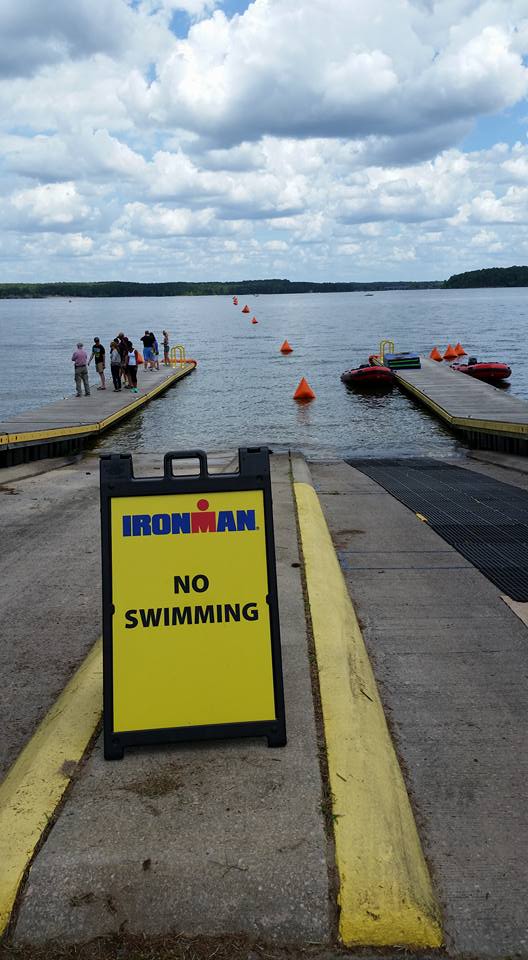
lake 2

Photo taken the day prior to the race.

T1- 3:01


T1 was relatively uneventful.  From the swim out area, there is about a 50 yard run to the transition area, and I hit the porta-potty on the way in.  I should have just gone on the home stretch of the swim, but neglected to do so.  The transition area was HUGE, and there were several very long rows of bikes.  The day before the race, I had made sure that I knew exactly where my bike was, because if I started down the wrong row, I was going to lose a bunch of time trying to get over to the correct one.
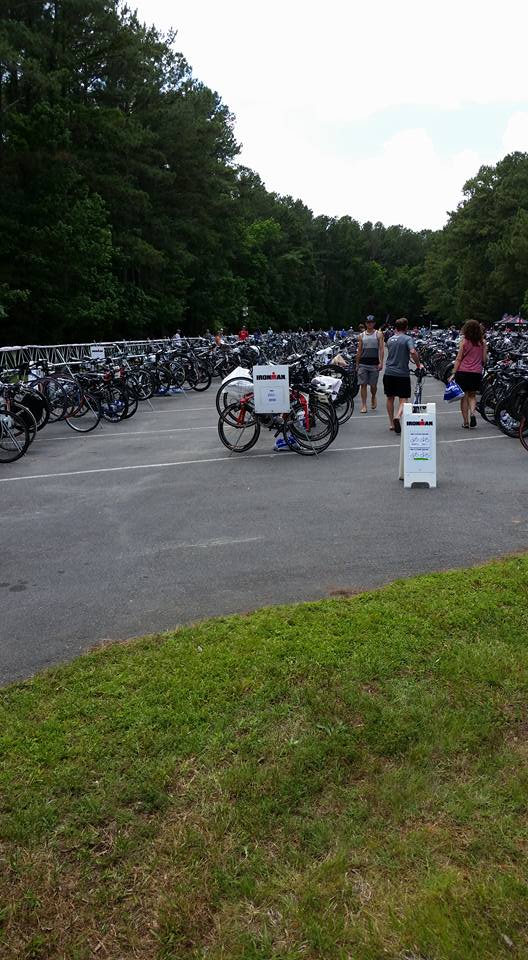
bike racks

This photo is from the bike drop off the day prior to the race.

Thankfully, my bike was right were I left it and ready to roll.  Since I was not wearing a wetsuit, it was pretty easy to ditch my goggles and swim cap, and then slip on my helmet and bike shoes.  Given the length of the race, I chose to wear socks.  A few seconds of fighting to put socks on wet feet was worth the diminished risk of getting blisters over the 56 mile bike course and then the half marathon.  I also scarfed down an entire Honey Stinger Waffle to get some calories into my system, whereas fueling correctly was going to be necessary to prevent a bonk.

 It was a long run with my bike to the bike out area, and I neglected to wait and let the volunteers re-apply sunscreen to me.  I figured that I would be protected since I had just applied sunscreen before the swim start, but in hindsight, that was a bad idea since I ended up with pretty a bad sunburn on my shoulders and upper back.  After bypassing the volunteers, I hit the mounting line and was off onto the 56 mile course.

Bike – 2:47:26  (20.07 mph) 

Bike Course Profile

The bike course was full of “rollers,” and the first 6 miles away from the Jordan Lake area were primarily uphill.  There were A LOT of people congested within those first few miles, and there was really no way to stay far enough away from everyone else so as to be out of the drafting zone.  If the race officials wanted to be Nazis about the drafting rules, then pretty much everyone would have received a time penalty in miles 1-6.  Not that drafting was really an issue climbing away from the lake, because the initial going was fairly slow.

After mile 6, there was a pretty good decline and then the course evened out, but it still seemed to be continually going up or down.  None of the hills were all that steep, and I probably only had to shift into my small chain ring a few times over the entire bike course.  Still, there were some long sustained climbs, that, over the course of 56 miles, taxed the legs a bit.

My goal for the bike course was sub-3 hours, and I felt really good on the bike.  I made sure that I stayed on top of my nutrition with GU gels every 45 minutes, and I also took a half banana at two of the aid stations.  Thankfully, the wind was relatively mild, but there were a few gusts on some of the roads close to Jordan Lake that gave me a good shove due to the deeper rims on my Zipp wheels.

I had driven the bike course the day before the race after dropping off my bike at the transition area, and it was helpful to know what was ahead of me.  I was amazed to see the amount of traffic control at the intersections, and Ironman continued to impress me with its level of organization.

The last aid station came about 13 miles from the finish, and when I slowed to grab a bottle of water, I noticed the heat for the first time all day.  The temperature had continued to climb while I was on the bike, and was probably in the upper 80’s or low 90’s by the time I hit the last aid station.  The movement of air on the bike can insulate you from the heat a bit, but when I slowed down at that last aid station, the heat really hit me.

Even though it had gotten hot, and even though the last few miles on the bike were tough, I never reached the point were I felt as though I NEEDED to get off the bike. That was actually quite a change for me at the 50+ mile distance, and I felt really good for the last 2 miles heading into downtown Raleigh.  The last bit of the bike course into T2 was uphill, and I caught up to a lot of people struggling up the hill.  Since I was feeling good, I decided to burn it up the hill, which probably was not a good idea since I was getting ready to run a half marathon.  Still, I accelerated up the hill, passing a half dozen or so riders in the process.  I saw Leigh Anne and Jackson off to my right, and gave them a big wave as I cruised into transition more than twelve minutes ahead of my goal time of three hours.
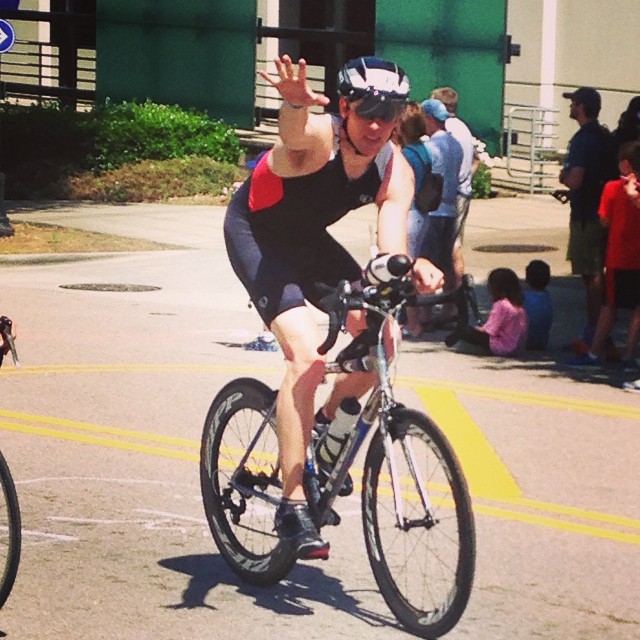
bike in

Heading into T2.

T2- 4:13

Once again, the transition area was huge, and I had made sure to walk it off in the morning so I would be able to find my spot quickly.  Once I racked my bike, I had decided to change socks and put Bodyglide on my feet to prevent blisters.  When I popped the cap of the Bodyglide tube, however, it had melted in the intense heat and shot out everywhere.  I quickly blotted my feet with the liquid, put on my socks and shoes, grabbed my Fuel Belt and then headed for the run out area.  I hit the porta-potty on the way out, and then let the volunteers smear me with sunscreen.  Once again, I lost some time by hitting the porta-potty since I was not willing to “go” on the bike.

I saw Leigh Anne and Jackson once again at the run out area, and Leigh Anne told me that I was catching up to Busher.  Given the intense heat, I should have known that I was getting ready to catch 13.1 miles of hell, but I was still feeling  good leaving T2.

Run- 2:05:49 (9:36 min/mile) 

Run Course Map

Run Course Profile
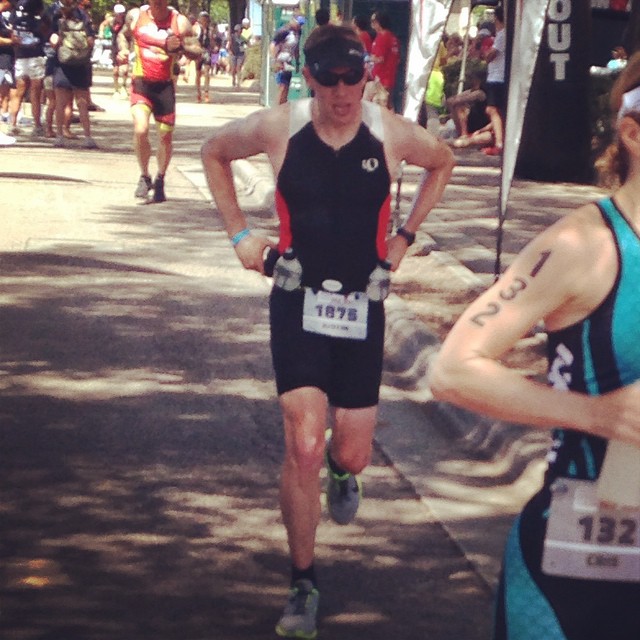
run out

Adjusting my Fuel Belt as I leave T2.

The run course has 563 feet of elevation gain, but seemed much worse than that at the time.  It is a two-loop course, with the “out” section generally going up and the “in” section generally going back down.  The worst part is that its only about 5% shaded, and there was no cloud cover on race day.  Thus, there were 13.1 miles of direct sunlight and 90 degree temperatures.

My goal for the run was two hours or less.  I had decided to bring my Fuel Belt, which had two 8-ounce water bottles.  I didn’t know it at the time, but those would prove to be a Godsend, particularly during the second loop.  For the first half mile or so I was doing fine, with the sole exception being the heavy leg feeling from being on the bike.  At the half mile point, however, my stomach tightened up and I was forced to walk.  This was not a GI distress type issue that required a porta-potty, but instead, was just tightness and pain.  That continued until a little after the 1 mile marker, and I was forced to run-walk for the better part of a mile until my stomach cramping eased up.

Ironman had aid stations every mile, and I’m not sure that I would have finished this race if they were spaced out much more than that.  I filled up each water bottle at the aid stations, and I also drank a few cups of water and put ice on my head and in my tri suit.  By the time I reached the subsequent aid station, I had drank one water bottle and dumped the other over my head.  I repeated that process for the entire race.

There were a fair amount of spectators on the run course, including a lot of people playing music.  I was able to enjoy them a little bit on the first loop, and managed to keep my pace just under the 9:07/mile pace needed for a two-hour half marathon.  Coming back in on the first loop was a little better than going out due the downhill sections, but by the time that I reached the start of the second loop near the finish line I was really beginning to struggle with overheating.  I hit the midpoint of the race a few seconds under one hour, but I knew that I was going downhill quickly – at least in the proverbial sense.

If the first loop of the run was tough, the second loop was the seventh layer of Hell for me.  I began walking every aid station and dumped as much water and ice on myself as I could.  My water bottles would be empty a half mile later, leaving another half mile to go before the next fill up.  Around mile 8 or 9 I saw a guy getting sick in the bushes, and Busher apparently saw a woman faint and collapse on the asphalt.  All around me people were people who had been reduced to a walk.

Speaking of Busher, I saw him about 100 yards from the turnaround point on the second loop, having made up approximately 15 minutes on him from my later start time.  I finally caught up to him at the first aid station after the turnaround, and he was really struggling with neck pain due to his car accident.  Karen had wanted him to quit after the bike, but he was continuing on.  At that point, I looked at my watch and calculated that I’d need to run approximately 8:00 minute miles to the finish in order to make it under two hours.  Given that my pace had already fallen off to about 9:30 minute miles, I decided to run with Busher for the last 5k.

Misery loves company, and running with Busher did seem to make the miles go by a little bit faster.  Still, it seemed as though we would never get to the finish line.  When we finally got to the last turn, Busher said he was going to sprint the last few hundred yards and took off.  I intended to do the same, but Busher had way more left in the tank than I did, and I finished about twenty seconds after him.
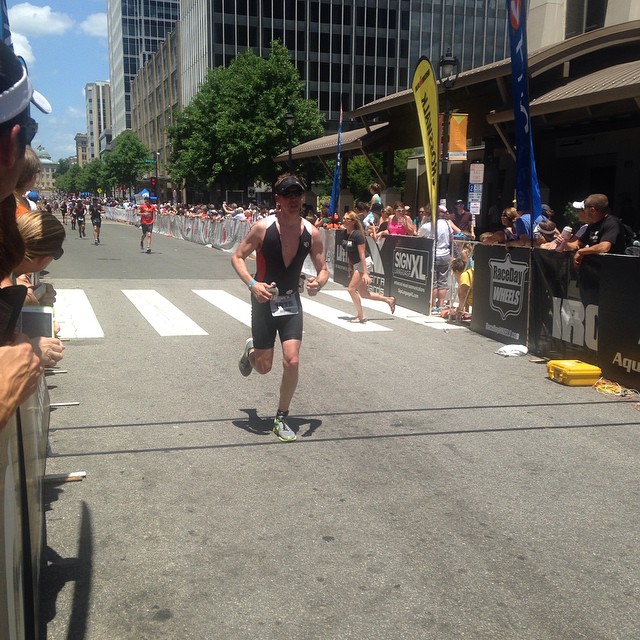
finish

About to enter the finishing chute.

After crossing the finishing line, my timing chip was taken away and I was handed a bottle of water.  The water went down quickly, and then I grabbed another, and another still.  There was pizza at the far end of the finishing chute, and I usually have no problem eating after a race, but due to the heat, I was starting to feel sick.  I sat down for a few minutes in the shade, and after drinking a Diet Coke I began to feel a bit better.

My goal for my first half-Ironman was six hours, and I managed to complete Ironman Raleigh 70.3 in 5:43:44 in less than optimal conditions.  I was very happy with my finishing time, even though the run took me 2:05:49.  Given the heat, I couldn’t be upset with my run time, and when I got in my car in the shaded parking deck around 4:30 p.m., my car indicated that it was 94 degrees.

In looking back at the race, there is not much that I would have done differently, and I probably performed near my maximum that day.  If I hadn’t slowed down to run with Busher I might have been a couple of minutes faster, but I still would have missed my two hour run goal.  The Half-Iron distance had been a big jump up for me, and it had taken more than a year of dedicated training to get me through that race.  The only thing left would be the full Ironman distance, and leaving Raleigh, I was already trying to decide which full distance race I would try to tackle.

In the short term, however, I needed to rehydrate and recover, and there were only a few weeks before my next race – the I Love the Tavern Sprint at Robious Landing.  I had completed that race in 2014, and it would be the first triathlon that I had completed twice.  I was really looking forward to seeing how much I had improved from my rookie year in the sport.

Official Results Link
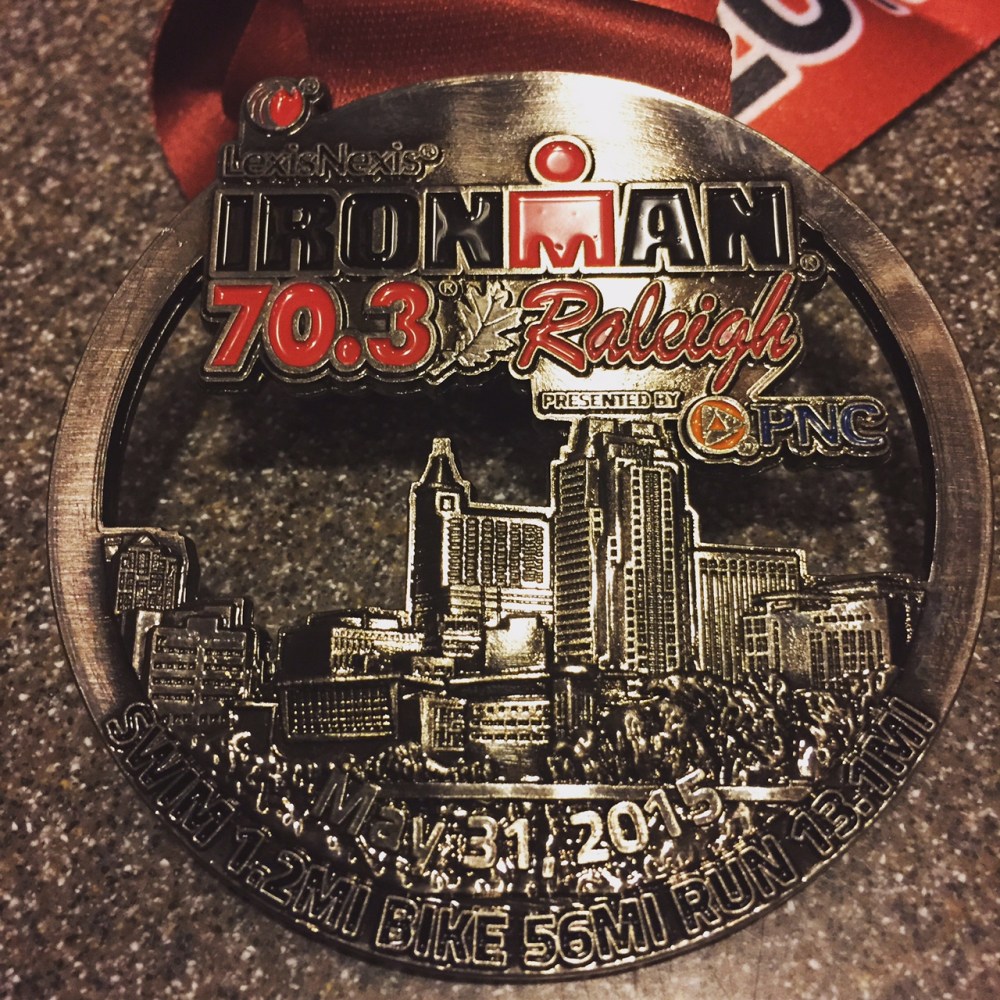
medal

“Out of the darkness comes light, like a flash…”

2015 Groundforce IT Powersprint Triathlon

Race Report

1:05:33

 7/15 AG     32/216 Overall

May 17, 2015 – Its been three weeks since the debacle that was the RTC Sprint Triathlon, where my goggles busted and then I flatted on the bike course.  Those three weeks couldn’t pass fast enough, and I was still looking to test my off season gains for the first time in 2015.  The Powersprint Triathlon is held at the Shady Grove YMCA, and there is a 300 meter pool swim, a 12 mile bike and then a 5k run.  The bike and run courses are fairly flat, so I was looking for a fast time.  I had yet to hold 20 mph on the bike in a triathlon, so 20+ was my goal.  I was also hoping to run a sub-24 minute 5k off the bike.

My buddy Chris Busher was not participating in this particular race, and Leigh Anne and the kids were unable to attend, so I was going to be on my own.  As always, pool swims are self-seeded, and I had put myself down for a 5:30 swim time, which meant that I’d be starting 53rd out of the 216 participants.  I had progressed nicely with my swimming since 2014, but it still was not my strongest discipline.  Nevertheless, I was swimming freestyle much more efficiently, even if my stroke still needed some refinement.

Pre-Race

It was pitch black when I left home, and I arrived at the YMCA before the transition area opened at 5:30 a.m.  I always try to snag the spot at the end of the bike rack to save a couple of seconds in transition, but unfortunately, my assigned rack was the inner of two connected racks.  Thus, I racked my bike on the outermost portion of the inner rack, which would have to do.


 The weather was perfect on race morning, and it was about 75 degrees even before the sun came up.  After racking my bike, setting up my transition area and getting body marked, I took a quick jog to warm up.  By that time, the pool had already opened for warm ups.  This time, I took my TYR Special Ops 2.0 goggles with me to the pool, swearing that I would never again purchase a pair of Aquaspheres in light of my broken strap experience weeks before.

The TYR’s worked perfectly during the warm up swim, and then it was back outside for the National Anthem.  Once that concluded, the athletes lined up from lowest race number to highest, and were set to enter the pool in 15 second increments.

 Swim- 5:24  (1:48/100 m) 

power pool 2

Lined up for the swim in the pool in the next room.  Sadly, no slides in that one.

My goal for the swim was to meet or exceed the 5:30 estimate that I had used to pre-seed myself with.  Pool swims can be a disaster if a few people seed themselves poorly, and I was hoping that everyone around me (including myself) had been honest with their estimates.  In waiting to start, I chitchatted with the girls immediately ahead and behind me, and both had participated in the RTC Sprint.  I regaled them with the tale of my adversity that day, and both remembered seeing “that guy” who was swimming breaststroke in one of the early swim waves.  The girl behind me also informed me that she was normally a sub-5:00 swimmer, but had seeded herself down a bit since she had a head cold.  I told her not to be bashful about tapping my leg if she needed to pass me – in the off chance that her head cold didn’t inhibit her swim abilities.

There is a timing mat at the pool entrance, and you wait a few feet behind it until you are signaled to start.  There is no diving allowed, so I jumped as far into the pool as I could once it was go time.  The 300 meter swim is 6 laps (12 lengths), and the first couple of laps went smoothly.  Near the middle of the swim, however, I noticed that I was being overtaken by head cold girl, so I let her pass me the next time that I got to the edge of the pool.  Other than her, the seeding was pretty good because she was the only person who passed me, and I never overtook anyone else.

power pool

After 4 laps I was starting to get a bit winded, but a 300 meter swim goes by pretty quickly.  Before I knew it, I was crawling out of the end of the pool after lap 6, but the timing mat was actually about 10 yards away in the next room.  According to the final stats, it took me 5:24 to get from timing mat to timing mat on the outsides of the pool, so my actual swim time was even faster.  Thus, I was very pleased, having covered 300 meters in less than 5:30, compared to the 7:21 that it took me in my first triathlon a year prior.

T1- 2:02

There is a relatively long run from the pool to the transition area.  Once you exit the pool swim, you then have to run through the kiddie pool area and out the back doors of the YMCA.  There is then a run of approximately 100 yards on rubber mats to transition.  During my jog from the pool to the transition area, I ran past the girl who had passed me in the pool.  As I went by I yelled, “head cold my ass,” and she just gave me a sly smile.  It seems that bib number 54 turned in a 5:09 swim, which was at least 21 seconds faster than her seeded time of 5:30 or more.

Power t1

I’m not in this photo, but it shows the pool exit and the mats to the transition area.

Upon reaching my bike, I put on my helmet and slipped on my cycling shoes.  To save time, I chose not to wear socks.  This was my first time going without socks on the bike and run, and I had never liked trying to put socks on wet feet.  That probably saved me 20-30 seconds in transition, and I was hoping to avoid getting bad blisters.

After changing, I ran my bike towards the bike exit and hopped on as soon as I crossed the timing mat.  Then it was off to the bike course, and I was crossing my fingers that I wouldn’t flat two races in a row.

Bike – 33:32  (21.6 mph) 

Bike Course Map

The bike is actually a bit of blur for me.  I remember taking off from the bike mounting line and passing a few people in the first couple of miles.  Since I was seeded 53rd and passed a few people in transition, there weren’t that many people on the course ahead of me.  Most of those already on the course had a head start, plus they were, by and large, very good triathletes due to their faster swim seed times.  Thus, I was largely on my own for the 12 miles.

The first part of the course had several turns, and most were at relatively large intersections.  Thankfully, there were lots of police directing traffic, so there were no issues.  The latter part of the course consisted of longer straight stretches, and I did my best to stay as aero as I could and to hammer as hard as possible without risking a blowup in the last few miles.  I recall feeling very good on the bike, but without a GPS or mile markers, I was unable to mentally compute my speed.  While I had held 20+ miles per hour in training rides, I had not done so in any of my three races in 2014 when I was first getting accustomed to biking.  In those races, I had averaged around 19 miles per hour, and I was really hoping to up my speed significantly after a full year of training.

Towards the end of the course, there were a few small hills on Shady Grove Road, but nothing significant.  There was then a left turn onto Nuckols Road, and I knew at that point that I was close to the finish.  Nevertheless, I was a bit turned around directionally, and I was not intimately familiar with the area.  Thus, when I approached the intersection of Nuckols Road and Twin Hickory, I didn’t know for sure which direction I was headed, but thought that I needed to turn right.  There was a teenage girl at the intersection holding a flag, but she was not paying attention.  Instead, she was dancing around and waving the flag in a manner that suggested that I was supposed to go straight.

I slowed down a bit as I got to the intersection and yelled, “which way am I supposed to go?”  That snapped her out of her dance party, and she finally indicated to the right.  By that point, however, I was too far into the intersection to safely turn, so I had to make a left looping 270 degree semi-circle to get back on course.  I probably only lost about ten seconds, but every second counts in a sprint race and I said some not-so-nice things under my breath.  I know that it takes a lot of volunteers to put on a race, and I appreciate their efforts, but this was the first of three incidents in 2015 where I would go off course due careless or inattentive volunteers.  I know, I know, its my responsibility to familiarize myself with the course, but it’s hard to memorize and then recall every turn in the heat of the moment.

Upon turning right onto Twin Hickory, it was a short ride to the YMCA on my left.  I cruised into the parking lot and hopped off at the dismount line.  From there, it was maybe 80 yards back to my bike rack in T2.  Later, I’d see that I averaged 21.6 miles per hour on the bike, which was a significant jump up from my 2014 averages.

T2- :59

I was very happy with my second transition, and did it in under a minute.  Sprinting in cycling shoes is not easy, and thankfully, my rack was close to the “bike in” area.  Racking my bike was easy since the rack was fairly empty, and after changing into my running shoes and grabbing my race belt, I was off.  Thanks to my Lock Laces, my shoes went on quickly without the need for tying.  I strapped my race belt with my race number while jogging to the “run out” area, and then I was off for the final 3.1 miles.  Small changes in my transitions since the prior year really added up.  Previously, I was spending 1:30 – 2:00 in T2, now I was sub-1:00.

Run- 23:36 (7:33 min/mile) 

Run Course Map

The run course for the Powersprint is fairly flat, but the first half is slightly uphill, with the second half slightly downhill.  Without a GPS, I had to run by feel, and I was only able to gauge my pace at the mile markers.  My goal was to run a sub-24 minute 5k off the bike, which I thought was a stretch goal.  In 2014, my runs off the bike were less than optimal, but I had been putting in more brick (bike to run) training sessions, so my legs were getting used to running while tired.  They still felt heavy, but that sensation was getting shorter and shorter.

From the transition area, we had to take a left onto Twin Hickory Road, and then there was a left onto Twin Hickory Lake Drive.  There was a turn around cone at the midway point of the run on Twin Hickory Lake Drive and then it was back to the YMCA.  All in all, there were not many turns on the course.

I felt pretty good coming out of transition, and by the time I was halfway up Twin Hickory Road, the race leaders were already heading back in to the YMCA due to the staggered pool start.  I passed the water station near the 1 mile point, and I thought that I’d soon be seeing the turnaround cone.  By that time I was beginning to tire, but I kept running and saw no cone.  After what felt like another mile, I finally saw the cone and rounded it to head back in.  When I checked my watch, I saw that I had completed the first half of the run course in a little under 12 minutes, so my 24 minute goal was possible if I could hold it together.

The run from the turnaround cone until the right turn back onto Twin Hickory Road felt like an eternity, and I did my best to run the tangents of the small curves in the road to minimize my distance.  I was really beginning to suffer by that point and had developed a cramp in my right side.

When I finally made the right turn to head back towards the YMCA, there was a slight downhill and I knew that there was only about 0.6 miles to go.  I was able to push the pace a little harder knowing that I was almost finished, even with the cramp.  When I was a few hundred yards from the YMCA, I could see a few people on the side of the road and someone was ringing a cowbell.  I took the final right turn back onto the YMCA property, and the finishing chute was directly ahead.

I always do my best to sprint through the finish, but I’m also mindful that if I have too much sprinting energy, then I haven’t pushed myself hard enough on the course.  On this day I was able to run hard at the end, but I still felt like collapsing as soon as I crossed the line, so I feel like I left almost everything on the course.  Immediately upon finishing, you are swarmed by volunteers who want to give you a medal and a drink, and another who removes the timing chip from your left ankle.  They then want you out of the finishing chute as soon as possible to make room for the next finisher.

Post-Race

After collecting myself for a few minutes, I hit up the Papa John’s pizza and found some leftover coffee from the volunteers who had arrived early that morning.  Unless its really hot out, I never have trouble eating immediately after a sprint race, and this day was no different.  Due to the chip timing, you can usually see your results within minutes of finishing, but for some reason, my time was still not up by the time that I finished eating.  I immediately came to the conclusion that I had a bad chip, and that my great day of racing was going to be totally wasted.  Finally, however, my time was listed on the scrolling board.

My overall time was 1:05:33, which put me 7/15 in my age group, but 32/216 overall.  The men’s 35-39 age group is generally very competitive, and I was pleased to see that I had only missed the podium by 4 minutes.  Now, 4 minutes in a sprint triathlon is still a fair amount of ground to make up, but I had severely narrowed the gap to the podium from my 2014 efforts.  At last I could see that my year-round training schedule was beginning to pay dividends, and a podium spot in the near future did not seem too far out of the question.

My 2015 Powersprint Triathlon was pretty much the polar opposite of the RTC Sprint Triathlon three weeks prior.  Everything seemed to go wrong for me at the RTC Sprint, but everything went as well as I could have hoped at the Powersprint.  I felt as though I paced myself perfectly in all three disciplines, and honestly, I don’t think that I could have been much faster if my life depended upon it.
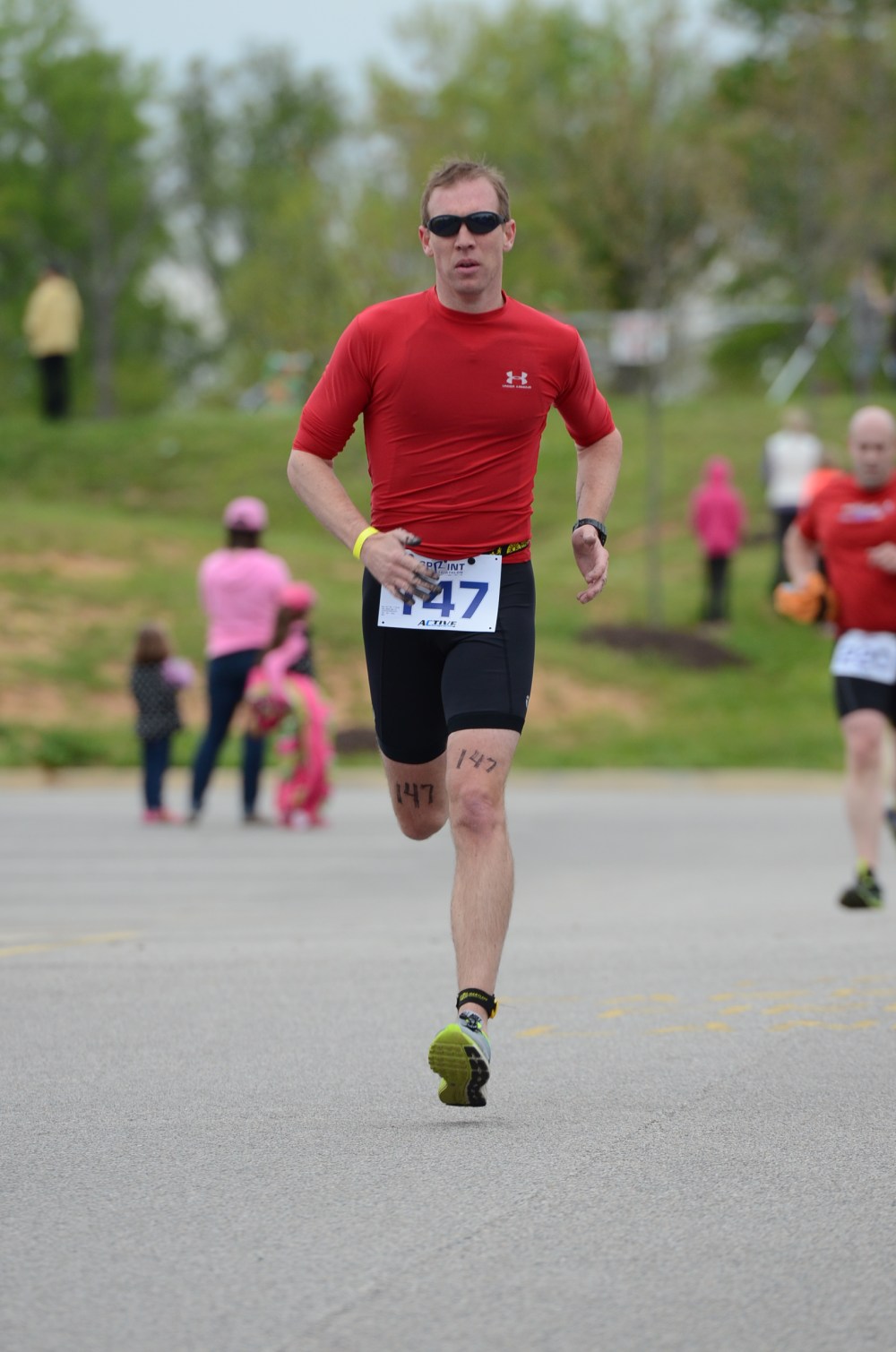
Next on the calendar, however, was an entirely different race – Ironman 70.3 in Raleigh.  That was the race that I’d been training for all winter, and 70.3 miles of racing was going to be a far cry from the 15+ miles that I’d just completed.  As it would turn out, I could handle the distance, but the unrelenting sun and heat would take its toll on me during the 13.1 mile run.

power finish

Murphy’s Law – Anything that can go wrong, will go wrong.

RTC Sprint Triathlon Race Report

DNF

April 25, 2015 – The start of my 2015 tri season was set to begin with the Richmond Triathlon Club Sprint Triathlon, which was held at the Collegiate Aquatic Center in Chesterfield.  2014 was my first tri season, and my main focus that year was simply to get through the races, while increasing my distance from sprints to the Olympic distance (and not embarrassing myself in the process).  In 2015, my goal was to climb up the ranks of the age groupers, and I had been working hard all Winter and Spring to improve.

One of my main acquisitions in the Fall of 2014 was a Wahoo Kickr bike trainer, which allowed me to train from the confines of my bonus room.  Training outside is great, but my schedule rarely permitted it, particularly in the winter.  The trainer allowed me to ride in fair or foul weather, and particularly, when it was dark outside and everyone else was sleeping.  Another upside was that the Wahoo Kickr has a built it power meter, which I could control via the Wahoo Fitness App with an Ipad.  I mounted the Ipad to a microphone stand, so I was able to control the trainer’s resistance with a few finger swipes, and my stats were readily available during the ride.

wahoo.jpg

I was pretty excited about the RTC Sprint because it was close to my house, and I also swim at the Collegiate Aquatic Center, so it was my “home” pool.  It has a 50 meter pool, and the 400 meter swim is conducted “open water” style.  In short, you’d swim 8 lengths of the pool, but instead of touching the wall, you had to swim around a buoy.  The swimmers were also sent off in groups of 10 every 30 seconds.  Thus, there would be a fair amount of jostling for position.

rtc pool

Pre-Race

On race morning I was up at 4:00 a.m. to have my obligatory bowl of oatmeal and my cup of coffee.  Then it was off to the Collegiate Aquatic Center to check in and to try to snag the optimal spot at the end of the bike rack.  Thankfully, the weather was clear, but it was a pretty chilly morning, with the temperature at the start expected to be in the high 50’s or low 60’s.  That’s not terrible, but getting on the bike while sopping wet can make for a pretty chilly ride at those temperatures.  I hate being cold, so I had opted to bring an Under Armor shirt for the bike.

Once I got my bike racked and my transition area set up, I did a quick warm up jog to loosen up.  Due to the chilly temperatures, I decided to head inside fairly early to warm up in the 25 yard instructional pool.  Normally, I swim with TYR Special Ops 2.0 goggles, but I decided at the last minute to swap them out for my older pair of Aquasphere goggles.  The Aquaspheres were not tinted and have a wider field of view.  Thus, I figured that they’d be better suited for the indoor swim, and would allow me to see the swimmers next to me a little better.

The pre-swim was uneventful, and I felt ready to go after swimming a few laps.  Soon enough, it was time to line up around the pool according to bib number.

Swim – 8:16    (2:04/100 m)

The swim began in waves of ten swimmers, and the swim waves went off every 30 seconds.  Thus, there were a lot of swimmers on the 400 meter swim course at any given time, and it can actually get pretty hectic for a pool swim.  My wave was the 14th to start, so the pool was already full when my start time arrived.  I had participated in the timed pre-swim the weekend before the race, and my unofficial time was just under seven minutes.  I hoped to do something similar on race day.

DSC_0092-2a

Yup, I still look goofy in swim caps…

When the starters finally allowed my group of 10 in the pool, I hopped in and waited for the starting signal.  As soon as it came, we were off.  Unfortunately, my right goggle completely filled with water as soon as I stuck my face in the water.  I don’t mean a slow leak, it was filled to the brim immediately.  My goggles had been fine during warmups, but failed miserably in the race.  Not panicking, I rolled onto my back and dumped out the water.  I put the goggles back against my face and pulled on the strap to tighten them up enough to prevent another leak.  As soon as I did so, however, the strap broke.

This time, panic set in and I flung my broken goggles onto the pool deck.  I was 10 meters into a 400 meter swim without goggles, and this was not a good situation.  I wear contacts, and its impossible for me to swim with my eyes open.  Still, I gave that a try for a few seconds, but everything was blurry and I was worried about my contacts floating out.  Given my level of blindness, there is no way that I could bike if I lost my contacts.  I then attempted to swim freestyle with my eyes closed, but I kept zigzagging and was either hitting the lane line to my right or the swimmers to my left.  I finally determined that my only option was to swim breaststroke for the remaining 390 meters.

Swimming breaststroke in a triathlon is not prohibited, but its also not favored since your legs can really flail out and cause damage if you hit another swimmer in the head.  There was also a high level of embarrassment for me as well, whereas we had pre-seeded ourselves based upon our expected swim times.  No one in my swim wave should have been swimming breaststroke, but nevertheless, there I was, kicking like a frog.  At my next race, I would hear several people talking about “that guy” who was swimming breaststroke in an early swim heat at the RTC Sprint.  Oh well, shit happens, and sometimes we have to turn lemons into lemonade.

The swim felt like it took forever, but I did try to mix in some freestyle when there was no one around me.  In the end, I finished the swim in 8:15, which was actually very good given my predicament.  I hopped out of the pool, and in the run to transition, I told myself that I would need to push myself on the bike to make up the time that I had already lost.

T1: 2:44

My crappy day continued in T1 as I struggled to get into my red Under Armor shirt.  I should have just sucked it up and been cold for the first few miles of the bike, but my parade of horribles continued.  Putting on a form fitting shirt is hard enough, and the challenge is magnified when you are wet.  The shirt probably cost me 40-60 seconds, but then I was off onto the bike course.

Bike – DNF

Bike Course Map   **I note that this course map is backwards from the course route**

The first bit of the bike course is uphill from the pool, and then you take a right onto Ironbridge Road and ride that all the way to the Chesterfield County Airport.  My head was reeling from my early struggles, but I actually felt really good on the bike.  I was out of the saddle all the way up the first hill, and upon turning onto Ironbridge Road, I was into the aerobars and cruising.

There were a few other bikers immediately ahead of me, and I managed to pass them all in the first mile.  I told myself that my problems were all behind me, and focused on turning in a good bike split.  Two miles into the bike I was still feeling good, and felt like I was going to have a good day on the bike.

After a few miles, I passed CVS and then the Comcast complex on my right, but then it happened.  I did see it a split second before I hit it, but there was no way that I could avoid the rock once I saw it.  I don’t know why it was on Ironbridge Road, but there was a three-inch piece of granite driveway gravel in the middle of the right hand lane.  I hit it so hard that my front tire immediately exploded and my chain came off of my chain ring.  Quite frankly, I’m lucky that I didn’t end up going over the handle bars.

I immediately pulled over to the right and said a few four-letter words.  I knew that my day was over – as far as a respectable time was concerned – but I did have a spare tube and CO2 to inflate it.  After putting the chain back on and turning my right hand black, off came the front wheel and my tube changing skills were put to the test.  I’m not the fastest at changing a flat, but I had practiced, and could to it all in 10 minutes or so.  Out came the old tube, on went the new, and then all I needed to do was inflate it.  I had never used a C02 cartridge, but once you open the valve, it comes out QUICKLY.

I managed to get the C02 working, and the tire inflated in a matter of seconds.  Soon enough, I was back on the bike and on my way.  About 15 seconds into my renewed ride, however, I felt a horrible vibration from the front tire.  I stopped once again and saw that a one inch section of my front tire had popped out of the rim.  This was caused by over inflation, and there was no way to get the tire back into the rim without deflating it again.  That was not a problem….BUT….I did not have another CO2 cartridge to reinflate the tube once I put the tire back in the rim.  At that point, my only option was to push my bike BACK to the transition area.

For those who have never worn cycling shoes and cleats, I’ll just say that walking/running in them is not fun.  Thus, it was a long 2 – 2.5 mile walk/run back down Ironbridge Road in my cycling shoes with my bike in tow.  I was really hoping to catch a ride with a race official, but none were to be found.  By the time that I got back to the transition area, more than 55 minutes had passed since I left, and approximately 48 of those had been spent dealing with my flat and pushing the bike back.

T2: 1:40

By that point, I seriously considered calling it a day, but I had paid for the race, and I at least wanted to get in a good run.  Thus, I walked my bike back to the rack, put on my running gear and headed out to try to salvage a decent run.

Run: 23:16     (7:29 min/mile)

DSC_0803a

See all of the chain grease on my right hand?


The run is a two-loop course, which circles around the soccer fields at Ukrop Park.  Its very flat, but there is one small incline once you get back to the Collegiate Aquatic Center.  By the time that I got onto the run course, all of the faster competitors had already finished.  Thereby, I actually passed a ton of people on the run.  Even though I had only biked 2.5 miles or so of the 12.5 mile bike course, I was a bit winded when I got back to transition from running my bike back in cycling shoes.  Still, I felt like I had a pretty good run.  There was also the fact that I was pretty pissed off by that point, so I was running angry, even though I had nothing to run for, as far as AG placing went.

The last 100 meters of the run is all downhill to the finish line, so I turned on whatever jets I have to finish fast.

DSC_0227

Post-Race

Upon “finishing,” I did tell a race official that I was a DNF, but that message apparently never made it up the chain of command, whereas they did assign me a “finishing” time.  No worries though, since I was at the rear of my AG, and I didn’t mess up anyone else’s placing.  I actually wish they had formally DNF’ed me since my “finish” time lowered my average Par score for the year.

After the race, I partook in the post-race food and commiserated with my grade school friend Andy Allen who was also in my AG, and who also blew a tire during the race.  Like me, he pushed his bike back to transition and then completed the run.

Even though bad races and mechanical difficulties are inevitable, I was particularly disappointed with my outcome since I was racing so close to home.  My parents had come to the race, along with my wife and kids, so I was hoping to put on a good show.  This was also my first race of the season, and I was really hoping to see the gains that I had made over the Winter.  Alas, it was not meant to be, so I would have to wait a few weeks for the Groundforce IT Sprint Triathlon to measure those gains.  Thankfully, that race would be the exact opposite of the RTC Sprint, with every facet of my race going as well as I could hope or expect.   My result in that race would also show me that a podium finish was getting within reach.

“Why do I run after you like I do, I love you…”

2015 Love Rox Half Marathon

Race Report

1:51:31     (8:30 min/mile)     16/33 AG     118/457 Overall

February 22, 2015 – The 2015 race season started earlier than normal for me, with my first half marathon coming in February at the Love Rox event put on by Richmond Multisports.  I had been building up my runs throughout the winter, and I was consistently running 10-12 miles on my weekend long runs.  That is, until a familiar pain crept back into the outside of left knee around mile 7 of one of my runs about three weeks before the race.

As you may recall, I injured my left IT Band in March of 2014, and I underwent physical therapy and ultimately received a cortisone injection.  I had been running pain-free since the injection, but I was hobbled once again, mere weeks before my first half marathon.  I made an appointment to see Dr. Young, and this time he decided to set up an MRI.  Of course, running the race was “discouraged,” and the MRI was scheduled for the Friday night before the Sunday morning race.  Thus, I would not have the MRI results before Sunday morning.

Of course I chose to run, knowing that if my pain was still coming from the IT Band, I wouldn’t be doing any permanent damage – just irritating it a bit more.  There was certainly the chance that another problem had presented itself, but I was too stupid, stubborn or both to forego the race after training for it.

Pre-Race

As it turned out, it snowed a fair amount in the days leading up to the race.  In fact, Richmond received about 8 inches of snow on February 17th, and little had melted since the storm  To make things worse, the weather forecast for race morning was calling for rain.  I’m used to running in the cold, but running in cold rain is another matter entirely.

Leigh Anne was also doing the half marathon, and was fresh off of her first half marathon experience in November.  My parents had agreed to keep the kids, and collected them on the Saturday before the Sunday morning race.  We spent our free night dining at The Boathouse in Chesterfield, before hitting up Dicks Sporting Goods so I could try to find a waterproof jacket for the next morning.

Thankfully, the worst of the weather held off, and Sunday morning was cold, but little rain was falling at the start time.  The half marathon started and finished at the Virginia Wine Expo, and we were able to warm up inside the Richmond Convention Center, with the starting line just outside of its doors.

LoveRox Course

Race

The start was self-seeded, and Leigh Anne suggested that we should both run in the 9:00/mile wave, which was the second to start.  My time goal was two hours or less, so that wave made sense for me.  Nevertheless, I was concerned that if we ran together, we might start competing with one another and fail to run the race that was best for each of us.  She seemed far less concerned about that than I did, but at the last minute, I decided to take off at the rear of the first wave.  In hindsight, that was probably a bad idea, since I was then dodging and passing people for the first mile or so.

Let me just say at the outset – I am not a fan of this particular course.  From the starting line near the convention center down to Brown’s Island, its all downhill until just before the 1 mile mark.  Some portions are so steep that you have to “brake” to make sure that you don’t get out of control.  The course is basically flat from mile 1 to mile 2, but its then pretty much all uphill from mile 2 on the south side of the 14th Street Bridge up to mile 5.25 when you turn right onto Leigh Street to head east towards the Coliseum.  In short, you lose all of your elevation in the first mile, and then work for 3+ miles to gain it back.  Of course, the fun resumes on loop number 2.  The link for the course GPS data is immediately below.
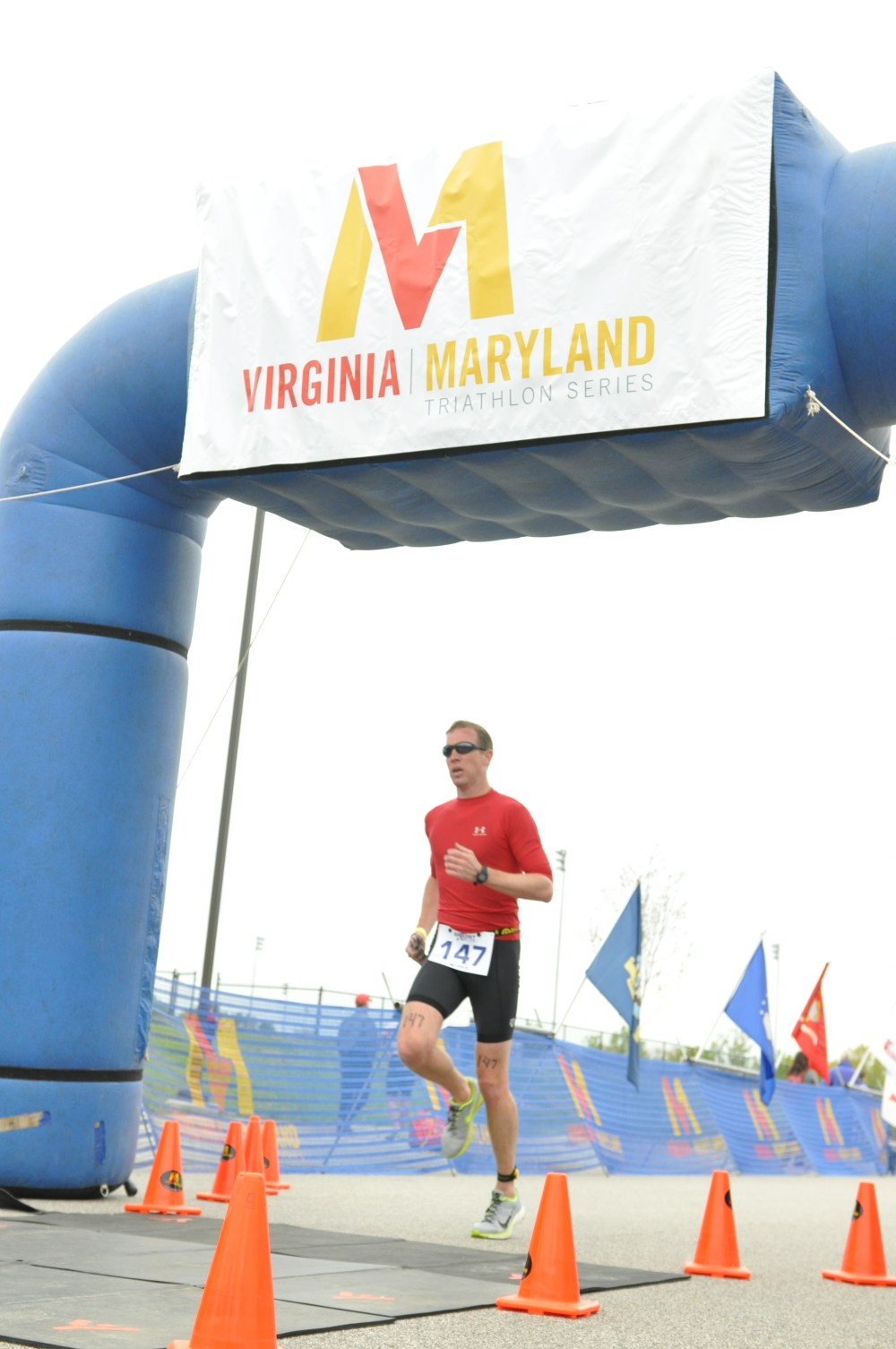
Route GPS Data

The “fun” topography of the course was compounded by the fact that there was still a lot of melting snow on the ground, along with lots of puddles.  While the streets had been cleared, there were only “goat trails” on Brown’s Island, and standing water on the Lee Bridge.  By standing water, I mean, the entire right lane was flooded in certain portions.  That meant that the runners had to either run through six inches of water or cross into the left lane, hoping to avoid traffic.  Thankfully, I managed to keep my feet relatively dry throughout the run, but Leigh Anne was less successful.  Her feet got wet on the Lee Bridge in the first loop, leading to bad blisters.

As noted above, my goal was to finish under two hours, and anything faster than that was a bonus.  1:50 was my stretch goal, but I really did not know how likely that would be since this was my first half marathon.  There was also the issue of my ailing left knee.

From the starting corral, we headed down towards Brown’s Island, and I did my best to bolster my speed on the downhill portion.  I was dodging some poorly self-seeded traffic, and I got to the first mile marker in under eight minutes.  Since the course flattened out, I slowed down, but I did not have a GPS, so I was running by feel.  I could monitor my pace at the mile markers based upon my stopwatch, and when I reached mile 2, I saw that I had slowed way too much.  In fact, I ran the second mile in a little over nine minutes.

love snow

The next three miles or so were mostly uphill, and I tried to pace myself for 8:45 minute miles.  The long constant upgrades on 14th Street, 7th Street and Semmes Avenue were difficult, but I knew that they would be less fun on loop two.  The Lee Bridge always seems to go on forever, and it also seems to have a constant headwind when you run across it to the north.  Again, there was also puddle and car dodging, but my spirits picked up once I got back to the north side.

Once the course flattened out again, I was able to pick up my pace, and I think was holding 8:25 minute miles coming back towards the Coliseum to begin loop 2.  The only real spectators on the course were near the finishing chute/start of loop 2, and even the ones there were limited.  I did take a GU gel at the midpoint of the race, and I had taken one about fifteen minutes prior to the start.  I also had two bottles of Gatorade Endurance in my Fuel Belt, so I was never thirsty, and I think that between the gels and the Gatorade, I had enough nutrition for the 13.1 miles.

Most importantly, my left IT Band had been doing ok.  There was a dull burn on the outside of my knee, but I had taken a few Tylenol prior to the start.  Thus, the pain was mild, but I was still on edge waiting for it to become sharp – as it normally did between 5 and 10 miles.

 When I began the second loop I was feeling pretty good, and I had tried hard to make sure that I ran within my limits on the first loop so that I could negative split the second loop.  Once again, I moved quickly down to Brown’s Island, and then tried not to let my pace fall off as much there as it did on the first loop.  Then it was back across the 14th Street Bridge to the south side and the three mile uphill slog that was waiting.

I  knew that my race could hinge upon how I handled miles 8.5 to 11.5, and I had steeled myself for them ever since the first loop.  Quite frankly, those three miles really sucked, but once I got back to the north side again I knew that the worst was behind me.  At that point, I was looking at my watch and doing some math in my head.  I was well within my two hour goal, but it appeared as though 1:50 or less might not be out of the question.  I needed to finish the last couple of miles at close to an 8:00 minute pace, and I began running harder once the course flattened out again.

As I headed back down Leigh Street towards the finish I was still feeling okay, but I just could not maintain a pace that was going to get me in under 1:50.  My left knee pain had gotten a bit worse, but overall, it was not really affecting me.  Whether it was the Tylenol, the adrenaline or both, the pain was only mild to moderate, which was a nice surprise.  In the past, once my IT Band became sufficiently irritated, it felt like a knife in the outside of my knee.

There were a few turns from Leigh Street to the finish, and I picked up my pace again in the last quarter mile.  I made sure that I bore right to hit the finishing chute instead of bearing left for a third loop, and I was able to put together a 100 yard sprint to the finish.  My final time was 1:51:31, which came to an 8:30 minute/mile average.  For my first half marathon, I was very pleased, and I felt as though sub-1:50 might have been possible on a flatter course.

Post-Race

Upon finishing, I grabbed a water and a banana and then returned to the finish line to wait for Leigh Anne.  She came through a few minutes later in 1:53:56.  Leigh Anne had completed the Richmond Half Marathon the prior November in 1:53:42, but that course was much flatter.  She felt great after that run, but she was NOT happy about her Love Rox experience.  While her times were similar, she disliked the hilly course even more than I did, and had been dealing with blisters on her feet during her second loop.  Her grumpiness quickly subsided, however, once we went back inside the convention center and hit up the wine expo.

I had drawn the short straw, so I was the designated driver for the day.  I did partake in a few tastings, and those went straight to my head.  Leigh Anne imbibed a bit more, but after a while she had to call it quits since the sugar was getting to her as well.

A few days later my MRI results came back, and thankfully, there was nothing of concern beyond the IT Band issue.  I underwent cortisone injection number two with Dr. Young, and to date, that second injection has cured my IT Band problems.  Different problems would eventually arise, but those will be addressed in future posts.

LoveRox