Taking Stock – 2014 Year in Review

Overall, 2014 was a successful year for me with respect to continuing my 2013 New Years  resolution of getting into shape.  I overachieved in my first race of the year, which was a 15k trail race, and probably because I was running “blind” without a GPS.  Its amazing what your body is capable of when your brain doesn’t get in the way.  I did injure my left IT band in that race, which slowed me down a bit for a few months.

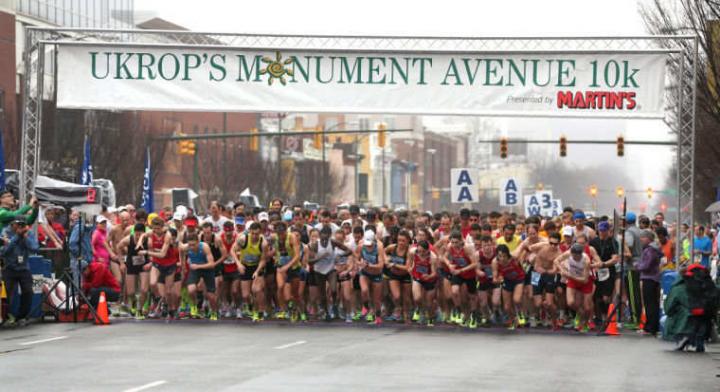
A friend of mine told me that you really start feeling the aches and pains after age 35, and that is certainly true in my case.  I underwent physical therapy for my left leg, which fixed me up before my first triathlon in April 2014.  Still, I was not able to train much in the month leading up to the Monument Avenue 10k, and my time was nearly two minutes slower than my 2007 time.

On the upside, I completed my first three triathlons in 2014, building from two sprint distance races to an Olympic distance race in September.  I managed not to embarrass myself, and even learned how to swim freestyle (correctly) for the first time in my life.  When I first began swimming in March 2014, I couldn’t swim more than two lengths of the pool without stopping to catch my breath.  By the time of the Richmond Rox triathlon at the end of the season, I was able to complete the 1500 meter swim in the James River without too much difficulty, even without a wetsuit.  I certainly couldn’t call myself a strong swimmer, but I wasn’t the slowest swimmer of the bunch.  Given that I only took one lesson and learned the rest from YouTube videos and from reading e-books on the subject during Jackson’s karate practices, I’d call that a success.  Actually, there was a lot of practice involved as well.

I did complete a second Tough Mudder and Spartan Race in 2014, but my focus had clearly shifted away from obstacle course racing.  The triathlon bug bit me quickly, and I already knew that I had no plans for obstacle course racing in 2015.  I really wanted to concentrate on triathlon, which seemed a bit more serious and competitive.  Don’t get me wrong, there are a lot of very competitive obstacle course racers, including pros, but it seemed to be more of a party scene than a competition.  In fact, the Tough Mudder isn’t timed, which is anathema to me.  In my book, somebody has to win and somebody has to lose, and that’s not possible when the “race” isn’t timed.

As to my training volume, I was working out about five days per week in 2014.  Roughly 60% of my workouts were swim/bike/run with the other 40% being strength training at home in my bonus room.  The strength training was largely focused around the P90X3 and T25 programs – which are only 30 minutes and 25 minutes long respectively.  At the time, it felt like I was working out a lot, but in looking back at my Mapmyfitness log, I was only averaging about 3 hours per week on swimming, biking and running.  That’s better than sitting on the couch, but not enough to make substantial gains.  When factoring in my strength workouts, my weekly average was between 4 and 5 hours.

In looking to take the next step in triathlon, I had already registered for the Ironman Raleigh 70.3 triathlon on May 31, 2015.  The 70.3 stands for 70.3 miles of racing (1.2 mile swim/56 mile bike/13.1 mile run), and is also called the half-iron distance.  Obviously, a full-distance Ironman is twice as far.  I knew that I would need to step up my training substantially to complete the Raleigh race, and I was already looking into 70.3 specific training plans at the end of 2014.

As 2014 came to a close, I was hoping that the injury bug would not bite in 2015, but unfortunately, 2015 would be very similar to 2014 in that respect.  My IT band problem would rear its ugly head again, leading to an MRI and another cortisone injection.  Nevertheless, my positive momentum would continue into 2015, and 2015 would be another year of firsts for me.  I’d complete my first half marathon, I’d complete my first half-iron distance triathlon (in unrelenting heat), and on a rainy day in July, I’d stand on a triathlon podium for the first time.


Gobbling Up A Podium Spot

2014 Martinsville Turkey Day 5k

Race Report

23:09     (7:27 min/mile)     2/7 AG     26/305 Overall

November 27, 2014 – Thanksgiving Day 5k races have become the rage in recent years, and Leigh Anne and I decided to give in to the trend by doing the Turkey Day 5k in Martinsville.  We generally travel to her parents’ home outside of Martinsville for Thanksgiving, so we’d have grandparents as babysitters.  Plus, we’d work up an appetite and work off some calories prior to Thanksgiving lunch and dinner.  All around, a cant’ lose scenario.

Pre-Race

Thanksgiving morning was not abnormally cold, but rain showers were in the area.  I watched the radar map all morning, and it appeared as though we might get a hiatus from the rain during the race.  I had finally gotten accustomed to running in cold temperatures, but I hate being cold AND wet.  I doubt that will ever change.

turkey 1

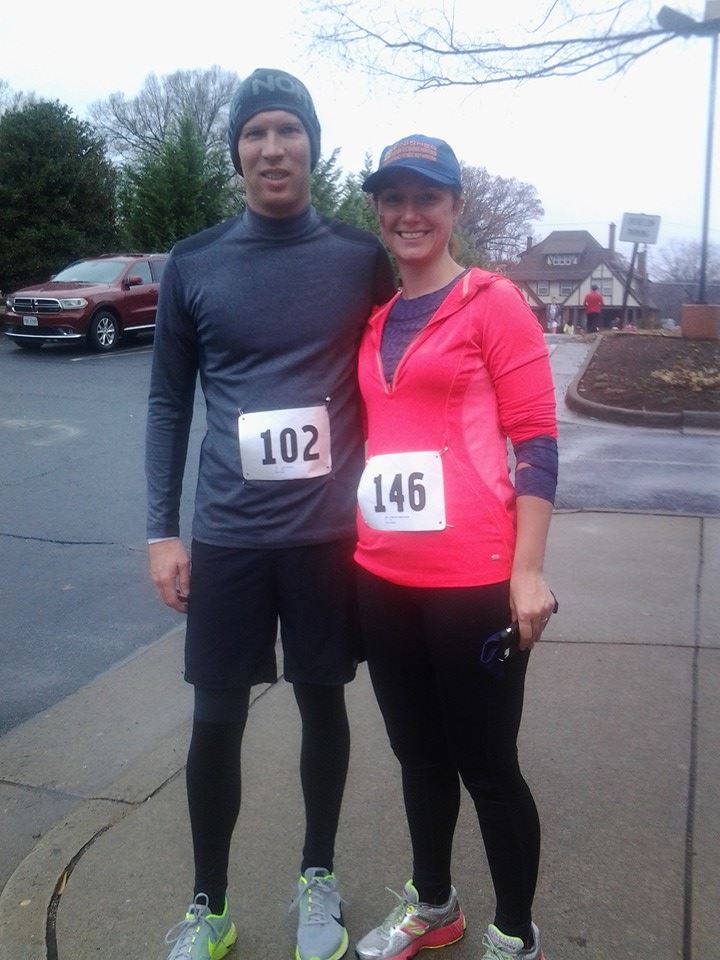
Leigh Anne was fresh off her first half marathon and was proudly sporting her stylish finisher’s hat.

The race was being held at the Martinsville YMCA, and we arrived an hour early since I am mildly neurotic about being late or rushed.  I tend to stress a bit in the 24 hours leading up to a race, and I generally arrive way to early since I don’t want to the stress of clock watching added to my pre-existing stress.  Thankfully, we did not have to wait outside in the cold and light rain.  In fact, the YMCA had an indoor track above and around the basketball court, which was useful for warming up.

A few minutes prior to the start time, everyone filed outside and lined up in the street.  After the National Anthem and a few words from the starter, the air horn sounded and we were off.

Race

I did not have a major time goal for the race, but anticipated something the in 7-8 minute/mile pace range.  I positioned myself near the front, but was careful to stay behind the people who looked like “real” runners.  Some were easy to pick out since they were wearing shorts and tank tops, irrespective of the cold and wet conditions.

I had studied the course map ahead of time, but was unable to find an elevation profile.  Martinsville is fairly hilly, but I certainly did not expect what awaited me.  The first half mile was a mild downslope on the public streets, which led to a pretty fast pace.  We then entered a paved running trail, and there was a very steep descent for the next .2 miles.  In fact, the descent was so steep that I was forced to slow myself and brace so I wouldn’t slip on the wet asphalt.  Sadly, I was unable to fully exploit that portion of the downhill without risking an injury, and pretty much everyone else was doing the same.

As they say, what goes down must go back up (I think?), and from mile .7 to mile 1.45 there was a lung and leg busting trek back uphill.  Based upon my GPS data from the 2015 race, the course gained exactly 100 feet over that distance, which is an average grade of 2.5%, and which slowed my pace considerably.  In fact, I ran the first mile in 7:15 and the second mile in about 8:15.

The last half of the 5k was up and down, but there was only 90 feet of elevation gain over that distance.  My legs slowly recovered from the climbing, and I began to increase my pace.  The back half of the course wound around downtown Martinsville, and gave the runners a chance to see who was ahead and behind them.  I saw Leigh Anne at one point around mile 2, and she was just finishing her uphill climb near the race mid-point.

After finding my stride again, mile 2 – 2.6 went by pretty quickly, but the last half mile of the 5k is a straight shot down E. Church Street that seemed to go on forever.  To make matters worse, the last .3 miles were all uphill, with the finish line just beyond the crest of the hill.  Thus, you could not see the actual finish line until you were within a few feet of it, and I was not 100% sure how far beyond the crest of the hill it was.  Thus, I had trouble pacing myself at the end, not wanting to go all out too soon for fearing of bonking 100 yards before the line.

After what seemed like an eternity on E. Church Street, I finally crested the hill and saw the giant inflatable turkey marking the finish line.  I’ve never been so happy to see an inflatable turkey, and I crossed the finish line and tried to catch my breath.  A few minutes later, Leigh Anne came through, and then we waited for the awards ceremony to start in the YMCA to see if either of us managed to obtain a podium spot.

As it turned out, she and I both came in second for our age groups, which was my first ever podium finish in a race.  Granted, the Martinsville Turkey Day 5k is not as competitive as the Monument Avenue 10k, but I was 2/7 in my age group and 26/305 overall.  Sadly, it was not good enough for a large cash prize, but it did net me a photo with a couple of llamas and a wooden carving board that I’ve never used.  I guess I should be thankful for the small things…

turkey 2

So that’s how my 2014 racing season ended, and I guess you could almost say that it came full circle.  My first triathlon had me chasing a chicken and my final race of the year had me posing with llamas at the finish.  The offseason would be spent preparing for my first half-Ironman triathlon in Raleigh in May 2015.

turkey final

Running on Empty

Richmond Rox Olympic Distance Triathlon

Race Report

2:48:56

 6/14 AG     92/244Overall
 

rox overview

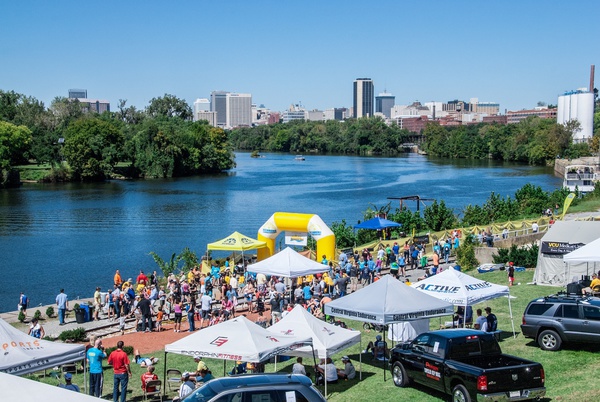
September 21, 2014 – The culmination of my first triathlon season was the Richmond Rox Olympic distance triathlon.  The name stems from the fact that the race is the same distance as the triathlon in the Olympic Games, which is 51.50 kilometers.  Alternative names are the “international distance,” and the “5150” for Ironman brand races of the same distance.  Most people, however, simply refer to it as the Olympic distance.

This race was going to be quite a step up from my two prior triathlons, which were both sprint distance races.  The Olympic distance triathlon features a 1500 meter swim, a 40k (25 mile) bike and then a 10k run.  My two prior races were completed in approximately 1 hour 15 minutes and 1 hour 30 minutes respectively, and my goal for the Richmond Rox triathlon was sub 3 hours.  In addition, my longest triathlon swim was only 650 meters in the Tavern Triathlon, but that was all down river with the current.  The swim at Richmond Rox was upriver and downriver, so there could be no faking it by floating along with the current.  Slow down enough on the upriver portion, and you’d be carried backwards.

Pre-Race

On race morning I was up at 4:00 a.m. to have my obligatory bowl of oatmeal and my cup of coffee.  Just enough nutrition to get some calories and caffeine in my body without weighing me down.  I had checked and rechecked my gear the night before, so it was simply a matter of grabbing a quick shower and hopping in the car to head down to Rockett’s Landing.

It was still dark when I arrived at the race site, and it was slightly cool.  By the time that I walked my bike down to the transition area and set up, however, the sun was beginning to rise.  Rockett’s Landing has a fantastic view of the Richmond skyline a mile or so away, and I took it in a few times to try to relax.  As always, my nervous bladder sent me to the porta-potties more than once.  I’m not the only one who has that problem, based upon the fact that the porta-potties seemed to have a higher athlete density than the transition area.

Leigh Anne, the kids and my mom were my spectators, and arrived about thirty minutes before my start time.  The half-iron race participants were beginning their swim prior to the Olympic distance folks, and we watched them take off and head up river.  Soon enough, however, it was time for the Olympic race to start, so I said my goodbyes and headed towards the dock.
prerace

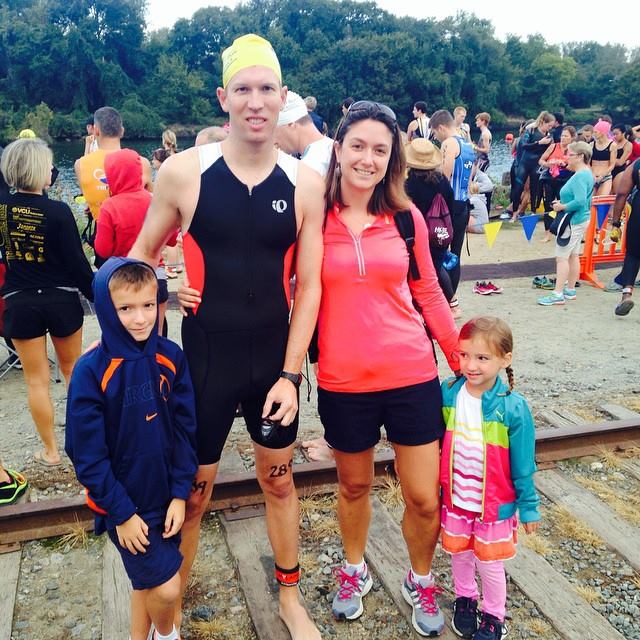
Yeah, I don’t wear yellow swim caps well…

Swim- 33:02 (2:12/100 m) 

Swim Course Olympic
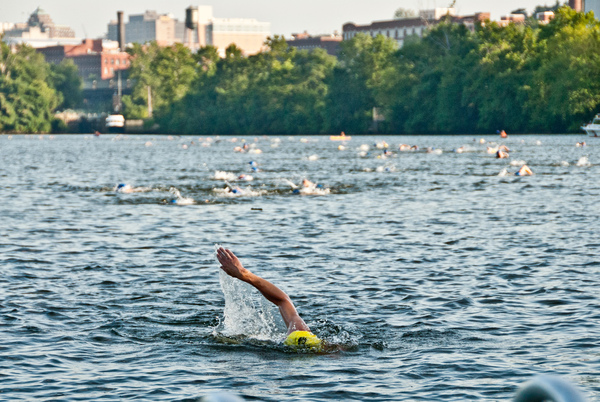
rox swim

The swim start is near the smoke stack in the background.

Unfortunately, I did not yet have a wetsuit and the race was wetsuit legal based upon the water temperature.  The water temperature was nearly perfect, so the lack of a wetsuit was not all bad.  Still, wetsuits make for faster swims, so I made a mental note to acquire one in the offseason.

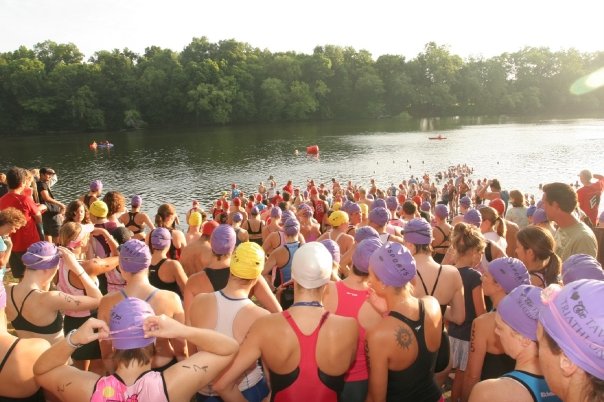
The swim was a wave start, and I was in the second wave to take off.  Prior to the starting horn, the swimmers were required to jump into the river from a dock, and we had to swim forward a bit to keep from being swept backwards by the current.  The current was not terribly strong, but the first half of the swim was upriver, and the going would be slower than normal for me.  Once the horn sounded, I did my best to swim away from the mass of swimmers so that I would not get kicked or have my goggles knocked off.  I also headed towards the left bank of the river, hoping that the current would be less severe near the shore.

The first half of the swim was relatively uneventful (other than turning left a bit too much), and I soon neared Gull Rock, which marked the turn around point.  As I rounded the rock, something odd occurred – my hands began hitting the bottom of the river.  In fact, the area around Gull Rock was only a couple of feet deep, and I considered crawling since I really could not swim.  Instead, I pushed myself farther away from the rock, and soon enough, I was in deeper water.

Once I made the turn, the current was with me and I continued to sight the smokestack at Rockett’s Landing to stay on course.  On the way back I stayed more in the center of the river to take advantage of the current.  The only issue that I had coming back in was the inadvertent intake of a leaf into my mouth.  That led to a 10-15 second coughing fit, but soon enough, I was on my way again.

The dock marking the swim exit soon became visible, and I tried to increase my stroke turnover, knowing that I would soon be done.  The last 100 meters or so went by quickly, and then I was climbing the ladder out of the water.  The inevitable dizziness of standing quickly after swimming hit me once I got upright, but I was ready for it this time and never really lost my balance.

My overall time for the 1500 meter swim was 33:02, which was in the ballpark of what I was expecting.

T1- 3:00

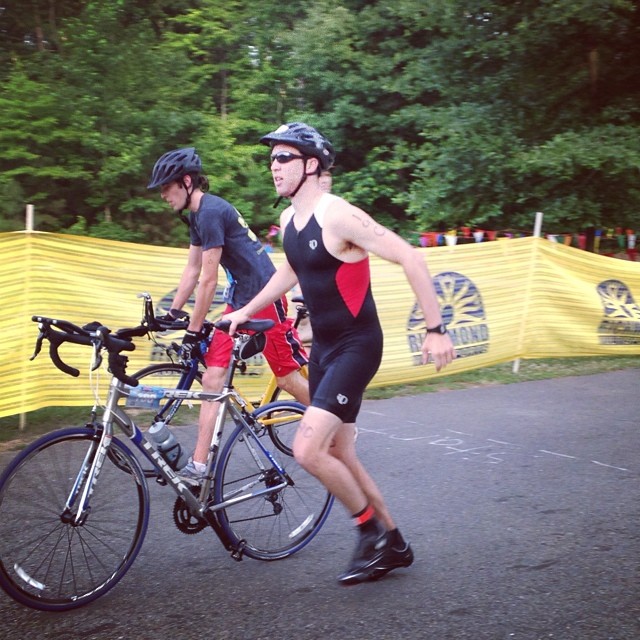
T1 involved a long run from the water up to the main transition area.  I would estimate several hundred yards, which led to a 3:00 transition time.  Once I found my bike, I put on my socks and shoes, and then threw on my sunglasses and helmet.  It was then a short run to the “bike out” area, accompanied by the click clack of my cycling cleats.  I hopped onto Blue after crossing the mounting lines, and had no issues clicking in and taking off.

swim exit


Bike – 1:18:29 (19.02 mph) 

Olympic Bike Course Map

Having never completed an Olympic distance triathlon before, I was not sure how my body would react to running a 10k after a 25 mile bike.  Thus, I did not want to overcook myself on the bike, so I was definitely trying to pace myself, particularly early on.  Based upon my training rides, I knew that I had the ability to hold 19.7 mph for 25 miles, and my training takes place on relatively hilly courses.  The Richmond Rox course was not quite as hilly as the normal courses that I ride, so I was hoping to average 19.4 – 19.5 mph, leaving some juice in the tank for the run.

I had one water bottle with me on the bike, and there was a single aid station just past the turnaround point.  Unfortunately, my bottle was filled with water instead of Gatorade, and I neglected to bring any nutrition with me.  I had not had any nutrition during my two prior sprint distance races, and I wrongly assumed that I could get by without nutrition during an Olympic distance triathlon.  So, off I went on the bike, having consumed no calories since my breakfast of oatmeal and coffee around 4:15 a.m.

The first two miles of the bike course were largely uphill, as you gain approximately 140 feet of elevation while heading south on Route 5 out of Rockett’s Landing.  Its then mostly flat or downhill until mile 9.5.  I took it easy in first two uphill miles, and then began to push it a little harder once the course flattened out.  There were a lot of other bikers around early on, and I did my best to avoid incurring any drafting penalties by keeping my distance from them or by passing them quickly.  Things got a bit more spaced out after the first 20 minutes or so, but there were generally several people in sight at any given time during the first half of the bike.

There was a big drop off as I crossed over I-895, and I remember thinking that I was not going to be happy when I came back in the other direction.  Immediately following the drop off, the course went back uphill, and then was fairly flat through the turn around.

Once I hit the turn around cone, the one and only aid station was a few hundred yards off.  I still had about 40% of my water bottle left, and I naively bypassed the station, thinking that it would just slow me down.  I could have just slowed down for a few seconds to grab a bottle of Gatorade, but I had made up my mind that those few seconds would be costly and difficult to make up later.  That was a rookie mistake and a bad idea.

The second half of the course backtracked over most of the first half, but a few portions were different.  In particular, we crossed back over I-895 in a different spot, but there was still quite an incline to go up.  The incline was not quite as steep as the prior descent, but it was a longer grade.  At the time, the uphill climb looked as though it would never end, but in fact, it only went on for about two miles.  By far, the hardest portion of that climb was at the I-895 crossover, and then it was about a 1.7 mile long stretch of incline.  To make matters worse, there was a slight headwind, and I really began to start feeling tired.  That 1.7 mile stretch felt much longer than it actually was, but I finally reached the crest of the hill.

From the top of the crest, the course flattened out a bit, and I knew that it was only a short distance before I descended back down towards the river at Rockett’s Landing.  I was feeling OK at that point, and the last few miles passed fairly quickly.  I rested my legs a bit by coasting towards dismount point, and I dismounted without any difficulty.

T2- 1:40

T2 was uneventful, and I saw my family cheering for me as I ran my bike back to the rack.  Off came the bike helmet and shoes, and on went my running shoes and my race belt with my bib number.  My legs felt as though they belonged to someone else at that point, but I had begun to get used to that sensation by practicing bike to run transitions.  As I hit the run exit of the transition area I reset my watch to monitor my run pace, and off I went for the final 10k of the race.
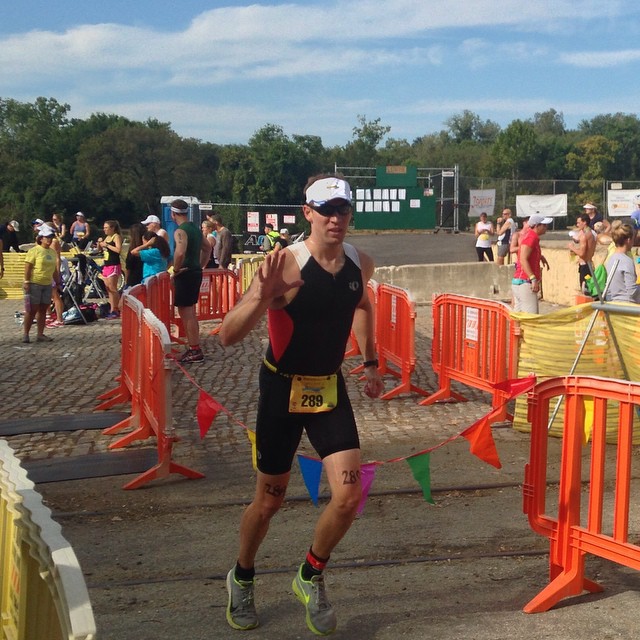
rox t2

Run- 52:48 (8:31 min/mile) 

Olympic Run Course

I am not a big fan of the run course, but to be fair, I did not know that at the time, having never run it before.  The first mile is fairly flat along the river, and then the next two miles to the turnaround point are pretty much all uphill past Legends Brewery.  It is tough to gauge your pace when you first transition off of the bike (particularly without a GPS), whereas your legs feel a bit numb.  My stretch goal for the 10k run was 50 minutes, which equates to an 8 minute/mile pace.  I really had no training basis for that goal, so I didn’t know if it was possible, but I was going to give it a try anyways.

I was still feeling decent leaving T2, and I set my internal pace to 8 minutes/mile.  The first time that I’d be able to check my pace would be at the 1 mile marker, which was on Dock Street on the flat portion of the course.  When I got there my watch read 7:05, and I was really hoping that the mile marker was off.  Otherwise, I knew that I had really overextended myself on the first mile of the 6.2 mile run.  I decided to dial it back a bit, and soon I was crossing the river to the south side.

From the south side of the 14th Street Bridge to the turnaround point, it is pretty much a constant upgrade until you take a right onto 12th Street just before the half way point.  The grade is never super steep, but its constant and feels like it will never end.  That feeling is compounded by the long lines of sight that show nothing but climb.  The mile and a half climb was a soul crusher for me, and my lack of nutrition was really beginning to hit me at that point.  I knew that my pace was slipping, but I still had the hope that I could make it up by hammering back down the hill on the way back in.

When I finally hit the turnaround cone, my run time was around 26 minutes, so 50 minutes was still within my reach due to the downhill portion on the back half.  I did pick up my pace as I headed down towards the river, but I still couldn’t seem to get moving as quickly as I should have been able on the downgrade.  Once I got back to the river and the flat part of the course, I no longer had gravity assisting me…and that’s when the wheels started coming off.

I was nearly back on my 8 minute/mile pace 5 miles into the run, but as I headed back down Dock Street towards Rockett’s Landing everything began shutting down.  I had an overwhelming urge to slow down, and then an overwhelming urge to walk.  Even though I had less than 1 mile to go, I was literally running on empty, having depleted my glycogen stores.  By that point, I had been racing for the better part of three hours at a high intensity, and I had failed to take in ANY calories, solid or liquid.  Big mistake.

My body was telling me to stop, and sadly, I was forced to comply – mostly.  I didn’t stop, but I did walk for about 10 seconds.  Another competitor passed me and urged me on, and I began to run again.  About a quarter mile later, however, there was another 10-15 second walk break…and then another.  Three walking breaks in the last mile of a 10k run!  I thought that I was mentally tough, but my body was talking louder than my brain and I simply couldn’t push through the urge to walk.

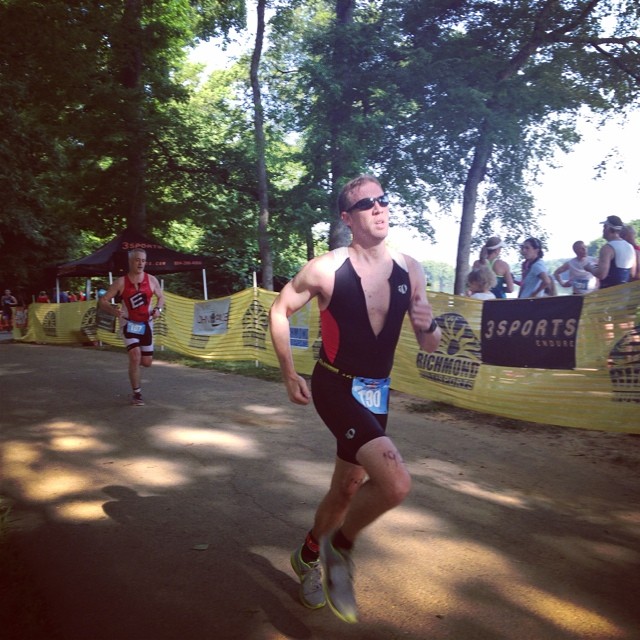
When I was about a 1/3 of a mile from the finish line, I decided to finish strong, and ran in from there.  The end of the course goes through an old building, and the finish line is not visible until you emerge from the other side.  When I finally saw the finish line I kicked it into high gear and sprinted the last 100 yards.  After crossing the finish line I resisted the urge to collapse, and managed to get my medal and walk out of the finishing chute.  My run pace was 8:31/mile instead of my 8/mile minute goal, but that probably wasn’t too bad considering my final mile bonk.

Post Race

After my first two triathlons, I had a brief recovery period and was then able to hit up the post-race food.  This time, however, I felt bad.  Really bad.  The kids tackled the bounce house, but I sat in a folding chair under the food tent nursing a 24 ounce Gatorade.  Once I got the Gatorade down I began to feel a bit better, but the recovery period was slow.

In a full Iron distance triathlon (140.6 miles), they say that nutrition failures are measured in hours, not minutes.  Thankfully, my nutrition failure came in a triathlon of less than a quarter of that distance, so I only lost minutes.  Still, I managed to finish in 2:48:56, which was more than 11 minutes faster than my goal.  My run time suffered, but I learned a valuable lesson in the “4th discipline” of triathlon – nutrition.  That lesson would serve me well in 2015, as I planned to tackle the half-Iron distance of 70.3 miles.  I was already signed up for the Raleigh Ironman 70.3 race, and a winter of training was awaiting me.
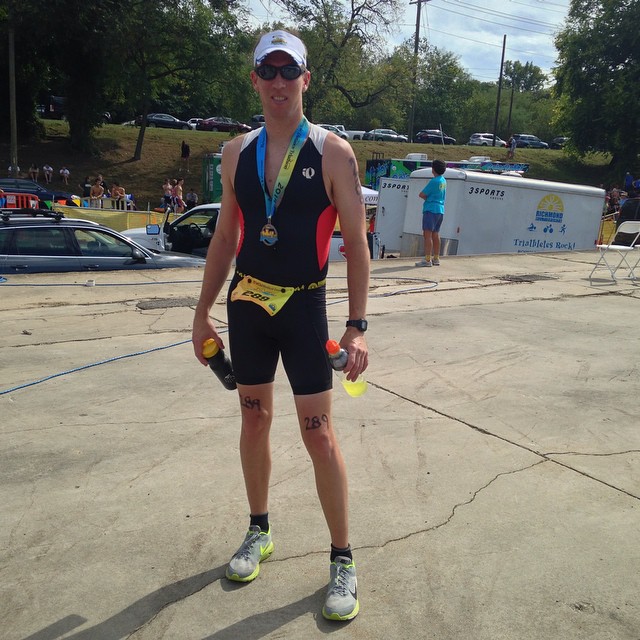
 

finish


“We’re strange allies with warring hearts…”

2014 Wintergreen Spartan Super Race Report

Time: 3:42:26

98/872 AG    550/6483 Overall

August 23, 2014 – It’d been 364 days since I took on Wintergreen Mountain by myself in the 2013 Spartan Super.  I went into that race totally naïve as to what I was facing and came out the other side beaten, battered and totally spent.  I had expected 8 miles or so of mostly running, and was unprepared for the constant up and down trek through the woods and streams around the ski slopes.  Based upon the comments after that race, however, the vast majority of the other participants were similarly unprepared.  I was given a 50/50 chance of completing that race by Richard Engel, who seemed to have a difficult time accepting my post-race description of the course.  In 2014, I was ready for round 2, and Richard was going to find out firsthand just how fiendish the Spartan Race folks could be at course design.

Rounding out “Team 50/50” with Richard and I was my neighbor Alan Posey, who had taken on the Tough Mudder with me in June.  The three of us agreed that we wouldn’t necessarily be running the Spartan Race together, as our group did for the Tough Mudder.  We would all start together, but whether we all finished together remained to be seen.

Pre-Race

In 2013, Leigh Anne and I drove to Wintergreen on the morning of the race, but in 2014, our group rented a house through VRBO.com for Friday and Saturday night.  This would allow us to have a non-rushed Saturday morning, and we could then enjoy the local breweries after the race without having to drive back to Richmond.  As luck would have it, I had a deposition on Friday afternoon in Brookneal, so I headed to Wintergreen once I finished and was checked in ahead of everyone else.  Somehow, this nominated me as the chef for the night, so I had a giant pot of spaghetti ready when everyone arrived.

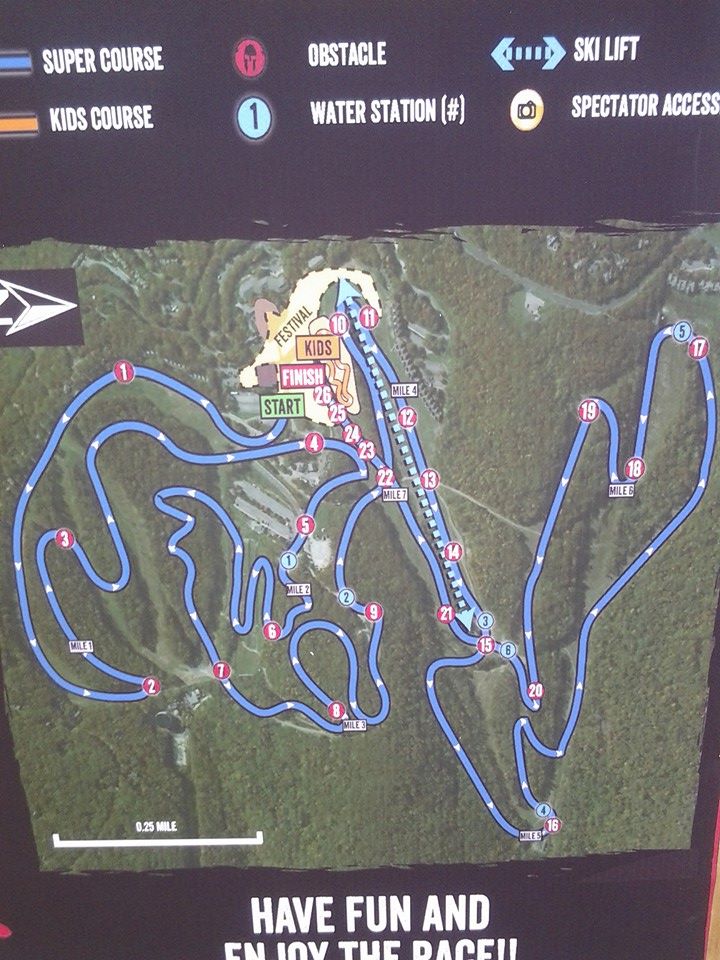
Before cooking, I walked from the rental house up to the top of the mountain to look at the course setup.  The Spartan Race crew was still working vigorously, but I did get to look at the course map.  The course appeared to be slightly under 8 miles this time around, but I was glad to see that they still had the “death march” up the black diamond ski slope. In 2013, the sides of the “death march” were littered with lifeless people, and I was glad that Richard would get to experience that fun firsthand since I had talked it up to him so much.

course map

The “death march” is from obstacle 16 to 17 on the right side.

In addition to Richard and Alan running with me, Jackson and Jillian were able to participate in the kids’ version of the Spartan Race.  They were both very excited, and particularly about the fact that they would get medals.  Both kids did awesome (so I heard), and claimed that they wanted to do the full course next time.

The night before the race the heavens opened up and it rained…a lot.  At one point, it was raining so hard that I was having water drip on me in bed.  I swore that the roof was leaking, but I later learned that Leigh Anne had cracked the bedroom window.  Regardless, I knew that we were going to be in for wet, muddy and slippery conditions the next day.

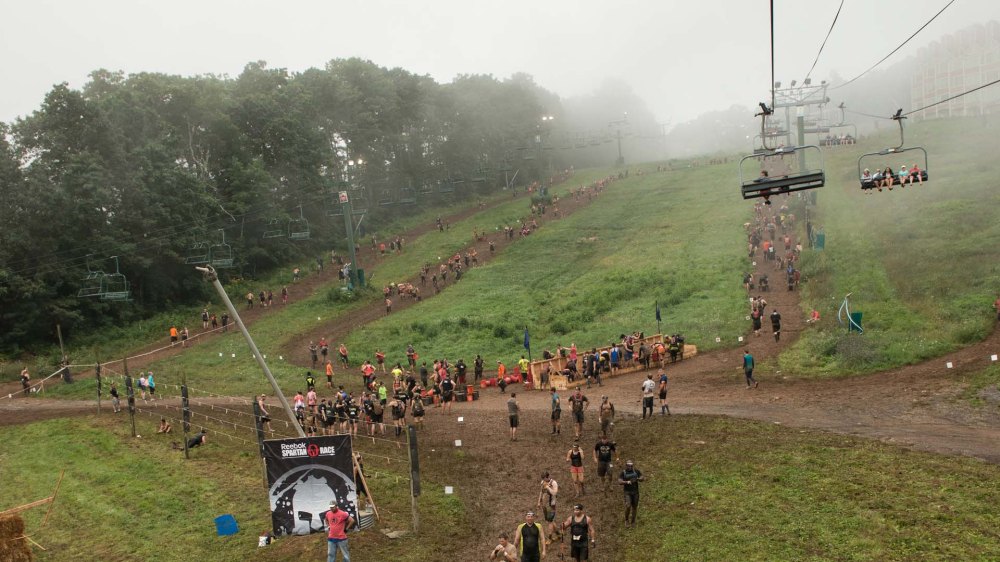
Upon waking, it was still raining and there was heavy fog.  The rain slowly began to subside as our start time neared, but the fog was there to stay.  In fact, when we got checked in and looked down the mountain at the course, it seemed as though barely 50 yards were visible.  I wondered how the television crews were going to make out since visibility was so limited.

Sadly, the kids’ race was set to begin a few minutes after our start time, so I would have to miss their first Spartan Race experience.  Alan, Richard and I made our way to the starting corral around 10:30, and then after a motivational speech from the starter we were off.

Race

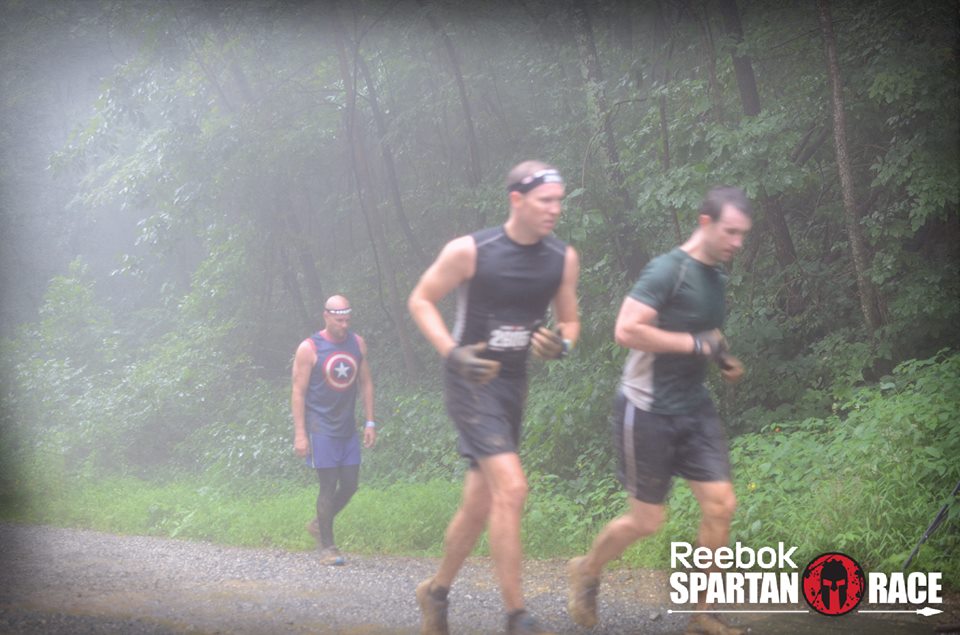
As in 2013, the first few miles of the race took place on the Eagle’s Swoop side of the mountain, which is a mixture of intermediate and expert trails.  The initial ascent of the day was the top half of Eagle’s Swoop, and is designed to get your legs burning quickly.  Richard and I made it to the top together, but Alan was somewhere behind us running his own pace.  We then made a descent down a very slippery black diamond slope, complete with muddy trenches.

Once we reached the bottom of the black diamond, Richard was finally able to begin seeing the parts of the course that I had described for him over the past year.  The trek back up the mountain wound through the woods on what can only be described as a “goat trail.”  Most places on the trail were too narrow for more than one person, and it was difficult to find good footing, especially due to the heavy rains.

The course wound up and down for awhile, and Richard and I kept running together.  The first few obstacles were relatively minor, but we soon came to the Atlas Carry.  The Atlas Carry consists of a 60-70 pound round boulder, which you are forced to carry about 20 yards.  You then drop the boulder, do 5 burpees and then carry it back.  What makes this obstacle difficult is that it is tough to get a good grip on the stone while walking, and you certainly don’t want to drop it on your foot.  Richard and I made it through the Atlas Carry unscathed, and within an hour and a half or so, we were through the first half of the course.  In 2013, the second half of the course took almost twice as long as the first half.  2014 wouldn’t be any different.

spartan trail

Has Captain America has already conceded defeat?

As we crossed back into the main area of the resort, the course took us back up the mountain towards the monkey bar obstacle.  I took off my wet and muddy gloves in order to have a better grip, and I made it across without falling.  Richard was not so lucky, and was forced to do 30 penalty burpees.  I thought about moving on without him, but decided to wait for him to finish his burpees.  Quite frankly, part of me wanted to tackle the Spartan Race with a friend, but the other part of me also wanted to see if Richard’s first encounter with the course would hurt him as much as my first encounter hurt me.  I also hadn’t forgotten how he ran backwards during the end of our run at the beach the year before to taunt me.  Thus, a little friendly payback was in order.

After the monkey bars and then the Herculean Hoist at the top of the mountain, Richard and I headed down the slope to one of the most insidious obstacles of the day – the Bucket Brigade.  This was the first obstacle of the race that was really intended to break people, and it consisted of carrying a five gallon bucket full of driveway gravel a quarter mile up and down an intermediate slope.  The misery was compounded by the fact that the buckets had no handles, and it was illegal to carry it on your shoulder.  Thus, you were forced to carry the bucket in front of you with your hands beneath it, which also made it difficult to walk.

spartan bucket

The bucket brigade course.

The sides of the path were littered with people sitting and resting on their buckets, and I was forced to stop 3 or 4 times myself.  Still, I made sure that I held out a little longer than Richard on every effort no matter how bad I was hurting, and soon I was good 30-50 yards ahead of him.  I finally made it back to the rock pit and dumped my bucket, and then waited for Richard to catch up.  It was at that point that Richard’s mood began to get a bit darker, and it would grow darker still as the course difficulty ramped up.

bucket

A well-worn track for the Bucket Brigade

Immediately after the Bucket Brigade, Richard and I ran into our families, and I stole a banana from Leigh Anne, which would be my only nutrition during the race.  The Spartan Race is a “self-supported” endeavor, so there was only water on the course, no food.  Leigh Anne asked Richard how he was doing, and being fresh off of the Bucket Brigade obstacle, his remark was a very terse, “How do you think I’m doing?”  After gathering ourselves for a moment and saying our goodbyes, it was off to the lowest part of the course on the expert side of the mountain.

spartan

About to take on the difficult side of the mountain.

From obstacles 15 to 16 on the course map above, we were headed downhill through a creek with very slippery rocks.  The going was incredibly slow, since one bad step could result in a broken ankle.  When we finally emerged from the creek we were at the bottom of The Highlands Express lift, but had to flip a 6-7 foot log over several times before we could proceed up the mountain.

And then it was time for the “death march” up the black diamond side of the mountain.  Once again, the sides of the expert trail were covered with people sitting down to rest, but Richard and I were determined to stay on our feet the entire way.  The slow trek up the steep incline burned the hamstrings and calves, but I told myself that I wouldn’t stop to rest until after Richard told me that he needed to stop.  I was successful in my mental game of “chicken,” with Richard asking to stop about 3 or 4 times on the way to the summit.  It was so much fun to hear him sheepishly ask me to stop after all the shit he’d given me over the past year.

Due to the fog, we couldn’t actually see the summit until we were almost there, and we heard many of the other racers wondering out loud how much farther the top could be.  All in all, it probably took us 30 minutes of near-constant trudging to cover the full length of the slope, and it was eerie to see nothing but fog above and below us during the trek.

Upon reaching the top, we were faced with two treacherous descents, which were even more dangerous than normal due to the wet conditions.  Climbing up a slick ski slope is one thing, coming back down on shot legs is another matter altogether.  Thankfully, Richard came up with a solution, which consisted of sitting on our feet and sliding down the wet grass on the slope.  The solution wasn’t without its own form of risk or pain, but was preferable to stumbling down at full speed and waiting to do a face plant down the mountain.

At the bottom of the second descent we were confronted by the log carry, which further sank Richard’s spirits.  We were forced to carry logs approximately a quarter mile down and back up the expert slope, which further taxed our already shot legs.  Thankfully, no out of control logs went blazing past me down the slope this time like one had the year before!  I began to get a little bit ahead of Richard on the obstacle, but waited for him at the top near the log drop off.  The lack of nutrition was really beginning to get to both of us at that point, and I could tell that Richard was ready to be done.

spartan 2

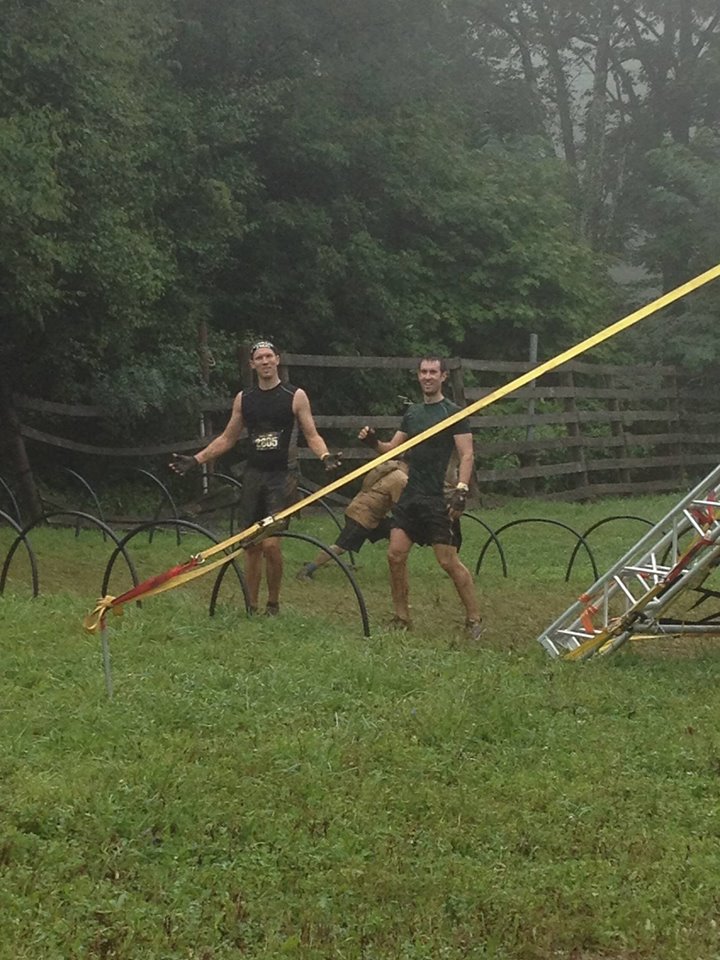
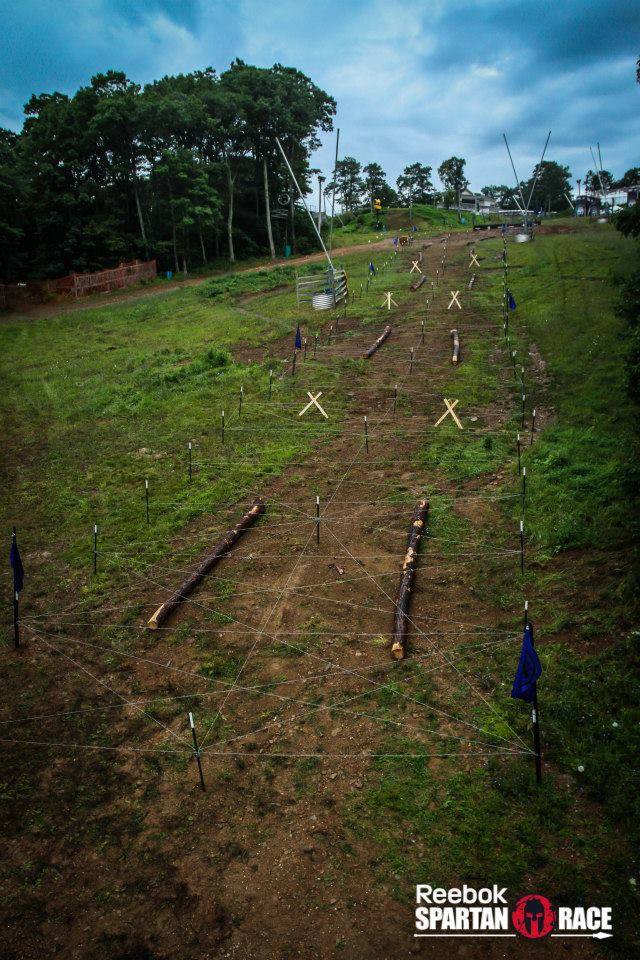
From the end of the log carry, all we had to do was make it up one more intermediate slope and we’d be done.  In true Spartan Race style, however, the course would maximize our effort over the remaining distance.  First up was the barbed wire crawl. In 2013, the barbed wire crawl was tough, but they really upped the ante in 2014.  The 2014 version was about 50% longer and on a steeper part of the course. Richard and I went in together, but I was soon ahead of him via my rolling technique.  Since we were so close to the end of the course, I decided just to push ahead and find him when we were both done.

spartan barbed wire

Lots of nice rocks to crawl through…

I continued rolling instead of crawling, but I had to stop a few times since I was getting dizzy.  I also had to crawl around people a few times to pass.  The ski slope was littered with rocks, so bumps and bruises were unavoidable.  The top of the barbed wired crawl was extra muddy, and it became difficult to make forward progress due to lack of traction.  After what seemed like an eternity, I came to the end of the wire and got back on my feet.

spartan mud

The rope climb was waiting for me, and the Spartan Race organizers love to put one of the toughest obstacles near the end for when you are completely exhausted.  I managed to make it up and back down without falling, and then it was a short climb to the finish.  One small pyramid wall and some flaming logs were all that remained, and then it was across the finish line.

Even though I was exhausted from the effort, I felt much better than the year before, and didn’t feel the need to collapse on the ground.  Richard finished about 10 minutes later, and apparently threw in the towel on the rope climb and just did the 30 penalty burpees in lieu of attempting the climb.  When he finished, he collapsed (as I had done the year before) and claimed that it was his first and last Spartan Race.

spartan finish 2

After getting cleaned up, Richard and I walked down the course to try to find Alan and encourage him to the finish.  Unfortunately, he had gotten really dizzy at the top of the “death march,” and took a DNF.  Sadly, he had made it through the toughest portion of the course and only had about 1 mile to go.  The lack of nutrition on the course caught up to him, and was really a surprise to us all.  There were gels at the water stops in 2013, but none in 2014.

That evening, there was some minor drama involving a hornet, and then we hit up one of the local breweries for some much needed sustenance and beer.  It began dumping rain again, but the rain had been fairly light during the race.

Overall, it was much better experience in 2014 since I didn’t have to race alone.  I felt as though my level of conditioning had improved substantially since the 2013 race, and my biking over the past year probably strengthened my legs for all of the climbing.  I think Richard finally realized that I wasn’t exaggerating as to how hard the course would be, and I was able to get a little payback on him for his 50/50 comment.  He can still run circles around me on a flat course, but I was the king of the mountain between us that day and got a little payback.

With the Spartan Race over, it was time to focus on the Richmond Rox Olympic distance triathlon, which was only a month away.  That was going to be my “A” race for the year, and I had a lot of recovering to do before I’d be ready to race again.

spartan kids

spartan finish

Slow but Speeding

2014 I Love the Tavern Triathlon Race Report

1:36:02

 16/25 AG     126/405 Overall

June 29, 2014 – My first “real” triathlon will be the I Love the Tavern sprint, which is held at Robious Landing.  Not only is this my first swim-bike-run format (my prior triathlon was a reverse format due to cold weather), this will also be my first open water swim.  Thankfully, the entire 650 meter swim is down river, so the current will be a big help.  By this time I had worked my way up to swimming 2000 yards during practice sessions, but my average pace for that distance was still only about 43 minutes per mile.  Not exactly Michael Phelps’ speed, but my stroke was much improved since the Chasing Chicken Triathlon in April.  I was still mixing in some breaststroke during training, but I was able to complete most of the 2000 yard training distance via freestyle.

The “Tavern Tri” as it is commonly known, is one of the more popular triathlons in Richmond.  It is also a bit longer than a standard sprint, whereas the bike leg is 19 miles instead of 12.  The run is interesting, in that, a portion is on winding wooded trails at Robious Landing, but cuts through the adjacent neighborhood for about 1 mile.  There are a fair amount of spectators in the neighborhood cheering on the athletes, and some even offer to spray them with water to cool them off.

By late June 2014, I had improved my bike handling skills and had made several upgrades to my bike to increase my efficiency.  My first purchase to upgrade Blue consisted of clipless pedals and cycling shoes, which helped tremendously.  Having your foot clipped into the pedals allows you to spin the pedals throughout your entire range of motion – not just on the down stroke.  I noticed a huge difference when training on hills, whereas I was still able to apply torque to the crank arm as my foot was in the upstroke.

The biggest downside to being clipped to the pedal is obvious, in that, you’d better remember to unclip when you come to a stop or you are hitting the pavement.  I had been warned by Chris Busher that everyone falls over at some point since they inevitably forget to unclip, but I was determined not to do so myself.  I particularly wanted to make sure that I didn’t topple over in front of spectators.

My other big addition to Blue was a set of Profile Design T2 aerobars.  Aerobars decrease wind resistance by getting your upper body lower and forward on the bike.  Since wind resistance squares with speed (doubling speed increases drag fourfold), getting into the most aerodynamic position possible results in much faster bike splits.  The downside to clip on aerobars for a road bike is that there are no shifters or brakes.  To shift or brake you have to take one hand off the aerobars and reach back.  Biking on the aerobars is already less stable since aerobars are narrower than the hood grips, and it can get dicey at times with just one hand on the bars. By the time of the Tavern Tri, I had only ridden with my new aerobars once, so I was a bit nervous about conducting my second test ride in race conditions.

aero

Pre-Race

On the morning of the race, I left home around 5:15 a.m. to get to Robious Landing early to try to claim an outer position on my pre-assigned bike rack.  The weather for the race would be perfect, but it was chilly before the sun came up.  I parked at James River High School and rode my bike down to the transition area.  Once I racked my bike and set up my transition area, it was time to grab my timing chip and get to body marked with my race number and age.  They put your age (as of the end of the year) on the back of your leg, presumably so you’ll know if the guy ahead of you is in your age group, and thus, needs to be passed in the finishing chute.

After readying myself and triple checking everything, I tracked down Busher, who was easy to find due to his colorful plethora of tattoos. His rack was a few rows over from me, and when it was time to vacate the transition area, we grabbed our swim caps and goggles and hit the trail.  Since the swim starts 650 meters upriver of the transition area, we had to walk a good ways up the dirt trails to our swim start.  The race coordinators have flip flop buckets that you can put your footwear in at the swim start and then collect them after the race, but I went barefoot, which was not a problem.

Once we got to the boat ramp that comprised the starting area, we were separated into 4 or 5 swim waves, and my age group was the second to go.  The National Anthem was sung, and the first swim wave hit the water.  They got a 5 minute head start, and then it was time for my wave.  I waded into the river with about 2 minutes to go, and thankfully, the water was warm.  Due to the current, you had to swim backwards in order to stay behind the starting buoy, but the current was fairly slow that day.  When my start time finally arrived, the air horn sounded, and off I went.

Swim- 9:57 (1:32/100 m) 

650 meters (.4 miles) is not all that far, but it looks like a long ways when you have a direct line of sight and no open water swimming experience.  From the swim start, I could see the giant orange buoy in the distance that marked the swim exit, and it looked a long way off to my eyes.  I had never swam freestyle in anything but a pool prior to the race, and I immediately noticed to the biggest difference between pool swimming and open water swimming.  In a pool, visibility is good and you have a nice black lane line to follow.  In the river, however, all you can see is brown outside of your goggles and it is tricky to swim in a straight line.  For some reason, I naturally turn left while swimming freestyle, and I found myself struggling to maintain a relatively straight line.

To make matters worse, I have a bad habit of taking in a small amount of water when I breath, which is fine in a pool thanks to the chlorine.  Nasty things like parasites can live in river water, and I had been reminded of the same by mother in advance of the race, who was convinced that I would either drown or become violently ill from a parasite and die.  Thus, every time that I took in a bit of river water, my body generated a gag reflex.  Several times in that 650 meters I was forced to do a bit a breastroke while my body expunged the brown water that had gotten into my mouth.

Swim starts in open water triathlons are prone to having competitors kick and punch each other in the pandemonium that is the start, so I had positioned myself towards the middle of the river before the air horn sounded.  This served two purposes, the first of which was to be as far from the main mass of swimmers as possible.  The second was to try to take as much advantage of the current as possible, which is strongest in the middle of the river.  I was able to avoid getting kicked or punched at the beginning, and I quickly decided to breathe solely to my right so that I could keep an eye on the closest river bank.  Doing so allowed me to swim in the general direction that I needed to go, but I did need to perform several course corrections along the way due to my left turning tendency.

Even though the orange buoy seemed so far off at the beginning, it quickly began to grow larger, and before I knew it, I was actually getting pretty close to the end.  I allowed my swim track to take me ever closer to the right bank of the river, and soon it was time to plan my exit from the river.  Busher had warned me about the underwater rocks next to the swim exit in advance, so I was not surprised when I stumbled several times when I was finally able to stand up near the dock.  The footing was precarious in the last 10 yards, but I was able to climb out without falling.

What I was not prepared for was the dizziness that hits you when you try to stand and run immediately after swimming.  I managed to stay upright, but the first 5-10 seconds were a bit rough.

tavern1

Yes, the picture is blurry, perhaps I was moving too fast for the photographer…

T1- 2:21

The transition area was up the stairs from the dock, and then about 50 yards or so straight ahead.  I managed to find my bike quickly, but I struggled to get my socks and cycling shoes on.  Socks are tough to put on with wet feet, and I had not yet seen the wisdom of going without socks in sprint distance races.  Once the shoes and socks were on, I strapped on my helmet and threw on my sunglasses.  Then the awkward run to the bike out area began with the “click clack” of my cycling cleats on the asphalt.

As I neared the timing mat, I saw Leigh Anne, the kids and her parents there cheering me on. I hopped on my bike, and thankfully I clipped in quickly and was able to begin pedaling before I lost my forward momentum and toppled over.  The timing mat is actually on a slight upgrade, and if you don’t clip in right away it can get dicey quickly.  I’d be less successful in that regard in 2015, but in 2014 I clipped in right away and off I went onto the 19 mile bike course.

Bike – 56:38 (19.07 mph) 

tavern 2

The first half mile of the bike is a slight incline up to Robious Road.  I stayed in a relatively easy gear initially to get my legs warmed up, and then switched to a harder gear once I made the right onto Robious.  The first mile or so on Robious is mostly downhill, and I felt good.  The only difficulty there was due to the fact that I was still getting used to my aerobars.  I almost had a bad accident when I reached back to shift with my right hand.  When only one hand is on the aerobars, that hand wants to push you in the opposite direction, and I found myself careening to the right towards a mailbox.  I managed to save myself with inches to spare, and thankfully, that was my only near-mishap on the bike.

In the last few miles before the bike turnaround there was a series of three inclines, which were followed by brief plateaus.  It seemed like each incline got progressively steeper, and the last incline forced me into my easiest gear.  I was able to make it up the grade by standing up out of my saddle, but the guy in front of me was not so lucky.  He lost all of his forward momentum and ended up toppling over since he failed to unclip his feet in time.

Once I hit the last plateau, the turn around cone was 50 yards or so ahead, and I rounded the cone and headed back down the declines.  The first mile back in was very fast, and I was a bit nervous at hitting 30-40 mph on the aerobars for the first time.  By the time I made it back to Robious Road my quads were burning, and I was just trying to keep a good pace going since it was mostly uphill.  Another guy and I “leapfrogged” each other a couple of times, but he finally passed me for good on the last incline before turning left to head back down to Robious Landing.

Thankfully, the last half mile was all downhill, and I did some easy spinning rest my legs a bit for the run.  As I came back towards the transition area I saw Leigh Anne with the kids and her parents again, and I unclipped both feet a good ways before the dismount line to make sure that I would not tumble over.  Once I crossed the line I hopped off the bike and began the awkward “click-clacking” run in my cycling shoes back to my transition area.

T2- 1:20

The second transition consisted of switching shoes, removing my helmet and strapping on my race belt, which had my race bib attached.  I felt fine on the bike and during the transition, but as soon as I began running towards the run out area it hit me.  By it, I mean the feeling of have a lead weight in my stomach.  I hadn’t done any brick sessions (bike to run) in my training, and I imagine that the feeling I had came from the shock my system felt when trying to switch from a strenuous bike to a strenuous run for the first time.  My transition area was near the run exit, and I stumbled out onto the dirt trail as quickly as I could, all the while, feeling like I had several bricks in my stomach.

Run- 25:49 (8:19 min/mile) 

The first mile of the run was brutal.  I figured that I was running at a 9:30/mile pace, and I actually considered walking a few times due to abdominal pain.  Had it been a training session and not a race, I certainly would have given in to the voices in my head and walked.  I told myself just to keep running, even if I felt like I was moving at a snails pace, and around the 1 mile mark I emerged from the trails into the neighborhood.

By that point the stomach pain was beginning to get a bit better, but I was still struggling.  In the direct sunlight on the paved roads it began to get hot, so the trisuit got unzipped a bit.  I saw Busher running towards me a short time later, whereas he had already hit the run turnaround point and was headed back in.  After what seemed like forever, I finally saw the turn around cone, and was glad to be halfway done with my run.

In actuality, the second portion of the run went by a lot quicker than the first, and by the 2 mile point my stomach pain was beginning to abate.  Miles 2 to 3.1 were back on the wooden trails, and I was trying to make up time since my stomach was getting back to normal.  It is difficult to gauge mileage on winding trails (without a GPS), but I knew that I was getting close to the finish line when I heard the music from the DJ getting louder.

As the music intensified, I began closing in on another runner and I was determined to pass him before the finish.  When we finally broke out of the woods, the finishing chute was just ahead.  I let go of everything I had left for the last 75 yards, and passed the other guy in the finishing chute and went across the finish line.  I crossed the timing mat and then tried not to collapse while the volunteers removed the timing chip from my ankle.  Sprint triathlons might not be that long distance or time-wise, but they will certainly exhaust you if you go hard the entire time.

tavern 3.jpg

Post-Race

After hitting up the food line and downing a barbecue sandwich, I milled around with the family a bit checked in with Busher.  He’d beaten me by about 4.5 minutes and had gradually pulled away from me during the race.  Busher and I were in T1 together, but he clobbered me by 2 minutes on the bike and almost 2 minutes on the run.  My bike fitness was still lacking, but our run splits could have been a little closer together if I’d been able to avoid my stomach pain and cramps.

Overall, I was pleased just to get through the swim with no major problems.  A downriver swim is a great equalizer of swim splits, and it was nice to get into T1 in sight of the frontrunners.  As for the bike, I had averaged 19.07 mph for 19 miles versus 18.1 for 12 miles in the Chasing Chicken Triathlon.  That was a pretty good improvement, but some of those gains could be attributed to equipment and not overall fitness.  My run was disappointing, but I really hadn’t trained to run off of the bike like I should have, so I had no right to complain.

As of the 2014 Tavern Tri, triathlon was still not “my” sport, and my training had not yet become triathlon specific.  I was still mainly focused on obstacle course racing, whereas I had second date with the Wintergreen Spartan Race in August – this time with Richard Engel in tow.  Thus, there was more emphasis on weight training and running, and still not enough on swimming and biking.  That would need to change, however, since I was signed up for the Richmond Rox Olympic distance triathlon in September.  That race included a 1500 meter (up and downriver) swim in the James River, followed by 25 miles on the bike and a 10k run.  As I began to take on longer races, my training needed to get more tri-specific.

Over the next few months, my training in the three triathlon disciplines would increase in focus, distance and intensity.  Nevertheless, I would learn the hard way in September that longer triathlons also have a fourth discipline – one that I failed to take into account.  That failure would ultimately lead to another sub-par run at Richmond Rox, with a quasi-bonk in the last mile of the 10k run.


“Its not where but who you’re with that really matters”

2014 Tough Mudder Race Report

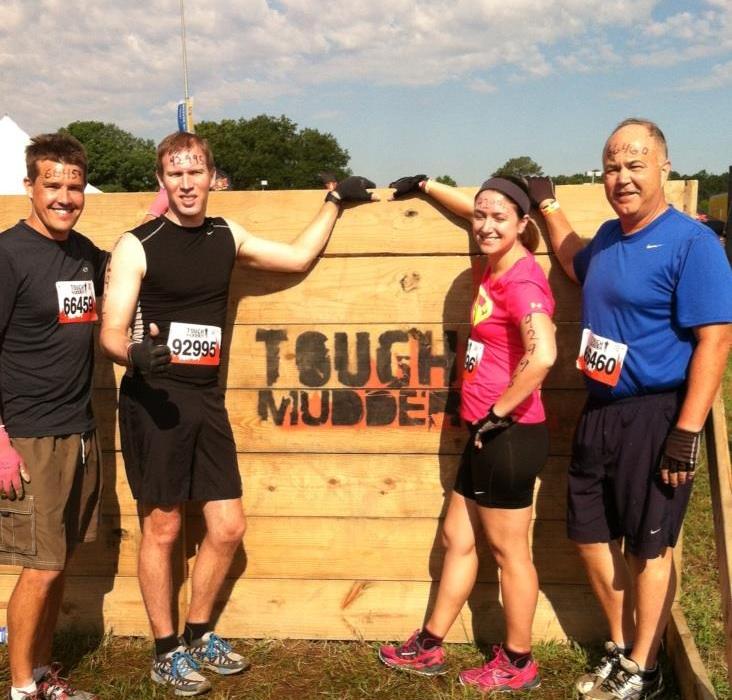
June 14, 2014 – Its time for the Virginia Tough Mudder at the Meadow Event Park in Doswell.  I had completed a Tough Mudder in West Virginia in October 2013, but this time I was not running solo.  In fact, Team 50/50 had four members this go round – myself, Leigh Anne, Mike Sprouse and Alan Posey.  Still no Richard Engel, but I think he was saving himself up for the Spartan Race in August.

In truth, this should not really be called a “Race Report,” whereas the Tough Mudder is not timed, and thus, is not truly a race.  It is, however, 10-12 miles with obstacles of varying difficulty.  Some are quite simple – crawl through mud.  Others can be a bit challenging, especially if you are lacking upper body strength – walls.  Some are designed to prey on your fears – heights and confined spaces.  Some are just evil – electrical shocks.  I was excited to be able to experience the full gamut of obstacles with others this time, and as they say, misery loves company.

Since the Tough Mudder was in Doswell, Leigh Anne and I stayed at my parents’ house in King William the night before.  They had volunteered for Sherpa duty while we tackled the course, which consisted mostly of wrangling Jackson and Jillian.  I use the term volunteer loosely, in that, it was more of a passive acquiescence to my request.   Mike and Alan were simply going to meet us at the Tough Mudder, apparently not wanted to bunk with us.

PreRace

The day of the Tough Mudder was warm, but not too hot.  I think the high was around 85, and it could have been much worse in mid-June.  Once we met up with Mike and Alan in the parking lot, we headed inside the Event Park and hit up the bag drop.  As always, there was the obligatory bathroom break, and then the four of us headed for the starting corral.

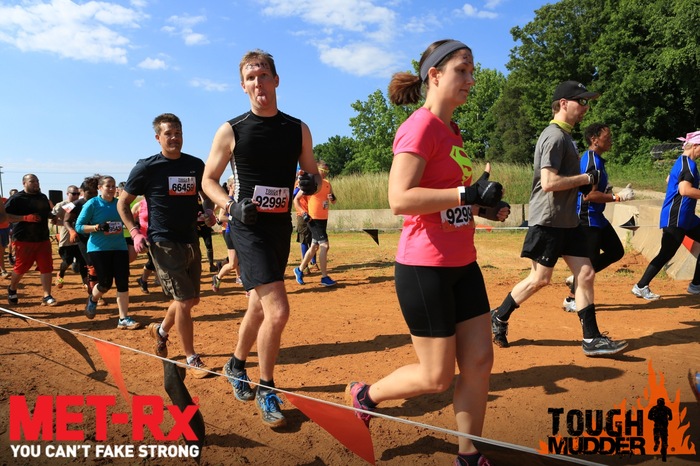
Like the Spartan Race, the Tough Mudder has a wave start, and each “Mudder” is given a starting time.  Unlike the Spartan Race, however, you can start with any wave, and the starting times are more like guidelines.  We hit the starting corral around 10:15 a.m., and they trick you into thinking that you are about to start once you climb a wall into the corral.  In actuality, there is a lecture on course rules, about helping fellow Mudders and then the National Anthem.  At approximately 10:30 a.m. our gun went off, and we were off.

Race

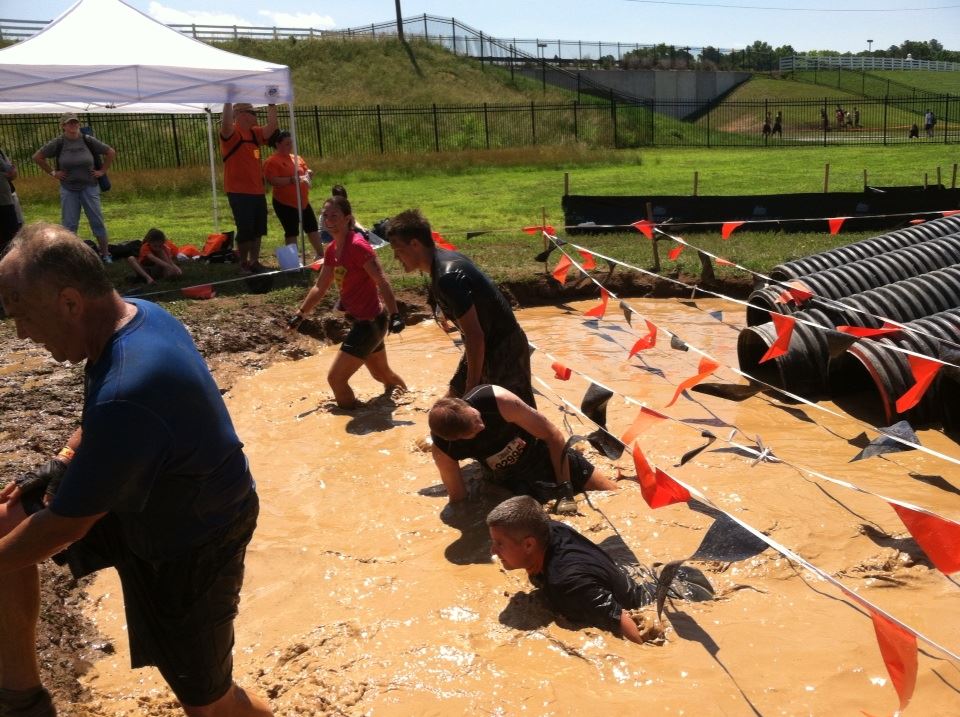
The beginning of the race consisted of a couple of miles of trail running, with a few minor obstacles mixed in.  The Tough Mudder folks like to get you wet and muddy early, and there were several ditches of muddy water.  Those typically don’t present much of a challenge, but it can be a bit difficult to find your footing, and you can’t really tell how deep some on the ditches are.  In fact, Leigh Anne took a wrong step and temporarily disappeared beneath the water.  She popped up quickly, with nothing wounded but her pride.

mudder 4

We soon came to the Boa Constrictor obstacle, which is a series of black piping that you have to crawl through, finishing up in more muddy water.  The Boa Constrictor is more of a mental challenge for people who are claustrophobic, but the portion where you are climbing uphill is tough.  The insides of the plastic tubes were wet and muddy, and it was hard to get good leverage to move forwards, especially since you are constricted in the tube.

10389518_10202694260051422_2557813628448521841_nOne of the most common types of obstacles the Tough Mudder folks use are walls of varying heights to scale.  Some are 6-8 feet tall, and can be tackled on your own.  Others are higher, and require the assistance of other Mudders to get over.  This particular course seemed to have its fair share of climbing walls, much to Leigh Anne’s chagrin.  By the end of the day she was thoroughly sick of climbing walls.  To make matters worse, Mike somehow managed to break a toe climbing over a wall near the mid-point of the course.  He continued on through the pain, however, and was still able to finish with a little help from his friends.
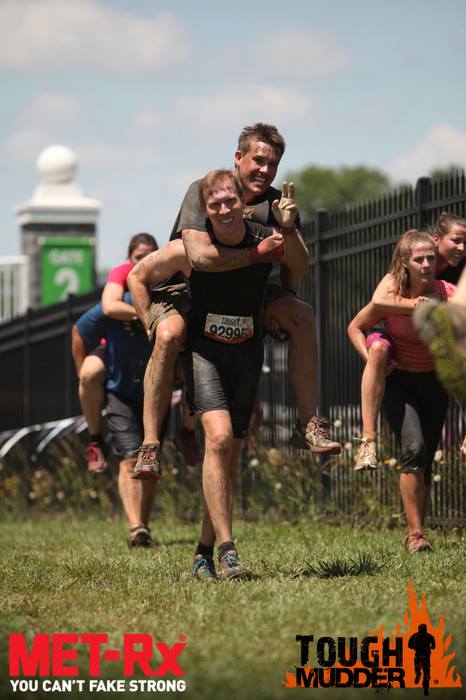
piggyback

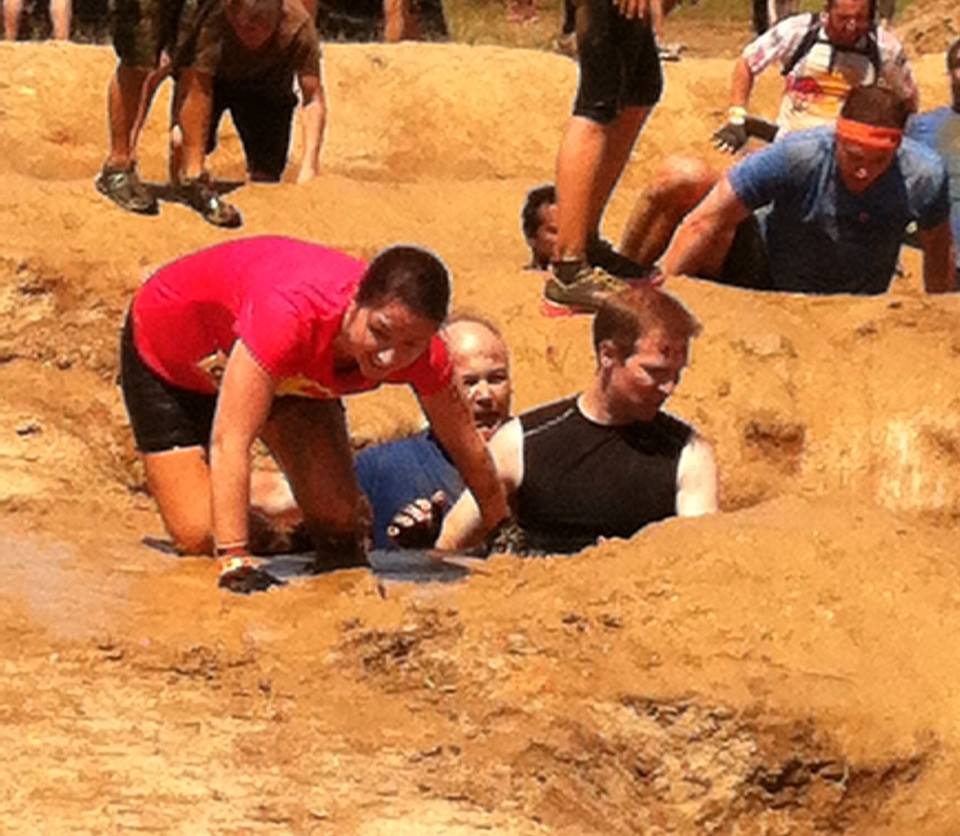
One of Tough Mudder’s signature obstacles is the Mud Mile, which consists of several mud filled ditches that are difficult to traverse.  The trenches are deep, and have muddy water that is about waist high.  If you aren’t careful, the mud at the bottom of the trench will suck off your shoe, and it can be challenging to get a grip on the top of the berm to pull yourself over.

603606_10202682798924901_5321734749018718161_n

Even though it was not a super hot day, it was warm enough, and we were ready for the Arctic Enema once we arrived at it near the halfway point.  This is essentially a dumpster filled with icy water, and you have to completely submerge beneath the water in order to get to the far side since there is a wooden wall in the middle.  They only let 2-3 people go in at once, whereas the icy water can paralyze you, and they don’t want anyone drowning in a dumpster of ice for obvious reasons.  Leigh Anne, Mike and I all jumped in at the same time, and Mike and I came out on the other side of the wall together.  We struggled to catch our breaths and wade to the far side, but once we got there, we realized that Leigh Anne had not come up out of the water.  I turned around and started to go back to see if she was at the bottom of the dumpster, but then she finally popped up out of the ice.  She had apparently tried to come up too soon on her first attempt, and was still on the other side of the wooden wall.  She then had to resubmerge and go under the wall.

10269605_10202682779404413_2665100412643572794_n

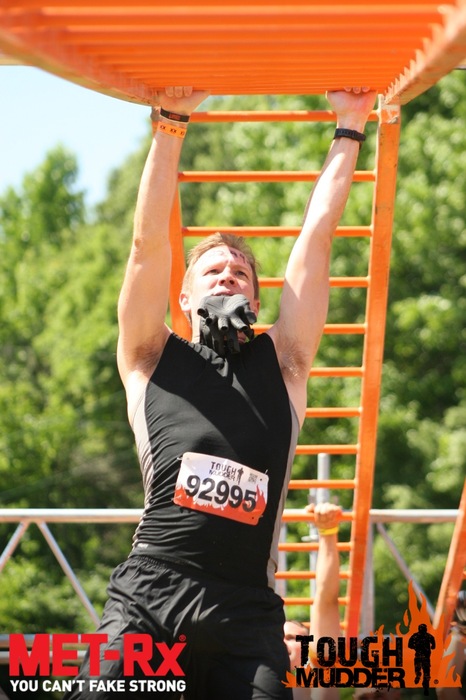
Once again, I felt energized by the shock to my system after climbing out of the dumpster, and eagerly took on the Killa Gorilla – which is simply running up and down a hillside multiple times.  Next up was the Monkey Bars, which were in the shape of a V.  Thus, you climbed up at an angle and then back down.  The bars were wet and slippery, but there was a pool of water beneath them.  There was a slight backup since someone ahead of us had slipped at the very end of the bars and knocked his head on a metal support rail.  We waited while he was taken off on a gurney.

Leigh Anne went first, and has never been a fan of monkey bars.  She fell into the water on the third or fourth bar, and swam to the other side.  Before she could do so, however, she was almost crushed by the guy behind her, who didn’t wait for her to get out of his way before starting his short-lived climb.  Alan, Mike and I made it across without incident, and on we went.

mudder 3

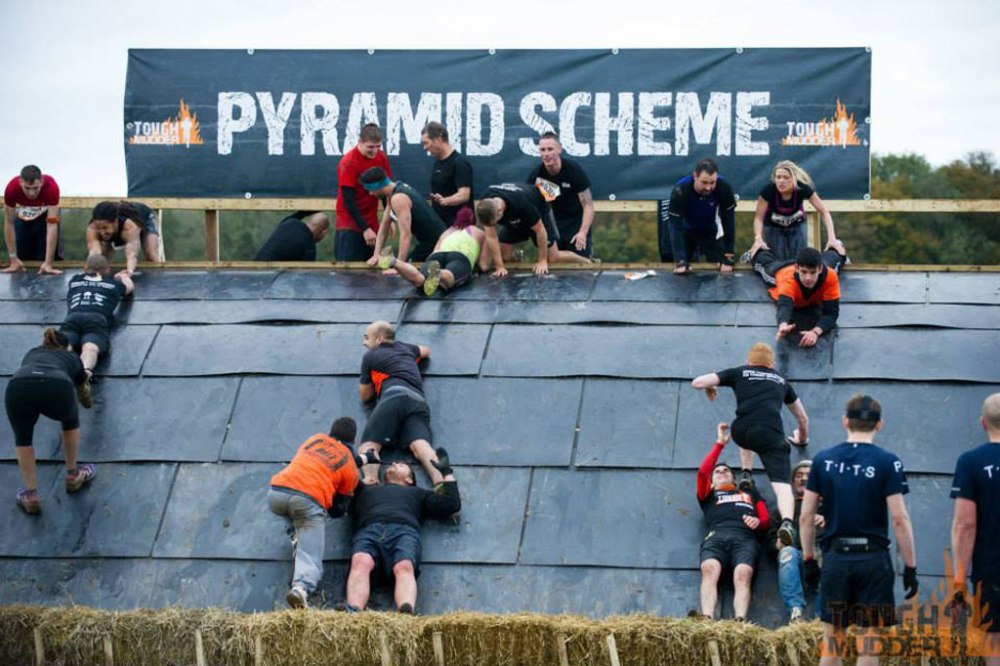
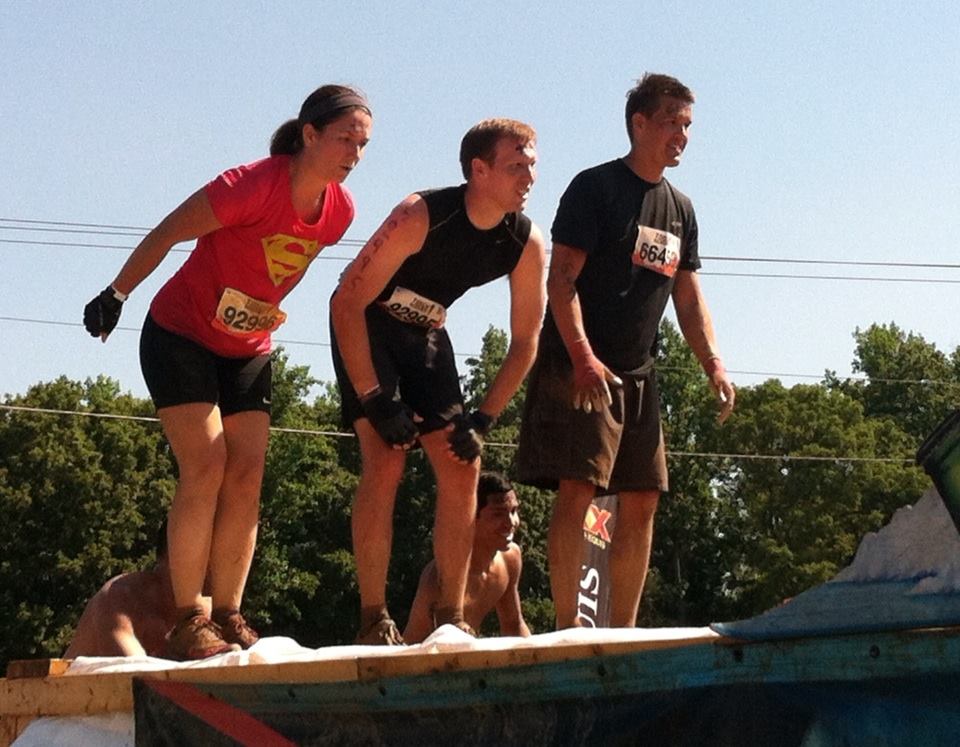
The most interesting obstacle of the day by far was the Pyramid Scheme, which was an inclined wall about 15 feet tall or so.  In order to get up the wall, you were forced to make a human chain, starting with someone standing on another person’s shoulders.  A Mudder already of the top would then have to lean down and pull you up.  After arriving at the top, it was expected for you to assist other people up, as others had assisted you.

Getting to the top took some doing, and then I turned around, hooked my feet to the top and laid face down with my arms out to pull people up.  All modesty was put aside while traversing the pyramid scheme due to its high level of difficulty, and I think I got to second base a few times as I was climbed over by girls in tank tops.  Leigh Anne got even farther, and “accidentally” grabbed another Mudder in the crotch as she pulled him over the wall.  There was a lot of blushing and apologizing, but he didn’t seem to mind at all.   In fact, I think he wanted to climb up again.

pyramid

Near the 10 mile point, Alan began having bad calf cramps, which forced him to a slow jog.  He and Leigh Anne bypassed the last set of 10-12 foot climbing walls and then we got ready to finish up with the Electroshock Therapy obstacle.  Having completed that obstacle in 2013, I was really not looking forward to getting shocked again, but I was happy that my misery would have some company.

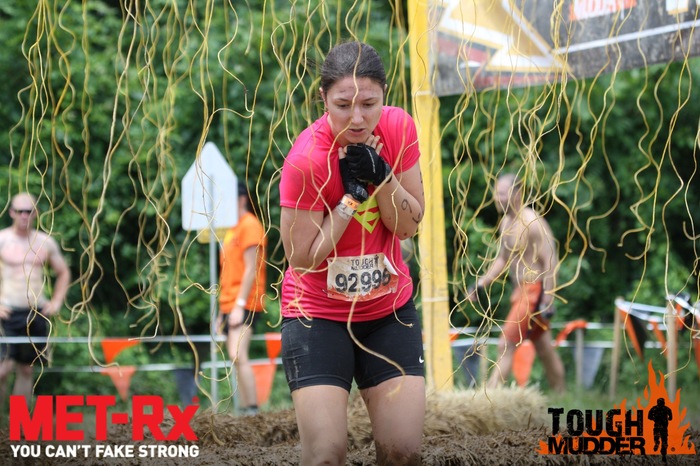
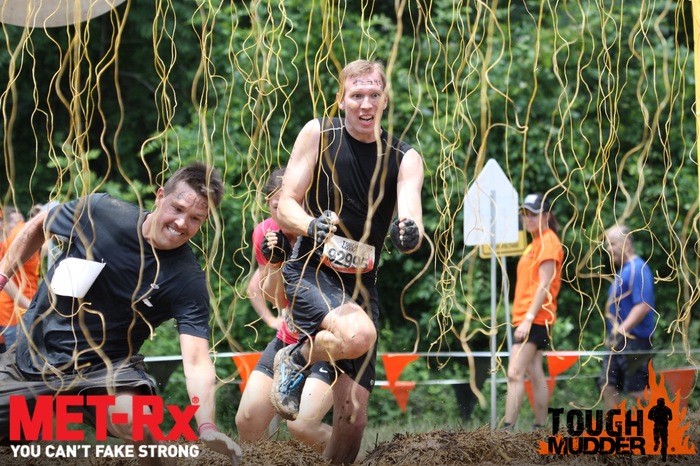
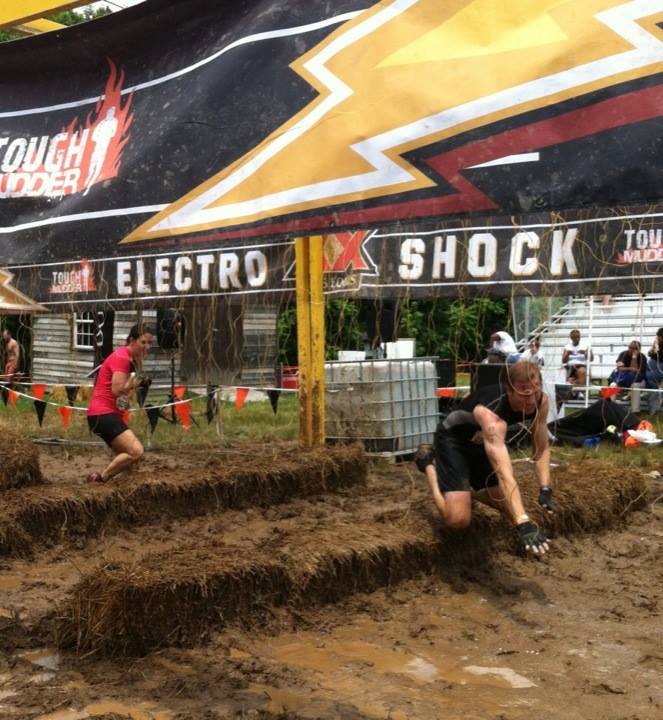
As we rounded the corner to the electrical wires, there was a backup of Mudders watching other people get shocked and waiting for their courage to build up before proceeding themselves.  Sometimes thinking about what is coming next is counterproductive, so we left the line behind and ran full speed into the jungle of hanging electrical wires.  I made it 3/4 of the way through and then got hit by multiple wires at once.  Just like in 2013, the jolt knocked me off my feet and into the mud I went.  Since I was so close to the end, I simply crawled out to avoid getting shocked in the face when trying to stand back up.

mudder 5

mudder

Mike and I getting shocked while Alan (in the blue shirt) looks on.


984097_10202682959568917_5351625890827754649_n

Down I go…

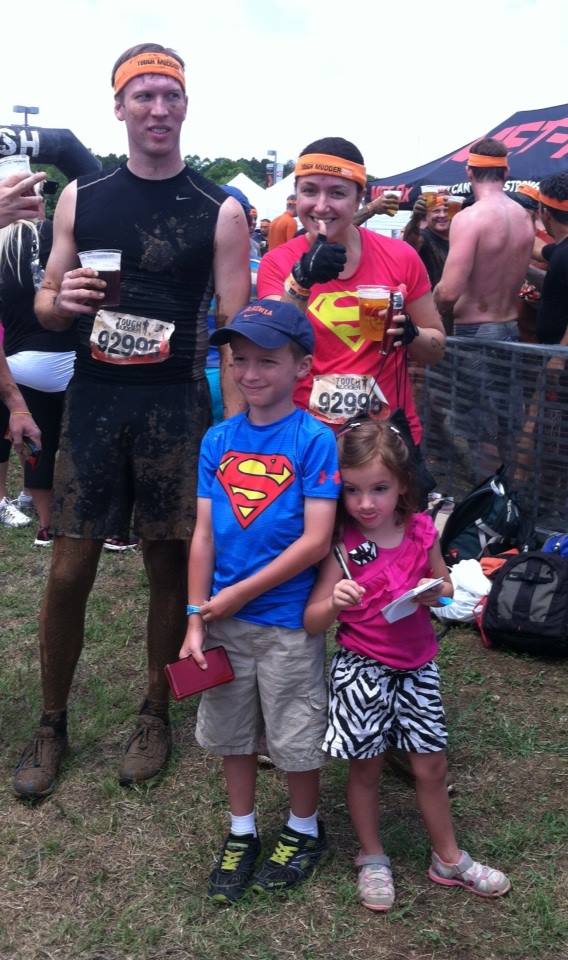
After pulling myself out of the mud, it was just a short jog to the finish line, where my parents and the kids were waiting.  I could tell that it had been a long day for them, especially my dad, who apparently had Jillian on his shoulders most of the time.  We all grabbed our finisher’s beers and orange headbands, and then hit the communal showers to try to clean off before the ride home.  Mike limped back to his car, and confirmed a few days later that his toe was definitely broken.  All in all, he managed to complete roughly half of the 10-12 miles with a broken toe, and Alan fought off debilitating muscle cramps at the end.  Leigh Anne and I made it through relatively unscathed, save for her trauma of pulling a stranger over the Pyramid Scheme via his crotch.


Overall, I felt as though the 2013 Tough Mudder in West Virginia was a much better venue, and it definitely had more varied obstacles.  The 2014 Virginia version had too many climbing walls, which really got repetitive, and the scenery was not nearly as nice.  Still, the process itself was much more enjoyable in 2014 since Team 50/50 had four members instead of just one.

Upon completion, however, I really was not motivated to sign up for another Tough Mudder.  They really are not races since they untimed, and the triathlon bug had already bitten.  The Tough Mudder was enjoyable in its own right, but I still preferred the challenge of racing against myself and others to see how far and hard I could push myself.  Thankfully, I would have several such challenges in the upcoming months, starting with my first real (non-reverse) triathlon in a few weeks.

finish


Playful Beginnings

2014 Chasing Chicken (Reverse) Triathlon Race Report

1:18:02

 4/11 AG     45/190 Overall

April 6, 2014 – I am ready to take on my first triathlon…I think.  Due to the time of year, it is a reverse triathlon.  Why?  Well, you don’t really want to swim and then get on a bike when it is 50 degrees outside if you can avoid it.  Riding a bike in 50 degree weather can get pretty cold.  More so when you are soaking wet.  Thus, the Chasing Chicken Triathlon was a run-bike-swim format in order to avoid hypothermia in most of its participants.

After my relatively poor showing in the Monument Avenue 10k because of ongoing IT Band Syndrome in my left leg, I had returned to Dr. Young at Ortho Va.  Physical therapy, stretching, ice, home exercises, snake oil and Voodoo magic had failed to markedly improve my ITBS, but thankfully, Dr. Young was ready, willing and able to stick a needle in my knee.  It sounds much worse than it really was, but he did indicate that the cortisone shot would be fairly painful.  I prepared for the worst and avoiding making eye contact with the needle, but it really was not all that bad.  Dr. Young informed me that the shot might work for 7 weeks or 7 years, but either way I was ready to get rid of my nagging knee pain.

Once my knee was taken care of, I had one other major issue to deal with – I swim like a stone.  Sure, I was on the Old Church Swim team when I was 5 or 6 years old, but I never really learned how to swim freestyle.  Granted, the Chasing Chicken Triathlon only required a 300 meter pool swim, but I had never been able to swim more than about 25 meters without gasping for air.  I really needed a crash course on swimming.

Thankfully, the triathlon included a free swimming assessment on a Saturday a couple of weeks before the event.  I was one of about 10 people to attend, and they started with a 300 meter time trial so that we could see where we stood.  At that point, I was wearing baggy swim trunks, but I had purchased a decent pair of Aquasphere goggles.  After struggling with freestyle for the first 50-75 meters, I switched to breaststroke for the remainder of the time trial.  My total time was right at eight minutes, which equates to 2:40/100 meters.  Quite frankly, that was awful.  Due to my swimming ignorance at the time, I didn’t know just how awful it was, so I was less embarrassed than I probably should have been.

Over the next two weeks, I watched swimming videos on YouTube and had one more training session (alone) at the Collegiate Aquatic Center.  I felt like I knew freestyle swimming theory a little better, but I had yet to really put it into practice.  I figured, however, that I could wing it with a 300 meter pool swim, and you can’t exactly drown in a pool with dozens of people watching, can you?

As for my attire, I had invested in a $100 tri-suit so that I would not need to have a wardrobe change in T1 and T2.  After years of avoiding and mocking Spandex, it was a bit odd to squeeze myself into the suit.  I had yet to invest in clipless pedals and cycling shoes for the bike, so I would be biking in my running shoes.  Not the best for pedaling efficiency, but at least I wouldn’t have to change shoes in T1.

Pre-Race

The morning of the race was chilly, but tolerable.  I had attended the pre-race briefing the prior afternoon, and I had done my best to memorize the course and the transition layout.  My wife, kids and mom planned on spectating, and they dropped me off early so that I could check in and set up my transition area.  They went to have breakfast while I tried to stay warm by running around.  After over-analyzing my transition setup, and after many trips to the Portapotties (thanks to a nervous bladder), it was finally time to race.

Run – 23:35 (7:37 min/mile) 

Again, this was a reverse triathlon due to the cold weather, so the run was first.  The course was fairly flat, but there were a few moderate inclines to deal with.  My run strategy was actually pretty simple – run 3.1 miles as fast as possible.  I figured that there was no real reason to conserve energy, and that I would be able to recover a bit on the bike.  In hindsight, I think that my strategy was sound, because conserving energy on the run really would not have led to significantly faster bike or swim splits.  Plus, in a sprint distance triathlon, you are really going as hard as possible the entire time.

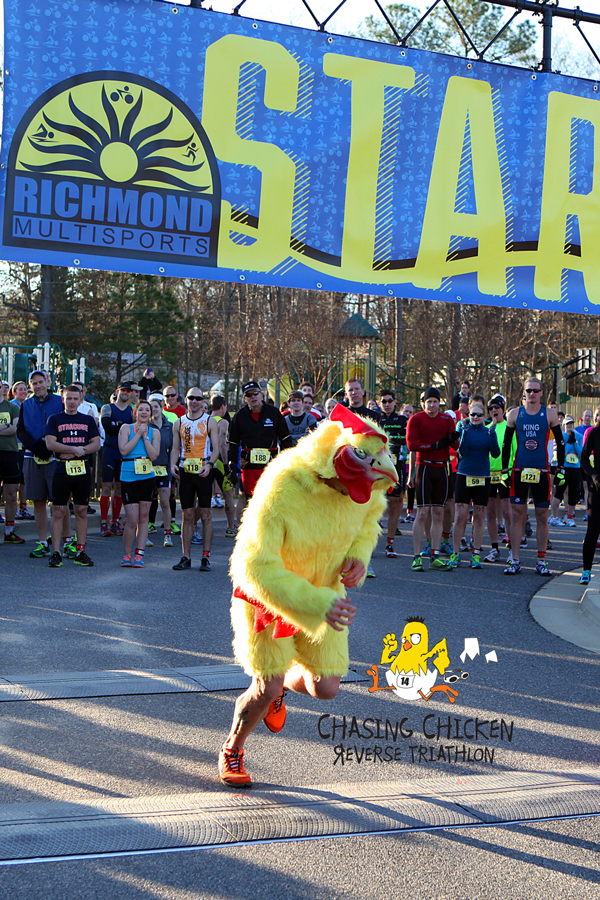
The run began in four waves, and my age group was in the first wave to take off.  Well, the first off the line was the guy dressed in the chicken suit that everyone was trying to catch – hence the name, Chasing Chicken Triathlon.  I believe that he got a five minute head start…and…I never saw him again.  I guess that shows my level of triathlon fitness at the time, in that, I couldn’t even catch up to a guy in a giant chicken costume.

chicken

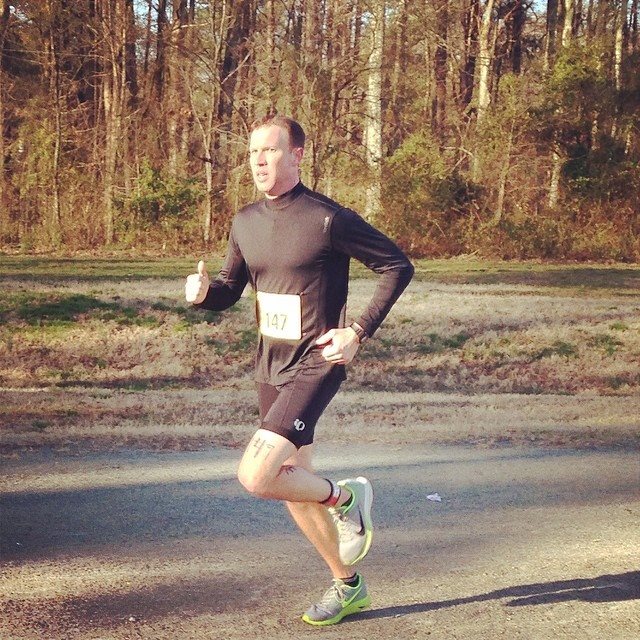
Anyways, my wave took off, which included the three professional men, and the professionals were out of sight within the first few minutes.  I was really running by feel thanks to no GPS, and my main goal was 24:00 or less.  I felt like I paced myself well, but I was starting to struggle near the end.  Thankfully, when I got back near the Tuckahoe YMCA all the spectators were there cheering, so I was able to finish strong.  I came in at 23:35, which was a somewhat respectable 7:37 per mile average.  Even better, zero knee pain!

chicken run.jpg

T1: 1:40

My bike was pretty much located at the farthest point of the transition area from the run entry, and it took me awhile just to get to it.  I saved some time since I didn’t need to change shoes, and I threw on my helmet and glasses and began pushing my bike to the bike out area.  Once I neared the bike mounting area, my wife started yelling at me to make sure that I crossed the timing mat before I got on my bike.  I heeded her advice, but was not really sure why she was so adamant about it at that time.  I would later learn that two of the three professionals had mounted their bikes prior to the timing mat, and that both of them ended up going over their handlebars in front of the crowd as they crossed it.  If you were wondering, the third pro went to mount his bike, but had a flat tire and had to borrow a spare tube from another racer.  Not the best day for the pros it would seem.

 Bike – 43:09   (18.1 mph)

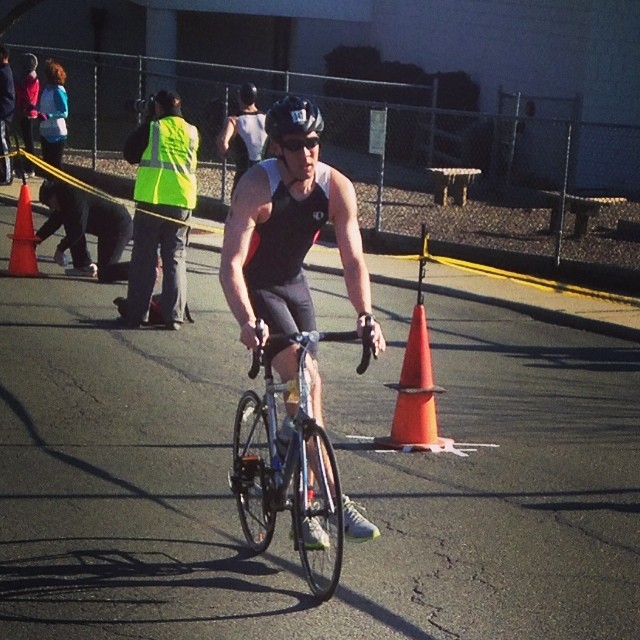
The first few miles on the bike were cold!  I was thankful to be wearing long sleeves over my tri-suit, but my hands were exposed and were quite chilly.  I began to warm up a few miles into the ride, and the first half of the bike course was reasonably flat.  USAT sanctioned races prohibit drafting on the bike, so I made sure to keep the required distance between other riders and myself in order to avoid a drafting penalty.  One guy and I ended up leapfrogging each other a couple of times, but I finally passed him for good around mile six.

I did have a dozen rides or so under my belt prior to the race, but I was still trying to figure out how to pace myself on the bike.  It takes a while to learn how hard you can sustain an effort for any given amount of miles, but I think that I paced myself pretty well for all twelve miles.  Once I made a right turn onto Patterson Avenue the course got pretty hilly.  It was about that time that the really fit guys from the second wave began to pass me.  I remember being tucked into the drops on my road bike going downhill as fast as I could, only to have some guy on a tri bike blow past me like I was sitting still.  I didn’t have aerobars on my road bike at the time, and the guys in the aero position on their tri bikes had an advantage of several miles per hour.

The last few miles of the bike were constantly up and down hills, with several “single digit” hills mixed it.  I didn’t know that Patterson Avenue was so hilly, but I was forced to switch into my small chain ring several times.  When I was about a quarter mile from the entrance to the YMCA, my front tire made a weird noise.  I presumed that I hit a rock since there was loose gravel near the shoulder of the road, and I was waiting for my tire to go flat.  Thankfully it stayed inflated, and I took the right turn into the YMCA and biked up the hill to the transition area.

chicken bike

T2: 2:19

My assigned transition spot once again seemed to be the point farthest from the bike in and swim out area, and I certainly did not have a lightning fast transition.  I parked the bike, took off my long sleeved shirt and shoes, and and grabbed my goggles.  It was then a run of approximately 100 yards or so back down the hill and inside the YMCA to the pool.

 Swim – 7:21  (2:27/100m)

I strapped my goggles on as I crossed the timing mat inside the YMCA and hopped into the pool (no diving allowed).  The 300 meter swim consisted of an up and back of all six lanes in a “snake” format.  Once you completed an up and back, you ducked under the lane line into the lane to your left.  Rinse and repeat until you made it all the way to the left side of the pool.

I was determined not to swim any breaststroke, and I made it the first 150 meters doing freestyle.  When I reached the halfway point, I actually caught up to two guys ahead of me – a minor miracle for sure.  The standard pool swim protocol is to tap the person’s leg ahead of you if you want to pass, which I did.  I kept waiting for him to let me pass at a wall, but he just kept swimming.  I would have simply gone around him, but there was someone immediately ahead of him, and people are swimming both ways in each lane.  Thus, I would have had to go into oncoming traffic and pass two guys at once in  order to go around.  Unfortunately, there was never a big enough break in the oncoming traffic for me to do so, so I ended up swimming breaststroke for the second 150 meters simply because I got held up.

After twelve lengths of the pool I had finally completed 300 meters (39 seconds faster than my time trial – even though I got held up), along with my first triathlon.  It may not have been a “real” triathlon since it was reversed, but I wasn’t going to quibble over such details at the time.  I hopped out of the pool, grabbed my orange finisher’s towel and dove into the free bagels and Oreos.  Breakfast of champions to be sure.

Post Race

After milling around a bit with my family and grabbing a few extra Oreos for the kids, I went to retrieve my bike from the transition area.  I was shocked to find my front tire completely flat, and I must have punctured the tube when I struck that rock near the end of the bike course.  I was fortunate, in that it was a small, slow-leaking puncture, which is a bit out of the ordinary.  When a bike tube gets a hole, it typically deflates rather quickly since it is under so much pressure (90-110 psi).  I would learn that fact the hard way in my first race of the 2015 season, but we’ll get to that fiasco soon enough.

I chose not to wait around for the awards ceremony, presuming (correctly) that I was not a podium candidate.  Still, I did finish 4/11 in my age group, so I was not as far off of the podium as I thought, and I was encouraged by my placing.  I was tired but not exhausted, and I was done with the race by 10 a.m.  Sprint triathlons are nice, in that they don’t take up your entire day.  They can, however, be quite painful in the moment if you are redlining yourself for the 60 to 90 minutes that it normally takes to complete them.

So, that was it for triathlon #1, and I had definitely caught the triathlon bug.  Triathlon #2 would be the I Love the Tavern Triathlon in June 2014, which featured a river swim and a longer bike leg.  Unfortunately, I would learn in that race that running off the bike is not at all like running on fresh legs.  More importantly, my lack of “brick” sessions in training would result in a dramatically slower run split at the Tavern.

“The playing time is won, but the difficulty’s coming here.”

2014 Monument Avenue 10k Race Report

 48:58 (7:52/mile)

230/1323 (AG)     2017/27,200 (Overall)

March 29, 2014 – Its time for the Monument Avenue 10k, but I certainly do not feel ready.  In fact, I am actually racing against the advice of my orthopedist, my friends and my family.  As you may recall, I injured my left knee during the Xterra Monster Dash 15k on February 22nd, and I am not yet recovered.  In fact, I have only run twice since the 15k, which was more than a month ago, and I was in pain both times.  Not debilitating pain, but pain nonetheless.

Thankfully, it turns out that my ailment is Iliotibial Band Syndrome (ITBS) and not a reoccurrence of my leg tumor from high school.  ITBS creates pain on the outer side of the knee, and is common in runners.  The Iliotibial band runs from the hip to just below the knee, and when it is tight, it rubs the outside of the knee and becomes inflamed.  Repeated motion causes and worsens the pain, which is why my pain started slowly during the 15k and gradually got worse.  During my only two training runs between the 15k and the 10k I started out pain free, but the pain began to creep in by mile two or so, gradually getting worse.

Itbs

On the upside, ITBS is not the worst injury to have – all things considered.  On the downside, rest, stretching and ice are the only ways to really fix it, and ITBS can be a nagging injury that lingers for a long time.  After the pain failed to go away after a few weeks, I managed to squeeze in a visit with Dr. Young at Ortho Va.  It certainly helps to have a law partner who has Dr. Young on speed dial, otherwise I might still be waiting for an appointment.  Anyways, Dr. Young confirmed that ITBS was my issue, and that physical therapy was in order.

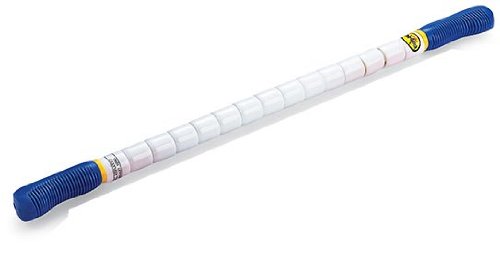
After three early morning visits to the physical therapist, I decided that I could do the same exercises at home.  Not only would that save me from missing time at work, it would also save me the $35.00 copays.  I also purchased a foam roller from Amazon, which helps stretch the IT Band.  Foam rolling is painful at first, but once you get used to the process, it actually feels nice.

It was also about this time that I was in the market for new running shoes.  I had heard that it was a good idea to get fitted for shoes at a running shop, but I had never put much stock into that idea.  On my wife’s advice, I stopped into the Lucky Foot store off of Hull Street Road, and it turns out that her advice was sound.  I explained my ITBS issue to the salesperson, and he had me run across the store and back.  In that little time, he diagnosed me as an over-pronator, which was probably the cause of my ITBS.  To make things worse, my old Nike shoes had a “design defect” which actually increased pronation due to a cut-out area of the sole.  Thus, I left the store with a new pair of running shoes with “dynamic support” to reduce over-pronation.

Ok, so enough back story on ITBS, on to the Monument Avenue 10k.

Pre-Race

As always, the packet pickup for the 10k was at the Arthur Ashe Center, and I got my race packet on Friday night.  They make you wind through a maze of vendors to get your bib and bag of goodies, and I got a bit sidetracked looking at some of the ITBS products.  At one booth, a salesman offered to massage my IT Band with “The Stick.”  My general rule is to avoid free massages from men and their sticks, but I decided to take a leap of faith since he promised ITBS relief.  There were also hundreds of people around, so I figured that it was safe enough if “The Stick” was merely a euphemism for something more sinister than an ITBS product.  While “The Stick” massage felt ok, I really did not feel like the product was worth nearly $50, so I thanked him for his time and passed.

the stick


A litter farther into the expo I found a leg wrap that is supposed to prevent IT Band pain during exercise, so I did splurge on that item, and it was far cheaper.  The wrap was not a cure, but essentially holds the IT Band in a spot that prevents it from rubbing and becoming more inflamed.  After finally winding my way through the vendor booths, it was time to make my exit.

When I woke up on race morning, it was relatively warm, but it was dumping rain.  I watched the weather.com radar over coffee and oatmeal, and thankfully, it looked like there might be a small break in the rain at race time.  I headed downtown alone since the kids had soccer games later in the day, taking an old rain jacket with me to dispose of at the starting line.

Anyone who has ever participated in a running race has probably read or been told – “nothing new on race day.”  This is sound advice, which I seem to reject at every occasion.  On March 29, 2014 I was wearing my brand new “dynamic support” running shoes, and I also had the aforementioned IT Band wrap around my left leg.  The instructions said to make it tight, and I didn’t want it slipping off mid-race, so that sucker was on tight.  I found my way to my starting wave and waited to hit the starting line after stashing my rain jacket behind a trash can.

Race

I really did not have high expectations for the race since my training had been limited due to my injury.  That being said, I was still hoping that I might be able to replicate my time of 47:10 from 2007 (when I trained for four months for that one particular race).  To do so, I would need to average 7:35/mile, which was probably optimistic.  I had no GPS, so I would be relying solely on my Walmart Casio watch to monitor my pace with the stopwatch function.  The first few miles are always easy, but the minutes/mile math can get challenging late in races.

When I ran the Monument Avenue 10k in 2007, my goal was to average 7:59/mile or better, and I went out way too fast – clocking 7:15 for the first mile.  I suffered mightily during the second half of that race, and I was determined to pace myself better this time around and to try for a negative split.  Thus, when my wave took off, I made sure that I did not go out too hot, which is easy to do when you are full of adrenaline.

My first mile was somewhere around 7:40, which was in line with my negative split plan.  Unfortunately, once I got to mile two my left foot began going numb.  I was not sure if that was from the new shoes, the left leg wrap or both, but it started getting quite severe and I was worried about having to stop.  I decided to rip the wrap off of my left leg, and over the next mile or so, the feeling began to return to my left foot.  I had apparently put the wrap on too tight, because I didn’t have that problem on subsequent runs with the wrap.

By the time I hit the 5k point, I was 24:09 into my race, which equates to 7:46/mile.  I had a lot of work to do if I was going to make it home in 47:10, and as I did the math in my head, I realized that it was not going to be a possibility.  Even though I was pacing myself better this time around, I simply did not have the fitness to match my 2007 time thanks to my injury.  To make things worse, the pain started to creep into the outside of my left knee around mile four.  It never got as bad as it was during the 15k the month before, but it didn’t make the final few miles all that pleasant.  At least the rain had largely held off, whereas it was just a light drizzle.

The final two miles were mentally and physically challenging, and my pacing continued to go south as the pain in my knee increased.  I ultimately made it my goal to finish under 49 minutes, and I once again found myself struggling mightily in the home stretch.  I recall Highway to Hell playing on my Ipod, which seemed appropriate at the time, and I think I hit repeat at least once.  As I neared the finish line, I double checked my watch and saw that I really needed to finish strong in order to meet my revised goal of 49 minutes.

I really did not have much in the tank at that point, but I was able to quicken my pace for the last .2 miles.  Once I saw the finish chute, I realized that I might have a photo finish with my 49 minute time goal, and I was able to cross the timing mat in a sprint.  Final time – 48 minutes 58 seconds.  I made it by two seconds, but that was a consolation prize to be sure.

Post Race

After recovering in the finish chute, I headed over to the 10k backdrop for the obligatory finisher’s photo and then retrieved my rain jacket, which was exactly where I left it.  On queue, the bottom fell out of the clouds and the heavy rain started up again.  I suppose that was the silver lining to my day, which was largely forgettable otherwise.  From there, I hit up the McDonalds drive through for some much needed coffee and an egg McMuffin, and then headed to the Chester YMCA to watch the kids play soccer in the rain.  The next race on my calendar was going to be my first triathlon, and I was really hoping to be pain free by that point.  Little did I know, that a needle was in my near future.


Hobbled in the Park

2014 Xterra Monster Dash 15k Race Report

1:16:21 (8:11/mile)

13/21 AG   29/83 Overall

February 22, 2014 – It has been nearly 14 months since I made my resolution to get back in shape, and thankfully, I have been able to stick with it.  My longest timed run to date is a little under 11 miles, but my longest non-obstacle course race was the Monument Avenue 10k back in 2007.  Somehow I discovered the Xterra Monster Dash 15k in Pocahontas State Park, which was taking place only a few miles from my house.  I put out feelers on Facebook to see who wanted to run with me, and Pat McStay was my only taker.

Pat is a full time soccer coach, and thus, his job involves a lot of running.  In fact, he once ran a marathon in less than 4 hours without training.  He claims that it was painful, but I think he was just trying to make everyone else in the room feel less bad about themselves.  I really had no expectation of being able to keep up with Pat, but at least it would be nice to have someone else I knew running with me.

Before that race, I had heard that your body is capable of more than you think possible because your brain gets in the way and tries to convince you otherwise.  Thus, I believed that the key to exceeding your expectations was simply to find a way to push through the pain.  The Xterra Monster Dash would teach me, however, that there are other ways to bypass the voices in your head.  In short, ignorance is bliss.

Prerace

The day of the race was fairly warm for February, with the high in the 50’s, so it was nice running weather.  Still, it was fairly chilly before the race got started.  Pat and I had met at the entrance of Pocahontas State Park, and since the check in went so quickly, we had a fair amount of time to kill before the race started.  After downing 5 Hour Energy shots, we spent a lot of that time running around the parking lot to stay warm and to loosen up.

The race itself was to be held on the dirt/gravel trails in the park, and I naively figured that there would be mile markers.  I did not have a GPS, only a Casio watch with a timer function that I had picked up at Walmart with a $25 gift card that I won the prior July.  Unfortunately, we were informed just prior the race start that there were no mile markers.  Moreover, there were only two water stations, with the first being “near mile 1” and the second being “somewhere near the mid-point.”  In actuality, there were three, because you passed by the first water station on the way back in.

There were only 83 people signed up for the 15k race, but there was also a 5k race being held as well.  Both races would start together, but the 5k participants would veer off on another route in the second mile.  After gathering near one of the lakes, the runners for both races were off.

xterra trail

**I can be seen in the black shirt in the middle of the photo with Pat to my left in the blue and red ski cap**

Race

Given that Pat is younger and faster than me, we really did not plan to run together.  Our plan was simply to take off and see if our respective paces were similar enough to stay together for awhile.  Oddly, even though there were not that many runners, we somehow lost sight of each other in the first hundred yards or so.  Some of the trails had long straightaways, and I scanned ahead of me to try to find Pat’s red and blue ski cap, but it was nowhere to be seen.  That made me think that he might be behind me, but I didn’t see him back there either.  After awhile I stopped looking for Pat, and figured that we’d find each other at the finish.

Based upon my training runs, I expected to be able to hold a pace between 8:30 and 8:45 minutes per mile – depending upon how hilly the terrain was over the 9.3 miles of the race.  The first water station came quickly, but my trusty Casio only read 6:30.  Given that the fastest mile that I have ever run was 6:10 (in high school), I was fairly confident that I was “near mile 1” and not actually at mile 1.  At that point, I knew that I would not have a reliable way to pace myself, so I decided that I was going to have to run by feel alone.  Thus, I settled into a pace that I hoped I could hold for the entire 9.3 miles without bonking.

For most of the race the trails were fairly wide, and it was no problem when passing (or getting passed by) others.  Much different than the Spartan Race at Wintergreen.  The biggest issue was that it had rained a fair amount in the week leading up to the race, and there were some areas of standing water, along with some washed out gullies.  You had to be fairly attuned to where you were running, lest you step in one of the gullies and twist your ankle.  I also made sure that I jumped over the standing water to keep my feet dry to avoid blisters.

Unfortunately, after about 25 minutes of running the outside of my left knee began to hurt.  It came on gradually, and I initially thought that it might subside.  By the time I hit the water station near the race’s midpoint, the pain had gotten much worse.  The pain was tolerable enough to continue, but I had started worrying about doing more damage to whatever was ailing my knee.  Anyone who knows me is aware of the fact that I hate losing.  Quitting, however, is an order of magnitude worse that losing.  Therefore, since I was still able to hold my pace, even with the knee pain, I decided to push on.

By mile 7ish my knee pain had peaked and plateaued, and I was doing fairly well at keeping my mind on other things.  An IPod loaded with a running mix helped immensely, but fatigue and oxygen deprivation were also setting in and helping to distract me.  My mind was also worried that I might be overextending myself with my pace (whatever it was), and I thought that a bonk might be in my near future.  About that time, my thoughts began to focus upon seeing the first water station again, because then I knew that I would be within 7 minutes of the finish.

It was about that time that the race took us on a narrower trail, which ended up having a fairly steep climb.  The course had taken us on some rolling hills up to that point, but nothing that made me consider walking.  Sadly, I was forced to walk a bit on that climb in order to catch my breath and to try to stop the burning in my legs.  Upon reaching the top, there was a welcome downslope and soon thereafter came the third and final water station.

Knowing that I was within 1 mile of the finish line lifted my spirits and gave me a second wind.  I soon saw the lake where we began the mass start, but the finish line was next to a pavilion up the hill from the lake.  That hill was not as long as the hill that had recently slowed me to a walk, but it still was not a whole lot of fun.  Up the hill I went and darted across the finish line, only to see Pat standing there looking calm, cool and collected.  He had apparently finished 8 minutes and 21 seconds before me, and was already enjoying some of the post-race refreshments.

Post Race

When I stopped my watch upon crossing the timing mat I saw that I had finished in a little more than 1 hour and 16 minutes.  This equated to an 8:11/mile pace, which exceeded my optimistic pace of 8:30/mile by a whopping 19 seconds per mile.  I guess the upside to not having a GPS or mile markers is that you have to run by feel.  In doing so, you are dependent on what your body is telling you, not what your brain wants to tell you.  The Xterra Monster Dash would be the first, but not the last time that I would experience a performance that was unencumbered by the voices in my head.

As the endorphins and adrenaline of the race subsided, the pain on the outside of my left knee got worse, and even walking became a chore.  To my dismay, there was no ice at the finish line, so Pat and I parted ways so that I could head home and ice my knee on the couch.  I was able to reflect on the race during that time, and while I was elated at my time, I was concerned about my knee.  I was scheduled to pick up my new bike from Busher later that day, and I had triathlon plans looming on the horizon, with no time to be hobbled by a knee injury.

I remember hoping that it was a simple strain, and that it would heal within a matter of a week or so.  Still, in the back of my mind, I couldn’t help but think that the pain was in the same area of the same leg that plagued me during my junior year of high school.  Weeks of outer knee pain during soccer practice ultimately led to an MRI, which revealed a 9 centimeter tumor.  The fact that the tumor was benign is the only reason that I still have my left leg today.  Subsequent MRIs had confirmed that the tumor had not come back, but I am somewhat of a worrywart, and my last follow up MRI occurred when I was in college.  Thus, as I sat there icing my knee after the 15k trail race, I was hoping that it was a minor injury, but I was fearing something far worse.

MonsterDashRoadRunner


The Butterfly Effect

According to the Butterfly Effect, the flapping of a butterfly’s wings can ultimately cause a hurricane halfway around the world.  I don’t really know about that, but I think that the principle really boils down to this – one small change in a moment in time can lead to dramatic changes in the future.  Don’t believe me?  Well then perhaps you should rent the Ashton Kutcher movie of the same name and then call me to discuss.  Seriously though, a chance encounter on January 25, 2014 would end having the Butterfly Effect on my life.

My wife is a pharmacist, and she went to pharmacy school at MCV.  Several of her pharmacy school friends live in the Richmond area, and they try to get together every once in awhile to reminisce, and perhaps to get some use out of their mortars and pestles.  In January 2014, their meeting place was the home of Chris and Mindy Busher in Goochland.  I remember Mindy from when Leigh Anne was in school, and we had been to the Busher house once before.  It was the January 25, 2014 visit, however, that would be eventful.

That evening Chris (who simply goes by “Busher”) was drinking a foul-smelling green concoction that smelled like human waste.  I was obviously interested (and concerned) as to why he would voluntarily ingest such a foul substance, and his response of, “I’m training for an Ironman” took me by surprise.  He took down the giant vat of green liquid like a champ, and we ended up discussing his triathlon training in great detail for most of the evening.

I’m not really sure why I was so fascinated with Busher’s triathlon commentary, whereas I had never swam more than 50 meters of freestyle in my life without hanging onto the pool wall and gasping for air.  I was on the Old Church Swim Team when I was about 5-7 years old, but I never really learned to swim freestyle.  I could swim breast stroke and tread water for an hour or more if need be, but I couldn’t swim more than one length of the pool using freestyle without feeling like I was about to drown.

In addition, the second leg of a triathlon involves bike riding, and conspicuously absent from my life was a bike.  Well, to be honest, there was a $129.00 “comfort” bike from Dicks Sporting Goods hanging upside down in my garage  (just beneath the steer skull), which I had purchased for Leigh Anne back in 2006.  That bike probably only had 20 miles on it, but it was a woman’s bike, and certainly not designed for triathlon.  As luck would have it, however, Busher had a brand new road bike that was too big for him…if I wanted it.

trek

The bike in question was a 2011 Trek Alpha 2.1, which retailed for $1,320.  Apparently, some pour soul went to Agee’s Bicycles looking for a “beach cruiser” and walked out with a $1,300 road bike.  After riding it once and finding it unsuitable for beach cruising, it was sold to Busher for about $650, who also rode it once, but found it to be too big for him.  Thus, it was available to me for $650 if I wanted it.  In actuality, that last sentence should read, “Thus, it was available to me for $650 if my wife would allow me to purchase it.”

The night of January 25, 2014 ended no differently for me than pretty much every shopping experience I’ve ever had at a mall clothing store – me saying, “Let me think about it and maybe I’ll come back.”  My interest was peaked, but I needed to come up with a sales pitch for the wife.  Those sales pitches typically involve me explaining to Leigh Anne about how the initial outlay of money will actually save us money in the long term, and how the item can be my birthday/father’s day/Christmas presents all in one without her having to shop.  What a deal, right?  Quite frankly, I don’t recall the exact details of my bike/triathlon sales pitch, but it must have been a good one, because I eventually obtained permission to buy Busher’s bike.

Thus, on February 22, 2014 I returned to the Busher abode to buy my new bike.  I hobbled in, injured from my 15k trail race earlier that day in Pocahontas State Park, and watched as Busher attached the Trek to his trainer so that I could be “fitted” to the bike.  As it would ultimately turn out, I am a bit too big for the Trek, but I did not know that at the time.  Even if I had known, I couldn’t pass up a brand new bike for roughly 50% of the cost.  Eventually, the bike would come to be called “Blue,” and Blue would serve me well, even if he was a tad too small for me.

blue

After a brief bike maintenance 101 session from Busher, I barely managed to squeeze Blue into the back of my Mazda, which is not designed for transporting bikes (on the inside).  Then Blue and I were off to hit up trifind.com to sign up for my first triathlon.  I had no idea how I was going to learn to swim, and I really didn’t know if I would even enjoy riding a road bike.  Little did I know, however, that my experience in my first triathlon would set me on the path towards Ironman, and away from  obstacle course racing.

Again, all of that was thanks to a chance encounter with Busher in January 2014, and in hindsight, perhaps there was more of a Busher Effect than a Butterfly Effect…


busher

Footnote: The picture above shows Busher and I just prior to the start of the I Love the Tavern Triathlon in June 2014 at Robious Landing.  I look melancholy because Busher was about to beat me by four and a half minutes.