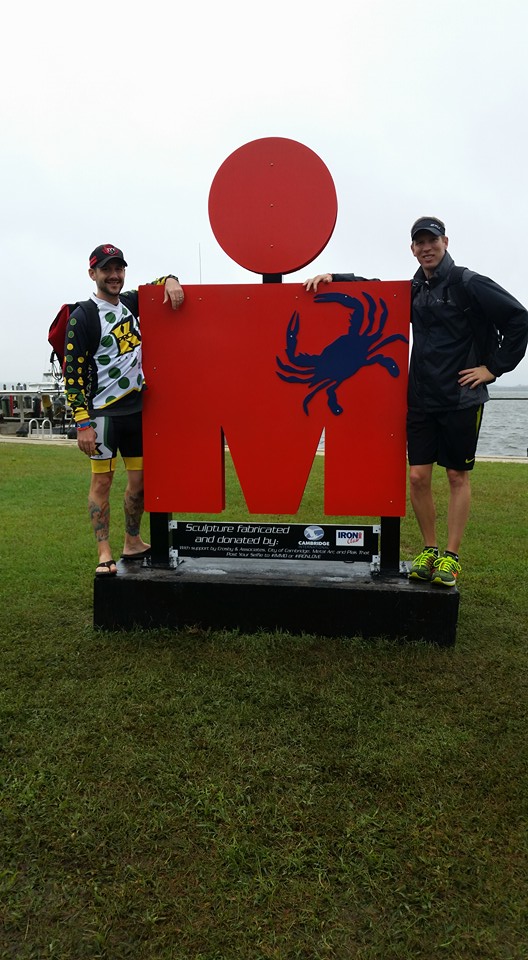
“Suck the marrow, drain my soul…”

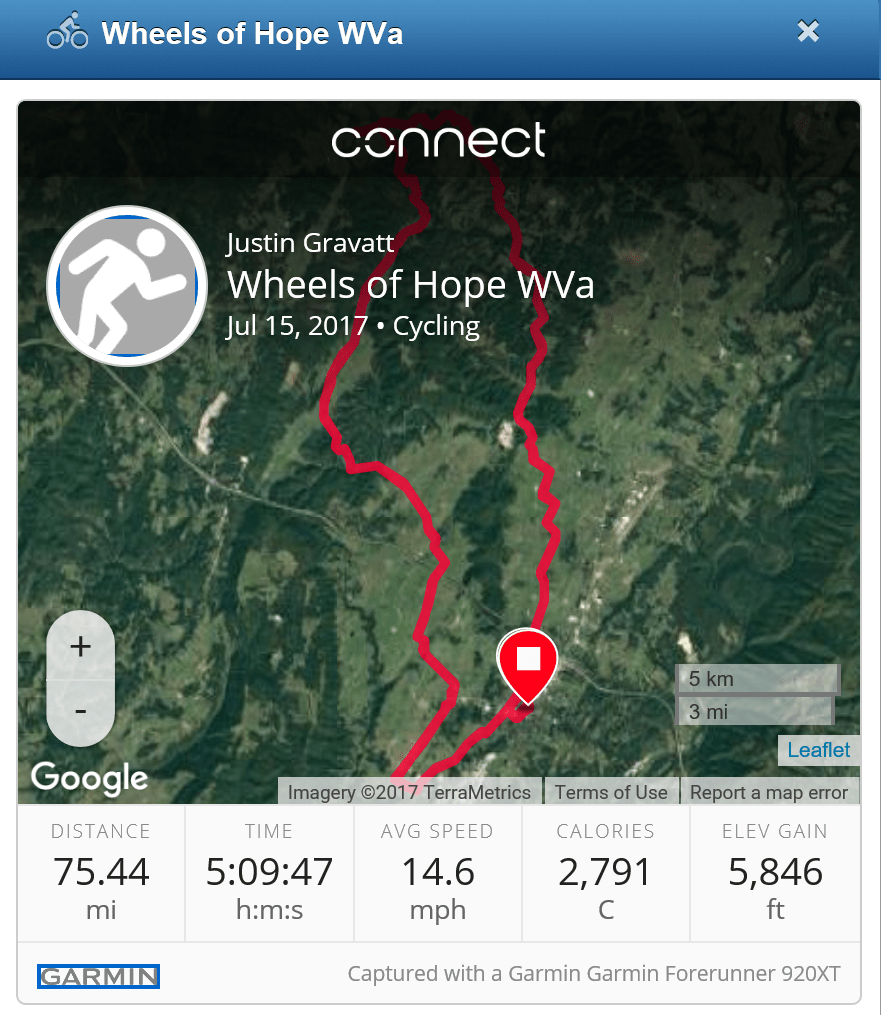
After returning from our vacation in Seattle on July 4th, the big build in my training for Ironman Chattanooga began in earnest.  There was no easing back into the training regimen, and I had a 2.5 hour bike on Saturday followed by a 13+ mile run on Sunday.  The real fun started the next weekend, however, when Busher and I drove to Lewisburg, West Virginia for an organized bike ride – Wheels of Hope.

There were several routes to choose from – a 19 mile red route, a 36 mile green route or combinations thereof.  The big draw for us was the elevation gain, which was about 3000 feet on the green loop.  The route wasn’t really suited for a tri bike with 11-25 gearing, but Karen wanted me to ride my Cervelo instead of my old road bike to make it more difficult.  The moment I inquired about the wisdom of the tri bike selection, she responded with, “I’ve ridden bigger hills that than on harder gearing!”  Ha ha, she knows how to shame me and get me going.

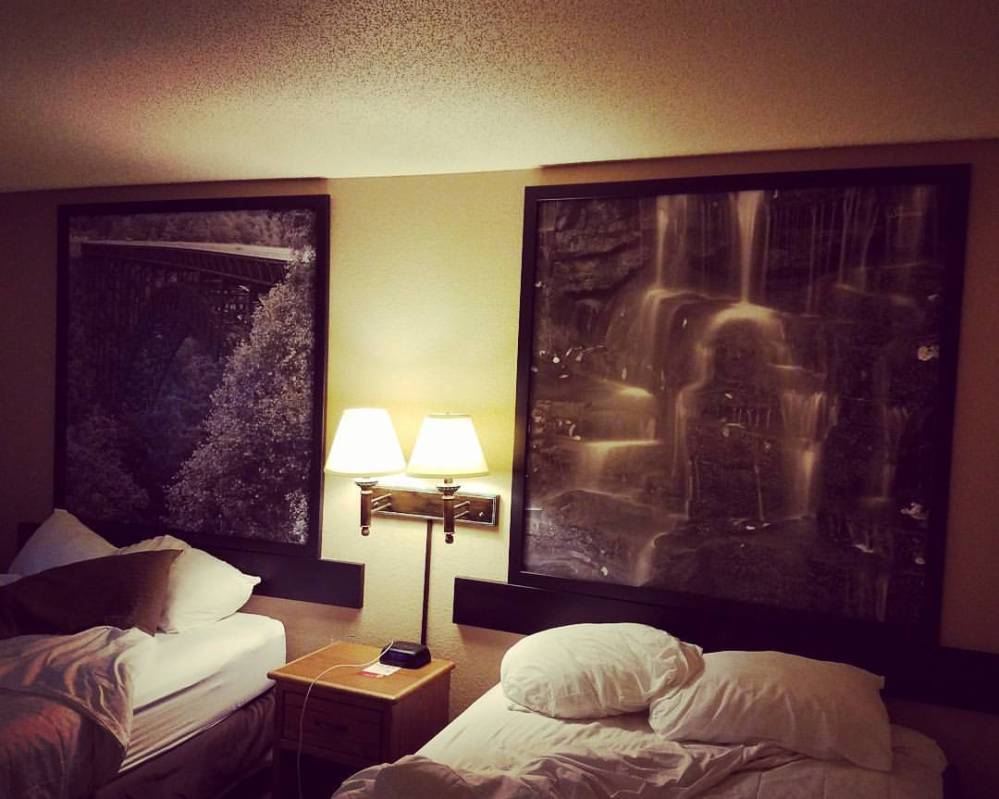
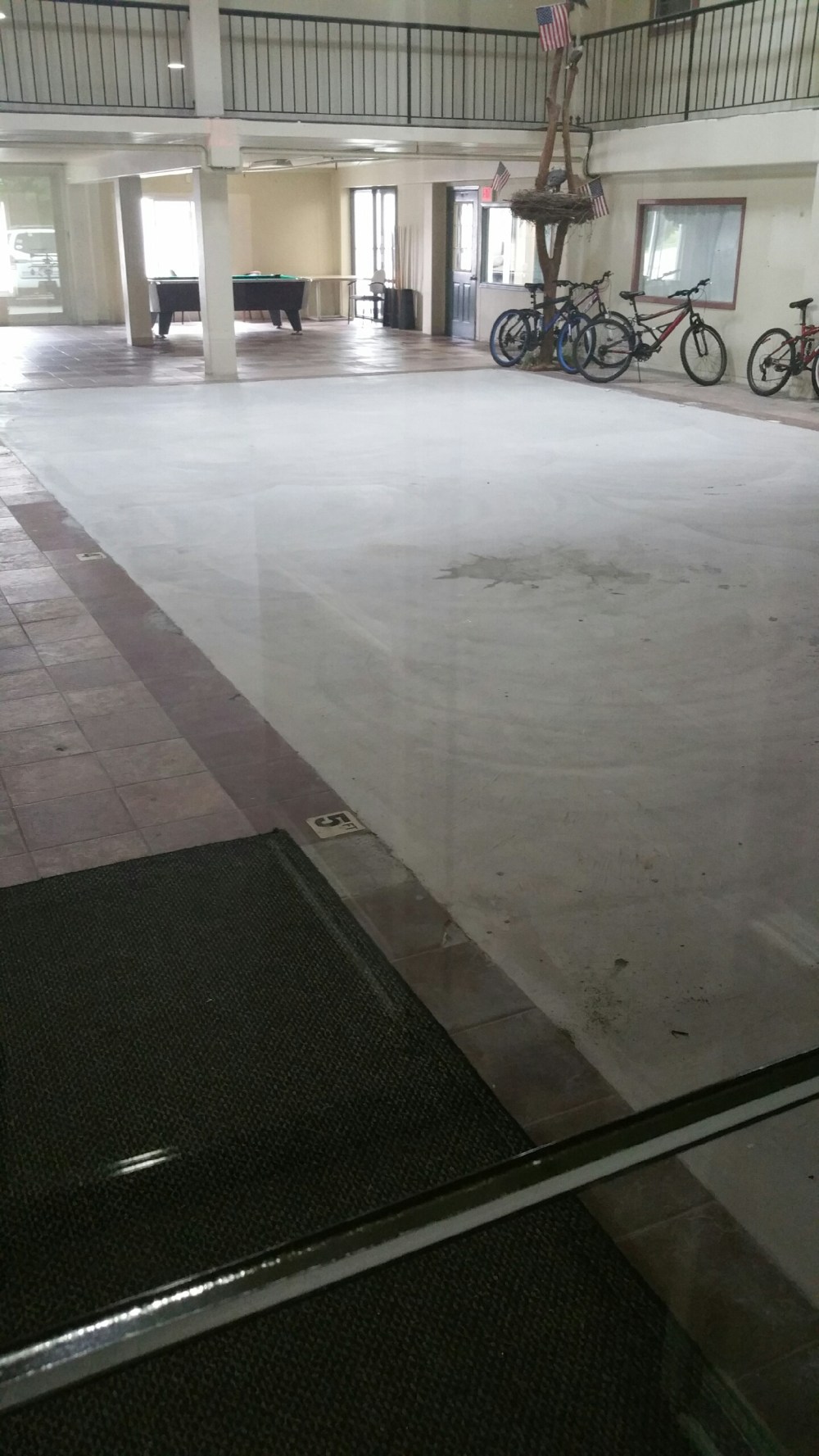
Busher and I drove to West Virginia on Friday night and settled into the luxurious Super 8.  He’d asked me if I was a hotel snob, and I’d answered “no” without inquiring into the details.  I knew that we might be in trouble when we arrived to find the receptionist outside smoking on the entryway landing, surrounded by about four guys in lawn chairs who were on the tail end of a 30 pack of Bud Light.  We managed to survive the night, but I ended up with an eye infection that made the next day’s 75 miles feel longer than they were.

Super 8

Serenity of the Super 8 in Lewisburg, WV.

The start of the ride was only a couple of miles away from the motel, and when we arrived, I was the only fool on a tri bike.  Busher and I quickly became known as the “tri guys,” and we set off on the green loop, which we planned on riding three times.  There weren’t many flat parts of the ride, and I was probably only laying in the aero bars 10% of the time.  A tri bike isn’t meant to be ridden while sitting up like a road bike, and by the time we hit the green loop for a second time my hands were getting sore. I’d also ejected three water bottles off the back of my bike by that point, and I made a mental note to buy some Gorilla cages before IM Chattanooga.

Busher and I handled loop one pretty well, but we both began running out of steam on loop two.  I think we were two of only about four people to attempt the green loop twice, and by the time we neared the end, neither of us felt like trying it for a third time.  It was getting late in the day and we still had a fairly long drive back home.  Busher seemed to be feeling a bit worse though, and dry heaved twice in the last ten miles.  After we were done, we both did a quick transition run and then headed back to Richmond.  I made it home around 8 p.m., but then had to get up early the next morning for a 2.5 hour run, which was no fun at all.  My quads were pretty much blasted from the bike ride, so I actually had to do some walking on the uphill portions.

WVA

I averaged 11 hour training weeks in July after getting back from vacation, and we continued building into August.  Your body gets used to it after a while, but I was still pretty tired most of the time.  My first 100 mile ride of the year was set for Saturday August 19th, and I planned to ride the Capital Trail down to Williamsburg to stay off the public roads and away from traffic.  I set out at first light and had no issues in getting to Williamsburg.  I ran out of trail and still needed some more mileage before turning back towards Richmond, so I set off down the Colonial Parkway near Jamestown.

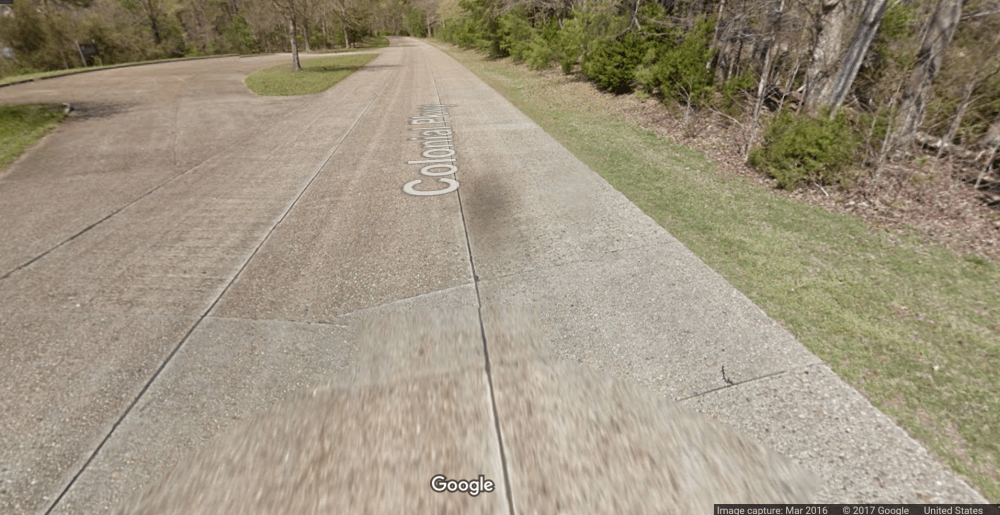
The Colonial Parkway is essentially three lanes of poured aggregate, and there are 1 inch wide gaps between the lanes.  I was mindful of the gaps at first, and after riding a few miles down the Parkway, I turned around  to head back towards the Jamestown visitors center so I could hit the restroom and refill my water bottles.

Shortly after turning around I got behind a couple on fat tire bikes.  I passed them on their left at about 20 miles per hour, and as I moved back to my right my front wheel went directly into the gap between the lanes.  I immediately went out of control and my bike darted towards the middle of the road.  Luckily, it then turned hard in the other direction and headed towards the right shoulder.  Upon reaching the shoulder, the bike jacknifed and sent me flying over the left front of the handlebars.  That entire process probably lasted 1-2 seconds, but it seemed like an eternity.  I had zero control of the bike or my body during that time, and it was pretty terrifying.

I landed hard in muddy grass on my left shoulder and then came down on my left side.  A bottle of sunscreen was in my left jersey pocket, which left a nice mark above my left hip.  After landing, I was staring straight up into the sky and had no idea where my bike had ended up.  It was presumably trashed, and I heard the people I had just passed yelling at me and saying, “Are you okay, don’t move?”  I’m sure I gave them quite a show.

parkway

I hate those grooves, but I’m thankful for the grassy shoulder.

At that point, I didn’t know the extent to which I might be injured and I laid there for a few seconds assessing the situation.  I finally sat up and saw the lady picking my bike up out of the mud and her husband was picking up the rest of my gear.  Pretty much everything (but the sunscreen and the water bottles in my new Gorilla cages) had flown off of me and my bike, including my cell phone, my extra bag of Carbopro and my sunglasses.  I realized that I had been knocked half-silly, but I didn’t seem to have any major injuries.  My bike was completely covered in mud and the chain had come off, but it also seemed to be in working order.

After about five minutes of getting myself together, I was able to ride a mile or two to the Jamestown bathroom where I cleaned up some more and called Leigh Anne to let her know what had happened.  I still had 40 miles to go to get back to my car, and felt like I could make it back.  I had really dodged a bullet, and if I’d have landed on the road instead of the grass I’d have broken several bones in my left shoulder area and IM Chattanooga would have been a no-go.  Adrenalin got me back to my car, and I even managed to do my transition run.

I was pretty sore for the next few days and I really wanted to cancel my long run the next morning.  I was in pain during the run, but not enough to justify canceling it.  There is pain where you worry about causing (or exacerbating) an injury, and pain that just makes you feel like shit that you just have to push through.  This was the latter.  I told Karen that I wanted a nickname other than “Big Baby” for completing my 100 miles after crashing and then my long run the next day, but sadly, the name had already stuck.  By this point, I fear it might be permanent.

Even though my bike had also been saved by landing in the muddy grass, like me, it didn’t come through the ordeal completely unscathed.  The bottom bracket had broken, and I had to take it to the shop for some repairs.  Karen and Erin set me up for another 100 mile ride the following weekend, and thankfully, that ride was uneventful.  I did the first two hours solo, and then did the rest with Busher   That ride was followed by another 2.5 hour run on Sunday morning,

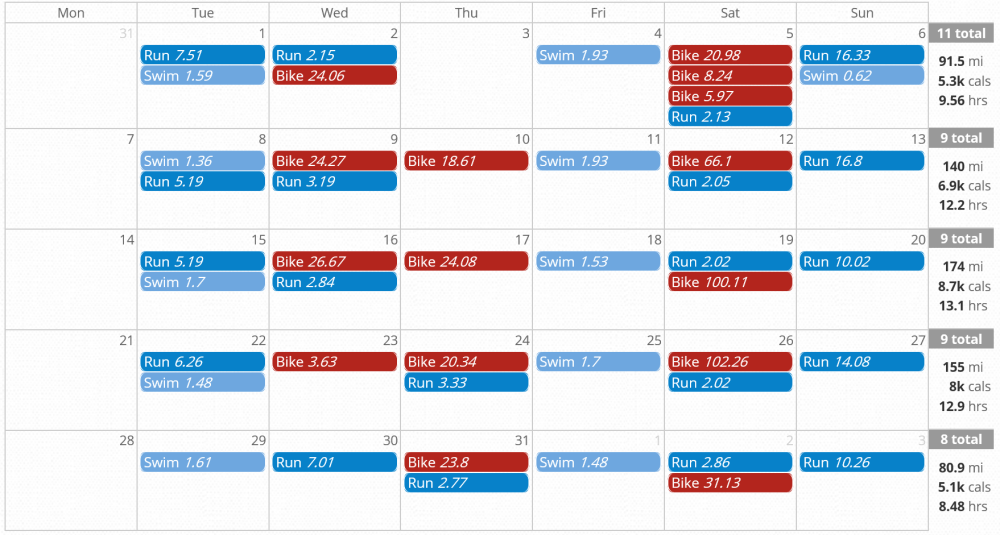
August of 2017 was the biggest training month for me since I started my Ironman journey, and I logged 51.26 hours over that period of time.  That was tough to handle on top of my other responsibilities, and as always, I did my best to get my training done when it didn’t interfere with anything else.  At that volume, however, there just aren’t enough hours in the day to avoid all of the conflicts, so it takes an understanding family to train for an Ironman.

august

Your body mostly adapts to the punishment, but after a while the constant training and the early mornings wear on you.  Mental fatigue dovetails with the physical fatigue, and there comes a point when you are just over the training and dying to get to the starting line.  There were a few times when I had to find motivation by reminding myself that I was lucky to be healthy enough to do what I was doing.  I’m not getting any younger, so my window of opportunity to do these things can close fast.

By the end of August, my taper finally began for my final pre-Ironman race on September 9th.  That was the Patriot’s Half triathlon, which was only two weeks before IM Chattanooga.  Due to the short turnaround, the Patriot’s Half was going to be treated as a long training day instead of a full-out race effort – particularly the run.  So, as I entered my taper, my energy levels started to return and the constant soreness in my legs began to dissipate.  The light at the end of the tunnel was finally getting brighter, and I was ready to see the fruits of my labors from the preceding months.

“Where all these disappointments that grow angry out of me will rise…”

2017 Robious Landing Triathlon

Race Report

1:23:51

 2/20 AG   14/251  Overall

June 25, 2017 – The Robious Landing Triathlon is one of my favorite races, and the only one that I’ve done every year since getting the tri bug in 2014.  As a sprint race, it actually suits my strengths very well since the bike is 19 miles instead of the standard 12, and the run is generally slow since you have to wind around on trails a lot in miles 1 and 3.  Its generally one of the larger local races, and I’d failed to make my age group podium in my first three attempts.  I finished 4th in my age group in 2016, but that race had been turned into a duathlon due to river flooding.  Thus, one of my better legs (the swim) had been replaced by a second helping of my worst leg (the run).  In 2017 I was determined to finish in the top three of the M35-39 age group.

The weather outlook was ideal, and the river was as close to calm as I’d seen it for this race.  In 2015 the current was brisk, and in 2016 the river was full of debris due to storms – which led to the swim cancellation.  You could see that the current was moving, but it was really slow.  Since I had been constantly improving my open water swimming ability, I was glad to see the slow current since I was hoping to try to swim ahead of all of those fast runners.

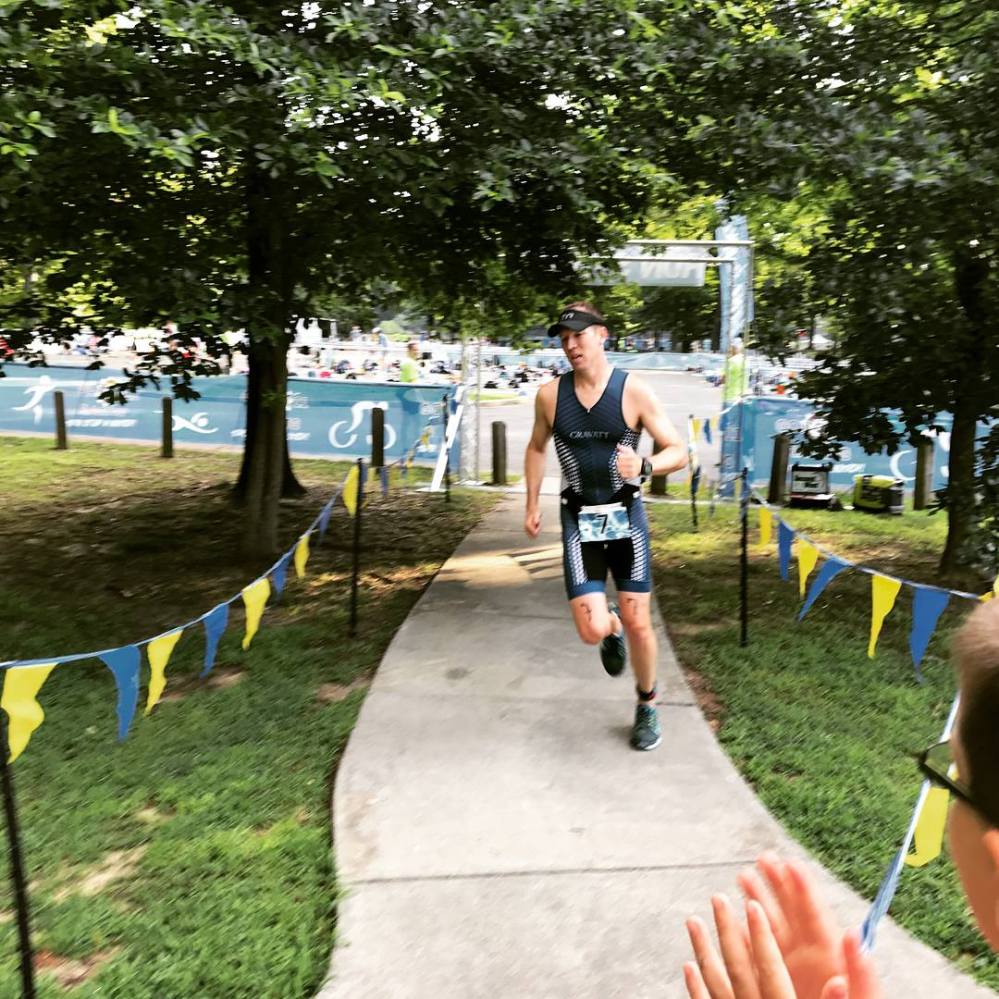
I’d done packet pickup on Saturday, and on Sunday I arrived at the race site before transition opened and had to wait impatiently for a few minutes.  Since I’d been assigned bib 7, I was hoping to have a fortuitous transition spot near one of the entrances/exits.  Much to my dismay, however, I was tucked away in a corner.  Karen likes to call me “Big Baby,” so I guess they can put Baby in a corner.  Oh well.  I set up, got body marked and grabbed my timing chip.  I ran into Jim Rosen in transition and chatted with him for a bit.  Then, after a warmup run and some light stretching, Jim and I walked up the river to get ready for the swim start.

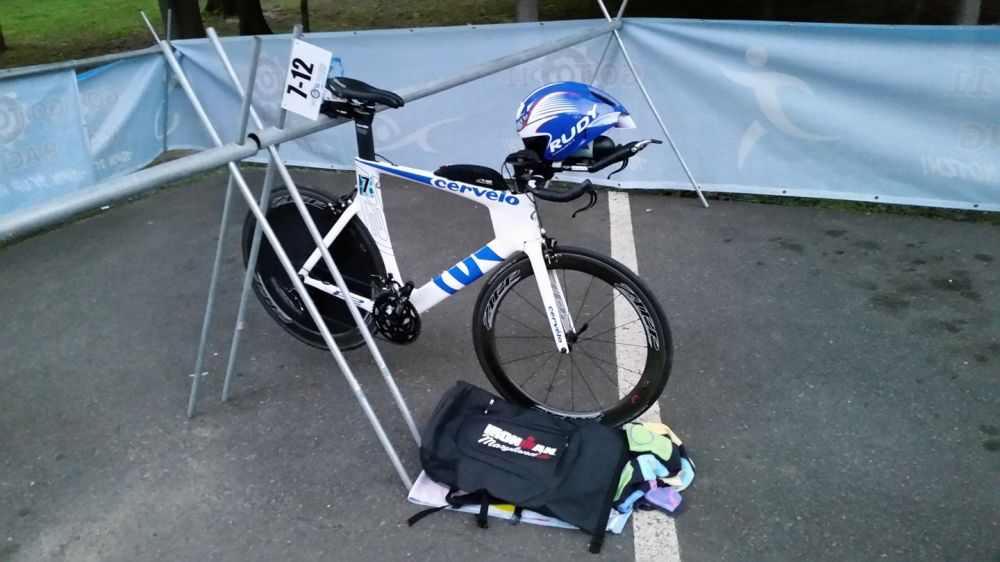
robious rack

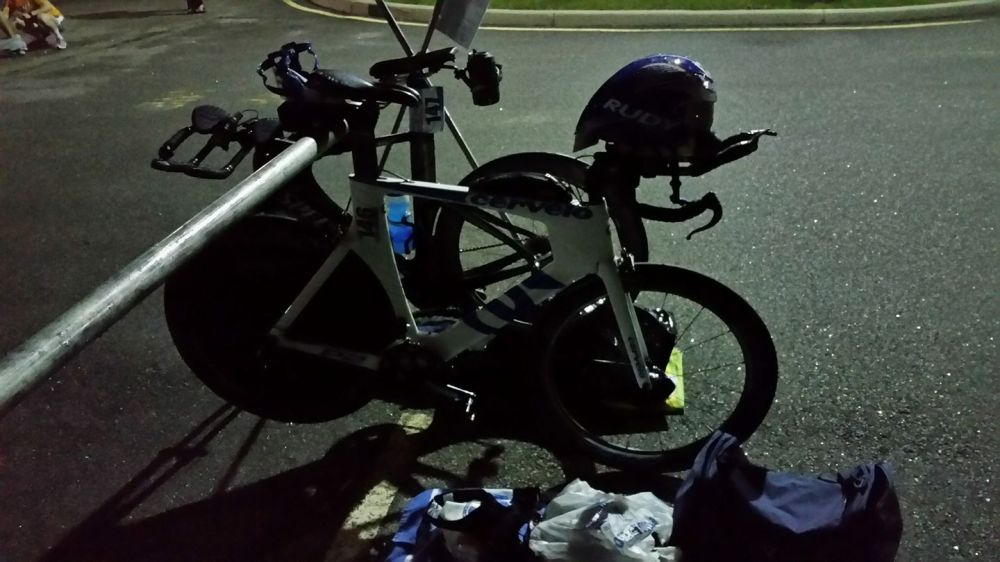
Bib 7 should have a better transition spot…just sayin.

Race Results

GPS Data

Swim- 8:26 (1:18/100 m)  (3/20 AG)

The Robious Landing tri features a 650 meter swim, which is fast since its all downriver.  As I got into the river a few minutes prior to the start, I saw my attorney buddy Danny Royce, who had been trying to qualify for Kona for a few years, and who does the local races for training purposes.  He mentioned that he’d aged up into the M35-39 AG with me, and I knew that he’d beat me by a country mile since he’s pretty much a semi-pro.  That being said, I figured that he’d be in the top 3 overall – if he didn’t win the race outright.  We joked for a few minutes, and I encouraged him to make sure he was in the top 3 so I’d have a chance to win our AG.  Danny claimed that he was better suited for long course racing and that some of the young bucks would beat him on the run.  I didn’t really believe him, and knew that he’d probably be the first person on the run course due to his swimming and biking prowess.  After chatting it up with Danny, I focused on the task at hand, and then the starting gun went off.

I was excited to see if my open water swimming had improved, and I was able to keep my heart rate under control at the start.  In fact, I just kept swimming at an even pace and never swallowed any water and never got out of breath.  I’d made sure not to go out too fast, and I just kept increasing the pace as the swim progressed.  The buoys just kept sliding by me, and my sighting was good so I stayed on course.

Midway through the swim, I knew that I was doing well, but its hard to see how many people are ahead of you when you’re in the water.  I just focused on keeping an even stroke and on trying to swim in a straight line.  Even though the current was minimal, I still tried to stay towards the middle of the river in order to maximize whatever current assist was available.

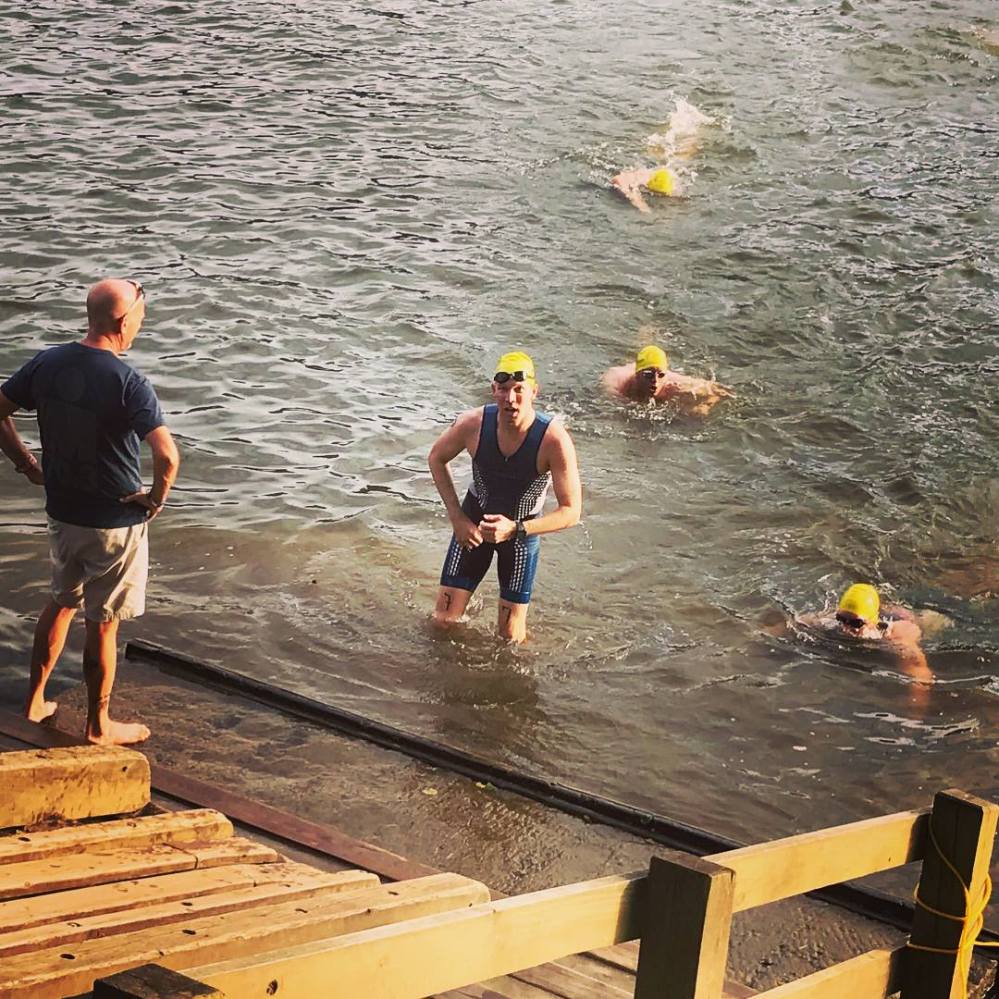
Before too long, it was time to swim my way over to the dock and get out of the water.  I saw my parents and Leigh Anne and the kids cheering for me, along with my friend Meredith (who was pregnant at the time and not racing).  Its hard to keep your balance when getting out of the water due to rocks under the surface, so I took it slow so as not to fall in front of everyone.

Overall, I’d had a solid swim, and one of my best open water swims to date from a consistency standpoint.  I stayed in a good groove from start to finish, and never had to pull up to catch my breath or to get my bearings.  Kudos to my sighting practice in the pool.  My swim wave included all men under 40, and I was 12th out of the water in my wave, so I was pretty happy about that.

robious swim.jpg

T1: 1:18  (4/20 AG)

All in all, I had a pretty speedy transition, but I probably lost a few seconds due to my rack location in the corner.  After getting into my cycling gear, it was a longish run to the timing mat and an uneventful mounting of my bike.

Bike- 51:31  (21.9 mph)  (3/20AG)

In 2016 I felt a bit fatigue as soon as I took off on the bike since there is a small hill heading out of the transition area up to Robious Road.  In 2017 I felt better, and was determined to best my 2016 bike split of 53:03 (21.3 mph).  As I took off up the initial hill my legs weren’t loading like they’d done the year before, and after taking a right turn onto Robious, I tucked in tight and started churning the pedals.

Since I was in the first swim wave and since I’d had a good swim and transition, there were only about 10 guys ahead of me on the bike course.  Thus, there really wasn’t much of an opportunity to do any legal drafting.  In fact, for most of my ride there were no other athletes in sight.  I knew that in 2016 I’d hit the turnaround point at 27:53, and my goal for the first half of the bike to was best that time.  I’d told myself, however, that I wasn’t going to look at my GPS until I got to the turnaround, so I was simply riding by feel and was trying to push the pace as hard as I felt comfortable.

At mile 4.5, I took a left turn off of Robious and headed into the hilly portion of the course.  Basically, there is three tiered climb up to the turnaround point, with the last tier being the steepest by far.  I felt like I was making pretty good time, but as I started going up tier one or two, I saw Danny screaming down the hill in the opposite direction on his pink Trek bike – which is hard to miss.  I knew Danny was fast, but I was amazed that he already had about 4-5 minutes on me at that point.

I finished my climb and finally hit the turnaround cone at the halfway point.  I snuck a glance at my GPS and noticed that it was reading 27:54.  What?  I was one second slower than last year?  I definitely felt better than I had in 2016 and thought that I’d been pushing hard, but I was still behind last year’s pace.  Maybe there’d been more wind in my face this time around or something, but if there was, I really hadn’t noticed it.  That pissed me off and redoubled my focus for the back half of the bike course.

After making the turn, the next couple of miles were back down the hills that I’d just climbed.  Even though my speed approached 40 miles per hour going back downhill, I kept pedaling to try to make up some time.  As I headed back towards Robious Road I finally caught and passed two or three bikers, and that motivated me to keep pushing.  Then there was a right turn onto Robious, and a slight downgrade to about mile 16.5.  Once again, I continued to pedal hard even though I had gravity on my side.

The course heads back uphill for the last mile or so before you take a left to go back towards transition, and I got up out of the saddle and pushed hard up the hill.  After turning left, it was about one mile downhill to the transition area, and I just kept pushing instead of easing up.  I was determined to beat my 2016 bike split and I was probably a bit too fired up about that.  I typically ease up when heading into T2 to lower my heartrate before the run, but I kept pushing until I was told to slow up by a race official as I neared the timing mat.

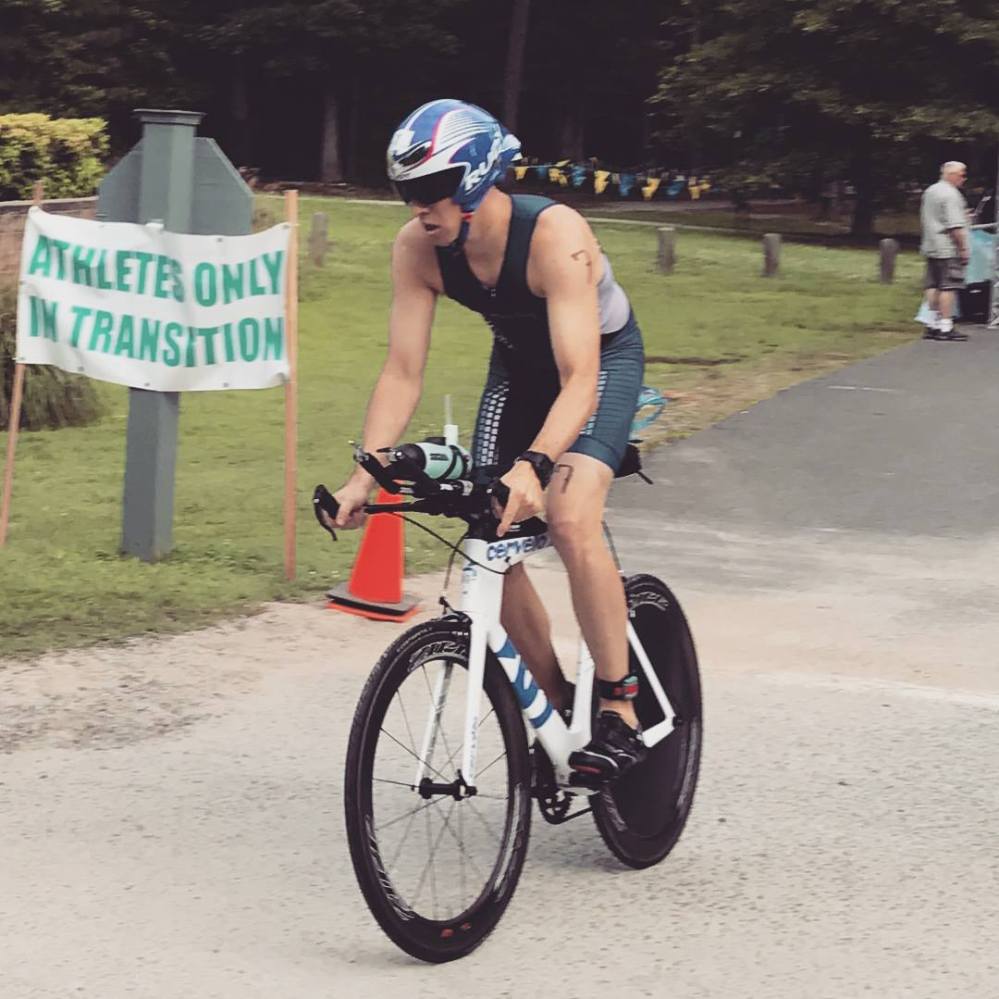
Once I got to the timing mat, I did my best version of a flying dismount, which must have been pretty violent since it knocked the chain off of my front chain ring.  I didn’t realize it at the time, but the race photos of me running into T2 show my chain dragging the ground and I found it that way after the race.  After it was all said and done, I’d completed the bike course in 51:31, which was 1:32 faster than in 2016.  All of that time gain had come in the back half of the bike course, so I guess I just needed to get a little bit mad.

robious t2.jpg

T2: :53 (3/20AG)

I didn’t waste any time in T2 and I was in and out in less than a minute, even with my transition spot being in the corner farthest from…pretty much everything.  I’d gone hard on the bike and kept my heartrate on the high side coming into T2.  It was time to see if that decision would come back to bite me on the run.

Run- 21:43  (7:41 min/mile **GPS pace**)  (3/20 AG)

(6:59 min/mile **official pace**)

robious run.jpg

Mile 1 (8:09)

The Robious Landing run is unlike most sprint triathlon 5ks for a few reasons.  First, you’ve biked 19 miles instead of 12, so your legs are a bit more worn out.  Second, miles 1 and 3 are mostly on winding dirt trails in the park, which lead to slower splits for those miles.  Finally, my GPS always says that the course is short of a full 5k.  Thus, my mile splits are generally slower, but my overall run time is fast (if you consider it to be a full 5k like the race claims).

Generally speaking, mile 1 of the Robious run never feels good to me, and 2017 was no different.  My quads were screaming as I wound around the dirt trails, and there are a few small hills thrown in that make things interesting.  I actually felt slightly worse than normal, which I chalked up to my decision to hammer into T2 instead of letting my heart rate settle down a bit.  I was energized by the fact that my dad had said that there were only seven guys ahead of me on the course as I exited T2, but I knew that a few guys were going to pass me on the run course – as always.  In fact, I had 2-3 guys go by me in the first mile, but none of them were in my AG.  I knew that there was no catching Danny, but I was pretty confident that he’d be in the top 3 overall, so I still had a chance to do well in, or even win my AG.

Mile 2 (7:24)

By mile 2 the course headed out of the park and into the adjacent neighborhood.  I began to feel a bit better since the course had straighten out, but I still felt relatively poor for mile 2.  Note to self – lower your HR when coming into T2 instead of being solely focused on your bike split.  Bike for show and run for dough, as they say.  Still, there was no one close to overtaking me and I hadn’t seen anyone ahead of me in my AG other than Danny.

After hitting the turnaround cone in the neighborhood, I began looking for people in my AG as I doubled back and met people head on.  I saw no other M35-39 for about a minute after making the turn, so I knew that I had about two minutes on him.  Okay, as long as I can hold it together I shouldn’t get passed by anyone.  That being said, I was hurting pretty good by that point and felt like I was in danger of having the wheels come off in spectacular fashion.

Mile 3 (7:27 pace)

Mile 3 was primarily back in the park and back on the winding trails, which slowed me down a bit.  At the Powersprint triathlon in May, I’d had a (relatively) pleasurable pain in the last couple of miles of the run.  There was nothing pleasurable about the last couple of miles on this day.  The wheels were still on, but keeping them that way was getting harder and harder.  Thankfully, no one was stalking me from behind, and that probably led to me not pushing quite as hard as I could or should have.  I certainly felt like nothing was left in the tank, but you really don’t know unless you’re being pushed by a warm body next to you.

As I wound around on the trails the music and noise from the finish line began to grow, and after what seemed like an eternity, I finally broke out of the woods and entered the finishing chute.  I used whatever I had left to sprint across the finish line and then collapsed on the far side.

Post Race

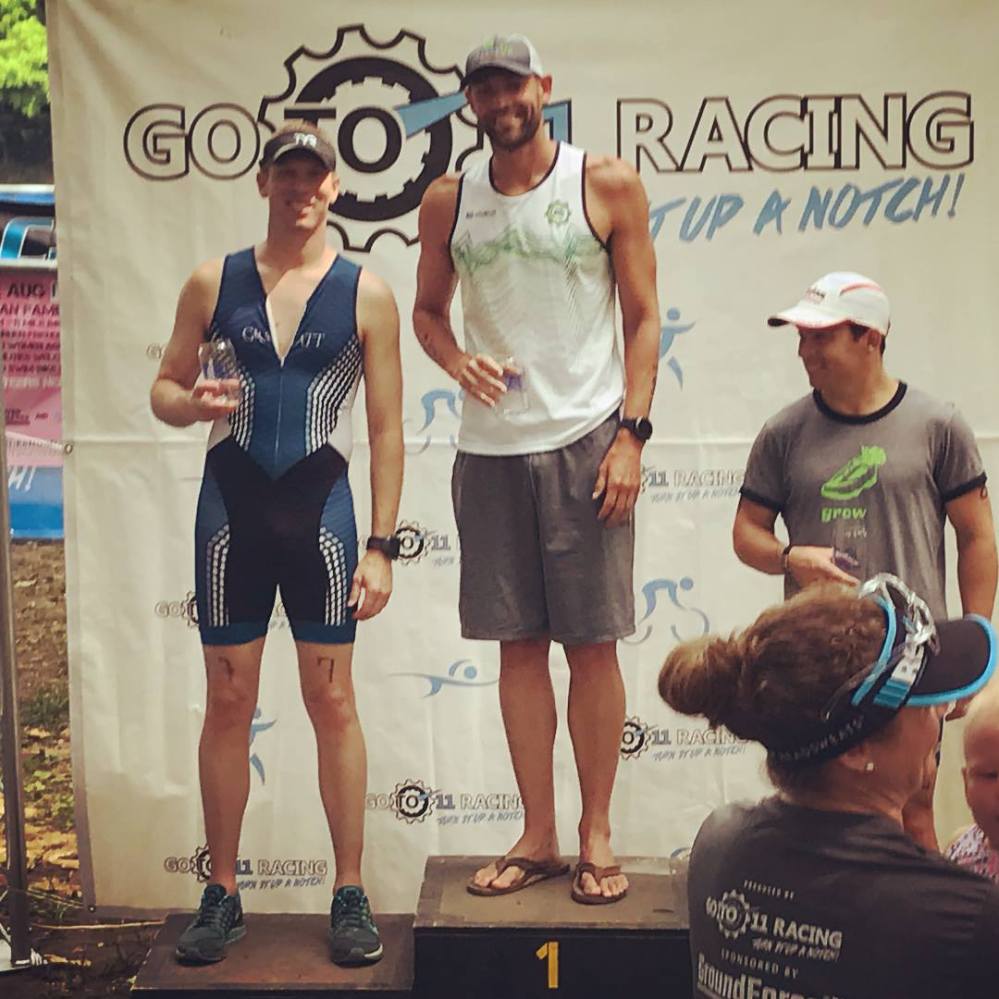
12 seconds.  A measly 12 seconds separated Danny from being third overall, even though he’d apparently set a bike course record for the race.  Probably while riding in his small chain ring just for the fun of it.  Since Danny had finished fourth and wasn’t on the overall podium, he stayed in the M35-39 age group, won it by a mile, and knocked me down into second.  While that was disappointing, I’d still managed to finish 2/20 in our age group and had made the podium in this race for the first time ever.  Joking aside, I was really happy, even though Danny had beaten me by 9 minutes and 41 seconds.  That is an eternity in a sprint race, and shows what a phenomenal athlete he is.  Honestly, I’d rather lose by 9:41 than by a close margin because there is nothing that I could have done to eliminate that gap.  I guess I could have deflated his tires, but Danny had been having some pretty bad bike mojo around that time already, and he probably would have still beaten me on flat tires anyways.

My next race wasn’t until the Patriot’s Half in early September, so I had a long, hot summer of training ahead of me until that race.  In actuality, the Patriot’s Half was only two weeks out from Ironman Chattanooga, so I would be using that as a long training day instead of a full-on race effort.  Before the heaviest training set in, however, we were taking a vacation to Seattle two days after Robious.  Karen had a few runs planned for me while I was on the west coast, but nothing major.  I planned to rest and recover over the next week so that I would be ready for the big training weeks when I got back.

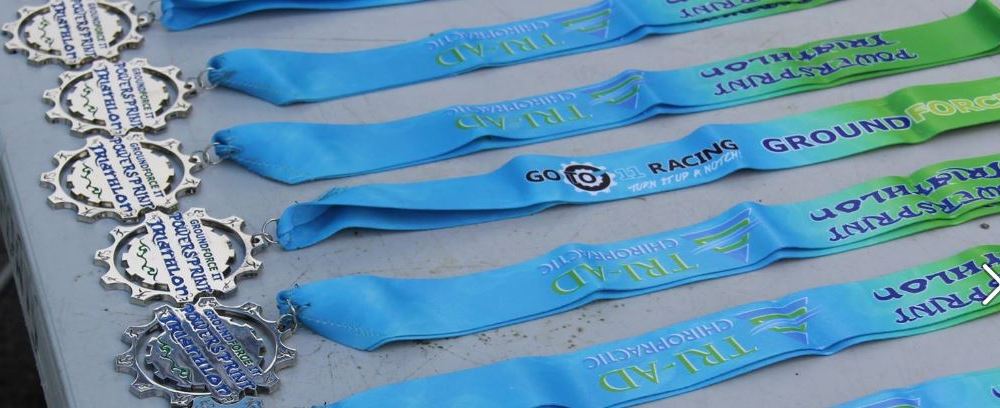
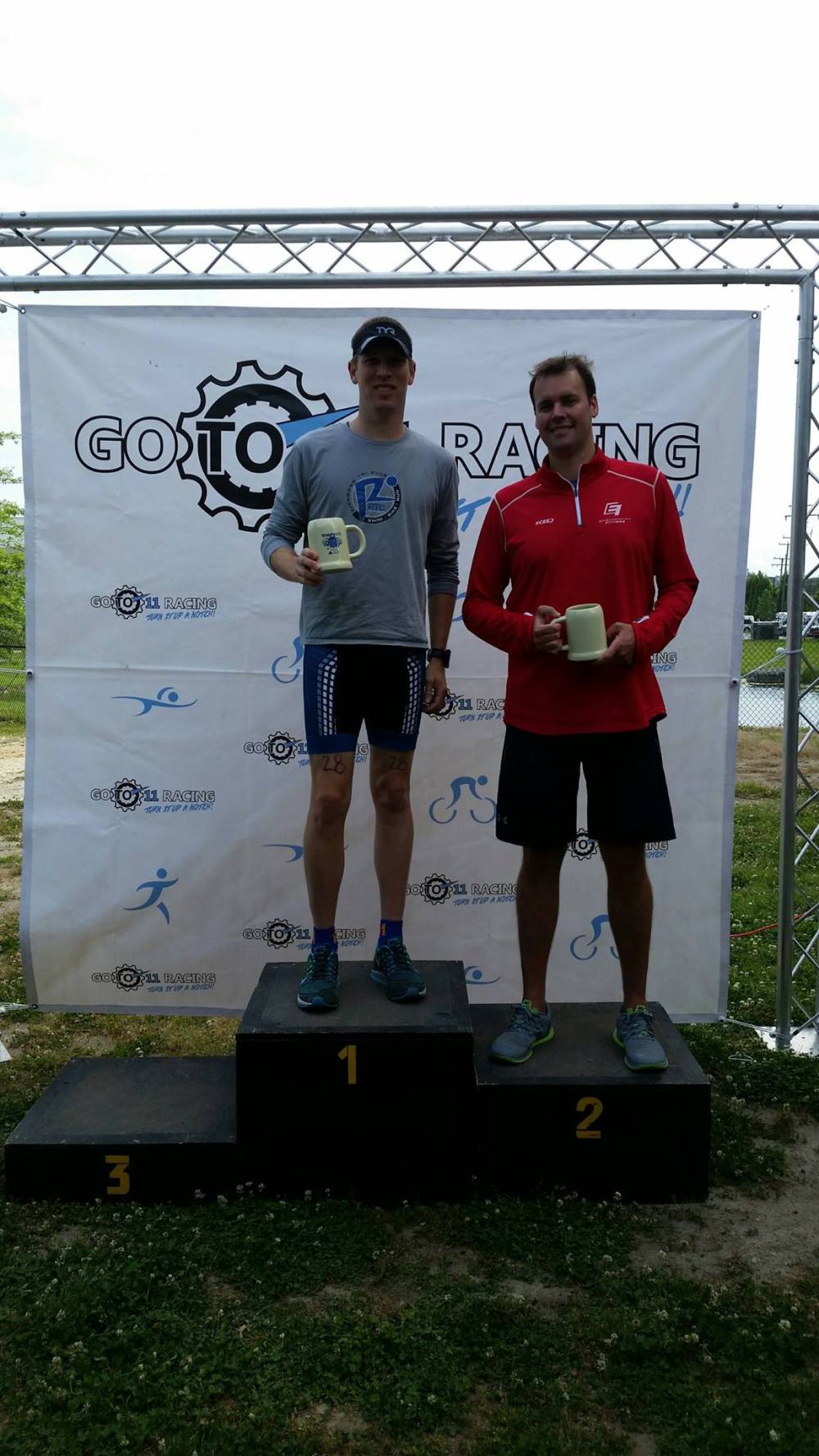
Before leaving for Seattle, however, I had a second place mug to collect…

robious podium

Beaten by Danny like a red-headed step-child…

“And now its time to build from the bottom of the pit, right to the top…”

2017 Groundforce IT Powersprint Triathlon

Race Report

1:01:56

 1/6 AG     9/175 Overall

May 21, 2017 – Its only been a week since the Kinetic Half-Iron triathlon at Lake Anna, and I’ve been fighting fatigue all week.  My workouts had been rather light, but I felt like I was still in recovery mode.  In addition, Jackson and I had camped out with his Cubscouts pack at The Diamond on Friday night, which pretty much led to no sleep.  The lights weren’t turned off on the field until about midnight, and I’m way past the age where sleeping on the ground results in feeling rested in the morning.  I had some easy workouts scheduled for Saturday after the kids’ soccer games, but scrapped those in exchange for a much-needed nap.

My first two triathlons of 2017 had been cool and wet, and the Powersprint pretty much continued that trend.  Thankfully it wasn’t raining, but it was still pretty cool in the morning.  So much so that as soon as I set up my transition spot, I headed inside to pre-swim and to try to stay warm.  Unfortunately, we all had to head back outside for the announcements and the National Anthem, and by the time that I got back inside to line up for the start, I was pretty much frozen.  Have I ever mentioned that I hate being cold?

I wasn’t quite sure what to expect since I’d done a 70.3 the week before, and I knew that I wasn’t fully recovered.  I still hoped to make the AG podium, but I certainly didn’t expect to match my bike and run speeds from the RTC Sprint back in April in light of my fatigue.

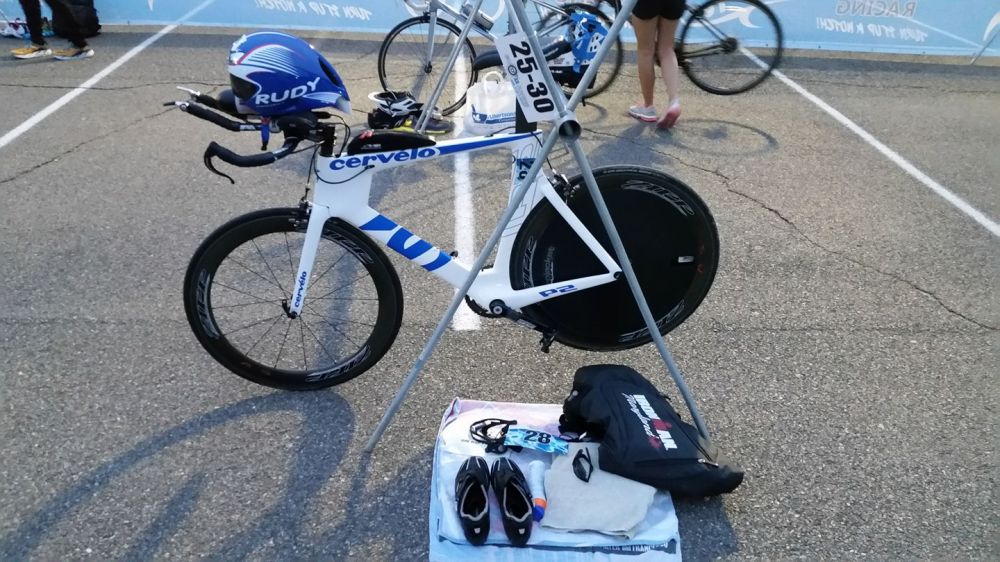
Due to my projected swim time, I was bib 28 of approximately 200.  Thus, I didn’t have that many people ahead of me on the course.  Pool swims can get a bit jumbled up, so I was hoping that everyone around me had seeded themselves properly.  I noted that bib 26 was in my AG, so I made a mental note to do my best to pass him on the course.

powersprint rack.jpg

Another end-of-the-rack spot!

Race Results

GPS Data

Swim- 4:56  (1:39/100 m)  (2/6 AG)

I seeded myself for 5 minutes, and but I hoped to complete the swim a bit faster than that.  The timing mats are obviously outside the pool, and it takes about an extra ten seconds or so to climb out and then run into the next room across the timing mat when you’re done.  There was a female athlete directly in front of me in the start line, and when she was about halfway down the pool, I got the signal to go.  I jumped in, and immediately started swimming hard since there’s no time to waste in a 300 meter swim.

The first two laps were uneventful, but by the halfway point I had caught up to the girl ahead of me.  I was hoping that she’d let me go by, but she ignored my tap on her ankle when I caught her and she just kept swimming.  By the fourth lap she finally let me pass her, and I feel like I lost about 15 seconds or so in getting caught behind her, but the final two laps went by pretty quickly.

Upon finishing lap six, I hopped out of the pool and ran across the timing mat.  My final time was 4:56, which was still four seconds ahead of my seeding, and 11 seconds faster than 2016.  I made a mental note to seed myself faster in 2018.

T1: 1:37  (2/6 AG)

There’s a fairly long run out the back of the YMCA to the transition area, and I saw bib 26 getting on his bike as I got go my rack.  Turns out that I’d gained 19 seconds on him on the swim, so I was really hoping to catch and pass him on the bike since he’d only started 30 seconds ahead of me.  After putting on my bike shoes and helmet, I raced to the bike mounting line, and wondered what sort of legs I’d have after the prior week’s half-iron effort.

Bike- 32:25  (21.7 mph)  (2/6 AG)

After getting on my bike getting up to speed, I noticed that bib 26 was already out of sight.  Ok, he transitioned quickly, but hopefully I’d still overtake him on the bike course.  The course was reversed from the year before, and after getting up to speed I noticed that my legs felt pretty good.  Definitely not 100%, but I was able to put some pressure on the pedals.

It was only 57 degrees, so I was a bit chilly for the first few miles on the bike – the story of 2017 it seemed.  I began to catch and pass a few riders, but there weren’t that many people on the course ahead of me due to my swim seeding (and thus, my bib number).   I probably passed a few people in transition, and then a few more on the bike.  Unfortunately, I never got around any other bikers that were riding about my speed, so there was no opportunity to do any legal drafting.

Since I was primarily riding on an island by myself, I don’t remember too many details about the bike, but I remember feeling good but not great for the majority of the ride.  The wind wasn’t really an issue like it had been in 2016, but the cool temperature and dense air probably slowed me down a bit.  Its hard to compare 2016 to 2017 since the course was reversed and slightly modified, but I finished the bike 1:27 faster than I had in 2016 – and on tired legs to boot.  Now it was time to see if I had any legs left to run on.

T2: :46 (1/6 AG)

T2 was only 46 seconds, so I pretty much nailed it perfectly.  I hit the ground running off of the bike, racked it and then swapped shoes.  I grabbed my race belt and visor and put those on as I headed out of T2.  The legs felt pretty good, so it was time to see what was left in them.

Run- 22:14  (7:09 min/mile)  (1/6 AG)

Mile 1 (7:26)

I’d run a 7:25 min/mile pace off the bike at the Powersprint in 2016, but had held 7:15’s off the bike at the 2017 RTC Sprint a month before.  I didn’t think I could hold 7:15’s on tired legs, and was really just hoping to beat my 2016 time of 23:01.  After running out of transition and getting down the road a ways I looked at my GPS, and it was reading 8:30/mile.  Uh oh, I could be in for a slow run today!  I got the legs to turn over a little faster, and before too long, the pace started coming down.

The run course had turned into a two loop course for 2017, with the turnaround cone being about 8/10ths of a mile in.  When I got to the cone, the volunteer monitoring the turnaround point told me that I was the 10th person there, which meant that I’d passed 18 people by that point.  That served as a bit of motivation, and by the time I reached the first mile marker, only 7:26 had elapsed.  Hmm, I was only one second slower than my 2016 pace and I was getting stronger.  Maybe I could do something on the run after all.

Mile 2 (7:17)

I hit the turnaround cone for loop two around mile 1.5 and had seen bib 26 well ahead of me by that point.  I’d never seen him on the bike, so I knew that he must be a strong biker.  As it turned out, he’d turned in a 31:21, which was more than a minute faster than me.  I didn’t know what sort of runner he was, but he seemed to be too far ahead of me to catch.  Well, it looked like I had no shot to win my AG, but 2nd still seemed to be in play.  Always the bridesmaid, never the bride!  Ok, not even always the bridesmaid, sometimes just the guy parking cars at the wedding.

At the beginning of loop two I was still feeling surprisingly good, and my legs were turning over better than they had at the start of the run.  My pace continued to creep down and I turned in a 7:17 for mile 2.  Not quite my 7:15 pace from a month before, but certainly respectable given last week’s race.

Mile 3 (7:03)

Mile three arrived and the legs just kept a-churning and picking up speed.  By that point, I was pretty well flabbergasted that I had anything left in the tank, and I guess that’s a testament to Karen’s run training.  I’d kept waiting to bonk, but physically and mentally I was still going strong.  Don’t get me wrong, it hurt, but it always hurt by that point in a sprint.  Somehow, however, I still had juice in my legs and air in my lungs.

I picked up the pace as much as possible in the homestretch, and after stopping my GPS after crossing the final timing mat, my total time for the run was 22:14 – for an average pace of 7:09.  That was 45 seconds faster than 2016, and 19 seconds faster than my run at the RTC Sprint the month before.  What?  Ultimately, my run was good enough for first in my AG, which is not how these races usually shape up for me.

Now all I had to do was sit back and wait most of the people on the course to finish so I could figure out my position in the overall and AG standings.  Due to the pool swim, there was certainly a chance that someone who was still on the course could finish ahead of me, so it was pointless to check the standings until a little later on.

Post-Race

After getting some pizza and doing some stretching, approximately thirty minutes had passed since I finished.  I figured that it was safe to go ahead and check the results, and saw that I was 1/6 in my AG.  It turns out that bib 26 finished third overall, so that put him on the overall podium and took him out of my AG.  Thus, I was currently in first in my AG.  I’d made my AG podium in triathlons twice before, but both of those were second place spots.  I waited another 10 minutes or so before I began to think about texting anyone, and before I hit “send,” I decided to check one more time just to be sure.  It was extremely unlikely for someone so far back in the seeding to have beaten me, but I figured I’d check one last time.

When I did, I saw that I was now 2/7 in my AG.  WTF?  It turned out that someone at the tail end of the seeding had finished third overall and had knocked bib 26 into 4th overall, and thus, back into my AG.  I immediately questioned how that might be possible since he had to have been stuck behind slower swimmers in the pool.  After throwing a minor pity party for a few minutes I looked at the transgressor’s splits and saw that he was showing a 5k time of around 12 minutes.

Doubting that any of the athletes participating in the Powersprint had the ability to run a world record 5k, particularly after swimming and biking, I immediately wondered if he’d only run one loop of the two-loop run course.  I certainly didn’t want to accuse anyone of cheating since there could have been a legitimate timing issue, but I wasn’t about to go down without a fight.  I printed the other athlete’s timing data and took it over to an official, who quickly declared that they were “already on it.”  By the time that I got back to the results screen, the transgressor had been removed from the standings, bib 26 was back to being 3rd overall and I was back to being 1/6 in my AG.  Kudos to the race officials for squaring it away so quickly.  Again, I’m not leveling cheating accusations, but that guy’s original run time of ~12 minutes was clearly incorrect.

Ok, so I know that winning my AG in a small local race is not quite akin to nabbing a Kona slot, but I’d never stood atop a podium after a triathlon.  Or a running race.  Or ever.  Moreover, I’d managed to rally after a grueling 70.3 the weekend before and put together a solid race on legs that were still in recovery mode.  In fact, I’d had my best ever 5k run off the bike in a sprint tri, which was some cause for celebration.  I still have a long way to go with my running to be competitive in the larger races, but now I was consistently running about 25 seconds per mile faster off the bike than I had the year before.  The arrow was still pointing up, even though I was rapidly aging out of the M35-39 age group.

Next up on the calendar was the Robious Landing triathlon in June, which has a deeper and more competitive field than the Powersprint.  I’d gotten 4th in my AG in 2016 when it had been turned into a duathlon, and I’d never made the podium in that race.  Thus, I was really hoping that I’d turned a corner and could compete for a podium spot there.

podium

“Dark clouds may hang on me sometimes, but I’ll work it out.”

2017 Kinetic Half-Iron Triathlon

Race Report

5:25:51

 8/29 AG     48/242 Overall

May 13, 2017 – My second triathlon of 2017 was the Kinetic Half-Iron distance race at Lake Anna, as put on by the Virginia-Maryland Triathlon Series.  It was fairly early in the season for a 70.3, but I’d been training pretty much non-stop since the start of 2016, so I was certainly ready for it.  I’d put this down as an “A” race on my calendar, so Karen and Erin brought me into it on fresh legs.  Good thing, cause I’d need them for sure.

I’d heard rumors about the level of suckitude of the run course, which was three loops.  The bike course had some hills too, but the run seemed to be what everybody was talking about.  The transition area was near Lake Anna, and there was a long hill up away from the lake.  You then took a right turn and ran down towards another part of the lake.  Then it was back up the hill you just ran down, then down again back to the transition area.  Essentially, 1 mile up, 1 mile down, 1 mile up, 1 mile down.  That’s one loop – rinse and repeat two more times.  The elevation profile is below, and as you can see, there’s not a lot of flat running to be had.

kinetic run

I run plenty of hills in my neighborhood, so I wasn’t overly worried, but I knew that I’d need to run conservatively in order to handle the elevation change without blowing up near the end.

Of more concern to me was the weather heading into the race.  It was unseasonably cool for mid-May and it had rained quite a bit leading up to race morning.  In fact, in my hour-plus drive to Lake Anna on race morning it was dumping rain, but the radar looked like the rain would clear out sometime around the start time.  Nevertheless, the temperature was in the 50’s and it wasn’t supposed to get much beyond 60 after the sun came up.

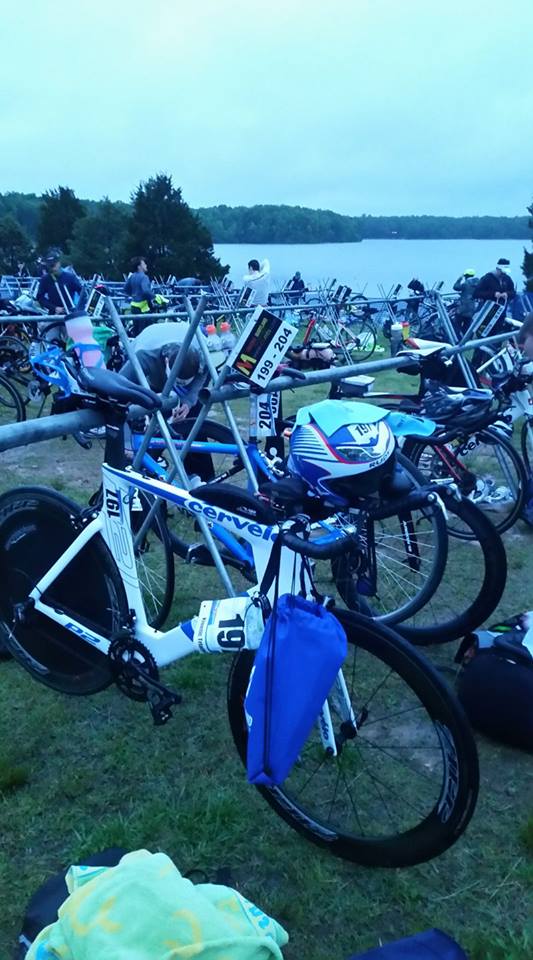
When I pulled into the parking lot it was still dark, but the heavy rain had turned into a light drizzle.  It was cold, and I was wearing a fair amount of clothing to stay warm.  After grabbing my race packet, I rolled my bike into the transition area, which was nothing but a grassy/muddy mess.  I took care to try to keep my shoes dry, but that was a losing proposition.  I had to strip down to my trisuit in order to get body marked, and quickly bundled back up.

As I was getting checked in I ran into Jim Rosen, who was the only other person I knew who was doing the half.  Jim was a couple of age groups above me, so he was starting in the swim wave after mine.  I think I had a four minute head start on him, so if he caught me on the run then I knew that he was actually well ahead of me.  I can typically out swim and bike Jim (not by much), but he runs like a deer, so we generally finish pretty close together.  He beat me by 26 seconds at the 2016 Robious Landing Triathlon, but that race had been turned into a duathlon since the swim was cancelled.  I wasn’t really racing Jim, but I knew that if I saw him stalking me on the run that it would give me a little extra motivation.

As race time approached, the rain was coming on and off and I changed into my wetsuit earlier than normal to try to get warm.  Once the start time approached, I gathered on the beach with the other athletes and waited for go time.

kinetic rack

GPS Data

Race Results

Swim:  37:07  (1:55/100m)  7/29 AG

As noted above, it was wetsuit legal for the swim, which was a nice change of pace.  My only other wetsuit swim had been at the Rumpus in Bumpass Olympic distance race in 2016, and I apparently had not learned to hike my wetsuit up high enough to keep it from restricting my shoulder movement.  I was able to swim fine, but I think my shoulders got a bit more tired than they needed to be.

The water temperature was in the 60’s, but it felt warm compared to the cold air.  I was in the first swim wave, and took off as soon as the horn sounded.  I always try to position myself near the sides to try to get some clean water at the start, but there were enough people in my wave to make that difficult.

From the get go, I knew that I wasn’t going to have a great swim and my heartrate got jacked up pretty quickly.  There were many times on the “out” portion where I had to pull up to catch my breath, and things only got marginally better coming back in.  It felt like I was having a pretty poor swim leg, but when I finally looked at my watch when I got out of the water, it was reading 36 minutes and some change.  Karen had predicted a 37 minute swim for me, so she was spot on.  The timing mat was about 20 yards from the water’s edge, so my official swim time was 37:07.

As bad as I thought my swim was, it was still good enough for 7/29 in my age group.  It was also more than three minutes faster than my last half iron distance swim at the Patriots Half in September 2016 – although that race wasn’t wetsuit legal.  Thus, I was happy with my effort, but felt like I had a better swim in me than what actually transpired.

T1: 3:18

I was dizzy upon exiting the water and it took me a good 30-45 seconds for that feeling to subside.  There was a fairly long run uphill from the lake to the transition area, and things weren’t made any easier by the muddy conditions.  Upon reaching my transition spot, I sat on the ground and did my best to pull my wetsuit off as quickly as possible.  I then had to fight to get socks onto my wet feet.  Sometimes I ride and run without socks, but not in a 70.3.  Particularly not a cold one.  After finally getting my socks and shoes on, I threw on my helmet and then grabbed my bike and headed to the bike out area.  My total transition time was over three minutes, but I felt like I made pretty good time, all things considered.

Bike:  2:45:26 (20.2 mph)  4/29 AG

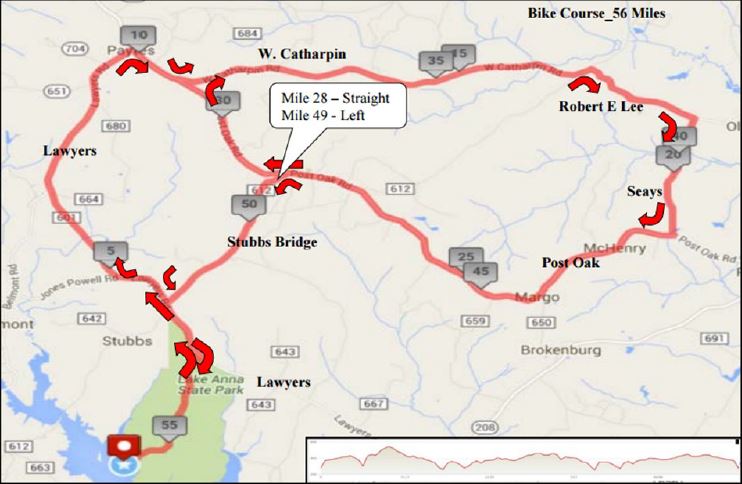
kinetic bike

It was in the mid-50s when I got on my bike and I had chosen to ride without long sleeves to avoid the extra drag and time involved in putting on extra clothing.  I was worried about being cold, but felt like it was JUST warm enough to get by.  That being said, I knew that I’d be cold in the first few miles until I got my core temperature up.

The first mile was all uphill, and I immediately noticed a squeaking noise coming from my chain.  I shifted gears, shifted in and out of the big chain ring and even tried half-shifting, but nothing helped.  I decided to ignore the noise and hope that it went away, but it was highly noticeable as I trudged uphill at low speed.

Miles 1-10 were some of the most unpleasant miles that I’ve covered on the bike in a race.  They were almost all uphill and into the wind and I felt like I was going nowhere.  I was still trying to get warm, and the average speed on my GPS was depressing me.  After mile 5 it read only 18.0 miles per hour and after mile 10 it was only up to 18.2.  To make matters worse, my chain continued to squeal like a stuffed pig and I seriously considered stopping because I was afraid of causing damage.  I didn’t know if the chain was rubbing and slowing me down, whether the wet weather was just causing lubrication issues – or something else entirely.  I decided to keep going, but felt embarrassed every time I passed someone (or got passed) on a hill since we were going slow enough to hear the awful noise.

Near the 10 mile mark the course made a right turn and headed downhill for the next six miles.  That did wonders for my mental state, particularly since the wind was at my back during that stretch.  I was holding 23 miles per hour, and finally saw my average pace heading upwards.  At the bottom of the decline there was a steep hill that sent me into my small chain ring, and then another downhill portion for about three miles.

The next 11 miles or so completed the first loop of the two-loop course, and went from miles 19-31.  The suck returned once again, because that portion of the course was almost all uphill and into the teeth of the wind.  I tried to keep a positive outlook, but it was a real struggle to get my bike up to 20 miles per hour.  I felt like I was working hard, but just couldn’t get any sustained speed.

At mile 31 I took a right turn and was back on the portion of the course that was downhill and with the wind.  Those miles went by quickly, and it was nice to see my average speed finally creeping up toward 20 miles per hour.  The fun was over soon enough though, and it was back uphill and into the wind again until mile 49.

Mile 49 brought the end of the second loop, and the final 7 miles were mostly back downhill to Lake Anna.  I continued to pedal hard since gravity was on my side, and by the time that I got back to the transition area, my average speed was 20.2 miles per hour.  For some reason, I was thinking my my average speed PR had been 20.4 miles per hour at the Patriot’s Half in 2016, but in reality, I’d only held 20.1 miles per hour in that race.  Thus, as crappy as I’d felt like my bike leg had been, it was actually a PR for me, and good enough for 4/29 in my age group.  This was shaping up to be a weird race, and my perception wasn’t neccesarily consistent with my results.  I guess the conditions on the bike sucked for everyone else as well.

T2: 3:08

Even though I’d warmed up enough to feel somewhat comfortable on the bike, upon dismounting, I immediatley noticed that both feet were numb from the cold.  It made running difficult, and I struggled to get back to my transition spot.  I got my shoes on and did my best to avoid the worst of the mud puddles in the transition area and then got out onto the run course.

Run: 1:56:41 (8:54/mile)  14/29 AG

kinetic run full

My goal for the run was sub-2 hours and my stretch goal was to hold a pace of 8:45 mins/mile, which equates to 1:54:42.  I knew that would be tough due to the hills, but I was going to give it a try since that’s what Karen had called for prior to the race.  The problem would be pacing myself properly since I was unlikely to run many (or any) 8:45 minute miles due to the terrain.  I figured that I would shoot for 9 minute miles on the uphills and 8:30 miles on the downhills.  I also wanted to try to negative split the three loops.

Miles 1-3 (9:24)(8:29)(8:58)

Karen always wants me to run the first few miles slow, and given that the first mile was a nasty hill up and away from the lake, that wasn’t a problem.  In addition, the sock on my right foot felt bunched up, so I had to stop and take off my shoe near the 1/2 mile point.  In actuality, my sock was fine, my foot was just feeling odd as it began to warm up and was becoming less numb.  By the end of the first mile my feet seemed to be getting back to normal, and I was glad to be done with the hill.  Unfortunately, I’d see it again on loops 2 and 3.

Mile 2 was pretty much all downhill, and I stuck to my plan of shooting for an 8:30 mile by turning in an 8:29.  I was feeling pretty good and began a small loop around some houses on the lake.  At the far end of the loop the coursed turned back the way it came and headed back uphill.  Mile 3 was mostly uphill, and I nailed my 9:00 minute plan for the uphills with an 8:58.

Miles 4-6 (8:33)(9:17)(8:41)

The first third of mile 4 was still uphill, and then I took a left turn to head back down towards the transition area to complete loop 1.  I was holding together well when I started the second loop at mile 4.5, but then it was back onto the nasty hill out of transition again.  I began to see some people walking up the hill, but I ran a slow steady pace and was able to get up it uneventfully.  I was certainly starting to tire, but was still in a good place mentally and physically.  By the time I hit the 6 mile marker, I was headed back downhill towards the lake loop again.  I had averaged 8:54 minutes/mile up to that point, but I still had more downhill to run on the first half of loop 2.  Thus, I was a pretty much on schedule, particularly since I planned to run loop 3 faster if at all possible.

Miles 7-9 (8:50)(8:57)(8:53)

By this point in the race, the miles were not lining up perfectly with the uphill and downhill portions, so pacing became a bit more tricky.  The hills continued to take their toll, and not just the uphill portions.  Running downhill taxes your quads, and after a while they get weak and feel like they want to give out.  By the time that I finished mile 9 I was getting pretty tired, but had completed my second loop.  Loop 1 took about 38 minutes, and loop 2 took 38:37.  It looked like my plan to negative split was going out the window, and hopefully I could keep from blowing apart on the final loop.  If I couldn’t hold an 8:45 pace, I definitely wanted to come in under two hours on the run.

Miles 10-12 (9:09)(8:38)(9:37)

My last trip up the hill out of transition was pretty brutal, but I was able to keep running.  There were a fair amount of hill walkers by that point, so I was encouraged by the fact that I didn’t need to walk.  I got to the top of the hill, took a right, and then it was downhill to the lake loop one last time.  I felt like I was doing well, all things considered, but I do recall seeing some really strong runners on the course.

After running around the lake loop for the final time, it was back uphill (for the last time!), and about halfway up the hill I saw Jim running down the other side.  He’d started about 4 minutes after me in the second swim wave, so I knew that I’d have to finish at least that much ahead of him to beat him.  He looked good when he went by and he is a super strong runner.  I tried to do the math in my head, but was unable to figure out how much of a lead I had.  Nevertheless, I knew that it was going to be close, and kept trudging up the hill, but with a little extra motivation.

Mile 13 (8:24)

I completed mile 12 at the top of the last hill, and then it was just a downhill run to the finish.  I tried to pick up the pace as much as possible, but my quads were pretty much shot at that point from the neverending hills.  I managed to dish out an 8:24 mile, but given the elevation loss, I would have hoped to have done a bit better.  When your legs feel like they could go out from under you at any moment though, you can only do so much.

Mile 13.1 (7:53 pace)

After reaching the bottom of the hill, I got to turn right into the finishing chute insteading of taking a left to begin another loop.  There was a 100 yard run on some fairly wet grass and then it was finally over.  I’d done loop 3 in about 38:04, so I was happy that I’d been able to rally and keep the wheels from coming off.  Overall, I’d put together an 8:54 min/mile pace, which was only 9 seconds off  Karen’s target.  That was a PR for me, and I was very happy with that performance, given how much I felt like I’d struggled on the bike.  Had the course been remotely flat, I felt as though I’d have been able to hit those 8:45 minute miles.  As noted above, however, there were a lot of strong runners out there, so my run was only good enough for 14/29 in my age group.  I’ve still got a lot of work to do with my running before I can compete for an age group podium in these larger races.

Post Race

After finishing, I turned and waited to see Jim finish.  He came in shortly thereafter, but it turned out that his overall time was about two and a half minutes more than mine.  Nevertheless, my time of 5:25:51 was only good enough for 8/29 in my age group, but Jim was 2/17 in his age group.  We both left the race site before the awards ceremony, but I think they ended up mailing him his award.

In reflecting on this race, I still have mixed emotions.  On the upside, I PR’ed in all three disciplines, and the conditions on the bike and the hills on the run made those discliplines very challenging.  Even though I PR’ed on the swim (in a wetsuit), I still felt like my swim wasn’t what it should have been, and I’d failed to keep my heartrate under control pretty much the entire time.  That led to way too much breaststroke in order to catch my breath.  I was still getting used to open water swimming, and still hadn’t gotten completely comfortable in a wetsuit.

I was most proud of my bike leg, turning in a ride that was 4/29 in my age group.  I’d dealt with a chain that was squealing so badly that I’d considered stopping, and I was able to fight off the cold and the negative emotions and keep pushing – even when I thought that it was going to be a bad ride.  As for the run, I ran well (for me), but I’ve got some real work to do there.  My 2016-2017 winter regimen with Erin produced big gains on the bike, and I’m determined to have similar gains on the run after my 2017-2018 winter regimen.  I’m sure that Karen will be up to the challenge.

So, I’d say that the 2017 Kinetic Half was a success for me, and since it was early in the season, I still had time to make additional gains before my next half in early September, followed by Ironman Chattanooga on September 24th.  In the interim, however, I’d signed up for the Powersprint Triathlon (as a bit of an afterthought), which was only a week away.  Thus, I didn’t have a whole lot of time to recover, and hopefully that quick turnaround wouldn’t be problematic.  I’d gotten second in my age group at the Powersprint in 2016, and I hoped to make the podium once again if I had any juice left in my legs after Kinetic.

“The black cat’s changing colors…”

2017 RTC Sprint Triathlon

Race Report

1:05:34

 7/22 AG     44/445 Overall

April 22, 2017 – Since 2015, the RTC Sprint has been my first tri of every season, and its a pretty big event in the Richmond triathlon community.  That being said, I hadn’t had the best of luck in prior years.  In 2015, my goggles broke in the first 10 meters of the swim and then I flatted on mile two of the bike course.  In 2016 things had improved, but a SNAFU at the swim start due to confused volunteers had cost me some time.  In 2017 I hoped things would go better, and my friend Meredith was running the swim start (since she was pregnant and could not race), so I was hoping for a smooth race.  I’d been training all winter, so I was ready to see if my suffering at the hands of Erin Wittwer and Karen Holloway had been worth all of the lost sleep.

The focus over the winter had been on making me faster, so the training had been focused more on intensity over volume.  Even though I had only begun swimming in 2014, Karen quickly figured out that my weakness was running.  I don’t know if that means that I was a quick study in the pool or just a slow runner, but I was used to sliding down the age group standings on the run in triathlons of every distance.  In sprints, I was averaging 7:30 minute miles off the bike, but the AG winners were consistently running in the 5:45 to 6:30 range in the local races.  Thus, I was hoping to improve in that aspect the most to limit the damage.

The forecast for race day was cool and rainy, and I arrived at the Collegiate Aquatic Center (or SwimRVA…or whatever its currently called) well before dawn.  It wasn’t raining when I arrived, but the radar showed heavy rain inbound.  Thus, I set up my transition area and then went inside in order to stay dry.  Unfortunately, my transition spot was much closer to the pool than it was to the bike out/bike in area, so I’d have a long run out of T1 and into T2 in my bike shoes.  That may not sound like a big deal, but every second counts in sprint races.

After an hour or so inside and warming up in the instructional pool, it was time to line up according to bib number for the start.  Due to my problems in prior years, I had seeded myself a bit lower in the swim, and was two groups behind Busher.  Since the swim waves were sent off in 30 second intervals, he had a 60 second head start on me.  He was still suffering from his car accident in late 2014, so he hadn’t been training very much.  Even so, I was looking to catch him on the run course.

Race Results

rtc bike.jpg

A tad wet on race day.

Swim- 7:10  (1:48/100m)  8/22 AG

The 400 meter swim started uneventfully (thanks Meredith!) and I made sure that I didn’t go out too fast.  Nevertheless, by the 100 meter mark, I began to pass people in my swim wave, and it isn’t easy to pass in the pool, particularly near the turn buoys.  By the 200 meter mark, I was catching up to people in the swim wave ahead of me, even though they’d had a 30 second head start.  It turned into a real clusterf*ck about that point, and I lost a lot of time trying to go around people.

rtc swim 2.jpg

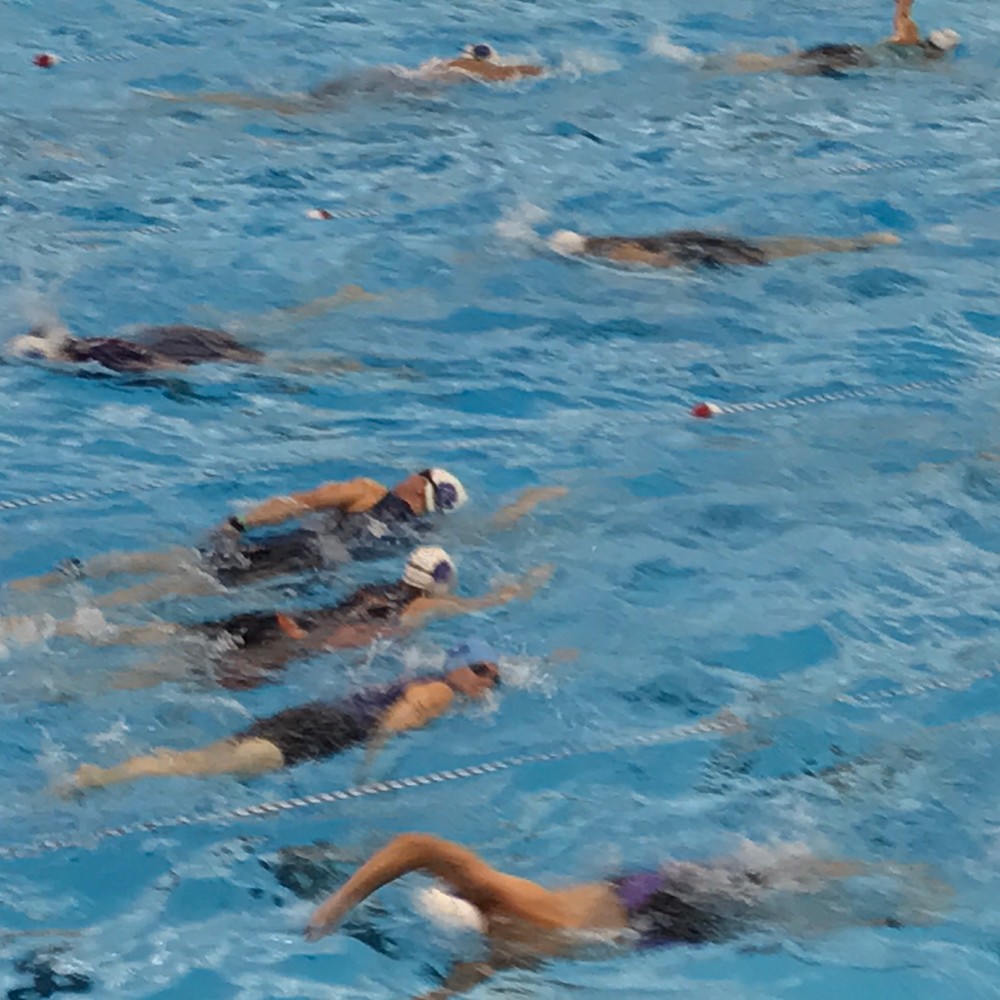
Middle of the picture, close to the lane line.

I began regretting my swim seeding decision, and it takes a lot of effort to pass people in this particular race due to the turns.  By the last 100 meters I was held up by “lapped” traffic, and even resorted to breast stroke since I was “trapped” by some of the other swimmers and had no where to go.  Lesson learned, next time I will over seed instead of under seeding myself.

As I approached the swim exit I saw Busher climbing out of the pool.  I was only a few seconds behind him, and was surprised that I’d gained nearly a minute on him in the swim alone, particularly since I didn’t have a great swim.  He would later tell me that he had a bad swim as well, and that he really hadn’t trained for this race due to ongoing neck pain from his accident.  In fact, he wasn’t actively training through ProK/Sweet Spot and was considering giving up the sport entirely.  Sad news since he got me into the sport and had been my primary mentor…but that would need to wait for later, the race was on.

RTC swim

I always look surprised to have lived through the swim…

T1- 1:36

T1 was uneventful, but took me a little longer than I’d have hoped due to the location of my transition spot.  After putting on my helmet and cycling shoes, I ran down the hill to the bike out exit, clipped in and took off.  Even though the temperature was on the cool side, I decided not to put on a long sleeved shirt and just to ride in my tri suit in order to save time.

Bike – 32:46  (22.8 mph)  5/22 AG

When you come out of T1 there is an uphill portion as you ride towards Ironbridge Road.  I didn’t have any trouble clipping in, and then took off up the hill and made the right turn onto Ironbridge.  As soon as I made the turn I tucked in tight and took off.  This was my first sprint race since Erin had started training me on the bike in late May of 2016 and I felt like I was flying.  I was fully tapered and riding on well-rested legs.  I must have passed 10-15 people in the first few miles, which included Busher – who wasn’t looking like himself at all.  I didn’t know if I could keep up the pace, but I felt great and was rolling.  It was a ton of fun.

By the time that I turned right near the Chesterfield County Airport I was still feeling good, and had continued to pass people.  My average bike pace kept creeping up, and I was already closing in on my 2016 average speed of 21.8 mph.  My legs still felt good, so I continued to push the pace.

The back half of the bike course is somewhat of a blur, but I do remember a car pulling in front of me around mile 10.  Thankfully, it made a right turn before it became much of a problem, but I thought I was going to get stuck behind it since it was stuck behind a couple of cyclists in front of me.  As I closed in on the end of the bike course, my average speed ticked up to 23 mph.  That was uncharted territory for me, but I lost a bit of speed as I came back into the transition area.  When I hit the lap button on my GPS it read 22.8, which was 1 mph faster than 2016.  That may seem a bit insignificant, but a 1 mph gain on the bike is pretty huge.  All those Sweet Spot intervals paid off – thanks Erin.

T2- 1:20

Once again, my transition was a bit slow, but I had an unfortunate transition spot.  I racked my bike, took off my helmet and then changed shoes.  I was then off towards the run-out spot of the transition area, and saw Meredith directing traffic as I headed out onto the run course.

Run- 22:33 (7:15 min/mile)   10/22 AG

Mile 1 (7:19)

Karen had challenged me to run 7:15 miles off the bike, which would have been a big improvement from my 7:27 mins/mile effort in 2016.  I came out of T2 “hot” and quickly saw that I was running a sub-7:00 pace.  That’s easy to do when you’re fired up by the spectators, and I’d just run by my family, so I was definitely overdoing it.  I slowed up, and was determined to negative split the run.  I eased into a 7:20 pace, and figured that I’d speed up every mile.

rtc run start.jpg

Turning right out of T2.

Mile 2 (7:17)

The first mile went by pretty quickly, and I was looking for Busher as I ran.  I never saw him on the run, and was wondering how his race was going.  By mile two, the pain had begun to set in, but I still pushed the pace a little harder to make sure that I could hit Karen’s goal of 7:15 mins/mile.  I was a tad worried about blowing up, but by the end of mile two, I still felt OK.

Mile 3 (7:12)

Mile three was painful (as always), but in a good way.  I continued to increase my pace, and even though my legs and lungs were burning, I found that I still had a little more left in the tank.  As I headed up the lone hill on the course towards the Martin’s parking lot, I began to pass some people, which spurred me on even more.

The last 1/2 mile is mostly an out and back in the Martin’s parking lot, and I ran as fast as I could convince my legs to carry me.  I saw my ProK colleague Jill (who was also volunteering) near the turnaround cone, but she didn’t see me and I didn’t have enough wind in my sails to say hello.  The final 1/4 mile seemed to go on forever, but the run into the finish line is all downhill.  I sprinted towards the final timing mat and finished about two minutes and thirty seconds faster than in 2016.  Again, that might not seem like a lot, but it’s quite a bit in a sprint race.  Thanks Karen.  Thanks Erin.  That was a huge improvement in less than twelve months of training.             

RTC run.jpg

Post Race

I was only 7/22 in my age group, but the RTC Sprint is super competitive and is one of the largest triathlons in Richmond.  I actually finished worse in my AG than in 2016 (6/22), but I was 44th overall, compared to 54th overall in 2016.  I was faster in every discipline, and probably would have been another 30-60 seconds faster if I’d had a more fortuitous transition spot and if I’d seeded myself more aggressively in the swim.  Even though I was well off of the 35-39 AG podium, I was extremely pleased with my performance.

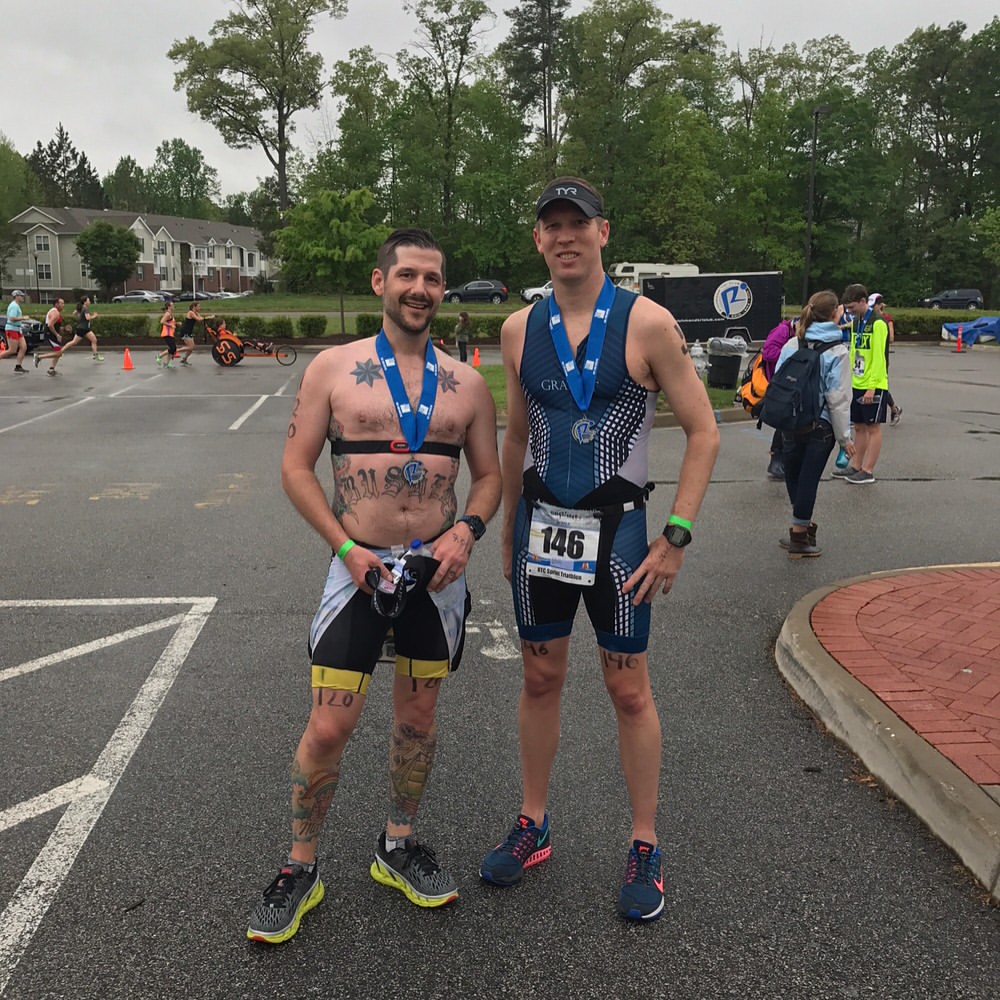
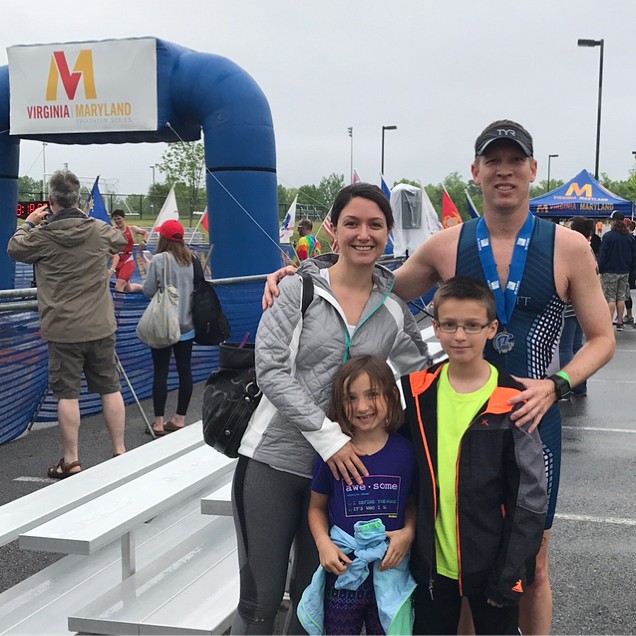
After finishing, I caught up with my family and then saw Busher finishing amongst a lot of fanfare from the announcer.  He didn’t have a particularly good race, but as always, was in good spirits.  There wasn’t a lot of time to hang around since the kids had soccer games, so after some post-race food, we were off.

My first triathlon of 2017 was definitely a success, even though the swim had been suboptimal due to poor swim seeding.  I’d made big gains on the bike and run, even though I hadn’t yet had a full year of coached training, and I was excited to see how the rest of the season would develop.  Next up was the Kinetic Half Iron Triathlon at Lake Anna in May, which I’d never done before.  All I knew is that the run was supposedly a bear due to the hills.  I was hoping that the weather would be a little better for that race due to the fact that I’d be spending over five hours on the course compared with the 65 minutes that it took me to complete the RTC Sprint.  Unfortunately, that would be another cold, wet and windy race, which would tax my mental and physical fortitude.

rtc busher.jpg


rtc family

“Winter’s cold, spring erases…”

2017 Monument Avenue 10k Race Report

 45:51 (7:22/mile)

93/954 (AG)     817/21,953 (Overall)

April 1, 2017 – My first race of the new season is the Monument Avenue 10k, which I’d only done twice before.  In 2007 my goal was to go sub-50:00 and I finished in 47:10 after my ability to go sub-50:00 had been questioned (by my well-intentioned neighbor).  In 2014 I raced with an injured left IT band after a month-long layoff and was only able to manage a disappointing 48:58.  I’d been training all winter with Karen and Erin since the conclusion of my 2016 season, with my only real downtime being the week that I’d spent in Haiti in December.  There were a lot of cold, dark mornings where I’d have rather been in bed instead of running outside, but I was determined to get faster before the spring racing season started.

The Monument Avenue 10k was one of the “A” races on my calendar, so my coaches gave me a full taper for it.  Karen thought that I might be able to run 7 minute miles, but she had never before trained me for a stand alone 5k or 10k – so I thought she was a bit optimistic.  My personal best in a 5k had been at the 2015 Turkey Day 5k in Martinsville, which is a hilly course.  I’d run that race at an average pace of 7:13 minutes/mile, so that was my best recent result to use to extrapolate my 10k pacing.  There was no point in using my time from the 10k in 2014 since I’d been injured.  Ultimately, we (mostly I) decided on shooting for a sub-46:00 race, so I’d need to run 7:24 minutes/mile or better to get it done.  I figured that was doable, and would lead to a PR of at least 1:10 if I was successful.

Over the course of my 2016 season I had learned to trust Karen’s pacing strategy.  There was some mild disobedience early on where I went out too fast on the run, and that had been counterproductive in every instance.  Thus, I was fully committed to doing exactly as she said for the 10k.  I was told to run the first three miles at a 7:30 pace, and then to negative split the last 3.2 miles as much as possible.  In 2007 and 2014 I’d gone out too hard in the first 5k and then really struggled coming back in.

From a health standpoint, I was injury-free for the first time in about a year.  I’d fought metatarsalgia and piriformis for all of 2016, and the metatarsalgia had been controlled with orthopedic inserts in my shoes.  I tried a couple of rounds of physical therapy for the piriformis, but it never fully went away.  Over the winter I’d started having deep tissue work done once a month at Karen’s suggestion, which was a fairly painful process.  That being said, after four or five sessions, the piriformis pain had finally began to abate.  So, come race day I was healthy, rested and ready to see if I was faster at 38 than I had been at 28.

My only problem heading into the race is that one of the ear buds for my IPod broke about five minutes before my start time.  It still worked, but was hanging by the wire.  I managed to get it back in my ear and hoped that it wouldn’t fall out as I ran.  Then, it was into the corral with Wave C as we moved forward to the starting line.

Race

GPS Data

Mile 1 (7:29)

Based upon my expected finishing time, I probably should have been seeded in Wave B.  Nevertheless, most of the folks in the Wave C corral ran past me in the first mile.  I resisted the urge to go with them, and in the past, I’d made the mistake of going too hard in Mile 1.  There was a fair amount of congestion, but after we took a right onto Monument Avenue I hugged the left side of the road and it wasn’t too bad.  I knew from experience that I’d end up running a tad over 6.2 miles, and thus, I would need to run an actual pace that was a shade faster than 7:24 minutes/mile in order to have an official time below 46 minutes.  As expected, my GPS read 1 mile just before I got to the Mile 1 sign, and I’d probably run a little extra distance bobbing and weaving around the other runners.  I ran the first mile in 7:29, which was right on Karen’s plan of 7:30’s for the first three miles.  The heart rate was climbing, but I was feeling good.

Mile 2 (7:29)

The second mile of a 10k for me seems to take forever, and this time was no different.  You’re beginning to get far enough into the race to start feeling the burn, but you’re not even halfway home.  I continued to have Wave C folks run past me, but I didn’t let that discourage me or get me off my pacing strategy.  I knew that at least a few of them would get passed on the backside.  I stuck to the plan with another 7:29 mile.

Mile 3 (7:27)

By the start of Mile 3 my heart rate had headed north of 180 but I was still feeling pretty good.  Its hard to tell, but the “out” portion of the race is a slight upgrade and there was a light wind blowing out of the west, which wasn’t helping.  Thankfully, I’d found a lot more daylight as the race progressed, so there was less bobbing and weaving going on.  Fatigue was creeping in, but I still felt better than in years past.  Once again, I came in very close to my 7:30 minutes/mile goal with a third mile of 7:27.  Given the extra distance that I knew I’d be running, I was really right on pace.

Mile 4  (7:19)

The turnaround cone was a welcome sight and I hit the 5k mat in a time of 23:26 for an official pace of 7:32 minutes/mile.  That meant that I needed to run the final 5k in 22:33 or less to go sub-46:00 minutes.  I’d signed Karen up for text message alerts so she could track my progress on her phone, and I imagined that she was pleased when she saw my 5k split.  I was behaving myself this time.

After turning around to head back east I picked up the pace a bit.  I was tired, but I still felt like I had a decent amount left in the tank.  I was conscious about overdoing it though, so I didn’t speed up too much, not wanting to bonk in the final mile.  By the end of Mile 4 I was hurting, but still OK.

Mile 5  (7:18)

Mile 5 of a 10k is kind of like Mile 2 for me.  It hurts, but the end is still a ways off.  On the upside, I was gradually moving up through the field and was passing people who had run past me in miles 1 and 2.  As much as my lungs and legs were burning, it felt pretty good to pick people off one by one, and that became a lot of my motivation.

Mile 6 (7:12)

The last full mile of a 10k hurts so good.  My legs and lungs were on fire, but I knew that the end was near so I was able to pick up the pace even more.  I passed a lot of people in Mile 6 and it was clear that many people had gone out too fast.  I’d done that in both of my prior 10ks, so I was familiar with that feeling of just hanging on.

I looked to me like my sub-46:00 goal was in reach, and by the end of Mile 6 my average pace was reading 7:22/mile on my GPS.  That was two seconds below my goal pace, but I knew that my official pace was slower since my GPS was tripping every mile before I was getting to the official mile markers.  I needed a time buffer for sure, but I wasn’t sure exactly how much.  I knew that it was going to be close.

Mile 6-6.26  (6:15 minutes/mile pace)

You hit that 6 mile marker and you think its over, but that last 2/10ths of a mile seems to go on forever.  I began my final kick as soon as I passed the 6 mile marker and kept glancing at my watch as it ticked ever closer to 46 minutes.    I could see the finish line up ahead and put everything I had left into the end of the race.  As I crossed the timing mat I stopped my GPS and saw that it was reading 45:51 – 9 seconds to spare.  I promptly collapsed on a nearby retaining wall to catch my breath, but was then chastised about moving through the finishing chute by a volunteer.

Post Race

After cooling down a bit, I found a couple of work colleagues and chatted about our races for awhile.  I took advantage of the free Chapstick and Whitehouse rolls, and then made my way back to my office where my car was parked.  The finishing area was getting pretty full by that point, so it was a good time to bail.

Overall, I was very pleased with my race and I’d executed Karen’s pacing plan pretty much spot on.  I PR’d by 1 minute and 19 seconds over my 2007 time, and I beat my 2014 time by more than 3 minutes.  All of those cold and dark runs over the winter months had paid off, and I was running faster at age 38 than ever before.

As much as the race had hurt, part of me wondered if I could have gone faster.  Karen had originally thought so, but I wasn’t convinced and had told myself that sub-46:00 was the best I could reasonably expect.  Perhaps my body was only willing to live up to my mind’s expectations.  If I’d have said 45:30 or even 45:00, could I have made it?  I don’t know, but maybe I’d have to be a bit more aggressive with my pacing goals in the shorter races moving forward.

Next up for me was the RTC Sprint Triathlon on April 22nd.  That race, and particularly the swim, hadn’t treated me very well in 2015 and 2016.  Maybe, as they say, the third time would be the charm.

monument result


Taking Stock – 2016 Year in Review

2016 was another year of firsts for me, and most importantly, my first attempt at a full Ironman.  I completed Ironman Maryland, but due to bad weather and flooding, the course had been shortened from 140.6 miles to 126.2 miles.  That included a complete cancellation of the 2.4 mile swim.  I’d hit my pacing goals for the bike and the run portions – even with a flooded run course – but it was still bittersweet.  I had trouble calling myself a true Ironman and ended up deciding against getting the M-dot tattoo.  Even though I’d promised not to do a full distance Ironman in 2017, my wife had pity on me.  By the end of the year she had agreed to let me to sign up for Ironman Chattanooga on September 24, 2017.

My other big first in 2016 was signing up for coaching services with Karen Holloway and Erin Wittwer through ProK Racing and Sweet Spot Cycling respectively.  I quickly learned that I hadn’t been training as hard as I thought I had, and they increased my training volume and intensity beyond my prior levels very early on.  There was also a new accountability factor, so workouts were only missed when I had a really good reason.  In fact, I found myself developing a phobia of yellow and red when it came to my Training Peaks account.  Anything other than green meant that I wasn’t doing a workout as prescribed.

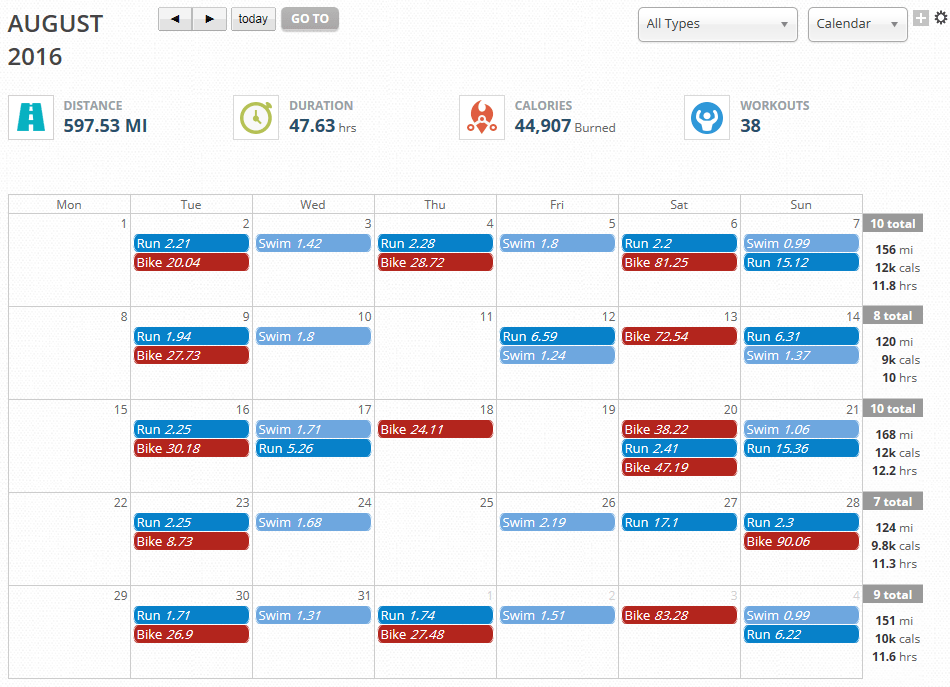
From a training standpoint, I had increased my swim/bike/run volume from 228.79 hours in 2015 to 305.37 hours in 2016. That was a jump from 4.4 hours per week to 5.9 hours per week.    The majority of that difference came after May once I began working with Karen and Erin, and my volume peaked in August 2016 as I prepared for IMMD.

August 2016.PNG

Peak training for Ironman Maryland


The goals for 2017 were to make some additional age group podiums in the local spring triathlons and then to prepare for a sub-12 hour effort at Ironman Chattanooga.  Other than recovering from IMMD and the Richmond Marathon, and then a week-long break during my Haiti mission trip in December, I really had no plan to take a hiatus from training.  I’d battled nagging injuries (piriformis and metatarsalgia) for most of 2016, but was mostly injury-free by the end of the year.  Hopefully the injury bug wouldn’t bite in 2017.

20162016 1

“Lately I’ve been feeling low, a remedy is what I’m seeking…”

2016 Richmond Marathon Race Report

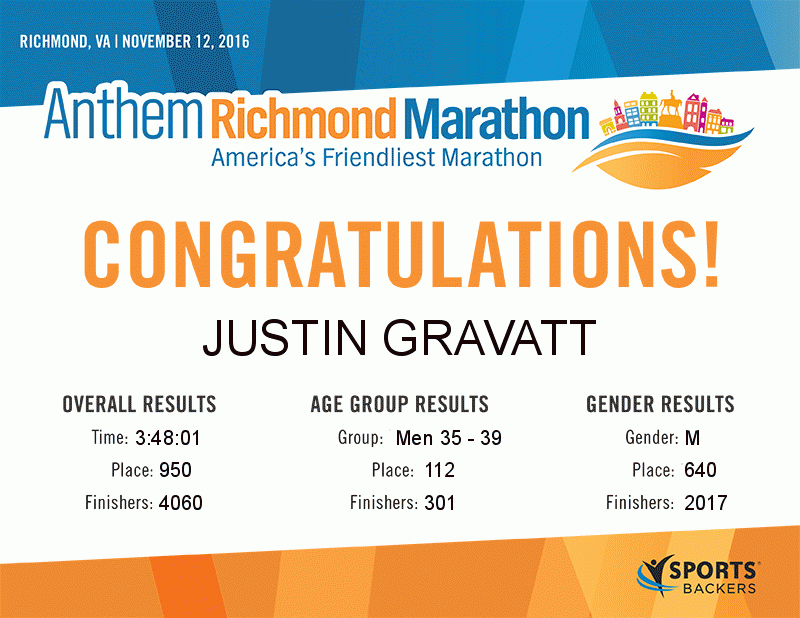
3:48:01     (8:41 min/mile)

112/301 AG     950/4060 Overall

Its so common that they have a name for it – the Post-Ironman Blues.  You train day after day, week after week, month after month – all for a singular purpose – Ironman glory.  You kill yourself for a day, you finish, you’re euphoric…and then…nothing.  No more 4:30 a.m. alarms.  No more weekend long rides and runs.  No more anything.  Your life has revolved around Ironman for so long that you don’t know anything else anymore.  Its like becoming “institutionalized” in The Shawshank Redemption.  After being released from prison, you’re ready to rob somebody just to get sent back to the big house.  “Brooks was here” indeed.

After Ironman Maryland, the rush of finishing faded fast and I felt like there was a giant void in my life.  Sleeping in while recovering from that endeavor was great, but it felt like my hard-earned fitness was going to slowly fade away.  I was already signed up for the Richmond Half-Marathon, but I was wanting more.  Ironman training makes you obsessive, and its a hard cycle to break cold-turkey.  I needed some metaphorical Methadone to help me kick the habit, so I began thinking about upgrading to the full marathon, and voiced my thoughts on that issue to coach Karen.  That was like asking a fox whether it wanted to babysit a chicken, and soon enough, I was signed up for the Richmond Marathon.

There wasn’t a whole lot of time left for race specific training, and I ran 13.2 miles exactly two weeks after IMMD as my last “long” run.  I continued biking during my marathon prep, but swimming was pretty much cut out of the program.  If the short turnaround time wasn’t problematic enough, my right knee starting hurting in late October and I was sidelined for a weekend.  Leigh Anne did a marathon with her friend Michelle that weekend in North Carolina, so my downtime was spent spectating and watching the kids while the ladies ran, which actually worked out quite well.  Thankfully, my right knee pain went away after a few days, but I was still fighting my left-sided piriformis issues.  Those were old hat, however, and come race week, I felt like I was ready to go.

I’d only run one standalone marathon before, which had been the Richmond Marathon in 2015.  That race was sort of an afterthought to the Richmond Rox 70.3 triathlon, so I had never really trained solely for a marathon.  I’d run a 3:53 in 2015, and Karen and I thought I should try for a 3:45 this time around.  That felt sort of like a moonshot for me, so I figured that I’d either meet my goal or blow up spectacularly.  Either way, it would be fun.

Pre-Race

A 3:45 marathon equates to an 8:35 minute/mile pace.  Karen had told me to run the first three miles at a 9:00 minute pace, and then to run the rest of the first half in the 8:35 – 8:40 minute range.  The plan was to negative split the race, and hopefully I’d be able to run some sub-8:35 miles on the backside.

Race morning was cold but not freezing, and I drove downtown and parked at my office to avoid the bulk of the traffic.  I then walked/jogged about 10 blocks to the starting area and immediately got in the long line for the porta-potties.  I’d given myself about twenty minutes to spare, but by the time they started playing the National Anthem, I still had a long ways to go in the bathroom line.  Thus, I abandoned the line and figured that I’d just have to hold out and hope for the best during the race.

Even though I hoped to run a 3:45, I hopped in the starting corral with the 4:00 pace group since I was going to ease into the race.  As soon as I found my place, the race had started, and so began the movement en masse towards the starting line.

Race

GPS Data

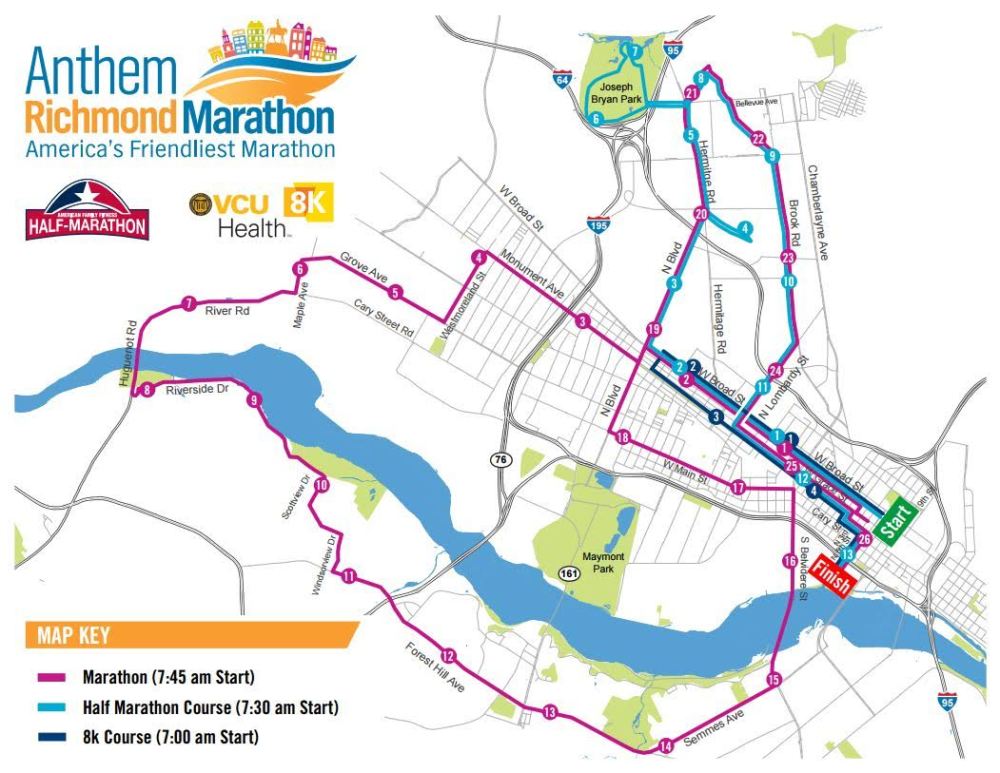
marathon map

Mile 1-3 (8:54)(8:57)(8:54)

From the get go, most of the folks lined up with the four hour pace group took off in a hurry.  A four hour marathon equates to 9:07 minutes/mile, and I was setting off at a 9:00 minute/mile pace.  I was near the front of the pace group and got swallowed up by throngs of people passing me.  That was okay, and I hoped that I would be passing them a little bit later in the day.  The first three miles all head west and are really flat, so it was pretty easy to lock in my pace.  In actuality, I ran slightly faster than I planned, but I was close enough to the plan to satisfy Karen.

Miles 4-6 (8:36)(8:36)(8:41)

The next three miles were still very flat and took us out towards the Country Club of Virginia on River Road.  I’d picked up my pace a bit after passing the Mile 3 marker and was feeling good and relaxed.  I hadn’t brought any gels with me since I knew they had those on the course.  I didn’t need one quite yet, but hadn’t seen any at the first couple of aid stations.  I did have an 8 ounce running flask with Gatorade Endurance with me, and had been sipping on that instead of slowing for handoffs from the volunteers.  I planned to finish it by the time I got to the “party zone” on River Road near Mile 7 and then toss the empty flask to Leigh Anne if I saw her and the kids.

Miles 7-9 (8:10)(8:38)(8:32)

Mile 7 was pretty much all downhill on River Road so I let my feet turnover a little faster.  That led to an 8:10 mile, but my heart rate actually dipped thanks to the gravity assist.  I saw Leigh Anne and the kids near the bottom of the hill and tossed her my empty flask.  The course then crossed the James River, and then took a left to parallel the river towards the east.  I knew that the easy part of the course was now behind me and that there were some hills coming very soon.  At that point though, I was still feeling pretty good and was nailing my pacing plan.

marathon mile 7

Mile 7

Miles 10-12 (8:37)(8:44)(8:40)

Mile 10 was pretty flat, but then there was some climbing through neighborhoods up away from the river in miles 11 and 12.  My heart rate jumped up a bit, as did my pace for those two miles, which was expected.  Still, given the elevation gain, my pacing remained fairly steady.  Still no gels at any of the aid stations, however, and I was beginning to get a bit nervous about my nutrition.  I began eyeing the gels that were hanging off some of the other runners’ race belts and considered asking for one.  I wasn’t quite that desperate yet, but I was beginning to fear a late race bonk if I didn’t get some additional calories soon.

marthon mile 12

Mile 12 on Forest Hill Avenue

Miles 13-15 (8:35)(8:31)(8:27)

I crossed the halfway point on Forest Hill Avenue and STILL no gels to be found.  I’d asked the volunteers about gels at the prior aid station and somebody told me they thought there were some around mile 15.  I picked up my pace a little to begin my negative split on the backside and began having evil thoughts about the people around me who’d had the foresight to bring their own gels.  I made a mental plan to execute a gel mugging if I didn’t come across any soon, but about that time I finally saw a lady with a box of gels on the near side of the next aid station.  I grabbed two, downed one immediately, and then took the other one about a half mile later.  Caffeine and calories, just what the doctor ordered.

Miles 14 and 15 were both below my overall goal pace of 8:35/mile, but I knew that my least favorite part of the course was up ahead.

marathon mile 15

Mile 15 before the bridge.

marathon kids

Miles 16-18 (8:43)(8:44)(8:35)

As soon as you pass Mile 15, you take a left from Semmes Avenue onto Belvedere, which is a slight upgrade for 1.6 miles until you turn left onto Main Street.  You also have to cross the Lee Bridge, which is notoriously windy.  Unfortunately, the wind was coming straight out of the north, and thus, directly down the bridge.  There’s no shelter from the wind on the bridge unless you’re lucky enough to tuck in behind a group of people.

When I got to the bridge, the 3:50 pace group was about 50 yards ahead of me and I wanted to link up with them and draft.  I tried to accelerate, but just couldn’t catch up to them without putting out more energy than I wanted to expend with so much of the course left in front of me.  In looking at my GPS data, my heart rate jumped up as soon as I turned onto Belvedere and wouldn’t return to its prior level for the rest of the race.

Upon turning left onto Main Street off of Belvedere, you get a little bit of reprieve from the wind, but its still a false flat with an uphill grade all the way to the Mile 18 marker.  Due to the wind and the elevation gain, my pace deteriorated a bit for miles 16 and 17, but I got it back down to 8:35 once I turned out of the head wind.  By that point, I knew that I was going to have to have a super strong finish in order to get in under 3:45.  In 2015, however, I had begun to fade after Mile 18, and faded badly after Mile 22.  Hopefully I could keep it together this time around.  I had grabbed another gel at an aid station on Main Street, so at least that nutrition problem had subsided.

Miles 19-21 (8:25)(8:44)(8:35)

Miles 19 and 20 were north on the Boulevard, and straight back into the wind again.  My pace for mile 19 dipped back down to 8:25, but then it creeped back up again, probably due to having to climb over the bridge near The Diamond.  It was in that area that I saw Leigh Anne and the kids one last time before the finish line.  I also managed to catch the 3:50 pace group on the Boulevard and ran with it for about a mile before continuing on past it.

I pretty much knew that 3:45 was out of the equation since I just didn’t have the legs to maintain the sub-8:35 minutes/mile pace that I was going to need in the last 10k.  Since my stretch goal was no longer in the cards, my fall-back goal was to see how long I could hold things together without blowing up.  My legs definitely felt better at the 20 mile point than they had the year before, but the pain was already in the mail.

Miles 22-24 (8:44)(8:44)(8:43)

The next four miles were dark times for me and my mood really went south.  On the upside, I was able to put together three straight miles between 22 and 24 at a consistent pace, but the struggle was real.  Other runners and spectators began to annoy me for no reason, and I felt like lashing out at anyone who said “you’re almost done.”  The poor souls, they were just trying to be helpful, but I wasn’t in a mood to be helped.  I needed all of my concentration to keep moving forward on legs that were increasingly feeling like jelly.

Miles 25-26 (8:58)(8:43)

Mile 25 was not pretty.  To borrow a t-shirt quote – everything hurt and I was dying.  It was my slowest mile of the day in 8:58…BUT…my slowest mile was still under a 9:00 minutes/mile pace.  In 2015 I’d ballooned to 9:42 in mile 25, and had run a total of seven miles at or above a 9:00 minutes/minute pace.  There were no such miles in 2016 and I was proud of that.

The last mile of a marathon for me is infinitely better than the 25th mile, and I managed to get myself back down to an 8:43 pace.  The final quarter-mile was all downhill, which is fun, but a bit precarious on blown out quads.  I didn’t scream down the final hill quite as fast as I did in 2015, but it was still a fun descent.  I crossed the finish line in 3:48:01, and was immediately sorry that I didn’t run two seconds faster to finish 3:47:59.

That being said, I was more than five minutes faster than the year before, so I was happy with my effort.  Perhaps more importantly, I’d executed Karen’s race plan as well as I could, so I knew that I hadn’t left any time out on the course.  It had taken me a few races, but I’d finally started heeding her advice and pacing myself more conservatively in the beginning.  The time that I “lost” in the first three miles when I was warming up was more than made up for on the back end.  I felt like I passed a lot of people in the back half of the race who’d passed me at the beginning.

marthon certificate

Post Race

After the race I found Leigh Anne and the kids and downed a couple of slices of pizza.  Leigh Anne insisted on taking my picture in front of the race banner even though there was a long line, and then we began the long walk back to our cars.  It was all uphill back to my parking spot at the office, which wasn’t a whole lot of fun on tired legs.

So, with the Richmond Marathon complete, my 2016 race season had come to a close.  Not with a whimper, not with a bang, but with a solid effort in a race that I didn’t plan on tackling until six weeks beforehand.  In actuality, I was signed up for the Turkey Day 5k once again in Martinsville, but this time I planned on running with the kids instead of racing.  The primary focus of 2016 had been the day-in-day-out grind of preparing for my first full Ironman race, immediately followed by my marathon prep.  It was time to dial it down and to focus on helping the kids through their race.

marathon pr

marathon post race

“If nothing can be done, we’ll make the best of what’s around…”

2016 Ironman Maryland

Race Report – Part 2

9:44:09

 79/216 AG     424/1890 Overall

October 1, 2016 – Race day is finally upon me.  I spent a moment reflecting on how I came to be on the cusp of tackling a full Ironman triathlon, and it goes back to my 2013 New Year’s resolution to get in the best shape of my life.  2013 began with running and P90X, along with some obstacle course racing.  I stumbled into triathlon by accident in 2014 (Read about it here ), and by 2015 I had dropped the obstacle course racing entirely and had committed to triathlon.  I completed my first half-iron triathlon in May of that year, and had signed up for IMMD that Fall.

I didn’t have long to reflect since there was a lot to do before Busher and I headed out the door.  On went the trisuit and tri-tat numbers (with a little help from Leigh Anne).  I lubed myself up with sunscreen, even though the forecast was for rain and wind, and then I grabbed my gear and off we went.

We took Busher’s car to the nearby school that operated as a staging area, and we had to catch a shuttle bus to transition.  When we got to the school, pandemonium was beginning to ensue since all of the parking spots were taken and there was no one directing traffic.  Up went my stress level as I imagined scenarios that involved missing the shuttle buses, and then, the swim start.  Busher took the initiative in creating a new line of parked cars in an unoccupied portion of the bus loop, but then we had to stand in a long line while waiting for more buses to arrive since the one that had been there when we pulled in had already filled and departed.  After 10 minutes or so (which felt like an eternity at the time), several buses appeared and we managed to get on board one.  At that point, cars were still rolling up to the school in droves, and I have no idea where the remainder ended up parking.  Even the bus loop had completely filled up by that point.

The bus ride to the transition area was only 5-10 minutes, and my stress level had reduced a bit by that point since we were in route with plenty of time to spare.  Busher and I had even remembered to bring a pair of nail clippers with us so that we could cut the zip ties that were keeping our bikes from blowing of the bike racks overnight.  If you read Part 1 of this Race Report, then I’ll bet you were thinking that we’d forget about that, right?  Wrong!  Unfortunately, just as the bus was pulling up to transition I realized that my two 900-calorie nutrition bottles for the bike leg were still safely cooling in the mini-fridge back at the Day’s Inn.  Commence full-blown panic mode.

I didn’t have my cell phone with me and neither did Busher.  Thankfully, the lady in the seat directly in front me had one in her hand, so I asked her if I could use it.  Since the bus was starting to empty, she was a bit concerned, and was probably wondering if I planned on taking her phone and running off.  Busher, sensing her hesitation, yelled, “He forgot his nutrition bottles and needs to call his wife!”  She reluctantly relented, and I managed to get Leigh Anne on the phone and asked her to make an emergency trip down to the transition area.  Since many of the roads were closed, however, I was concerned about whether she could even get to me before the swim start, let alone find me in the throngs of people.

Roughly 20 minutes and three borrowed cell phones later, I finally managed to find Leigh Anne and grab my bottles.  Crisis averted, but I’d certainly wasted a lot of extra heartbeats in my anxious state that might have come in handy a little later in the day.
IMMD swim

Early morning controlled chaos.

Garmin Data

Swim: Cancelled

Now that the bottle-fiasco was over, I could finally focus on getting ready for the swim and in getting into my wetsuit.  At that point, the wind was blowing hard and the Choptank River still looked really rough.  After lining up in self-seeded swim waves, an announcement was made that the swim was going to be delayed for thirty minutes due to the rough conditions.  If the waves didn’t die down some during that time, then the swim was going to be cancelled.  Thus ensued thirty minutes of waiting and wondering.  More anxious heartbeats wasted.

At the appointed time, another announcement was made that the swim was being cancelled.  A collective groan went out from the athletes, and we were told that a “time-trial” start would begin for the bike leg in thirty minutes.  The lowest number would begin first, with athletes being sent off every 5-10 seconds.  Since I was bib 1442, I knew that I was going to have to wait awhile.  Interestingly, there were a handful of athletes who grabbed their gear and bailed.  I can’t image spending so much time and money on a race, only to quit due to a swim cancellation.  But I digress.

Back to transition I went and off came the wetsuit.  I didn’t have anything but my trisuit to wear since my long sleeve shirts were already in my gear bags and in the special needs bags that had been turned in to the race volunteers, and as soon as the wetsuit came off a chill began to set in.  Busher and I moved into the transition tent, but all the chairs were already occupied, so we were forced to either stand or sit on the cold concrete.  I was in the tent for over an hour waiting for my turn to take off on the bike, and in that time, I began shaking from the cold.  Many of the athletes had long sleeves for the bike leg, but I had decided that it would be warm enough to ride in just my trisuit since it was supposed to be in the 50s and 60s.  I began having serious reservations about that decision, and wondered if I’d set myself up for trouble.  I am, admittedly, a total wuss when it comes to being cold.

After what felt like an eternity, it was finally time for me to get out onto the bike course, and I left Busher behind in the tent.  Unfortunately for him, his walk up registration left him with one of the highest bib numbers, so he had about another hour to wait.  I wouldn’t see him again until the run course.
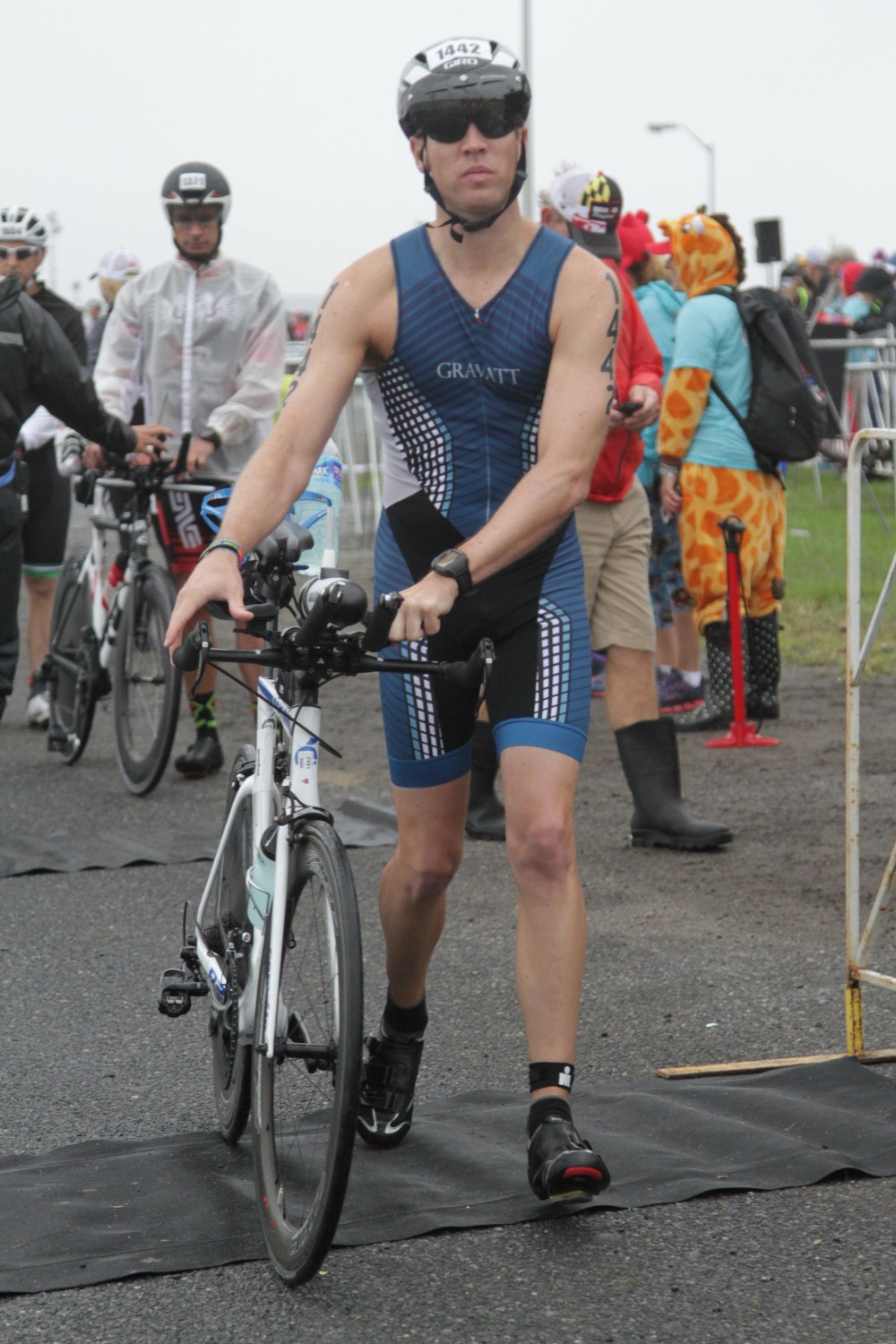
30_m-100751826-DIGITAL_HIGHRES-1391_054804-6064533

Time trial bike start by bib number due to swim cancellation.

Bike: 5:07:59   (19.48 mph)  

My conservative goal for the bike leg had been to complete the original 112 mile course in 6 hours or less, which equates to 18.6 miles per hour.  I knew that such a pace was more than doable since Coach Erin had me in good biking shape, and I was actually setting out to shoot for the 19-20 mph range.  Still, I’d never run a marathon after riding 112 miles (or 100 miles as it turned out), so I didn’t want to overdo it on the bike and end up walking on the run course.  I was going to err on the side of caution instead of pushing my luck.

The bike course was two loops after an initial 12 mile ride out of town.  Its very flat, and even though the official course map claims that it has ~1400 feet of elevation gain, I can’t recall that much elevation change.  The tough part of the IMMD bike course is the wind, and that part didn’t disappoint.  It was blowing out of the northeast pretty steady at about 10 mph, and must have been gusting to 20 miles per hour or more.  The wind, coupled with on and off rain, made for a challenging ride.

At my coaches’ direction, I eased into the bike and didn’t let the initial surge of adrenalin control my pace.  Any fears that I’d had of freezing on the bike evaporated after about five minutes, and I was plenty warm for the rest of my time on the bike.  I immediately noticed, however, that the high humidity was going to be an issue all day, and my glasses and helmet shield kept fogging.  I finally had to stow my sunglasses in the front of my trisuit and rode with just the helmet shield for the remainder of the ride.

Around mile 12 I got out onto the “loop” portion of the course and passed the local high school that was doubling as an aid station and the special needs area.  Shortly thereafter, I was riding in relative proximity to several other riders and noticed that the guy behind me was riding on my tail.  Interestingly, as soon as I noticed it a marshall came up from behind on a motorcycle and gave him a drafting penalty.  They are pretty good at sneaking up on you, and I’d see several marshalls on the course throughout the day.

From miles 13-30 I was able to make pretty good time since the wind was generally at my back.  It was during that stretch that 5-6 guys went by me in a pace line like I was sitting still.  They were blatantly drafting and riding together, and I don’t know if they ever got caught, but I was certainly hoping that they would.

From miles 30-40 the course turned to the north-west, and the favorable tailwind turned into a cross-wind.  This made things more difficult, but still manageable.  From miles 40-51, however, the course was headed north-east – directly into the teeth of the wind.  For the vast majority of that stretch we were on an open and unprotected portion of the highway.  I saw my speed dropping to 15-18 miles per hour, and I fought the urge to pedal harder to keep my pace up.  The goal was to ride at a fairly even effort all day long, and I didn’t want pride to sucker me into fighting the wind and blowing up later because of it.  That part of the course wore on me a bit mentally, but I knew that loop 2 was going to be even worse.

Around mile 51 I hit the turn to start the second loop and saw my family on the right side of the road just before the high school.  I hadn’t expected to see them until the run, so that was a nice surprise.  Shortly thereafter I pulled into the aid station, but didn’t actually need anything from my special needs bag.  My first nutrition bottle was kicked, and I needed to refill it from the second bottle, which was hanging off the back of my bike.  There was no safe way to do that while riding since I needed to remove the screw top from my original bottle, so I stopped for about 30 seconds to take care of business.  Then it was back out on the road for loop 2.

The second loop of a two-loop course is interesting in the sense that you are tired, but you no longer have to deal with the mind-f*ck that comes with seeing the second loop’s mile markers on loop 1.  For example, the 40 mile marker on loop 1 came just before the 80 mile marker for loop 2.  Thus, you end up telling yourself how much you’d give to be passing the 80 mile sign instead of the 40 mile sign.  The second time around, even though you’ve gone 80 miles and your butt hurts, you thank God that you’re not actually at that the 40 mile point.  There are plenty of mind games that get played when you’re on a bike for 5+ hours, at least in my brain.

Everything went well for the majority of loop two, and it was nice to pick up the tailwind again between miles 51 and 70.  I started seeing long lines for the porta-potties at the aid stations, and wondered how much time people were losing just to empty their bladders.  Karen had told me to just go on the bike, which is not as easy as it may seem – particularly after you’ve spent nearly 40 years telling yourself not to pee your pants.  The first time is definitely the hardest, but it certainly helps when its raining.  Once the seal is broken though, you feel like you have to go every 5 miles.

Miles 78-91 were back into the teeth of the wind, and were the worst part of the ride by far.  A larger guy passed me somewhere in that stretch and I accelerated a bit to stay behind him in order to get a little bit of relief from the wind.  I made sure to stay at least 5 bike lengths back from him to avoid a drafting penalty, and its a good thing I did because the marshalls came back around again.

At mile 91 I took a left turn to head back towards town and finally got out of the direct headwind.  At that point, I still believed that the bike course had only been shortened from 112 miles to 104 miles – per the Facebook posts the night before – so I thought I still had 15 miles to go.  As I got closer to town, however, I realized that I was running out of course, and later learned that additional flooding had caused the course to be shortened to 100 miles.  So, no swim and a loss of 12 miles on the bike.  My 140.6 had been turned into a 126.2.  Well, at least not many people can say they’ve done one of those.

20_m-100751826-DIGITAL_HIGHRES-1391_039954-6064523.JPG

Somewhere on loop 2 since my second nutrition bottle is already gone.

As I rolled back towards T2 I felt pretty good, and I had never gotten to the point were I felt like I “had” to get off the bike.  Fighting the winds on the bike had taken its toll on my physically, but my training had held up and I felt ready to run.  Thanks for all of those Sweet Spot intervals on the trainer Erin!  My family was off to my right as I came into the transition area, and it was nice to see them again.  After crossing the timing mat, I was off my bike and on my way back to my transition spot.
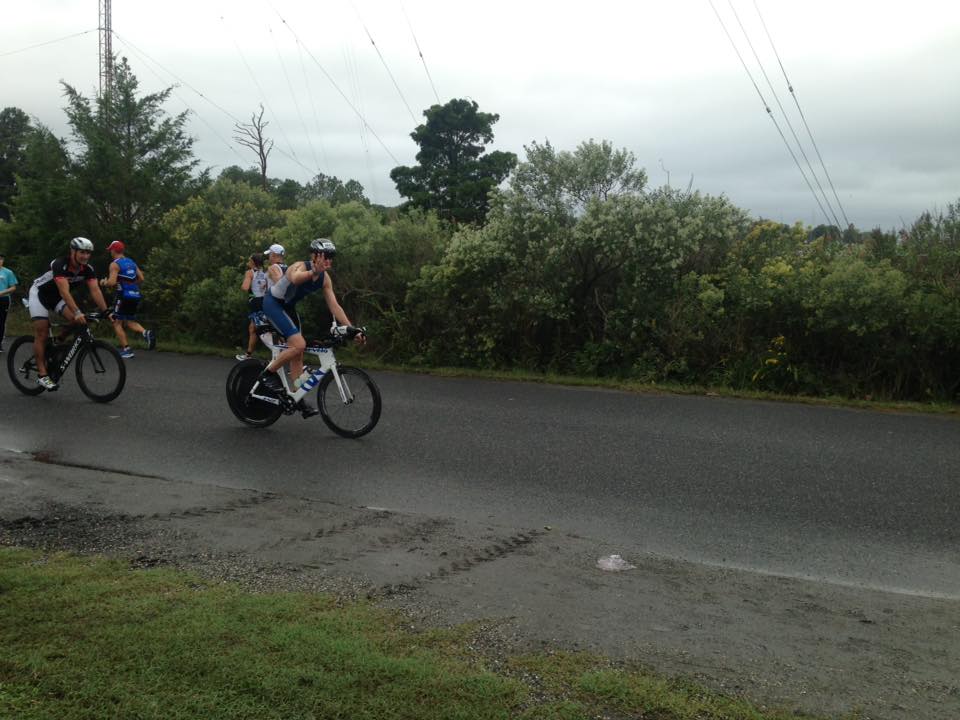
IMMD T2

Entering T2 – prior to course flooding.

T2: 8:22

It was a fairly long run around the transition area to rack my bike and then to get my run bag from a volunteer.  I had an assigned spot on a rack that was well off the beaten path, so it took me awhile to get there, especially since I had to run on the asphalt in my bike shoes.  I then headed into the transition tent that I’d spent over an hour freezing in earlier in the day.  Off went the cycling shoes and helmet, and on went my race belt.  Time was spent applying liberal amounts of Bodyglide on most every area of my body, and I was willing to take a little longer in transition to prevent some serious chafing issues later.

Immediately outside the tent was a volunteer, and I inquired about sunscreen.  There were several bottles for you to use on yourself, and I was a bit disappointed since at Ironman 70.3 Raleigh in 2015 they had volunteers who would smear it on you, which was much faster.  Thus, a bit more time was lost in trying to make sure that I was fully coated.  I then handed off my bike gear bag to another volunteer and headed out onto the run course – passing my family again as I left the transition area.

Run: 4:27:48    (10:13 min/mile)

Miles 1-3 (9:44)(9:59)(9:59)

Karen had given me strict instructions to run the first three miles at a 10:15 pace, and then my plan was to try to hold 9:45 – 10:00 min miles thereafter.  Coming out of T2 I felt really really good, and the crowds were spurring me along.  Unlike the start of the bike course, I was unable to keep my adrenalin from taking over and I was running faster than planned.  I remember looking at my watch and thinking that Karen was going to yell at me, but I felt like I couldn’t run any slower.  I tried and tried to slow down, but I was feeling great and felt like I’d have to walk in order to hit the 10:15/mile time goal.  I sure wasn’t about to walk in the first three miles of the marathon, so I kept going and knew that I’d hear about my disobedience later.

Miles 4-6 (9:59)(10:11)(9:53)

The first six miles of the marathon were probably the quickest and easiest six miles of my life.  Not in terms of pace, but the miles just seemed to fly by.  I was seeing the run course for the first time and there were a fair amount of spectators on that part of the course to keep me energized.  My pacing remained pretty even around 10:00/mile, with the only deviation coming in mile 5 due to a quick stop at the porta-potty near the turnaround point.  I was then headed back towards the transition area to begin the downtown portion of the first run loop.  So far, so good.
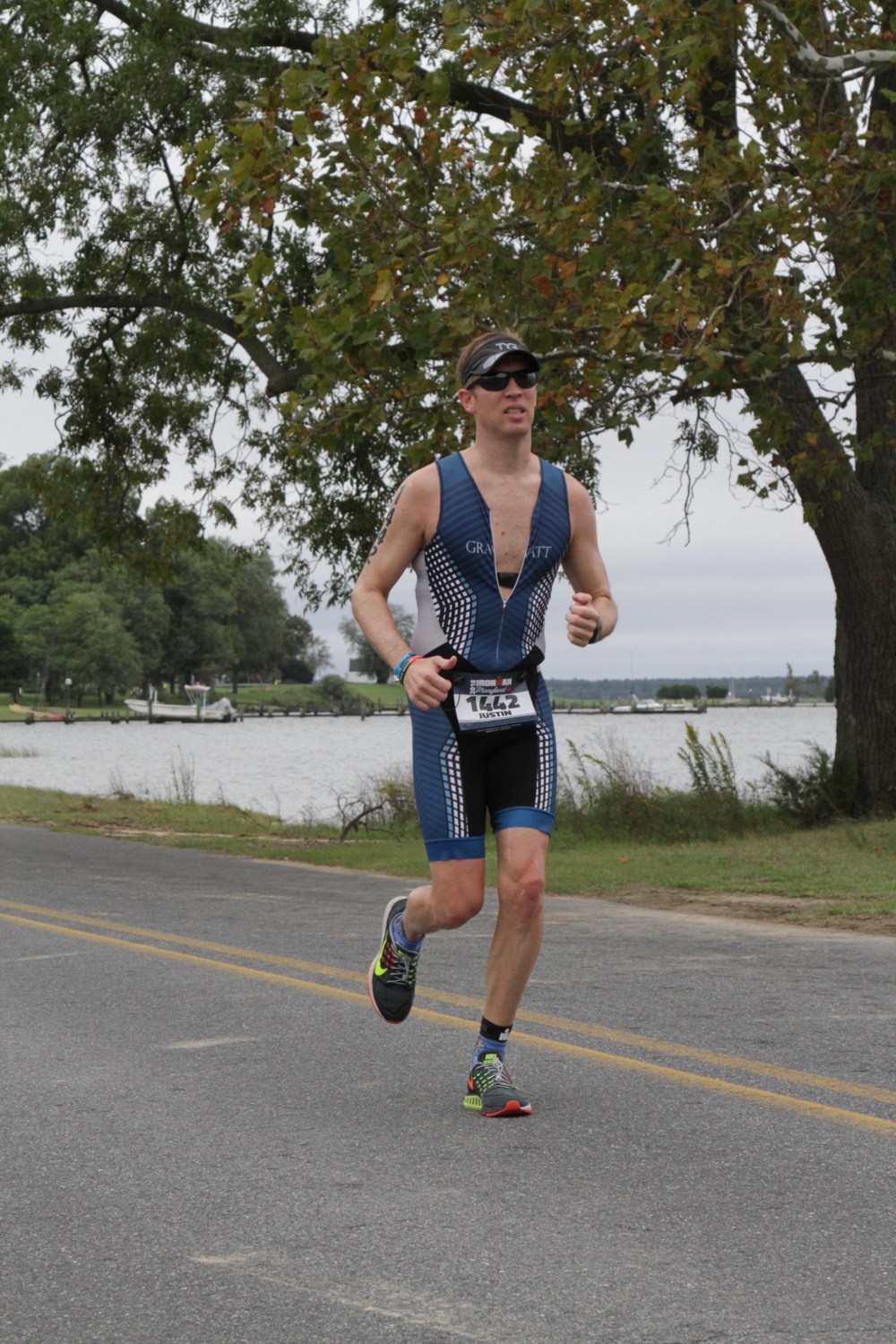
32_m-100751826-DIGITAL_HIGHRES-1391_057328-6064535.JPG

Around Mile 6.5.

Miles 7-9 (10:01)(10:18)(9:53)

If the first six miles were a cakewalk, the next twenty were about to get crazy.  At mile 7, I saw Busher for the first time since the early morning, and he was just heading out onto his run due to his later bike start.  Around the mile 8 point I had to run back around the transition area to head downtown.  See the picture above labeled “Entering T2.”  Unbeknownst to me, the transition road had flooded in the hour and a quarter since I came out of T2.  At that point, the water was just over ankle deep and was about a city block in length.

Without thinking or slowing, I trudged into the water but then saw a bunch of people stopping to take off their shoes and socks.  I immediately regretted my decision to keep my shoes on since I’d have 18 miles of wet feet, but I did have an extra pair of socks in my special needs bag.  I tried to run through the water without walking, but high stepping was pretty tiring.  Thus, I walked a bit to keep my heart rate under control and waved to my family as I went by.  My pace for mile 8 jumped up to 10:18 due to the slow down, but I was able to maintain a positive outlook nonetheless.

After rounding the transition area and turning towards the finish line and downtown area, I realized quickly that keeping my shoes on and plowing into the water had been the right call.  There were two more flooded areas ahead of me, and these seemed to be deeper and longer than the first.  Basically, two more city blocks of water to run through.  Did I mention that IMMD has a three-loop course?  This meant that I had to run through each flooded area five times – approximately fifteen city blocks worth of water jogging.  Turns out they didn’t cancel the swim, they just combined it with the run.
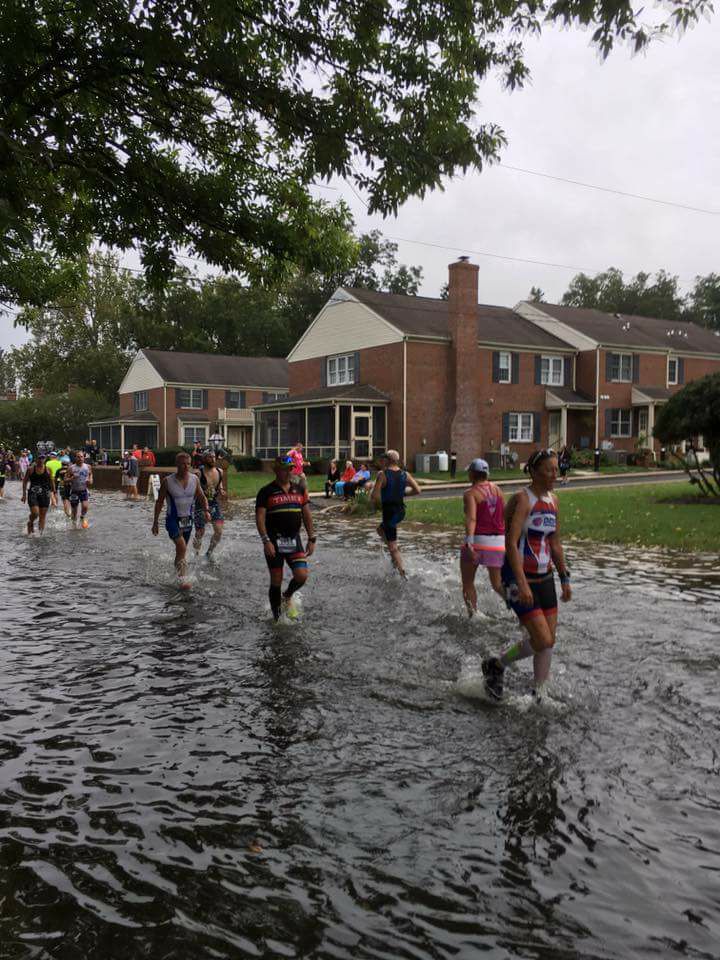
IMMD water

The second or third flooded area near the finish line/downtown area.

In a weird way, I liked the flooding issue because so many people were mentally defeated and were doing a lot of vocal complaining.  I’m usually a glass-half-empty type of person, but I somehow managed to put a positive spin on the situation and I kept a good attitude about it.  Karen had said to take the course as it comes the night before, so that’s what I chose to do.  That being said, trudging through the water was exhausting.

Miles 10-12 (10:00)(10:00)(10:19)

By mile 10 I had escaped the water and was in the downtown portion of the run course, which was filled with spectators.  A local brew pub is open all day for the race, and there were a lot of inebriated people out there.  Some beers and kisses were offered as I passed by, but I politely declined and kept moving forward at my 10:00/mile pace.
immd run

Downtown – looking towards the brew pub at the far end.

By mile 12, I had gone back around the transition area, through the flooded transition road again, and was onto loop number 2.  It seemed as though the tide was still coming in because the water had gotten a bit deeper.  The early-run euphoria had long since faded, but I was still feeling OK.
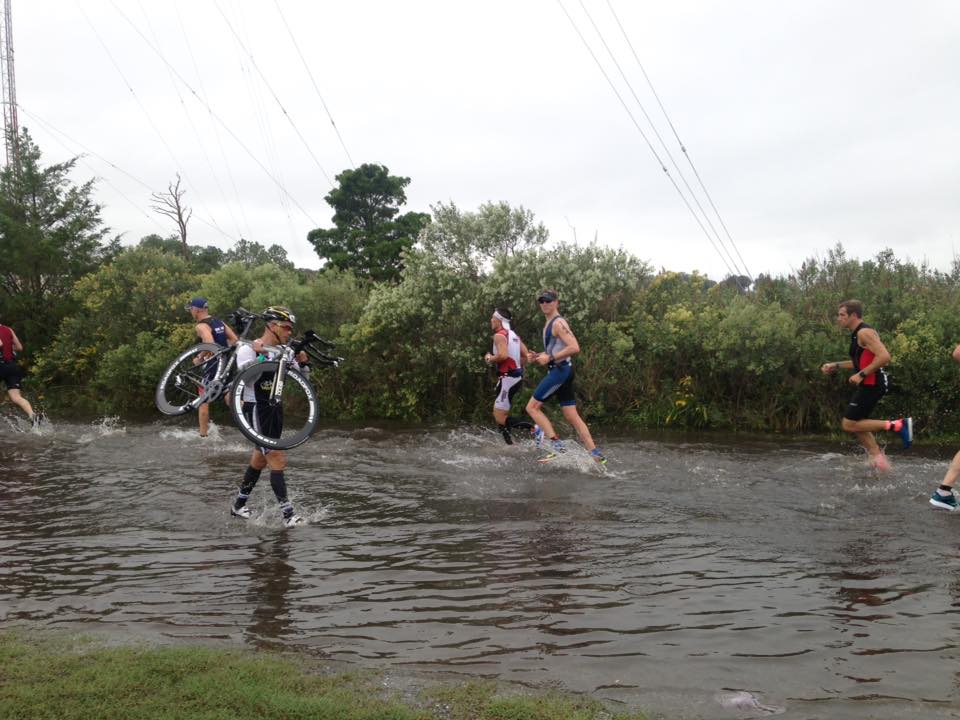
IMMD water

Headed onto run loop 2 near Mile 11.

Miles 13-15 (9:51)(9:50)(10:08)

Miles 13-15 were on the most boring portion of the course, but it was completely dry so I was able to make decent time.  I still had enough juice in my legs to run some sub-10:00 minute miles, and when I got to the turnaround cone at mile 14.7 it felt good since I knew that I’d never have to pass that point again.  There are three run loops, but the third loop is a bit truncated on the part away from town.

I’d tried to stay on top of my nutrition on the run, but unlike the bike, I didn’t have any nutrition with me.  I was taking a gel about every other aid station, along with Gatorade, but was worried that I might need some additional calories.  I also dipped into my medicine bag at that point to take a couple of Tylenol, some salt tablets and a Diclofenac, which had been prescribed for my ongoing left-sided piriformis issues.  I’d fought those issues all year with varying degrees of success, and had even undergone physical therapy.  Thankfully, the combination of Tylenol and Diclo was working well-enough, so the piriformis pain was at a minimum.  I’d learned my lesson at the Patriot’s Half-Iron triathlon three weeks before about putting pills in my trisuit pocket, and had wisely put the pills for IMMD in a small baggie to keep them from dissolving.

Miles 16-18(10:11)(10:10)(9:58)

Miles 16-18 were still free and clear of water as I wound my way back towards the transition area once again.  Fatigue was definitely setting in, but I was still able to run a sub-10:00 minute mile for mile 18.  It would be my last such mile of the day.  I found myself taking longer to get through the aid stations, and every time I slowed down it took more and more effort to get back up to speed.  I’d begun to see A LOT of people walking on the course, and not just in the areas of the standing water.  Mentally, I was still strong, but my body was starting to wear down.  Sadly, I still had three more trips through each of the three areas of standing water still in store for me.

Miles 19-22 (10:41)(11:14)(11:02)

I hit the transition area flooding again at mile 18.5, and damn if the tide hadn’t come in even more.  I tried to run through it, but eventually was reduced to a walk.  Then a run.  Then a walk again.  Once I got through it my legs felt like I’d just gotten off roller skates.  If you haven’t tried it, its a fun feeling with more than 7 miles left to go in a marathon.  On the upside, I hadn’t felt any blisters develop, which was a miracle in and of itself.  Score one for my liberal application of Bodyglide in T2!
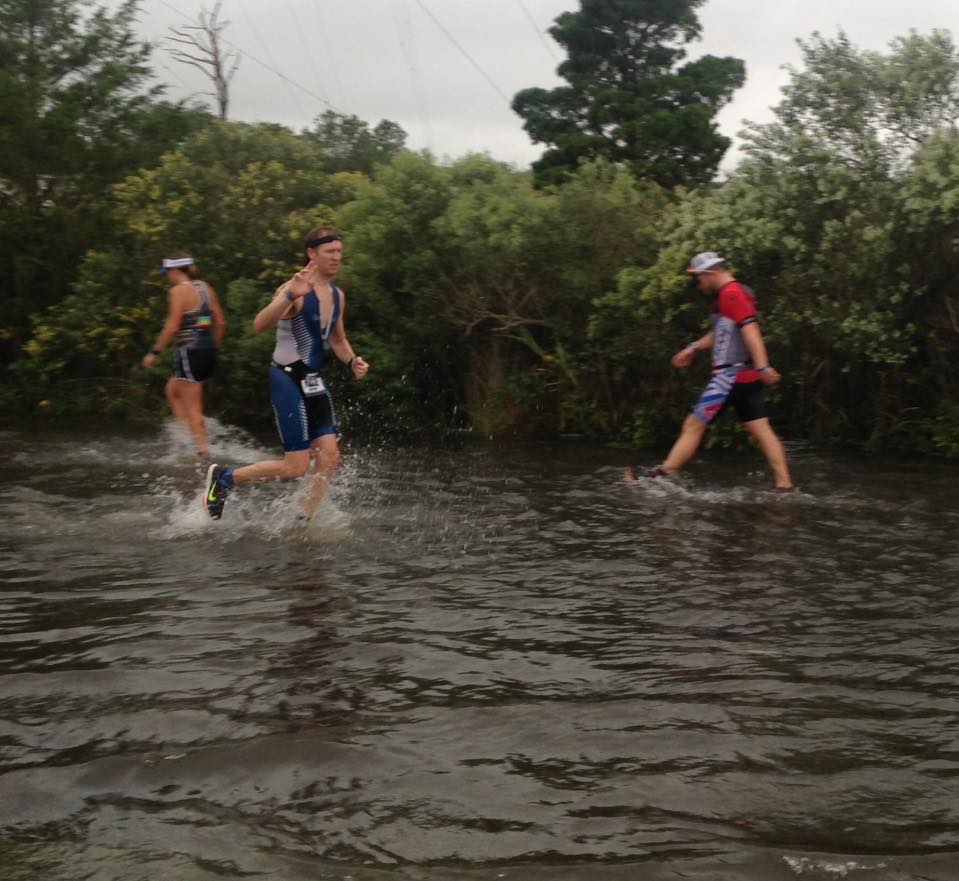
Flooded run course
Suffering at mile ~18.5 just outside the transition area.  Visor reversed for good measure.

After getting through the water, I rounded the transition area again and headed into the two other flooded areas on my way to the downtown area.  Those were now out of control, and the water was getting close to knee level in the deepest parts.  I tried to find slightly shallower parts to pass through, but that was like trying to nail Jello to the wall.  I made it through and then headed back towards the nightlife near the brew pub.  That area was a nice pick-me-up, and I was seriously considering snagging a beer from someone.
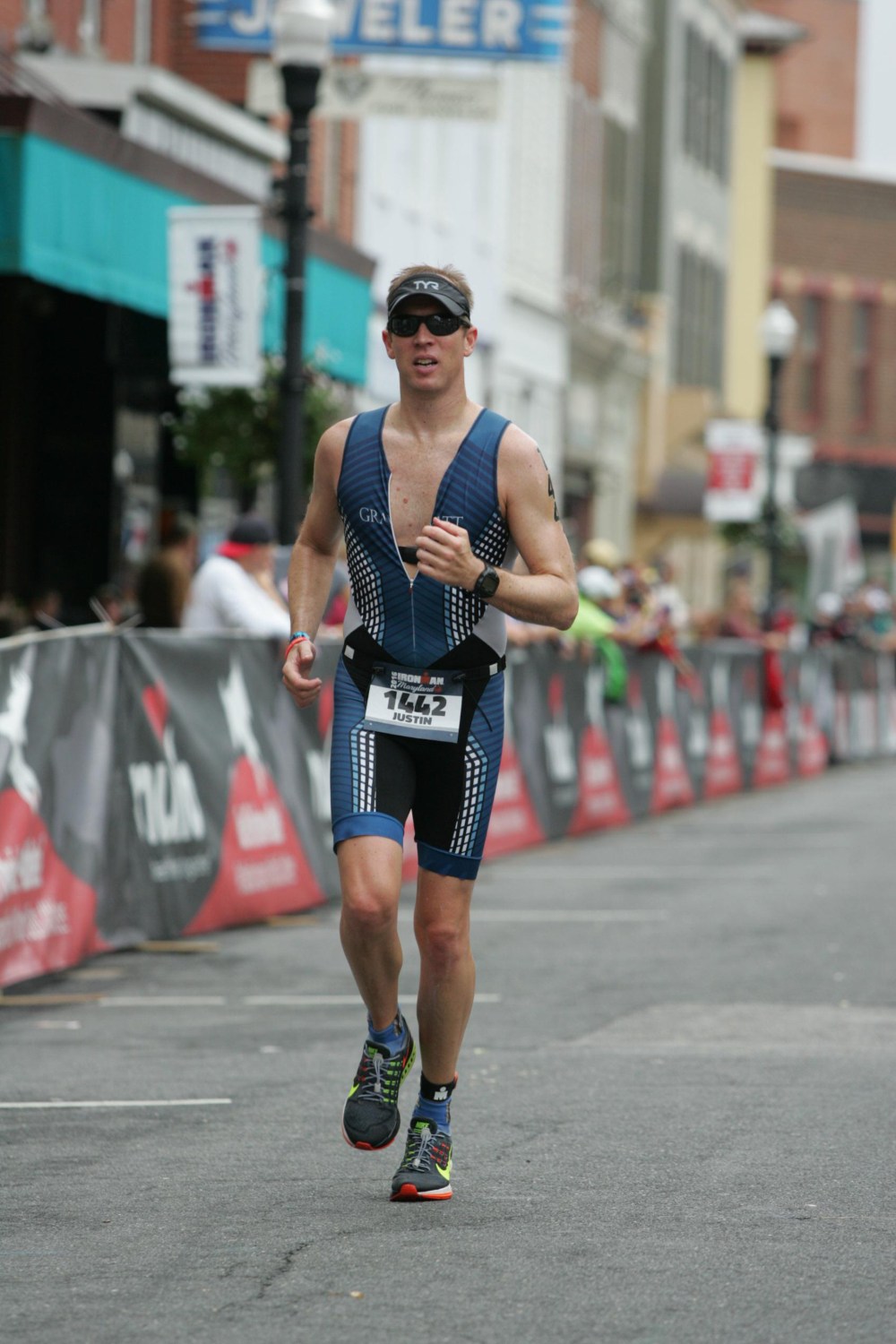
39_m-100751826-DIGITAL_HIGHRES-1391_066806-6064542.JPG
Heading out of the downtown area of the run loop in either loop 1 or 2.

Even though my spirits were good, my body was rebelling and my quads were burning.  My pace deteriorated into the 11:00 min/mile range, which was OK, but I was worried about blowing up and having to walk it in.  I was determined to continue running, and to only walk in the flooded portions and at the aid stations.  As I came through the flooded transition area again around mile 21.5 I saw my family and told them to go ahead and head over to the finish line.  They were shocked to see the other two flooded areas on that part of the course, and thought that the flooding had been limited to one area.

Miles 23-25 (10:47)(11:17)(11:39)

I’d read about the “dark times” of the Ironman run and experienced that first-hand between miles 22 and 25.  You know you’re close to the end, but it still feels a long way off.  I began to be reluctant to slow at the aid stations.  Every time I did so, my legs tightened up and it was hard to get back up to speed.  Night was falling, and there was the carnage of walkers all over the course by that point.  They began giving out glow necklaces at the aid stations, and I was told that the athletes had to put them on, but wasn’t sure if that was correct.  I think I wore one for a mile or so, then felt silly and threw it away at the next aid station.

In the first two loops of the run, the turnaround cone for loop three had taunted me and I’d looked forward to finally getting to go around it myself.  That finally occurred around mile 22.6, and then I was on my way back to the transition area for the final time, and then back downtown.

My 4 hour 30 minute goal for the marathon was attainable if I kept running, even with the unexpected combination of the swim and the run.  My legs felt as though they could give out if I got slightly off balance, but I was able to keep running, even if my pace continued to degrade.  By the end of mile 25 I came up upon the finish line, and turned right to head towards the brew pub one last time.  I could hear the finish line music playing and began to laugh because it was that hilariously terrible song from the beginning of Dumb and Dumber, Boom-Shak-A-Lak.  Google it, you’ll laugh too.  That brought me out of my dark time and I got excited since the finish was almost upon me.

Mile 26 (10:53)

Upon rounding the final turn near the brew pub, I took one of the American flags that a volunteer was handing out.  It was then pretty much a half-mile straight shot up to and through the finishing chute.  I’d run past the finishing chute five times by that point, and it was nice to finally be able to head into it instead of around it.  There’s nothing quite like seeing the red carpet (literally) rolled out for you and being called an Ironman for the first time.  I managed to pick up my pace a bit just prior to crossing the finish line, but it wasn’t a sprint by any stretch of the imagination.  I crossed the line in a total time of 9 hours, 44 minutes and 9 seconds.48_m-100751826-DIGITAL_HIGHRES-1391_081630-6064551
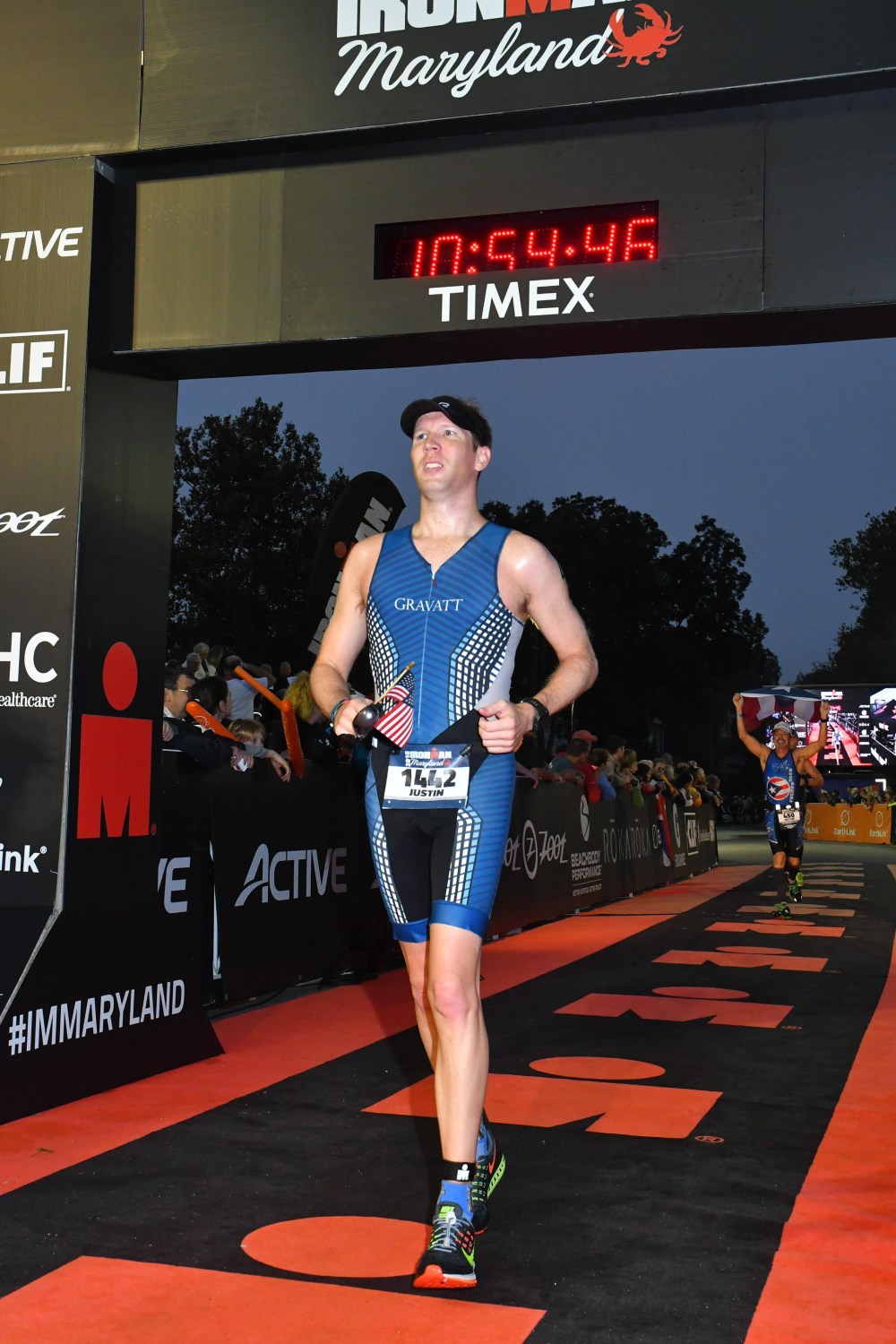
Post-Race

In the weeks leading up to the race, I was wondering if I’d break down and cry upon finishing, as many Ironman finishers do.  My finishing moment was the culmination of three and a half years of training, a lot of which was done in the dark, the rain, the heat or in pain from nagging injuries.  Had I thought back to all of those moments as I ran through the finishing chute, I certainly may have broken down, but I was focused on the moment and on seeing my family in the grandstands off to my right.  Quite frankly, it all happened really fast and before I knew it, I already had my finisher’s medal, a t-shirt and a bottle of water.
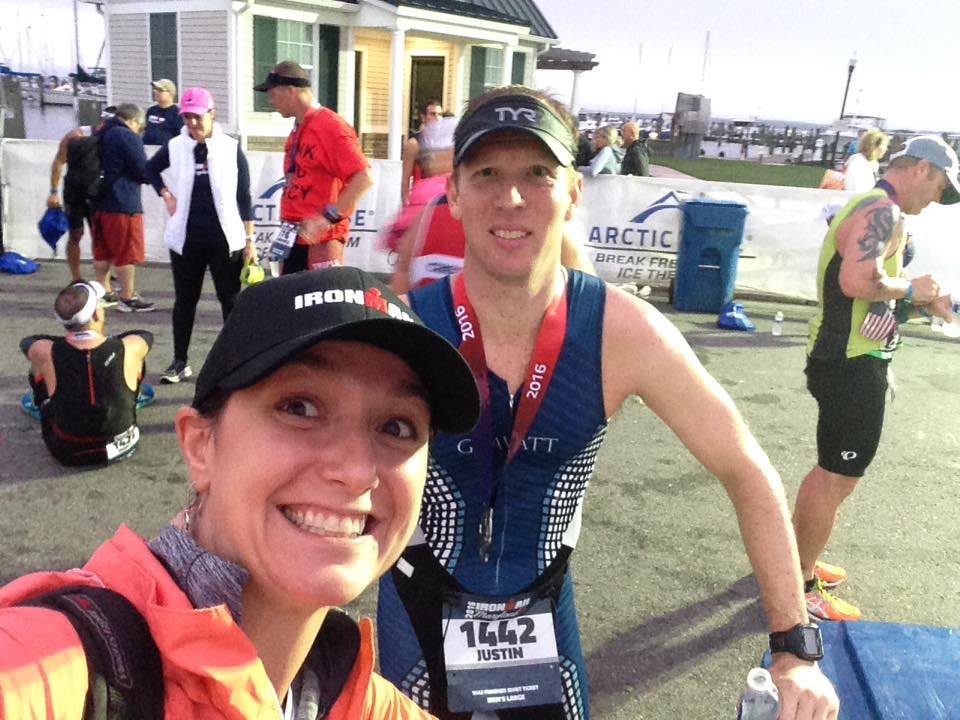
IMMD finish

Immediately after the finish.

My family met me just beyond the finish line, which included my wife and kids, my parents, and my uncle Jeff and aunt Marcy.  All things considered, I felt pretty good, and we chatted for five to ten minutes about the race.  Once my heart rate came down I began to get cold, so Leigh Anne gave me a long sleeved shirt to put on.  I’m not quite sure what happened, but I really began struggling with my fine motor skills and couldn’t put the shirt on.  Jeff noticed what was going on and suggested that Leigh Anne take me over to the medical tent.


The medical tent was maybe 50 yards away, but the closer I got, the worse I felt.  I began to have to lean on Leigh Anne to stay upright, and then I started getting tunnel vision.  By the time I got inside the tent I could barely see since the sides were closing in and I was close to passing out.  Thus began an hour stint in the medical tent on a cot, and I was given a bag of IV fluid since my blood pressure was low.  I had promised Leigh Anne that I wouldn’t try to do another full Ironman in 2017, and she took that opportunity to tell me to remember how I was feeling as I laid on the cot when I started thinking about doing another one.
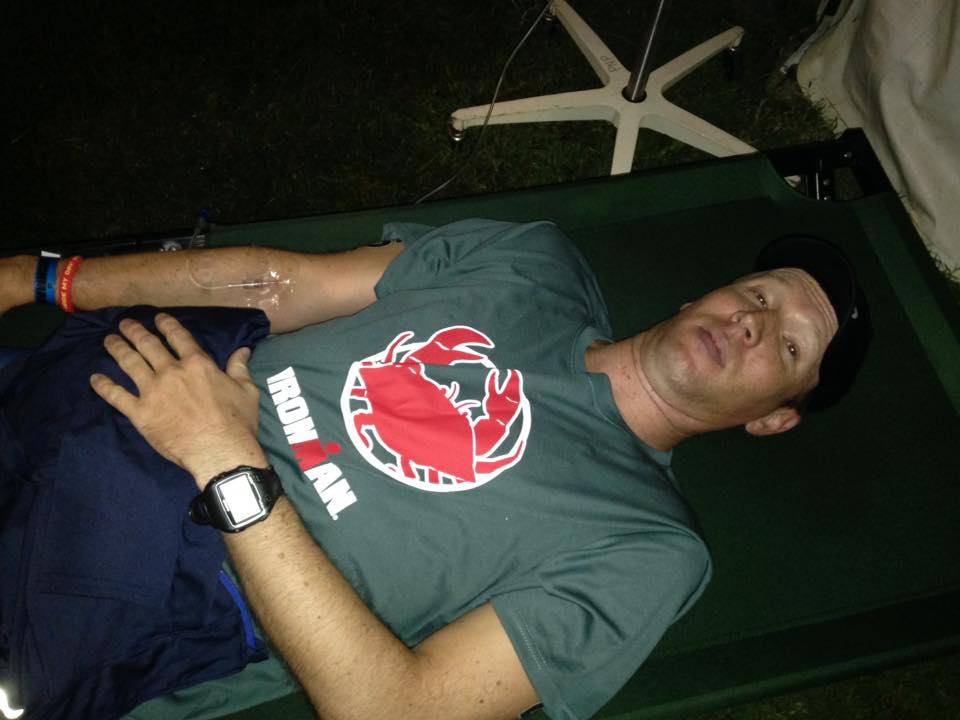
IMMD med tent

I may have an IV in my arm, but I still got my finisher’s shirt!

I still felt pretty shaky after leaving the medical tent, but after downing a Pepsi, everything got back to normal.  I was then able to walk back to the transition area to get my gear with Busher (who’d finished in dumping rain while I was convalescing), and then he, Leigh Anne and I hit up the McDonald’s drive through for some much needed calories.   Then it was back to the Day’s Inn for our fine post-race meal and a couple of beers, but exhaustion soon set in and we called it a night.  Sleep has rarely come so easy for me.

Overall, IMMD was a great experience and I was able to meet my performance goals, even with some adverse conditions.  Due to the swim cancellation and the shortened bike course, however, I was left wanting more, and had (and still have) reservations about calling myself an Ironman.  I’d also planned on getting an “M-Dot” tattoo after the race, but ultimately decided against it since I didn’t want to have to tattoo an asterisk next to it.

Still, I’d managed to bike and run for nearly ten hours in a single day without dying, which would have been impossible for me a few years prior.  The road to IMMD had been long, with many ups and downs – but mostly ups.  Thankfully, I had a lot of support from my family, which made the whole endeavor possible.

IMMD marked the end of my 2016 tri-season, but I still had the Richmond Half-Marathon on my calendar in November – even if that was something of an afterthought to IMMD.  I was glad to be done with my high volume training weeks for awhile, but dedicated training for the half-marathon was going to commence as soon as my body recovered from the 126.2 miles of IMMD.  I was still pining to tackle the 140.6 miles of a full Ironman, but I’d already made that promise to my wife to wait until 2018 before doing another full.  If only I could find a loophole to get around that agreement…
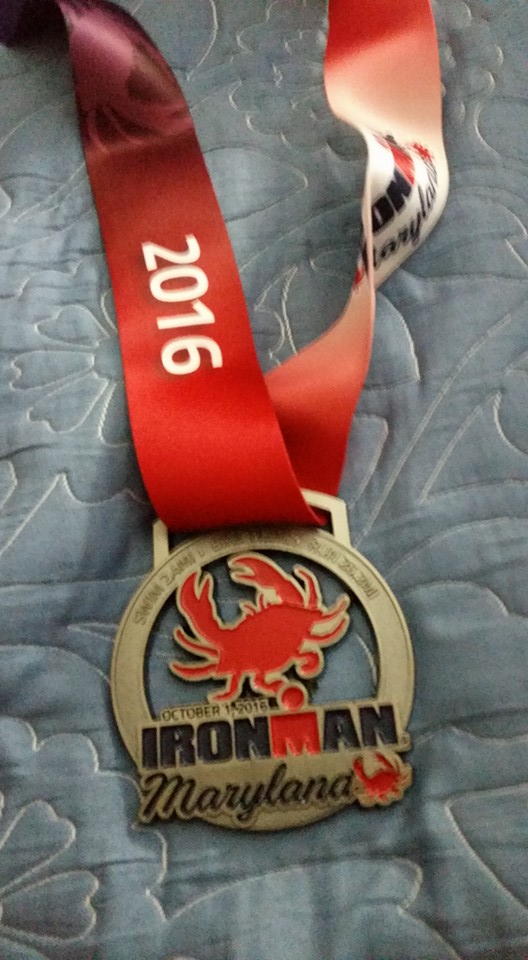
IMMD medal

Yes, that is the bedspread from our room at the Day’s Inn, Cambridge.


“I laugh at this weatherman’s satellite eyes…”

2016 Ironman Maryland

Race Report – Part 1

Thursday, September 29, 2016 – I’m packed for Ironman Maryland (“IMMD”) and on the road to Cambridge with the family by 7:30 a.m.  Its overcast and rainy, and its been raining pretty heavily in Richmond for two days.  More importantly, the forecast in Cambridge through race day (Saturday, October 1st) is nothing but wind and rain.  The AccuWeather outlook even includes the possibility of thunder storms.  I’m not worried about myself per se – I’m really worried about a possible cancellation, along with the discomfort of my familial spectators over the course of a 12-hour day.  In fact, the 2015 version of IMMD was postponed several weeks due to adverse weather and then the swim had to be shortened due to rough conditions in the Choptank River.  Preparing for your first Ironman is stressful enough without obsessing over weather reports every few hours.

I’d reserved one room at the Day’s Inn on Thursday, and two rooms for Friday and Saturday.  Those were booked a year in advance since there aren’t a ton of hotel rooms in Cambridge.  My friend, Chris Busher, had decided at the last minute to partake in IMMD, but online registration had closed by the time he was ready to commit to the race.  It was our understanding that the race hadn’t sold out, but we weren’t 100% sure and couldn’t get confirmation from the race officials.  Thus, Busher was going to drive up separately on Thursday and try his luck at walk up registration.  If he couldn’t get into the race, he was either going to drive back home or stay with us and spectate.
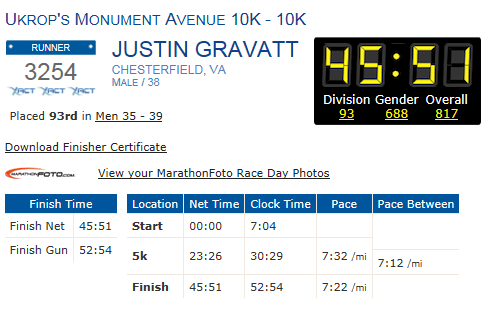
The drive from Chesterfield was uneventful, but the wind was blowing pretty good and there were intermittent periods of rain showers.  My first order of business upon arriving at the race site was checking in at the Ironman Village, whereas there was no check in on Friday.  I’d actually lost sleep worrying about having car trouble on Thursday and missing the check in deadline since I’m an eternal pessimist!  Leigh Anne dropped me off near Ironman Village once we pulled into town, and within twenty minutes I had my race package and a nice backpack (that was included with the entry fee).  I took a quick peek at the Choptank River, and was a bit dismayed to see the choppy conditions.  It looked nothing like the glassy smooth surface in the picture below, which was taken the day before.

IMMD village

Ironman Village in the calm before the storm on Wednesday….literally and figuratively.

After completing check in, we drove a few blocks into the downtown area and stopped in for lunch at the Rock Lobstah.  I’d never had a lobster roll before and was determined to have a couple, even though there were some familial concerns about the fact that they might be too “heavy” to eat before a race.  Knowing that I still had Friday to recover if they gave me any issues, I went ahead and bit the bullet and was glad that I did.

lobsta

Conditions on the Choptank upon our arrival in Cambridge.

Upon finishing lunch, we made our way to the Day’s Inn and checked in there.  I’ll say that the accommodations were borderline satisfactory, and certainly nothing special.  There was no elevator, and when we entered the stairwell to go to our room on the second floor, there was a lit candle sitting on a chair in the landing.  I’m pretty sure that wouldn’t have been in compliance with Virginia’s fire code, but as for Maryland’s, who knows.  Either way, Leigh Anne and my mom were convinced that we were going to die in a motel fire.  The Day’s Inn staff was very nice though.
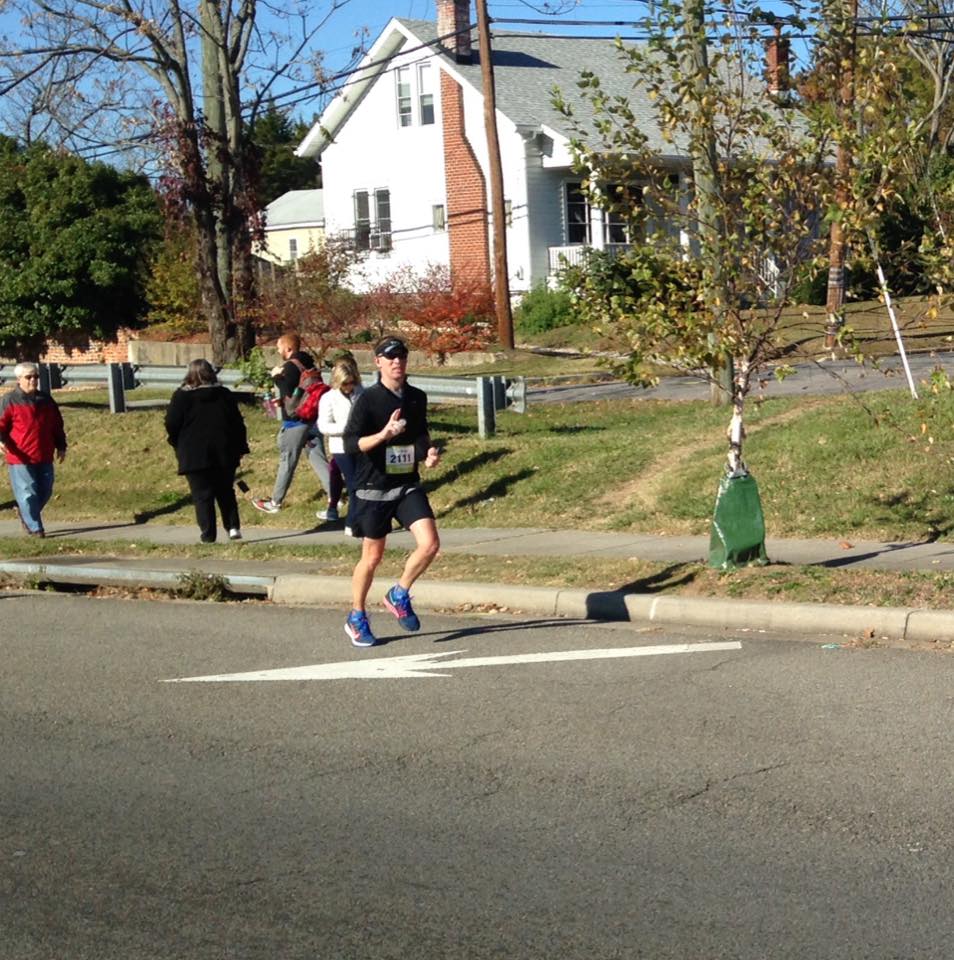
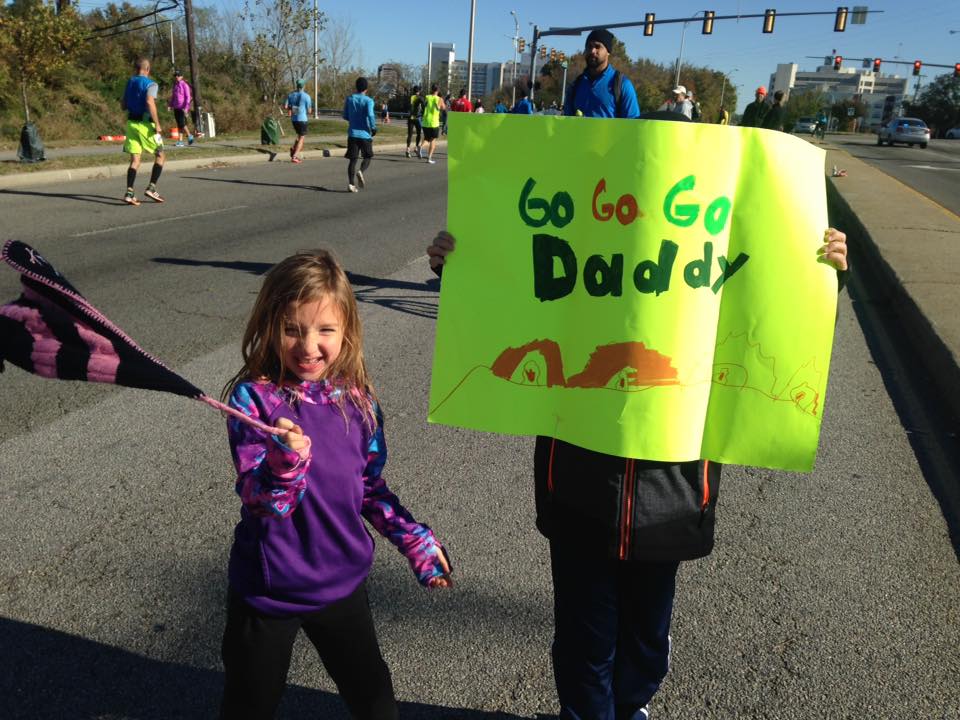
Busher arrived in Cambridge an hour or so after we did and was lucky enough to grab walkup registration spot.  Interestingly, he decided to play dumb, and asked the sign up ladies what was going on.  When they tried to explain that it was a full Ironman triathlon, he replied that it “sounded fun,” and maybe he should give it a try.  After all, he rides bikes with his kids and does Aqua Zumba.  Upon handing over his credit card, he elicited some dumbfounded looks, but the ladies realized they’d been had when he presented them with his USAT card.  Touche Busher.

Somehow he’d also managed to get a room at the America’s Best Value Inn, which was only a few blocks from the Day’s Inn.  I was originally planning to stay with him on Thursday night to give my family a bit more space in our room, and then he would move over to the Day’s Inn on Friday and Saturday since we’d have two rooms then.  Nevertheless, after seeing some pictures of his accommodations that he texted me after he checked in, Leigh Anne forbid me to stay the night there.  Interestingly, the indoor “pool” had been totally concreted in and it was adjacent to a liquor store.

pool.jpeg

No warm up laps to be had here.

Thursday evening was spent at the Ironman welcoming party, but the weather outside continued to deteriorate.  The wind was picking up, and the party was right next to the Choptank River, which was looking pretty treacherous.  My mom is always concerned when I participate in races with open water swims, and I think she was about to have a heart attack watching the waves on the river.  She was definitely hoping for a swim cancellation.

After breakfast on Friday morning, Busher and I rode our bikes from the Day’s Inn to the transition area in order to rack them for the race.  On the way there, we had to ride over a small bridge with grates in it.  My front tire went down into the grate and my bike shifted pretty violently, but quickly righted itself.  It was one of those “pucker” moments, but thankfully I didn’t crash the day before the race.

When we got to the transition area the wind was blowing really hard, and due to our rear disc wheels (technically – mine is a disc cover), our bikes kept blowing off of the racks.  The discs were just catching too much wind.  My stress level went up a bit thinking about my bike blowing onto the asphalt and laying there all night, but we managed to find a bike mechanic who had some zip ties.  Two zip ties were able to keep the bikes from twisting and blowing off, and Busher and I made mental notes to remember to bring something with us on race morning that we could use to cut the zip ties off with.  It would be quite the conundrum to get out of the water, only to be unable to remove my bike from the rack.  After getting our bikes squared away, we took a moment to pose next to the IMMD sign.  I also snapped a picture of the Lexus “Official Vehicle” of IMMD for posterity.

IMMD

20160929_122250

For me, the rest of the day was spent relaxing with the family and watching as my kids went bowling.  Busher decided to do a pre-swim in the river with his wetsuit, and got beaten half to death by the wind and the waves.  Since the weather wasn’t supposed to change, we were pretty concerned that the swim would either be cancelled, or would turn into a situation where a good portion of the field had to be fished out of the river for a DNF.

To make matters worse, the IMMD Facebook page began to fill with photos of massive flooding on the bike course – courtesy of racers who decided to drive the bike course that afternoon.  I’m not talking about an inch or two of water, it was more like a foot of standing water.  After monitoring the Facebook page for an hour or so, we learned that the 112 mile course was being rerouted and would be shortened to 106 miles.  There was nothing that the race coordinators could do, but I was disappointed that I wouldn’t be getting the 140.6 miles of a full Ironman.  I was starting to feel a little bit robbed, and was further concerned that the swim might be cancelled altogether.

Busher and I talked to coach Karen that night over the phone and she told us not to stress about the shortened course.  Take it as it came, and when I was done, I’d still be an Ironman.  I understood where she was coming from, but I’d been training a long time to take on 140.6 miles and felt like I’d have to equivocate every time someone asked me if I’d done a full Ironman.  I tried to set aside the negativity, and focused on double-checking my gear and in making my two 900 calorie bottles of CarboPro for the bike.

So….with my nutrition bottles safely stored and cooling in the mini-fridge, it was lights out around 9:30 p.m. to try to get some sleep before the alarm went off around 4:00 a.m.  In actuality, there were several alarms set, which included cell phone alarms and a wake up call from the front desk.  I might not get my full 140.6 miles, but I sure as hell wasn’t going to oversleep and miss the race.  That was one thing that I still had control over.

TO BE CONCLUDED