“All fall down…it won’t be too long now.”

2016 Patriot’s Half-Iron Triathlon

Race Report

5:41:17

 5/15 AG     39/227 Overall

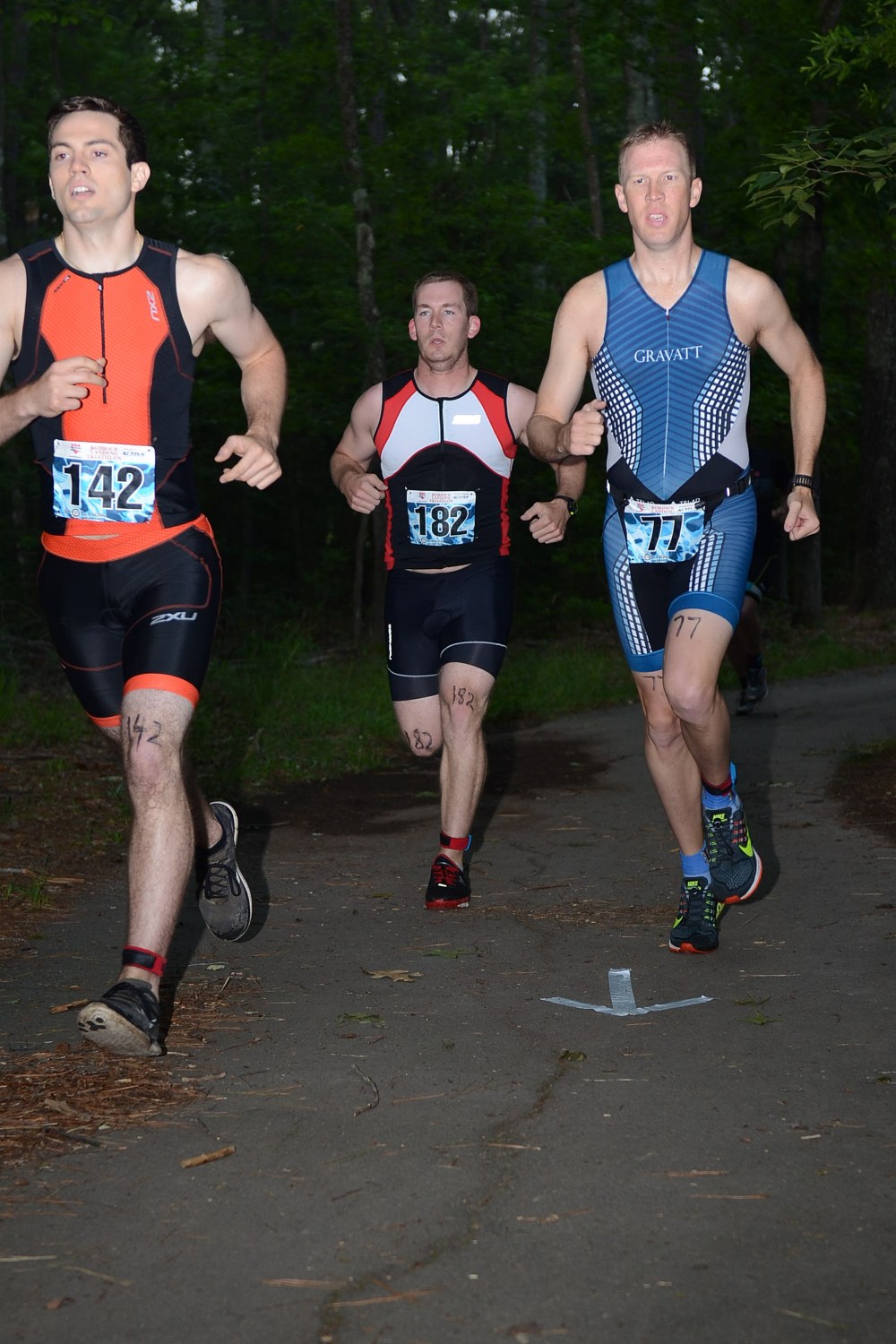
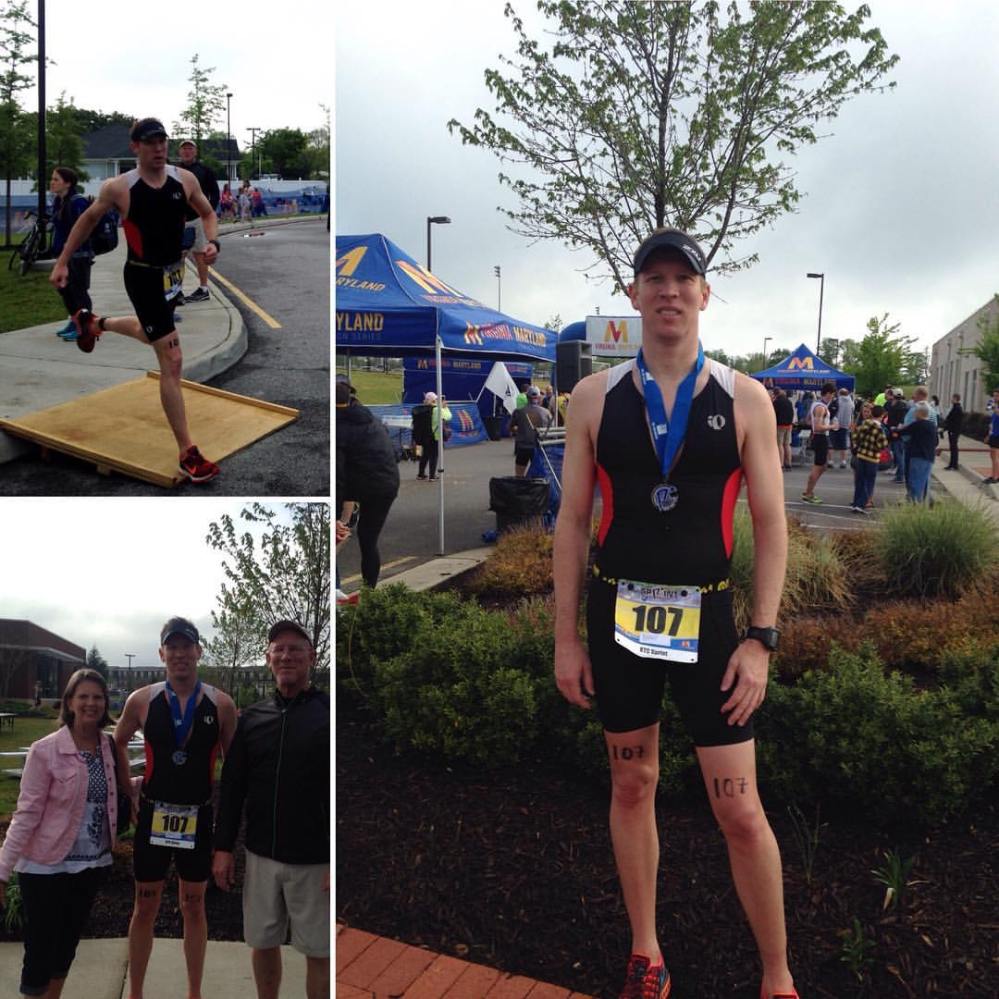
September 10, 2016 – My final race before Ironman Maryland was the Patriots Half in Williamsburg, which is put on by the Virginia Maryland Triathlon Series.  This was three weeks out from IMMD, and I planned to race hard, but probably something more like an effort level of 99% instead of 100%.  I was more concerned with making sure that I had my nutrition under control and pacing myself properly than in killing myself on the course.  That being said, I’m super competitive, so I knew that I’d be pushing myself even if that wasn’t necessarily the plan.

In actuality, I was chomping at the bit to get to this race since it marked the end of a long, hot summer of intense training for IMMD.  Karen and Erin had been working me harder than I ever had before, which culminated in 11-12 hour training weeks in August.  Before I signed up for their coaching services I’d averaged about 20-30 hours of swim/bike/run training during the warmer months.  From June through August of 2016 I’d averaged over 41 hours per month.

I usually had Mondays off, but Tuesday through Sunday was fairly hectic.  The training weeks typically culminated with a 50-80 mile bike ride on Saturday, followed by a 20-30 minute transition run.  Sundays were usually reserved for a long run of 1.5 to 3 hours in the morning, followed by a swim in the afternoon.  Due to the heat and humidity, I’d typically try to start my weekend workouts as soon as it began getting light outside, which was around 5:30 a.m.  I also wanted to get done at a reasonable time so that I could spend the rest of the day doing whatever needed to get done around the house.  I did most of my long bike rides on the Capital Trail, so getting on the bike at 5:30 a.m. meant that the alarm went off at 4:30 a.m.

Leigh Anne was training for the Richmond Marathon, so our training schedules overlapped a bit, which had made things difficult.  We did our best to stagger our workouts, but there were a few days when we both had long runs scheduled.  Thus, one of us would run at the crack of dawn and the other immediately thereafter.  The upside to getting the later running slot was sleeping in a bit.  The downside was having to run in direct sunlight and sweating through your shorts in the first few miles.  The training was hard and I was a near-constant zombie, but I made it through it and was excited that the Patriots Half signaled the end of heavy training and the beginning of my taper to IMMD.

Since the race was in Williamsburg, I got a room for the night so that I wouldn’t have to get up super early.  We had dinner at a local Italian restaurant, and then headed back to the hotel.  The kids were excited to hit the indoor swimming pool, but I stayed in the room to finish getting my gear together.

patriots hotel.jpg

On race morning I got up and left the hotel around 5:00 a.m., and since Leigh Anne had met me in Williamsburg after work on Friday (and had her own vehicle), she and the kids got to sleep in a bit.  I had no issues getting to the race site and quickly racked my bike and set up my transition area.  A recent heat wave meant that a wetsuit legal swim was unlikely, but I’d brought my wetsuit just in case.  I’d rather have it and not need it then vice-versa.
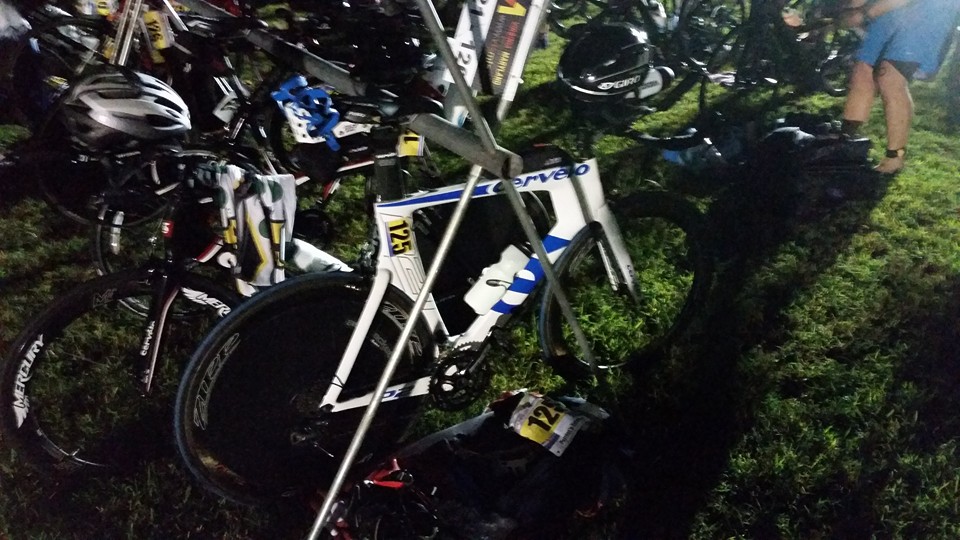
patriots rack

Results Link

GPS Data

Course Maps

Swim:  40:27  (2:06/100m)  3/15 AG

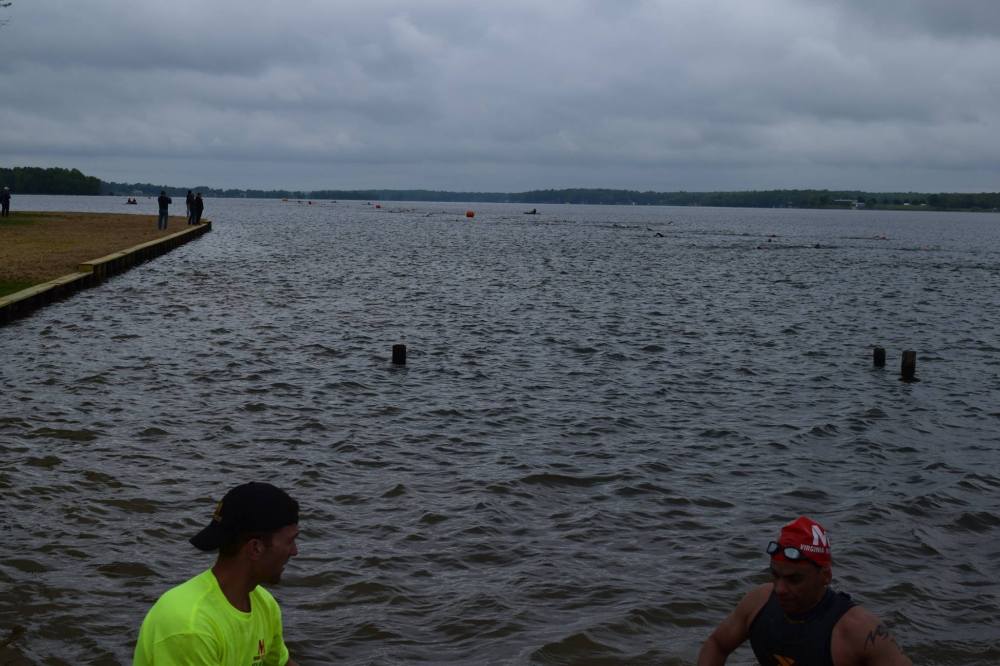
Thanks to some helpful tips from Karen, my swimming had improved quite a bit, at least in the pool.  My open water swimming experience is limited, and I was still getting used to swimming in large bodies of water.  There are no lane lines to follow, waves and wake to deal with, and not to mention the strong gag reflex I have when non-chlorinated water gets in my mouth.  My last attempt at 1.2 miles of open water swimming had resulted in a swim split of 43:15 at Ironman Raleigh 70.3 in 2015.  I definitely wanted to beat that time, and like the Raleigh race, the Patriots Half water temperature was too high for a wetsuit.

The swim started at a beach a few hundred yards from the transition area, and I was in the first wave to go off.  I positioned myself to the far right to try to avoid the mass of people, but I was only marginally successful.  As soon as we took off, a mass of swimmers enveloped me and it was every man for himself for awhile.  My heartrate went up and my goggles got hit, which caused a small leak in my left goggle.  Instead of stopping to try to fix it, I just breathed to my right, which was fine since the waves were coming from my left.

The first third of the swim was pretty ugly, but after I passed the turn buoy for the Olympic distance swimmers (who were starting after the half swimmers) things started to get better.  It was only a short distance from that buoy to the turn buoy for the half course, and I took a left turn and headed towards the middle of the river.  After a short ways, there was another buoy to turn left around in order to head back the way we’d originally started.  Things were still ok at that point, but I was still breathing to my right due to the water in my left goggle, and now the waves were coming from my right.  Thus, I took in a few mouthfuls of water before I got accustomed to the change and timed my breathing with the waves better.

Not long after I made the turn to head back in, things started going well for me.  I really got into a good groove, and it helped that I was turning my head back a little farther when breathing to avoid taking in water from the waves.  In my mind, I was thinking about whether I’d be able to swim twice the distance in three weeks, and I was feeling pretty confident in that aspect since I was feeling better coming in than I had going out.  Honestly, this was the first time when I wasn’t ready for an open water swim to be over, and I felt like I had just hit my stride when the water got shallow enough to stand.

There was then a short run to the shore, but the timing mat was pretty far up the hill away from the beach.  Officially, my swim time was 40:27, but I was probably out of the water pretty close to the 40 minute mark.  Either way, I was more than two minutes faster than my swim time in Raleigh, so I was happy with the effort.

T1: 3:52

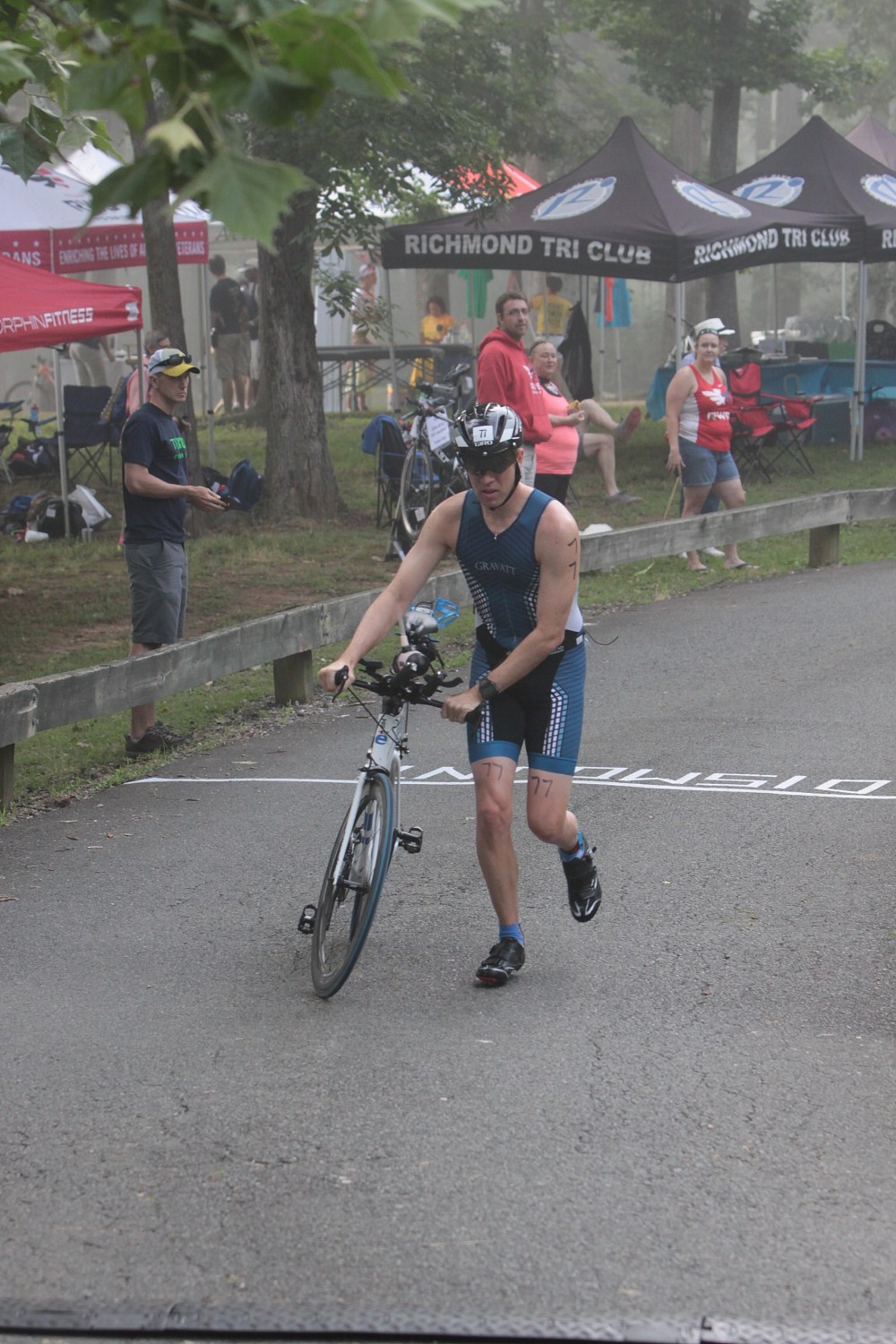
I didn’t rush to get through T1, but even if I had, it would have been at least three minutes long due to the long run from the beach to the transition area.  I took time to put on my heart rate monitor and sunscreen, whereas I’d gotten burned pretty badly in Raleigh on the bike even though I’d put on a bunch of sunscreen before the swim start.  It was then a pretty good run out of the transition area to the bike mounting line.  After clicking in, I was off for 58ish miles on the bike since the Patriots Half bike course is about two miles longer than the standard 56 miles for a half-iron distance triathlon.
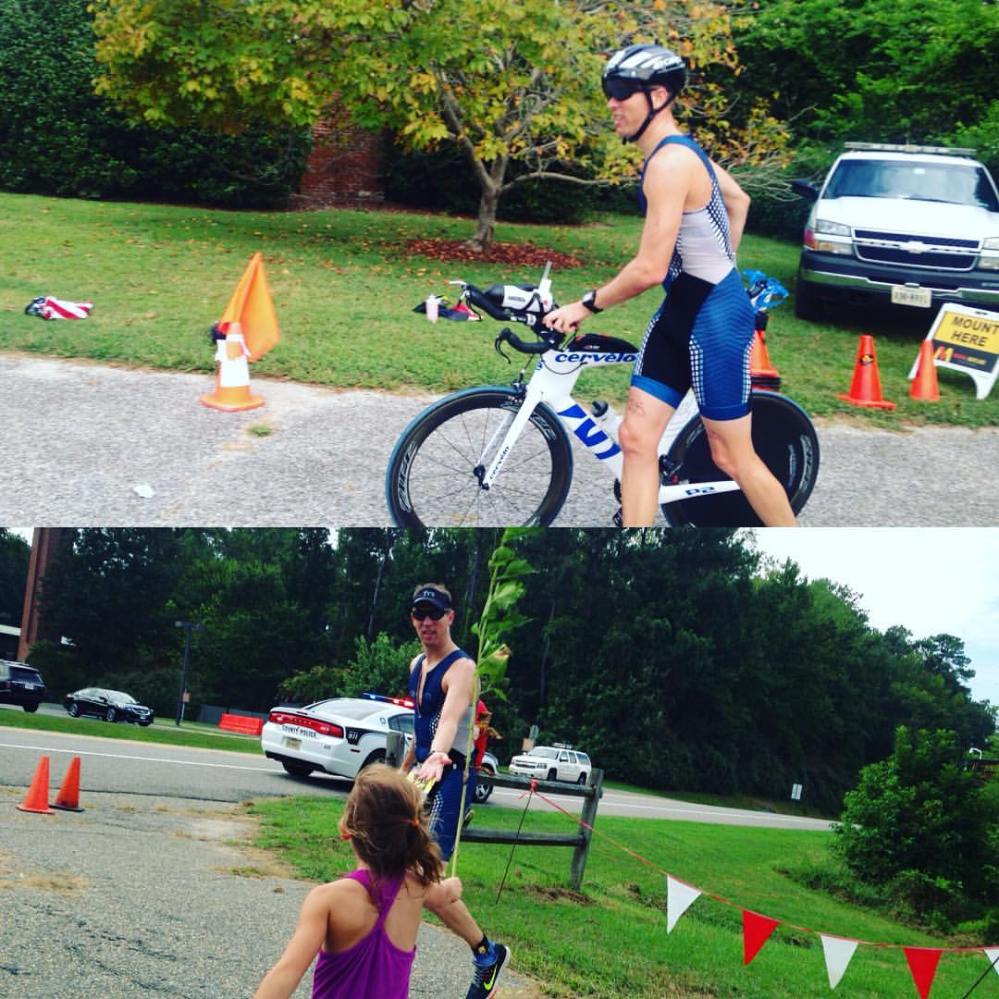
patriots transitions

Bike:  2:54:18 (20.1 mph)  5/15 AG

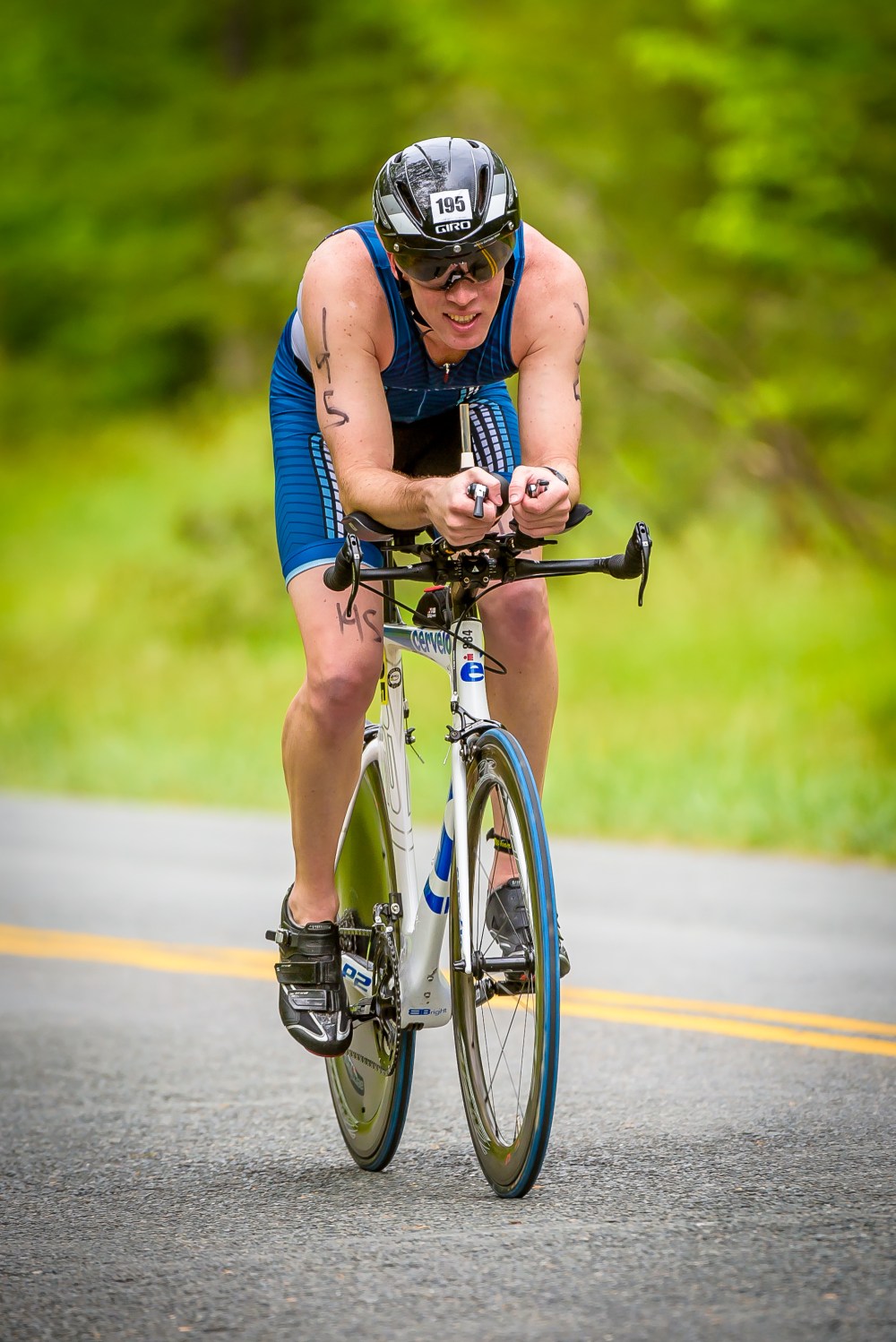
The bike course was deceptively windy and I felt like I was fighting the wind for the first 36 miles since it was coming out of the west.  Karen had told me to take it relatively easy for the first few miles, which was good since those mile were slightly uphill.  There was also the Route 5 bridge near mile 6, which has a nice incline to it.  After descending the far side of the bridge I tried to pick up the pace a bit, but it seemed like the wind was pretty much right in my face at that point.

Around the 11 mile mark, the course took a right turn off of Route 5 and I got into a group of about five riders.  We stayed far enough apart to avoid illegally drafting, and it was a good thing too, since an official on a motorcycle went past us soon thereafter.  It was nice riding with a group, but I felt like I was slightly faster than the other guys and was being held up a bit by not passing.  Nevertheless, I didn’t want to overtax myself so early in the ride, and even a legal drafting distance gives you a small benefit.

Somewhere around mile 18 we came across the first of two aid stations.  Even though I took a bottle of water in a handoff, I got through the station quicker than the other guys and took off on my own.  From that point, I felt like I was on an island for the next 18 miles or so.  I would come across another rider or two every now and again, but by and large, it was pretty lonely.  I tried to stay on top of my nutrition, which consisted of a swig or two of Carbopro every fifteen minutes and a gel every hour.  I had learned that 300 calories of Carbopro per hour served me well, so I had an 800 calorie bottle mixed for the ride.

At mile 36, I took a right turn back onto Route 5 and felt the benefit of the wind for the first time all day.  The course was pretty flat at that point as well, so I decided to increase my effort a bit.  A few miles down Route 5 a monster biker from a later swim wave passed me, so I decided to go with him at a draft-legal distance for a few miles.  He was really moving, and it took some extra effort to stay with him, but it was worth it since we were moving at a pace that I’d have been unable (or unwilling) to sustain if I was riding alone.  After a few miles I lost him on a slight upgrade and went back to riding solo.

At that point I was in the latter stages of the ride and was still enjoying the tailwind on Route 5.  There was another up and over the bridge, and then a right turn to head back towards Jamestown and the transition area.  Unfortunately, the sun had burned off the clouds, and a humid day quickly turned into a hot and humid day with direct sunlight.  As I neared the transition area, the Olympic distance racers were already out on the run course, and they all looked unhappy.  I tried to mentally prepare myself for the suffering that was coming my way on the run, and I took it relatively easy as I came back into transition.

Overall, I’d completed the 58.3 miles in 2 hours and 54 minutes, which equates to a 20.1 mile per hour pace.  I’d averaged 20.07 mph in Raleigh on less training, but that bike course was completely filled with other cyclists, so I’d had the benefit of a lot more legal drafting.  While it was hot in Raleigh, I don’t remember there being any wind, so I think that might have played a factor as well.  I was pleased with my bike effort, but I had still been hoping for a slightly faster split.  Then again, I was constantly telling myself not to overdo it with IMMD three weeks away.

T2: 2:24

Off the bike, some more sunscreen, and a then change of footwear and headgear and I was off.  I saw Leigh Anne and the kids as I took a left out of transition, and for some reason, Jillian tried to hit me with a branch that she’d found.  I’m not sure why, but perhaps she was as delirious from the heat and humidity as some of the people on the run course.

Run: 2:00:57  (9:14/mile)  3/15 AG

Only two guys in my age group completed the run course under two hours, and neither did it by much.  The run was a total shit-show…pardon the language.

Miles 1-3 (8:51)(8:55)(9:04)

My goal for the run was sub-two hours, and Karen had given me strict instructions to run a 9:15 min/mile pace for miles 1-3.  Unfortunately, I was not yet adept of actually heeding her advice, and my mind was telling me that I’d never be able to make up the “lost” time if I ran too slowly at the beginning.  Thus, I overran the first three miles by a combined 55 seconds.  I would hear about that from her after the race.

Due to the heat and humidity, I grabbed ice at the first aid station and stuffed it into my tri suit.  I also dumped a cup of water over my head, trying my best to keep from getting my feet wet so as to avoid blisters.  I’d repeat this process at every aid station thereafter until they ran out of ice around mile 7.  Overall, the first three miles were ok, but I knew that the heat was going to take its toll later in the run.

Miles 4-6 (8:58)(9:18)(9:01)

Around mile 4 I caught up to a female runner who was beginning to struggle.  She commented that she didn’t think she was going to make it, so I gave her some positive reinforcement and kept on.  Near the 4.25 mile mark, there was a cool wooden bridge that is a part of the Capital Trail, and it was fun to run on it for a bit.  It was actually quite long, and running on wood took my mind off the head for a little while.  There was a turnaround with a timing mat and a porta-potty at mile 4.88, and after passing those, I headed back the way I’d just come to complete my first loop – on pace for a sub-two hour run.

By that point, however, I was really beginning to feel the heat and decided to take one of the sodium capsules that I’d stashed in the rear pocket of my tri suit.  Unfortunately, they had both dissolved since I was sweating so much, so I was totally out of sodium.  I made a mental note to buy tiny Ziploc baggies for IMMD so as not to run into the same problem.

Miles 7-9 (9:14)(8:55)(9:28)

I hit the turnaround point for the first lap at mile 6.5 and got my wristband to prove that I was on lap two.  Shortly thereafter, I hit an aid station and learned that they were out of ice.  Not good.  Mile 8 was mostly shaded so I kept it together reasonably well, but the wheels started coming off once I got back into the direct sunlight around mile 9.  Mile 8 was completed at an 8:55 pace, and would be my last sub-9:00 minute mile for the day.  Mile 9 was completed at a 9:28 pace, and I felt like I was roasting.

I wasn’t the only person struggling, and everywhere I looked I saw people walking.  There had been a lot of people walking in Raleigh in 2015, but percentage-wise, this was definitely worse.  Even though the temperature was slightly lower than it had been in Raleigh, the humidity was much worse and was reeking havoc on the field.  I wanted to walk as well, but decided to try to hold out as long as possible and to only walk the aid stations long enough to rehydrate.

Miles 10-12 (9:37)(9:48)(9:48)

Miles 10-12 were hot and painful.  My splits continued to climb and I knew that I wasn’t going to be able to run a sub-two hour half marathon unless I had a miracle recovery – which was not in the cards.  On the upside, I was passing a lot of runners who had wilted into walkers, but I was really overheating.  It was also around Mile 12 that the Bodyglide on my chest (i.e. nipples) had worn off since my tri suit had been completely soaked for the majority of the run.  Thus, not wanting to be immortalized in race photos for having bloody streaks on the front of my tri suit, I unzipped it and pulled it down to waist level.  It seemed as though I was one of last men of the course to go that route, whereas a lot of the other guys were bare-chested early on.

Near mile 12, I exited the last shaded portion of the course and was finally headed back towards the finishing area.  My brain knew that I was almost done and began shutting down my body.  My cardiovascular system was still good to go and I had no problems breathing, but it was getting harder and harder to get my legs to turn over.

Miles 13 – 13.1 (9:51)(7:46 pace)

As much as I wanted to run the last mile at a faster pace, I just didn’t have anything left in me.  In fact, it was all I could do at that point to keep from walking.  At mile 12.1 I passed the turnaround point for loop one and was thankful not to be one of the people who still had to do another loop.  At mile 12.5 there was a right turn to head back to the transition area and I saw a guy who was doubled over in pain.  I asked him if he was okay since it was odd to see someone stopped like that so close to the finish, but he said that he was and told me to keep going.

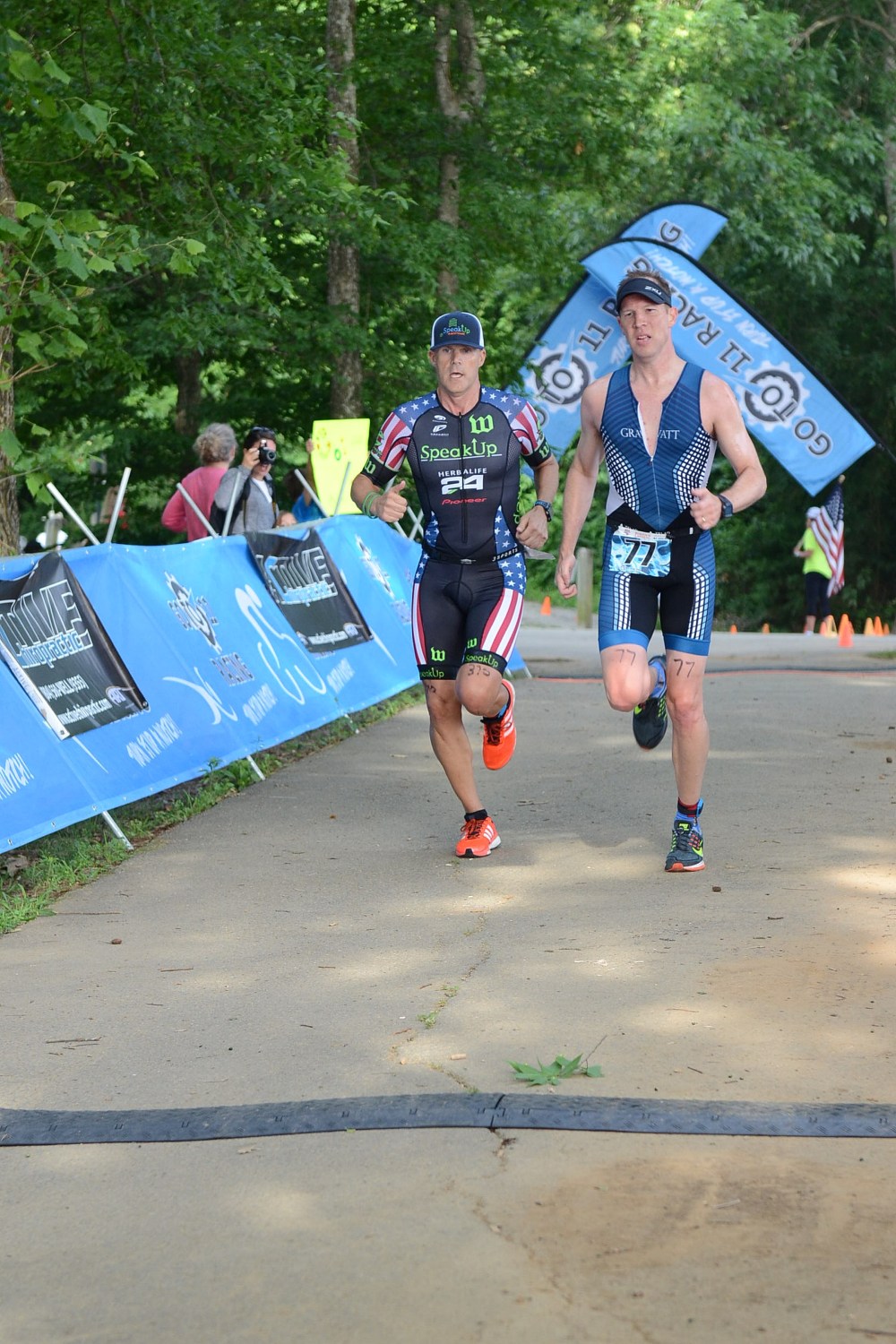
The last half mile was a mixture of agony and elation, but I was able to speed up a little as I ran up the finishing chute.  I saw Leigh Anne and the kids off to the right side cheering for me, so I tried to finish strong.  I was able to run through the finish line, but flopped down on the grass shortly thereafter.

I’d finished the run in 2:00:57, which was less than one minute shy of my goal time.  Given the weather, that was pretty good (for me), and I was actually 3/15 in my age group for the run.  I typically swim and bike pretty competitively in my age group, but then slip down the standings in the run.  Its pretty much unheard of for me to do as well or better in the run than I did in the swim or bike, but I was 3/15 in the swim, 5/15 on the bike and 3/15 on the run.  Thus, it looked like I tolerated the heat of the run a little better than some of the other guys.

One other interesting note from the run was that Leigh Anne witnessed a finisher a few minutes ahead of me falling, stumbling and crawling up the finishing chute.  He was overheated and probably depleted of sodium, and it took him several minutes to make his way through the last 50 yards.  After getting across the finish line he didn’t know where he was, so they ended up having to get the paramedics for him.  Kudos to him for even finishing, but it kind of shows how brutal the heat and humidity were that day.
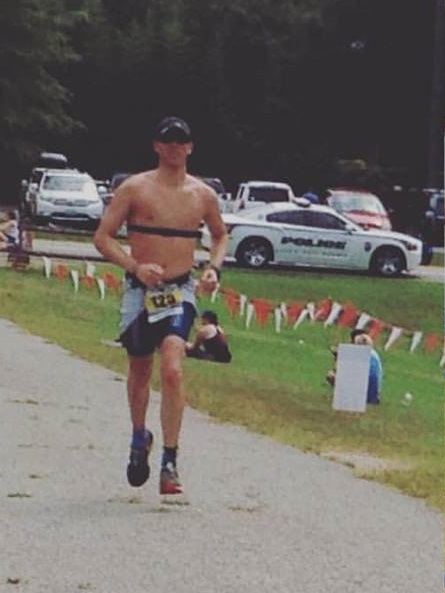
patriots finish

Post-Race

They had craft beer in the finishing area, and normally I would have knocked back a cup or two to celebrate.  The race had taken its toll on me, however, and I couldn’t think about drinking alcohol at that point.  After an hour or so of recovering, we all headed back to Richmond and a Slushee at a gas station on Route 5 helped fix me up a bit.

Ironman Maryland was three weeks away and I was ready to taper into that race and to try to finally become an Ironman after three years of progressing through triathlons.  I was hoping for cooler temperatures in Cambridge, but sometimes you have to be careful what you wish for.  Ironman Maryland wouldn’t have the heat of the Patriots Half, but that didn’t mean that it wouldn’t have challenges of other sorts.

Unfortunately, a lot of the other ProK racers had done Ironman Louisville together in 2015 and weren’t doing a full Ironman in 2016, so other than Jim Rosen, I didn’t know anyone who’d be racing in Cambridge.  Busher’s racing season was scheduled to end the next weekend at Savageman, but IMMD wasn’t sold out so maybe there was a chance that I could convince him to add one more race to his schedule.  Only time would tell.
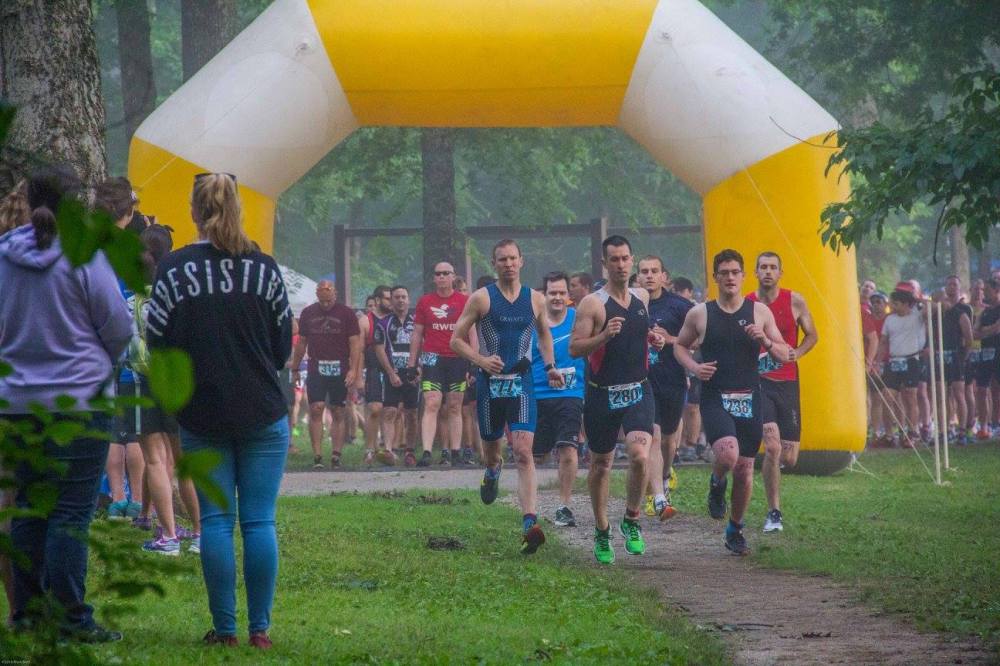
“The path to heaven runs through miles of clouded hell.”

2016 I Love The Tavern Sprint Triathlon

Race Report

1:22:35

 4/24 AG     29/332 Overall

June 26, 2016 – The one triathlon that I’ve done every year is the I Love the Tavern/Robious Landing sprint triathlon.  It features a 650 meter down river swim, an 18.8 mile bike and then a 5k run.  Its one of the most popular triathlons in Richmond, and I’ve always had a good time doing it.  After many months of poking and prodding, I’d finally convinced my friend Richard Engel to sign up.  In actuality, he’d promised to sign up about a year in advance, but Richard has a bad habit of waiting until the last minute to actually register.  He’s even been known to have backed out once or twice since the entry fees are so high for late registrants.  Thus, I was pleasantly surprised when he finally logged on and claimed a spot.

You may recall Richard from some of my prior posts, and yes, he is the same person who taunted me at the beach in 2013 during a friendly jog when he decided to run backwards as I was collapsing from exhaustion due to the pace he’d set.  He also informed me in all seriousness that I had a roughly “50/50” shot of finishing the 2013 Spartan Race at Wintergreen.  I’d gotten some retribution on him at the 2014 Spartan Race, when he’d underestimated the difficulty of the course and had to drag himself across the finish line several minutes after I finished.  In hindsight, perhaps I should have run the last bit up the mountain backwards to motivate him, as he once motivated me.

I’d been mentoring Richard on his cycling skills a bit, but this was going to be his first triathlon.  He was new to swimming, but he’s built for cycling and running since his legs are freaking enormous.  I mean, proportionally, he’s a T-Rex.  Due to his lack of swimming experience, however, I figured that I’d be able to beat him in his inaugural triathlon.

Unfortunately, the week before the race was filled with major storms on the east coast.  They were so severe that there were houses in West Virginia that ended up floating down river, and one was actually on fire as it floated off.  I’m sure the video of  it can still be found on YouTube.  When I went to packet pickup for the triathlon, the James River was swollen and cluttered with logs and tree branches.  Since it wasn’t going to be safe to swim, the race officials converted the triathlon into a duathlon.  My biggest advantage over Richard (the swim) had been turned into another run, which was his biggest advantage over me.  As such, I knew that I’d need to have a strong bike if I was going to have bragging rights over him.

Since I’d recently bought a new tri suit, I loaned my old one to Richard for the race. He somehow managed to get his meat-eater legs through the same leg holes that were tight on my chicken legs.  I thought for sure that he wouldn’t get through the race without having a wardrobe malfunction.  Nevertheless, strained as it was, the Lycra was holding fast, and I headed to the starting line with Richard, along with a newfound respect for the tensile strength of the man-made fabric.

Official Results

GPS Data

Run 1 – 6:22  (7:09/mile)

The first run was .89 miles per my GPS, and was an out and back.  It was primarily uphill going out and was downhill coming back in.  Groups of six were sent off thirty seconds apart, and it was pretty much a first-come-first-served send off.  Richard and I were lucky enough to get in one of the first few starting waves, so we didn’t have to stand around very long.

Robious start

Richard is 280, I’m 77.

Coach Karen had told me to hold something close to my 5k pace for the first run, and to try not to get my heartrate out of control too early in the race.  My starting wave took off at a pretty fast clip, with Richard leading the way.  He had indicated that he’d probably stay with me during the first run, but I’d told him to run his own race and not to slow down on my accord.

As we headed up the hill and away from the transition, I noticed that Richard did a lot of talking while running, and he seemed to want to carry on a full-fledged conversation.  He was used to running with one of our mutual friends, and I almost always train alone, so I don’t converse much.  Quite frankly, we were running at a pace that made conversation difficult for me, but Richard was coasting along.  After essentially talking to himself for several minutes, he finally realized that I wasn’t up for friendly banter and decided to focus on the race.  At that point, he accelerated and left me behind.

Robious run 1

Heading back downhill towards T1

We eventually turned a corner and headed back downhill towards transition.  Richard opened up a lead on me, but I never lost sight of him.  I finished the first run in 6:22, and according to my GPS, I’d covered the distance at a 7:09/mile pace.  Not blazing fast, but not slouching either.  Richard entered T1 seven seconds ahead of me, but I was determined to exit the transition area before he did.

T1: 1:02

T1 was uneventful for me, and consisted of changing shoes and putting on my helmet.  Richard’s transition spot was several racks over, so I lost track of him while I was changing.  I then headed towards the “bike out” area and stopped short of the mounting like to get on my bike.  The mounting line is on a slight upgrade, and I’d had some minor difficulties in years past when I failed to clip in quickly.  There were no issues this time, and as I took off, I saw Richard running towards the mounting line.  His T1 was 16 seconds slower, so I’d managed to take a slight lead on him.  Given, however, that this was his first ever transition under race conditions, he was pretty quick.

Bike: 53:03 (21.3 mph)

My goal for the bike was to beat my 2015 time of 52:08 and to build a large enough cushion on Richard that he wouldn’t be able to catch me on the final run.  I learned immediately out of transition, however, that I didn’t have an A+ ride in store for me.  As soon as I headed up the incline from the transition area to Robious Road, my legs began “loading.”  I’d certainly expected to take some time to settle into the bike, but I didn’t expect to feel tired at the bike start.

Less than a month before the race, I’d signed up for coaching services with Erin Wittwer and Karen Holloway, and the increase in training intensity had really hit me hard over the first few weeks.  The Robious Landing triathlon was not an “A” race on my calendar, so Erin and Karen didn’t fully taper me for it.  They certainly would have if I’d asked them to, but being at 100% that day wasn’t my goal.  Ironman Maryland was my primary focus, so Robious was more like a spirited training session on a quasi-taper.

I struggled so much on the first hill that Richard rode right past me.  We took a right onto Robious Road, and when I got into the aero position I passed him back rather quickly.  I wouldn’t see Richard again for the rest of the bike portion, but as it turned out, he was never that far behind me.  My legs did a little better after getting warmed up on the bike, but no matter how hard I tried, I could never get moving quite as fast as I had the year before.

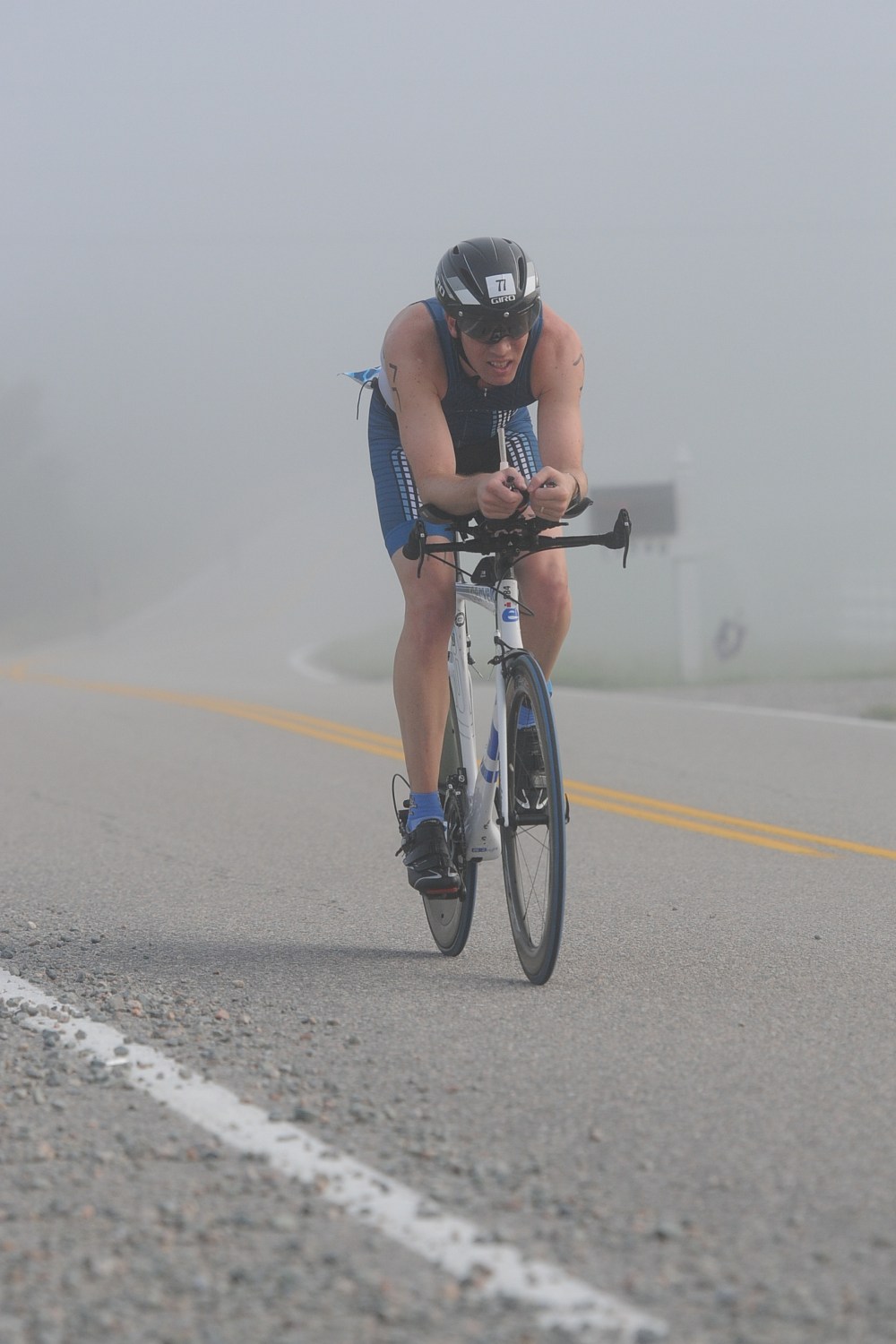
The weather was a bit cooler and the humidity was higher in 2016, which is evidenced in the fog shown in the picture below.  That may have also affected my bike split a bit, but fatigue was the overriding factor.  Since Richard and I took off in one of the earlier run waves, there weren’t a lot of cyclists on the course ahead of me.  I felt like I rode most of the course on an island, which is evidenced by the lack of any other visible riders below.  In hindsight, the lack of riders to (legally) draft off of may have also contributed to a slower bike split.

Robious bike

Alone in the fog.

The first half of the out-and-back bike course is primarily uphill, and concludes with a moderate hill in the final mile before the turnaround cone.  The course gains about 150 feet over that distance, but approximately 100 feet of the gain comes within a quarter-mile span.  If my math is correct, that’s a 7.5% maximum grade, which sends most people, myself included, into the small chain ring and an easy gear.  When I did the race for the first time in 2014, the guy in front of me got going too slow and toppled over.  Thankfully, that’s never happened to me, but it does take some effort to get to the top.

One you’re over the top, the turnaround cone isn’t far, and then its back down the hill the way you came.  I maxed out around 35 miles per hour, and I’m always crossing my fingers that I don’t blow a tire at that speed.  Richard said that he saw me just after I started back down the hill, but I missed seeing him.  I was actually looking for him to see how much of a lead I had on him, and when I didn’t see him within a mile of the turnaround, I mistakenly believed that I had a sizeable advantage.

The course loses a little more than 300 feet on the way back to transition from the turnaround cone, so its a much faster ride heading in that direction.  The elevation loss gave my legs a bit of a break, but I still didn’t feel all there.  The last part of the course on Robious Road does go uphill, but after I turned left to head towards transition, it was all downhill.  I let gravity due the lion’s share of the work in the last half mile to try to lower my heartrate and get ready for the run.  I saw Leigh Anne and the kids near the dismount line and did my best to wave and say hello while planning for the dismount.

In total, it took me 53:03 to complete the 18.86 mile bike course, which was 55 seconds slower than in 2015.  Perhaps the cooler and more humid conditions were a factor, but I think that riding on tired legs was the primary factor.  I hoped that my legs would be ready to run, and Richard wasn’t far behind, having completed the bike in 55:21.

T2: :52

I almost crashed coming into T2 when I tried to do a quick dismount.  I’d unclicked both cleats as I neared the dismount line, and I swung my right leg over to the left side of the bike.  Somehow, my left cleat snapped back into the pedal, and as I began to run, the bike came with it.  Thankfully, it unclicked again, and even though I stumbled a bit, I was saved the humiliation of toppling over.

I didn’t know how much of a cushion I had on Richard at that point, but I knew that his 5k PR was about three minutes faster than mine.  Thus, I racked my bike as quickly as possible, changed shoes and then headed towards the “run out” area with my race belt with all due haste.  I was only two minutes and twenty-seven seconds ahead of Richard by that point, so the chase was on.

Robious T2.jpg

Run 2: 21:19 (7:35/mile) 

**My GPS had this “5k” at 2.81 miles, and the pace above is based upon the shorter/actual distance.

The first half of the run winds through trails at Robious Landing, with an out and back portion through a nearby neighborhood.  You then hit the trails again until the finish line.  My legs didn’t respond well off the bike initially, which is evidenced by mile 1 being completed in 8:08.  The trails were wet and winding, and the going is certainly a bit slower on that portion than on the paved neighborhood roads.  That being said, I just didn’t feel super terrific at the beginning of the run.

I broke out of the woods into the neighborhood around the 1.25 mile point and things started getting a little bit better for me.  I finally began to settle into the run and was feeling OK when I hit the turnaround cone at mile 1.67.  Mile 2 was completed in 7:30 – a marked improvement over mile 1.  As I headed back towards Robious Landing, Richard ran by in the opposite direction towards the turnaround cone.  He was much too close for comfort and I began trying to do math in my head to try to figure out whether I’d be able to hold him off.

Due to the wet conditions, they had changed the run course a bit, and had added another turnaround cone on the Robious Landing property.  I was unaware of this new turnaround cone, whereas it wasn’t in the original course map.  The last portion of the run is always a bit confusing to me since its easy to lose track of direction on the trails, and since you can hear the finish line music and announcements from a ways off.  As I approached the final turnaround cone, the music got really loud, and I thought I was close to the finish.  I began my “final kick,” only to see the second turnaround cone off in the distance.  I quickly realized that I had to turn back around, and that I had farther to go than previously believed.

After rounding the cone and easing up the pace, along came Richard again, albeit much closer this time.  I was determined not to let him pass me in the home stretch, and poured everything I had left into the run.  After winding through the woods a little more, I finally saw the finish line off in the distance.  I was slightly behind another runner and was determined to pass him before the end.  I began sprinting towards the line and pulled ahead of him a few feet before the final timing mat.

Robious finish.jpg

Don’t get passed in the finishing chute!

After crossing the finish line, I turned around and waited for Richard.  He finished 28 seconds later, and much too close for comfort.  After recovering a bit, we checked the standings, and I was happy, yet disappointed, to see that I’d finished 4/24 in my age group.  Very respectable, but one position off the podium.  Richard was surprised to see that he’d won his age group – not bad for a first timer – but the conversion from a triathlon to a duathlon played to his strengths and eliminated his weakness.

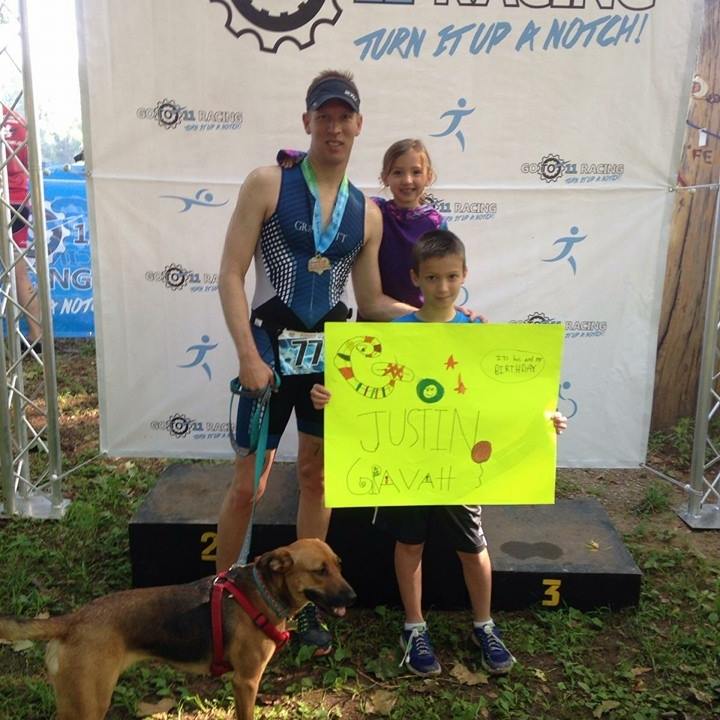
My family and I didn’t stick around the race site long after I finished since we were headed out of town to the Outer Banks for vacation.  We posed for a quick picture in front of the podium (Heidi included), and I was sad to have missed out on a podium spot by a mere 35 seconds.  It would have been great to podium in a race with 24 people in my age group, but I was still pleased with my performance.  By the time this race comes around again in 2017 I’ll have a full year of coaching under my belt, so maybe a podium spot will be within my grasp at that point.

In the meantime, it was time to head to the Outer Banks and to have a few adult beverages for my birthday.


13529193_10204884456871273_4162454034873719617_n

“In a corner I was wondering, if a change would be better than this…”

Sweet Spot Cycling Home Page

ProK Racing Home Page

May 2016 – Its less than five months before Ironman Maryland and I’ve decided to make a big change to my training regimen by purchasing coaching services.  My buddy Chris Busher had been training with Karen Holloway of ProK Racing for some time, and he’d been encouraging me to come on board.  I’d met Karen the weekend before Ironman Raleigh 70.3 in May 2015, and she was kind enough to give me some last minute advice.  I’d been getting second-hand training advice from Busher, but as informative as that was, it was no substitute for input directly from Karen, who just happens to be the 2005 Ironman Canada female champion.

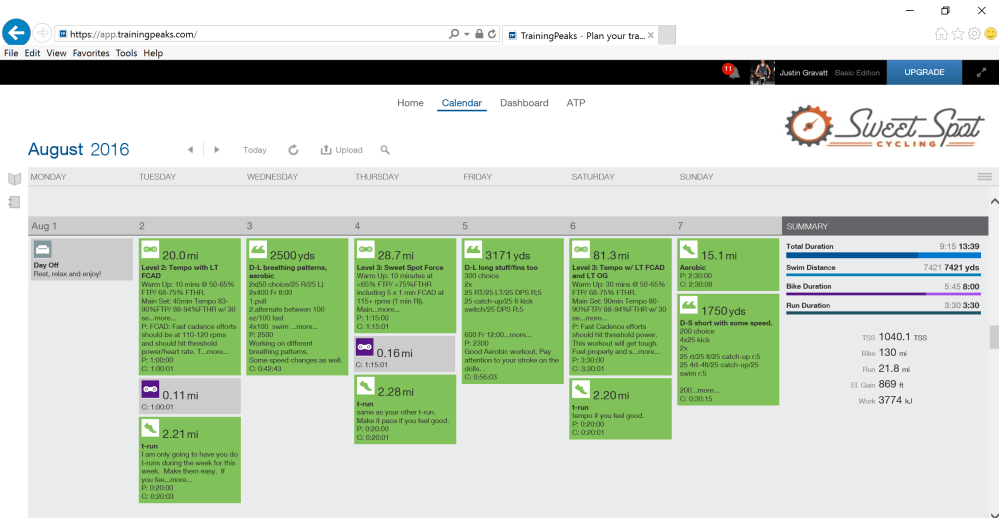
I didn’t realize it at the time, but I’d actually be getting two coaches for the price of one.  Karen had partnered with Erin Wittwer, who runs Sweet Spot Cycling out of the Richmond Bicycle Studio near The Diamond.  Erin has a cycling background, and she and Karen offer triathlon coaching services together.  Via the Trainingpeaks website, they would input my workouts for the week, so all I had to do was get my butt out of bed and go do them.  No mental gymnastics were necessary on my part as to what I needed to do, when I needed to do it, how hard I needed to do it or how long I needed to do it for.

My new age of training began immediately after the 2016 Powersprint Triathlon, and two things became apparent to me quickly.  The first was that I thought that I had been training hard – I was mistaken.  My swim/bike/run training volume went from 4-6 hours/week on average to 7-9 hours/week in short order.  That may not seem like a big jump, but when you have a full time job and have two kids (with their own activities), it’s a fairly big adjustment.  My first three weeks on the program left me chronically tired, hungry and quick-tempered.  Leigh Anne claimed that I was constantly “hangry,” which is some combination of hungry and angry.

The second thing I noticed was that I had been training all wrong and putting in too many “junk miles.”  When I swam, I’d go to the pool and swim a non-stop 2000-2500 yards.  I’d bike on the trainer at a constant wattage most of the time, and when I ran, there were no pace changes – I’d pick a pace and run that pace from start to finish.  Sure, there were some exceptions, but not many.  I was also doing most of my runs in the “bullshit” zone that is moderately hard, but not super hard.  There was also a semi-neurotic avoidance of easy workouts since I thought those were worthless.  I mean, what’s the purpose of running 10-12 minute miles if you can run 7-8 minute miles?  All that does is make you look slow to your friends on Mapmyrun and Garmin Connect, right?

My calendar was quickly filled with “super easy” aerobic runs, followed by fartleks a couple of days later.  There were also “recovery” spins and then “Sweet Spot” interval sessions that made me want to quit halfway through.  Straight swim sessions were replaced by programs that took me a half sheet of notebook paper to write out.  There were pull sessions, drills, build intervals and a bunch of other stuff that I’d never heard of before.  Some of it I figured out.  Some of it I faked until I built up enough courage to text Karen that I had no idea what I was doing so that she could enlighten me.

While the infinite wisdom that was being passed onto me was helpful, another important part was the accountability factor that inevitability comes with people looking over your shoulder.  When I was training on my own, I had an informal plan of what I wanted to accomplish in any given week.  If life intervened, like say, an impromptu happy hour session on a Wednesday, Thursday could simply be turned into a rest day.  With Karen, Erin and Trainingpeaks, however, a missed workout was like a glaring red badge of failure hanging out there in cyberspace.

When you complete a scheduled workout, Trainingpeaks turns it green on your training website.  When you complete 50-80% of the workout, it turns yellow, warning you of the impending wrath of your coaches for slacking.  When you complete less than 50%, it turns red – shaming you into coming up with some half-assed excuse as to why you’re not a total failure and an embarrassment to said coaches.  Ok, perhaps I tend to exaggerate the colors, but that’s pretty much how I see them.  Karen and Erin actually understand that life gets in the way of training sometimes, but I try to avoid anything on my website other than green like the plague.  The upside, however, is that there have been many cold, dark mornings when I’ve wanted to sleep in, but the fear of a yellow or red mark on Trainingpeaks has ripped me out of bed and into my prescribed workout.

tp2

Good boy…all green.

In actuality, it was my wife who encouraged me to sign up for the coaching.  I was willing to trudge on towards Ironman Maryland in my blissful ignorance, alone and relying largely upon training tips extracted from Busher and Google.  Triathlon is an expensive sport, and I was somewhat reluctant to spend even more money on the (assumed) intangible benefits of coaching.  Perhaps, Leigh Anne just didn’t want me to die on the course, or perhaps she just wanted me to succeed beyond my own expectations.  I’m not quite sure of the answer to that question, but she did repeatedly ask whether the life insurance premiums had been paid.

So, in May of 2016 I finally relented and signed up for a triathlon coaching package.  The decision ultimately proved to be a good one, and over time, the benefits would manifest themselves in my race results.


Prok


“Short but sweet for certain…”

2016 Groundforce IT Powersprint Triathlon

Race Report

1:04:27

 2/7 AG     15/190 Overall

May 22, 2016 – Its been three weeks since my Olympic distance race at the Rumpus in Bumpass, where I had a good showing, but was still three spots off the podium.  The Powersprint Triathlon is held at the Shady Grove YMCA, and has a 300 meter pool swim, a 12 mile bike and a 5k run.  Jackson and Jillian had competed in the Powerkids Triathon there the day before, but the bike leg had been cancelled due to heavy rains and severe flooding.  In fact, there had been so much rain that the registration table had knee deep water around it since it was sitting in a small depression behind the YMCA.  The weather for my race was better, but it was still unseasonably cool with some wind.  The high was supposed to be 60 degrees, but it was closer to 50 degrees at race time.

Pre-Race

I arrived at the Shady Grove YMCA pretty early, and was bundled up well due to the temperature.  The wind wasn’t terrible, but it was blowing enough to create some wind chill on what was already a cool morning.  After racking my bike and setting up my transition spot I went for a short run.  Since I didn’t feel like standing around in the cold, I grabbed my swim cap and goggles and headed into the nice heated building to warm up in the pool.

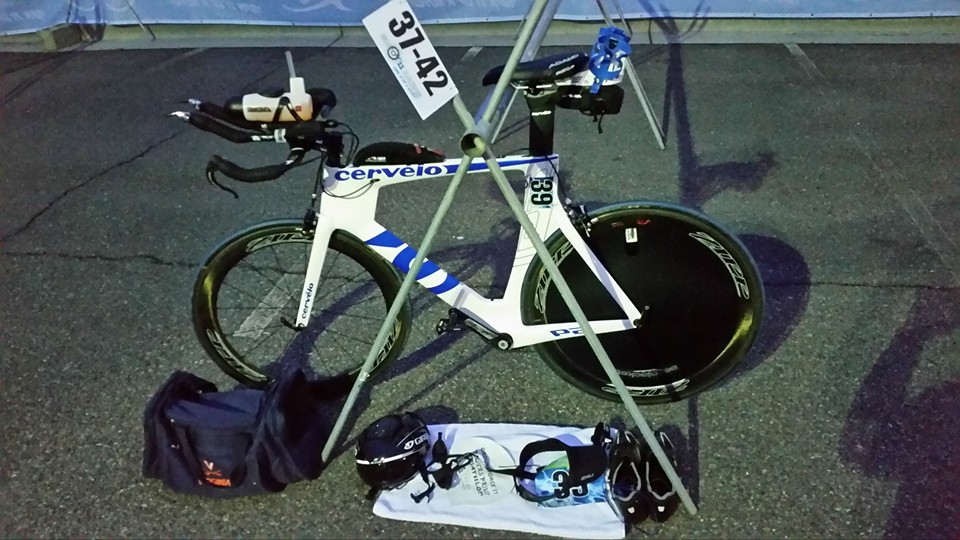
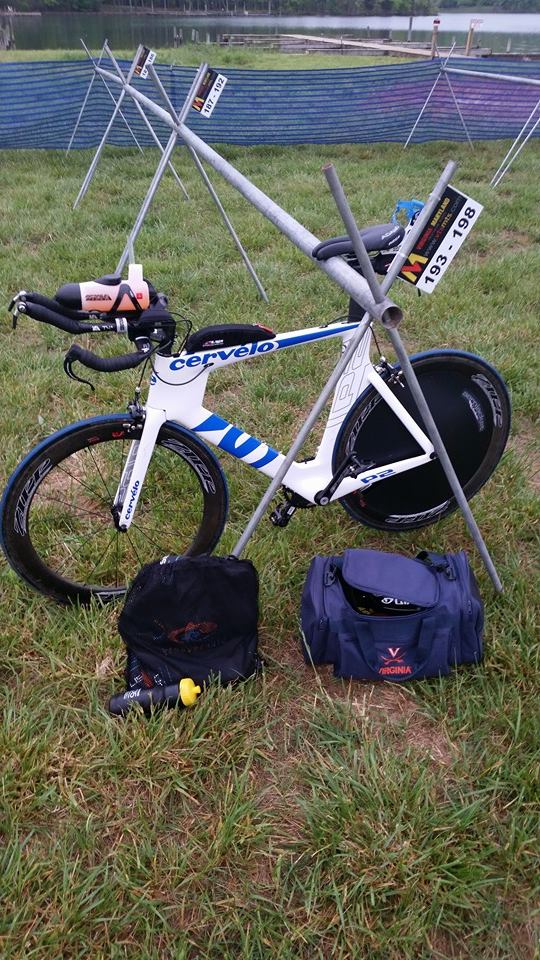
power rack

Once the start time neared, they ended the swimming warmups and moved us back outside for some race announcements.  At that point I was only wearing my trisuit, which was still wet from my pre-swim, so I was FREEZING outside in the wind.  It seemed like we had to stand outside for quite a long time, and then we were allowed to line up numerically by bib number to get ready for the start.  I was bib 39, so I was starting near the front and got to move back inside the YMCA.  The higher numbers were still outside in the cold due to the long line, and I felt sorry for the people near the back since I was already shaking once I got back inside the building.

The bib numbers were based upon your estimated swim time, and the faster swimmers get to start first.  I think I had put myself down for a 5:15 swim since I’d done the swim in 5:24 the year before.  I was hoping to do better than 5:15, but I didn’t want to “overseed” myself and then hold up a faster swimmer.  Each swimmer started when the person before them made it half way down the first length of the pool, so I didn’t have to wait too long to start once the race began.

Athlete Guide with course maps

Swim- 5:07  (1:42/100 m)  (1/7 AG)

The 300 meter swim was 12 lengths of the pool, and there were timing mats a few feet from the start and finish on the pool deck.  I do much better swimming in a pool than I do in open water, whereas I just don’t have enough experience swimming in open water to feel completely comfortable.  When it was time to start, I crossed the timing mat and jumped into the pool (no diving allowed).

I got into a good rhythm pretty quickly and I was hoping that the swimmers ahead and behind me had seeded themselves properly so we wouldn’t get bunched up in the pool.  Passing is difficult with people swimming in both directions of each lane, and thankfully, the self-seeding worked great – I didn’t have to pass anyone and no one passed me.  I felt good from start to finish, and this was probably my best swim since getting into triathlon two years prior.

On the 5th and 6th laps, I increased my pace as much as I felt comfortable, but I didn’t want to go all out and burn too many matches in the pool with two disciplines left.  I was pretty winded by the time that I finished the swim, but I climbed out quickly and ran across the timing mat in a time of 5:07.  That was 17 seconds better than my 2015 time, and good enough for 1/7 in my age group.

This was kind of a watershed moment for me since I couldn’t swim freestyle AT ALL when I got into triathlon in 2014.  Granted, a 1:42/100m pace over 300 meters is not exactly world class, but it was good enough on this day to best the other six guys in my age group.  It was also good enough for the 19th fastest swim of 190 athletes.  There was still a lot of room for improvement, but at least I had some level of confirmation that my early mornings spent at the Collegiate Aquatic Center were paying dividends.  To put my improvement into perspective, it took me over 8 minutes to do the 300 meter pre-swim before my first triathlon in 2014.

T1- 1:37

I was pretty dizzy when I got out of the pool, so I did my best to stay upright as I ran though the kiddie pool area and out the back door of the YMCA.  There was then a long run to the transition area, and once I got to my bike, I donned my helmet and shoes and took off for the “bike out” area.  I noticed that the timing mat was about 20 feet prior to the mounting line, so that had a small impact on my bike split.  It obviously affected everyone the same, but in 2015 the timing mat was very close to the mounting line, which led to faster bike splits.

Bike – 33:52 (21.3 mph)  (2/7 AG)

I completed the bike course in 33:32 in 2015, and under similar conditions I should have beaten that time in 2016.  I had another year of training under my belt and I also had a rear disc cover for better aerodynamics.  Nevertheless, due to the cool/dense air and the windier conditions, this was a slower bike than the year before.  I discussed this issue with some of the ProK guys who had raced in 2015 and 2016, and they confirmed that their bike splits were slower in 2016.

As I took off onto the bike course I began to catch a few people who had started the swim before me.  Not a ton, but probably three or four in the first few miles.  I was only passed by one cyclist on the entire ride, and he was really moving.  I tried to ease myself into the ride to keep my heart rate from spiking, but I was also cognizant of the fact that in a sprint distance race, there’s not a whole lot of time to ease into anything if you want to try to make the podium.

The wind wasn’t whipping, but it seemed to be pretty steady at 10-15 miles per hour.  I felt like I was pushing hard, but I just couldn’t get my average speed to creep up to my 2015 level of 21.6 mph.  It was particularly bad after turning right onto Pouncey Tract Road, since there was a direct headwind and no protection from it.  After turning right onto Ashland Road things got a little bit better, but the dense air still made it feel like I was pedaling through Jello.

The bike course is pretty flat overall, but there are a couple of hills in the last few miles.  I pushed it hard on the uphill portions to try to make up some time, but the ride just felt slow.  After a few more turns it was finally over, and I shifted my thoughts to having a good run split.  In hindsight, I still managed to have the second fastest bike split in my age group, so I guess I did better than my GPS was leading me to believe during the ride.  The conditions were tough, and I guess I was putting too much emphasis on my 2015 bike split.  It just wasn’t an “apples to apples” comparison between 2015 and 2016 due to the weather differences.

T2- :52

T2 was pretty quick, with the most difficult part being the dismount of my bike.  My old road bike had been a few inches shorter, which made it easy to fling one leg over at the dismount line.  My new tri bike was tall enough to test the limits of my leg flexibility, so I had to be a bit slower and more methodical.  After pushing my bike back to the rack, I changed my gear quickly and then set out for the “run out” area.  My only hiccup was stopping briefly to adjust the tension of the Lock Laces on my right shoe since it seemed to be looser than I remembered.  T2 was still done in under a minute, so I’d consider it a successful transition.

Run- 23:01 (7:25 min/mile)  (3/7 AG)

The run is slightly uphill on the out portion and then slightly downhill coming back in.  As bib number 39 there were not that many runners out on the course ahead of me.  I had ultimately passed about 8-10 people on the bike course and I may have passed a person or two in each transition.  Thus, there were probably only about 15-20 people ahead of me coming out of T2.  I wanted to negative split the run, particularly due to the elevation change being favorable on the second half, so I made sure to go out relatively conservatively.

Mile 1 (7:35)

The first mile went by pretty quickly, and my legs adjusted off the bike well.  Due to the weather, there weren’t any spectators outside of the YMCA property, and I focused on keeping my breathing under control.  There was a left turn onto Twin Hickory from Shady Grove Road just past the half-mile mark, with a water stop shortly thereafter.  I bypassed the water station, not wanting to slow down, but thanked the volunteers nonetheless.  The first mile passed by in 7:35, and I felt like my pacing was were it needed to be.

Mile 2 (7:33)

Things started to hurt a lot more in the second mile, and I knew from prior experience that the turnaround cone would be farther down Twin Hickory than expected.  Twin Hickory is a fairly straight road, but there is enough of a right meandering bend that you can’t see the turnaround point until you are within a couple hundred yards of it.  You keep thinking that you have to be at the midpoint, but the freaking turnaround cone just doesn’t appear, which is a bit demoralizing.

After finally seeing and rounding the cone I checked my GPS and saw that I was just under 12 minutes – pretty similar to my mid-point split in 2015.  This time, however, I felt like I had a little more left in the tank and I headed back in the direction that I’d just come.  Even though my legs and lungs had started to burn, I felt encouraged by the fact that it was going to be slightly downhill going back to the YMCA

Mile 3 (7:23)

The third mile of the run in sprint triathlons is a balance of the pain from over an hour of racing and the euphoria of knowing that the end is near.  Its also the time when you learn a little about your personal fortitude and your willingness to embrace the pain.  This run was no different, and I was talking to myself in my head a lot as I headed back down Shady Grove Road towards the YMCA.

As in 2015, there were about 30 spectators at the edge of the YMCA property, where you turn right and head into the finishing chute.  I could hear them making noise for the runners as I was about a quarter of a mile out, which gave me some additional motivation.  I picked up the pace as much as I could as I neared the YMCA, and turned it into a quasi-sprint as I entered the finishing chute.  After crossing the finish line I got my medal and a bottle of water, and then laid in the grass for a bit while I waited for the results to be posted.  I felt like I’d had a strong race and figured that I might be in contention for a podium spot.  I’d completed the run in 23:01, which was 35 seconds faster than the year before.

Race Results Link

GPS Data

Post Race

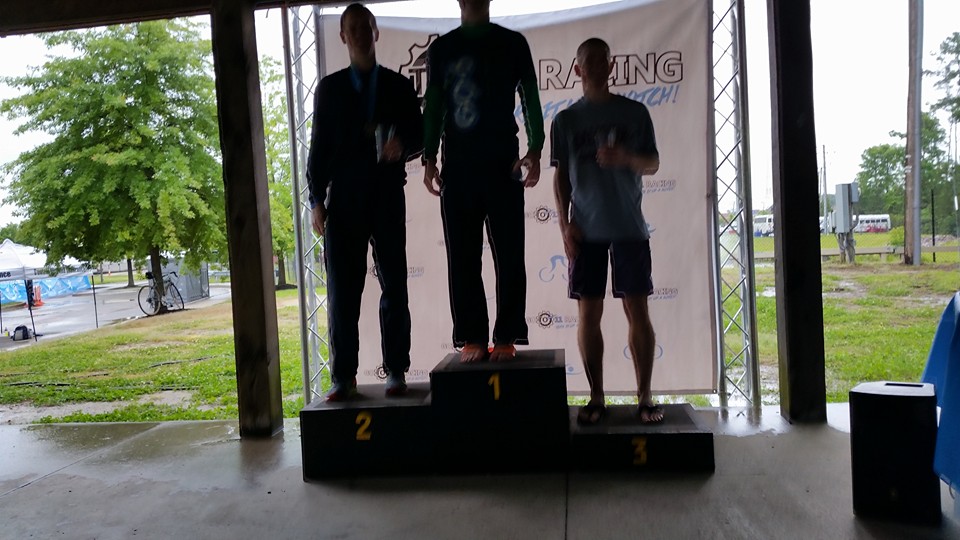
After rehydrating and taking in a few pieces of Papa John’s pizza, I figured that enough results were in to make it meaningful to check the standings.  I saw that I had finished second in my age group, so I was excited to have made my second ever triathlon podium.  Granted, my age group only had seven guys in it, but I had also come in 15/190 overall.  I’m not going to be in contention for a Kona slot anytime soon, but it was nice to see that my training was paying off.  My swimming and biking had really improved after two full seasons of training and racing, and if I could get to where I was running sub-7 minute miles off the bike, maybe I’d have a chance of standing atop a podium at some point.  For now though, second place would have to do.

silver

power podium

Terrible photo, but that is me on the left.  Notice the rain and puddles in the background.

“Reaching searching never stop…”

2016 Rumpus in Bumpass Olympic Triathlon

Race Report

2:31:22

 7/28 AG     53/320 Overall

April 30, 2016 – I haven’t tackled an Olympic distance triathlon since the culmination of my freshman tri season in 2014 at Richmond Rox.  In that race I failed to fuel properly, which led to an almost-spectacular bonk in the final mile of the run.  I managed to overcome it to a degree and run to the finish, but walking in the last mile of a 10k  means that something didn’t quite go as planned.

In 2016 I was determined to right my past wrongs, but I was only a week out from the RTC Sprint Triathlon were I set PRs in the bike and run.  The day after that race, Busher and I had taken part in a metric century ride in Powhatan, where we were both struggling in the final few miles due to the race the day before.  Thus, I was hoping that my body was recovered and ready to take on a triathlon that was more than twice the distance of the one the week before.

Olympic races seem to be the least popular distance among non-professionals, and I liken them to a 10 or 15k in running.  They’re short enough for most triathletes to tackle, but if done at maximum intensity they hurt…a lot.  There’s a 1500 meter (.93 mile) swim, followed by a 40k (25 mile) bike and then a 10k (6.2) mile run.

In the 18 months since my first Olympic race I’d tackled several sprint triathlons, along with two Half-Iron distance races.  I’d also learned a lot about proper fueling strategies, and my training volume and intensity had also increased significantly.  Thus, I was looking to drop several minutes off of my 2014 time of 2:48:56.

Pre-Race

The Rumpus in Bumpass is put on by the Virginia Maryland Triathlon Series, and the swim takes place in the “warm” side of Lake Anna.  The bike course is two loops around the southern portion of the lake, and each loop takes you across four bridges.  The run course climbs up away from the lake, and then is mostly flat with a few rolling hills.  I had never really been to Lake Anna before, so this would be a new experience for me.

The race venue was the better part of two hours from my house, so I left home well before dawn.  Upon arriving, I put on the rear disc wheel in the parking lot and the transition area was just opening by the time that I finished.  Before I could go rack my bike though, I had to pick up my packet, which included a cool pair of Rumpus in Bumpass socks and a t-shirt.  I still rock the blue socks, and I ended up wearing them in Ironman Maryland on the run.

From the registration tent, I made my way into transition and snagged the end of the bike rack.  I still had plenty of time before transition closed, so I ended up going for a slow jog to loosen up.  Due to the 60-something degree water temperature, this race was wetsuit legal, so I went ahead and squeezed into my wetsuit after hitting the porta potties one last time.  Some people were pre-swimming, but after feeling the water temperature I decided against it.  I didn’t feel like standing around wet on a cool morning, even in a wetsuit.  I couldn’t imagine swimming in the cold water without a wetsuit, and I only saw a handful of people without them.

rumpus-rack

Eventually, it was time to get started so I made my way down to the swim start and waited for my swim wave.

Race

Race Results

GPS Data

Swim- 29:55 (2:00/100 m) 10/28 AG                            

I waded into the water a minute or two before my swim wave and was cold, even with the wetsuit.  I should have done a quick pre-swim to acclimate to the water, but I’m a real sissy with cold water.  Once the gun sounded for my swim wave I took off, and the cold water took my breath away as soon as I put my face in.

Nevertheless, after the first 30 seconds or so of swimming I warmed up and the water actually felt great the rest of the way.  Still, I was getting jostled around a bit by the other swimmers in the first few hundred meters, so I moved over to the right to try to find some clean water.  That left me out of the draft, but at that time, I really needed to try to get into a groove.

The swim course is basically a triangle, and I just couldn’t get going very well on the “out” portion of the triangle.   The oddest part of the swim occurred in the “out” leg, when the water went from dark to light brown.  At first I didn’t think too much of it, but after a minute or two the water seemed to look weird, but I couldn’t figure out exactly what was going on.  Eventually my fingers hit something, and I realized that I was touching the bottom of the lake, which must have been about two or three feet deep at that point.  Since my swim was not going well at that point I considered getting up and running, but figured that doing so might be slightly against the rules, so I continued on.  After another 100 meters or so the water turned dark again, so I must have gotten to a deeper part of the lake.

Once I rounded the first turn buoy things started to go a bit better, and by the time I rounded the second turn buoy to head back in, I was finally getting comfortable in the water.  The “in” leg of the triangle went well, and I felt like I wasn’t ready for the swim to end since I’d finally gotten into rhythm.  I wasn’t about to swim another loop for the fun of it, so I headed up the boat ramp into T1.

swim.jpg

Swim exit – looking back at the second half of the swim course.

T1- 3:12

My T1 was a bit longer than normal since I had to take off my wetsuit and since there were no wetsuit strippers.  I’d put Bodyglide on my wrists and ankles before donning my wetsuit, but removing a wetsuit isn’t a superfast process when doing it solo.  After finally getting out of it, I had to fold it up and stash it in my transition bag, whereas the marshalls had warned us before the race that we’d keep our transition areas clean or get penalized.  Once I was done with my wetsuit, on went the bike shoes and helmet, and then there was a long run to the “bike out” area.

Bike – 1:07:55 (20.9 mph)  7/28 AG

The first .3 miles were all uphill away from the lake, and then there was a two loop course with a little over 400 feet of elevation gain on each loop.  That doesn’t seem like a lot in hindsight, but there didn’t seem to be many flat portions of the course, other than the four bridges that we had to cross on each loop.  The fourth bridge was easily the longest, and was about a half-mile in length.

My conservative goal was to average at least 20 mph, whereas I’d averaged 19.04 mph in my first Olympic distance race in 2014.  That had been on my old road bike, so I shouldn’t have too much trouble besting that on my new tri bike, especially with another 18 months of training under my belt.

The first 4.5 miles of the loop were primarily uphill, and I almost had an incident around the first mile marker when someone tried to back out of their driveway when me and four other racers were passing by.  Tragedy was avoided, but there were some friendly gestures and suggestions for the impatient motorist as we dodged his SUV.  Just before mile 5 the course headed back downhill towards the lake, and we crossed the first of the four bridges for the first time.

There was a right turn around mile 7, and police and paramedics sped past me just before I made it to the turn.  Someone had apparently crashed, but the paramedics had stopped just beyond the turn and I couldn’t see what was going on.  After making the right turn, the course was nothing but rollers until about mile 10, when it turned right again to go back across the lake towards the transition area.  The half-mile bridge seemed to be slightly uphill and into the wind, and I noticed several grooves in the bridge that looked like crash hazards.  I made a mental note to avoid them on the second loop.

After making a left turn after crossing the bridge and heading uphill, I passed the road leading back down to the transition area and started loop 2 of the bike course.  It was at that point that I noticed the photographer, so I did my best to smile for the camera, even though the race was starting to get painful.

bumpass-bike

Starting loop 2 of the bike course.

Loop 2 of the course consisted of me trying to increase my level of effort so that I could negative split the bike.  Since I didn’t have a power meter I was riding by feel, while also using my GPS to check my speed and average pace.  Due to the initial climb away from the lake, my average pace was constantly creeping up, and I felt ok after the first loop so I thought it was safe to work a little harder on loop 2.

Things went pretty smoothly until I got to the fourth and final bridge for the second time around mile 21.6.  I had been overtaking more riders on the second loop, whereas there were people who had come out of the water after me and who were on their first bike loop.  There were two people ahead of me on the bridge, so I moved to the left side of the lane to pass them.  I passed without incident, but just as I went to move back to the right my front wheel sank into one of the grooves that I’d seen on the first loop.

Before I could react, I began sliding and my rear wheel began to come around to my right.  I then had a major “Oh shit!” moment, which involved the puckering of a certain bodily orifice.  Within the span of a second or two, my front tire came out of the groove and my bike righted itself.  I wish I could say that my superior bike handling skills had something to do with it, but to honest, I really just got lucky.  Had I crashed, the two riders that I’d just passed would have run me over and it would have been a very bad day for all of us.

After that incident, it was just a climb up away from the lake and then a left turn to head back towards the transition area.  This time I didn’t have to go straight for another loop, and I got to turn left to head back downhill towards the lake.  I was glad to be getting off the bike, and I coasted down the final hill to get ready for the 10k run.

T2- 1:58

T2 was quicker than T1, but still longer than normal since there was a fairly long way from the timing mat to the actual transition area.  Running in cycling shoes is never easy, and running in soft grass might be more difficult than running on pavement.  Once I got back to my bike I swapped out my gear and took off towards the “run out” area.

Run- 48:33 (7:48 min/mile)   12/28 AG

In 2014 I’d run a 52:48 10k, which included some walking in the last mile due to my fueling failure.  This time I’d made sure to fill my water bottle on the bike with Gatorade Endurance, which was supplemented by a couple of gels as well.  I was determined to run a sub 50-minute 10k this time around, and I hoped that I’d taken in enough calories on the bike to get me to the finish line without walking.

My plan was to run 8 minute miles for the first half of the race  and then to push the pace when I knew that a bonk was probably out of the equation.  The first quarter mile or so away from the lake was all uphill on a dirt trail, which slowed me considerably.  When I finally got to the top of the hill, there was a gravel trail leading out to the paved road.  The run course was an out and back on the paved road, with a short run to a turnaround cone that was on the gravel trail.  After hitting the turnaround cone, you had to do the out and back on the paved road once again, and then you could head back down to the lake and the finish line.

The run up away from the lake was tough, especially since there had been some rain recently, so the ground was fairly soft.  It was about half a mile to the paved road, and it took me that long to begin settling into the run.  Once I hit the pavement, however, the course seemed to be nothing but rolling hills.  There wasn’t anything as steep as the climb away from the lake, but there weren’t many flat portions either.  I probably over-ran the first mile, because I was seven seconds under my goal pace even though it had been mostly uphill to the first mile marker.

It seemed to take forever to get to the turnaround point at the 1.7 mile mark, and while I was feeling relatively good, fatigue was beginning to set in.  I retraced my steps to the turnaround cone at mile 3 back on the gravel trail, and then set off on my second loop.  It was at that point that a guy in my age group ran by me, and I was determined to stay on his heels as long as possible to see if I could try to pass him near the end.

The second loop of the run was much more painful than the first, but I was able to stay within ten yards of my age grouper until we neared the 5 mile mark.  He sped up or I slowed down (or both) and he gradually began to pull away from me.  I hated to let him go, but based upon his body language, he had more left in the tank than I did.

At mile 5.6 I made the turn back onto the gravel road, and I knew that the remaining portion of the run was primarily downhill.  I increased my pace, and as I neared the finish line there was some much needed assistance from gravity.  The last bit of the run course was on the grass near the lake, and there was a long sprint through the finishing corral up to the finish line.  My total time for the run was 48:33 – which was comfortably inside my 50 minute time goal.  My GPS had the run course at 6.1 instead of 6.2, but even if the course was a tenth of a mile longer, I still would have been inside 50 minutes.

rumpus-finish-line

Post-Race

After the race I pretty much collapsed in the grass near the lake for a few minutes and then got my free pizza from the Papa John’s stand.  I was very pleased with my race, and finished my second Olympic distance triathlon more than 17 minutes faster than my first.  Granted, the courses were different, but they were similar enough to provide somewhat of an “apples to apples” comparison.

In looking back at my performance, the only area that I felt like I had underperformed was the swim.  It took me two-thirds of the swim to really get comfortable, but I think that was still due to my lack of open water swimming experience.  Swimming in a lake or river is markedly different from following a lane line in a pool, and I was still not fully comfortable.  I was pleased with my bike and very excited about my run.  I’d run an 8:31/mile pace in 2014 and a 7:48/mile pace in 2016 (7:58/mile if the course was really 6.1 instead of 6.2 miles).  Some of that gain was due to proper fueling, but my overall fitness had improved as well.

So…I was two races into the 2016 season and had already seen nice gains in my bike and run splits.  I knew that my swim fitness had improved as well, but I had not yet been able to put that on display in those two races.  I was happy with my age group finish of 7/28, but on the downside, I was more than 14 minutes off the podium.  There were some seriously good athletes in my age group at this race, and I could train for several more years and still not be able to shave that much time.

As I packed up and headed back to Chesterfield I was already thinking of my next race, which was the Groundforce IT Powersprint triathlon in May.  Everything had gone right for me at that race in 2015, but I hadn’t been fast enough to make the podium.  Perhaps an additional year’s worth of training would change things this time around.

rumpus finish.jpg

My first outing in the new tri-suit.

“I laugh at what I cannot change, I throw it all on the pyre again…”

2016 RTC Sprint Triathlon

Race Report

1:08:03

 6/22 AG     54/419 Overall

April 23, 2016 – Its been a year since my debacle at the 2015 Richmond Triathlon Club sprint triathlon where my goggles busted at the start of the swim and then I flatted on the bike.  I had additional complications after changing my flat tire, which forced me to push my bike two miles back to transition.  No fun task in cycling shoes.  Technically, that race was a DNF since I didn’t complete the bike course, but I still took out some of my aggression on the run course just for the heck of it.

Thus, in 2016 I felt like I had some unfinished business with this race, and was determined to have a better go of it the second time around.  The 2016 version would be an improvement, but factors outside of my control would negatively affect my swim once again.  Frustrating, but the only thing you can control in life is your own effort.  Credit to Mark Cuban for that insight.

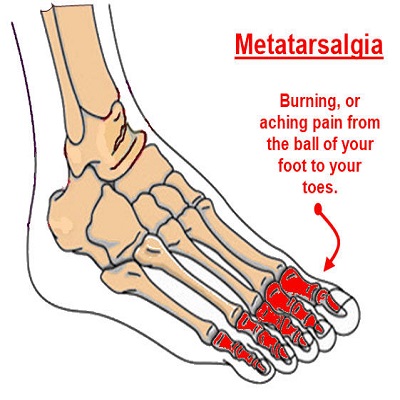
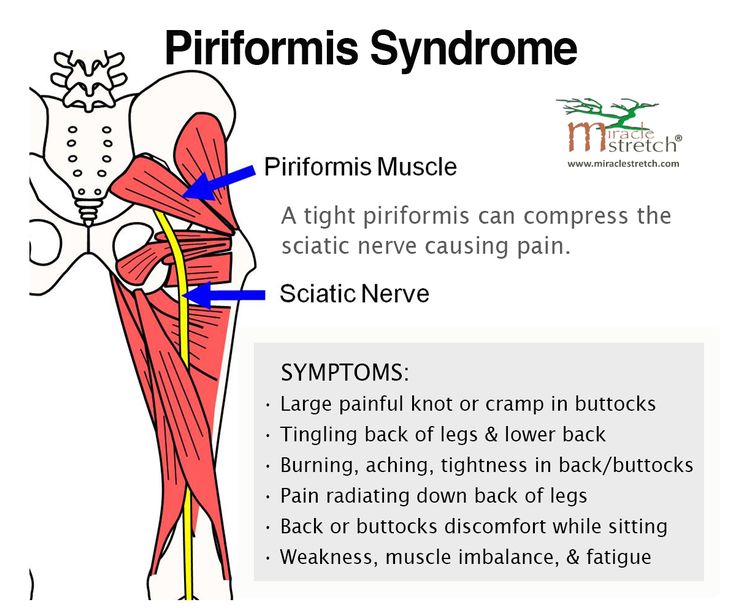
One of my other concerns going into this race was my ongoing left-sided piriformis issues.  It always flared up with increased intensity workouts, and sprint races are definitely high intensity.  I’d seen my physical therapist two days days before the race, and she’d taped me up and made sure that my hips weren’t out of whack.  A couple of hours before the race, I’d also taken my prescription anti-inflammatory, along with two Ibuprofen.  If those didn’t work, then I’d just have to tough it out.

Pre-Race

The RTC Sprint takes place at the Collegiate Aquatics Center (aka SwimRVA), which is where I do the majority of my swim training.  I always try to arrive at races early to snag the end of the bike rack, and since I live only 20 minutes away, I was obscenely early.  Parking was had at the nearby Martin’s, and since I wasn’t comfortable transporting my bike on my bike rack with the rear disc cover on, I had to swap out my rear wheel in the dark parking lot.  That was a bit of a challenge since I forgot to bring a flashlight, but I managed.  A lot of people were riding their bikes down to the transition area in the dark, but I walked my bike, not wanting to pop a tire on an unseen rock or other hazard.  Thankfully, my coveted end-of-the-rack spot was still available when I got to the transition area.

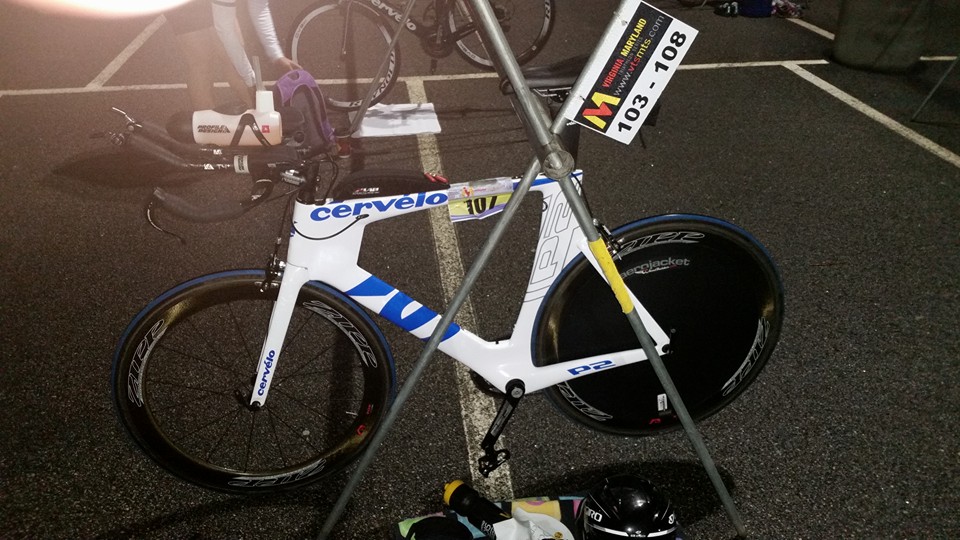
rtc-rack

I hadn’t picked up my race packet before race day, so after racking my bike I had to go inside to pick up my bib and bike/helmet stickers.  Then it was on to body marking and chip pickup, followed by some jogging and stretching to warm up.  It was cool outside, but thankfully it was warm enough to be relatively comfortable, even in a tri-suit.  The sky was overcast, but it was a good 10 degrees warmer than the 2015 race.

After obsessing over my transition area for far too long, I decided to go inside to warm up in the instructional pool.  I had a fairly new pair of TYR Spec Ops 2.0 goggles, and I was hoping that they’d hold up better than the Aquaspheres that snapped on me the year before.  I did several laps (with no goggle issues), and then decided that it was time to head over to the 50 meter pool to start lining up for the swim start.  Busher was bib 86, so he was starting a couple of swim waves ahead of me.  After wishing each other luck, we took our spots in the line of people winding around the pool deck.

Race

GPS Data

Course Maps

 Swim- 7:48  (1:57/100 m) 14/22 AG                                 **Official time   

               7:05 (1:46/100m)                                                     **Actual time

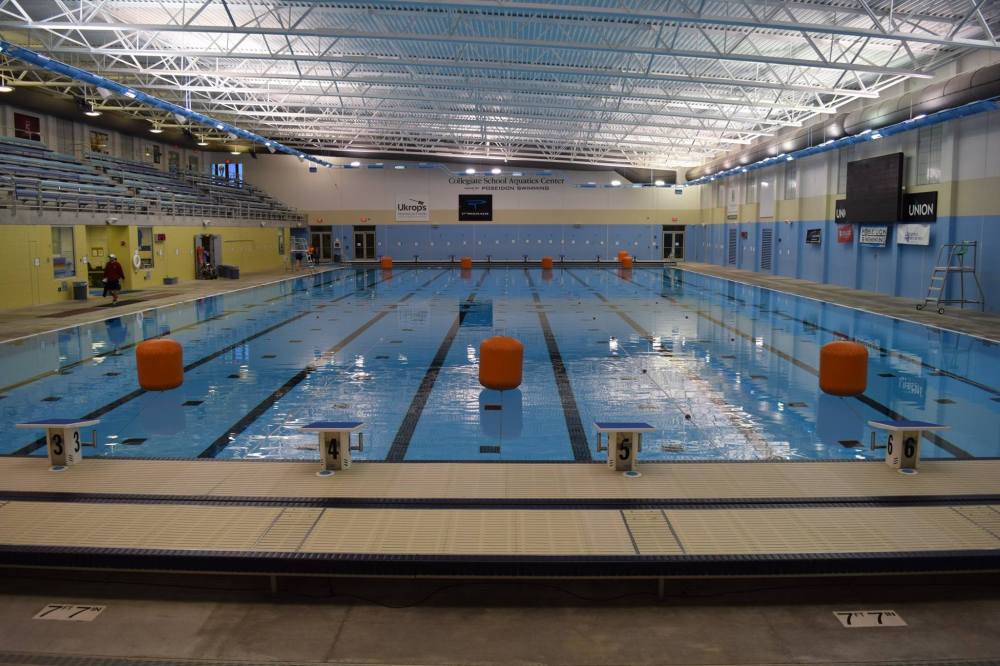
rtc pool.jpg

The RTC Sprint features a 400 meter “open water” pool swim.  Its 8 lengths of the 50 meter pool, where you round buoys instead of touching the wall.  Groups of 10 are started 1 minute apart, and your bib number is based upon your predicted swim time.  Thus, bib 1 has the fasted predicted swim, and the first swim wave includes bibs 1-9.  Bibs 10-19 start a minute later, and so on and so on.

The biggest problem with this format is that there is no timing mat at the swim start.  The official race clock is followed, and if swim wave 1 starts at 7:30, then swim wave 2 is put down as starting at 7:31, even if something happens to hold them up.  In my case, I was in the 11th swim wave as bib 107, and two girls were coordinating the swim start.  The protocol was to make sure that the correct 10 people were ready to go for any given swim wave, and then they’d be allowed to jump in the pool.  They’d tread water for about 30 seconds, and then they’d be sent off at the appropriate time.

That protocol went smoothly in 2015, but in 2016 one of the two starters didn’t seem to know what she was doing.  The first girl checked our numbers and then we got ready to jump in the pool.  The second girl then stopped us and said that we needed to line up numerically, which made no sense since we were all starting together en masse.  I noticed that the clock had already passed our official start time, but the one girl was still trying to make us line up lowest to highest.  The second girl finally realized what was going on and told us to jump in the pool.

I was the first or second person to jump in, knowing that my time was already going to be off due to the foul up.  As soon as I hit the pool they started shouting “go,” and I was promptly jumped on by another guy in my swim wave.  He didn’t hit me directly, but it was enough to shove my head under and cause me to swallow a bunch of water.  I came up coughing and my heart rate went through the roof.

One of the toughest parts about triathlon swimming is controlling your heart rate, particularly at the beginning of the swim when there is a lot of congestion around you.  Once your heart rate gets too high, you can’t catch your breath and swimming is very challenging.  My high heart rate was compounded that day since I had also swallowed a bunch of water.  Thus, for pretty much the first half of the swim I felt as though I couldn’t catch my breath.  Getting into any sort of a rhythm was impossible.

By the time that I neared the mid-point of the swim I was starting to feel a little better.  My heart rate had come down a bit and I was finally able to swim in rhythm without feeling like I was out of air.  Still, I was pretty upset about the delayed chaotic start, and was already thinking about sliding down the age group standings due to the delay.  In looking back at my Garmin data, my swim pace was pretty abysmal for the first couple of minutes.  It picked up just before the mid-point, and then peaked in the last third of the swim.

By the last 100 meters I was ready to get out of the pool and to start making up some time on the bike.  I put as much into the final 50 meters as I had in me, then I climbed out of the pool and ran across the timing mat.

T1- 1:19

T1 involved a long run out of the pool, around the side of the building and then into the transition area in the front parking lot.  It was fairly uneventful for me this time around, but in 2015 I lost a good amount of time struggling to  put on a long sleeve Under Armour shirt.  Body-hugging technical shirts don’t go on wet bodies very easily.  It was chilly in transition in 2016, but warm enough were I wasn’t going to fight another shirt and lose all  that time.  Once I got geared up, I ran my bike across the next timing mat and took off up the hill to Route 10.

Bike – 34:38  (21.8 mph)  6/22 AG

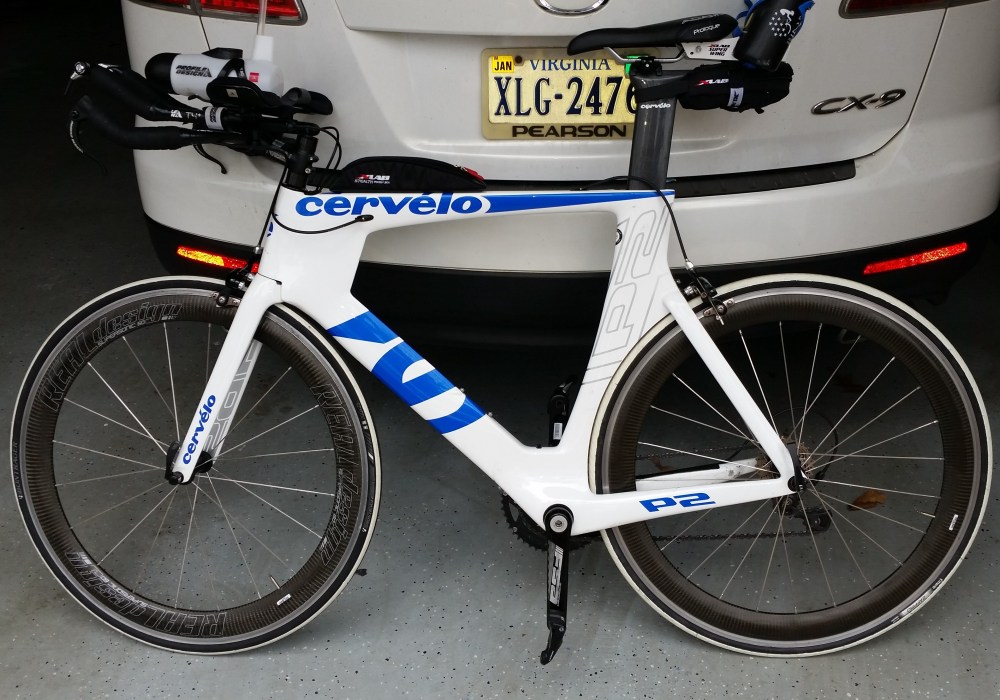
This was my first race on my new tri bike, and I was determined to have my fastest sprint tri bike split.  The first third of a mile out to Route 10 was uphill, but the course was pretty flat thereafter, with the exception of a few rollers after rounding the Chesterfield County airport.  Once I took the first right onto Route 10 I got into a good groove, and I began catching some of the people who’d been in the earlier swim waves.  Present in the back of my mind, however, was my flat tire around mile 2 the year before, and I was glad to get past that portion of the course this time without incident.

By the time that I took a right onto Whitepine Road near the airport I had begun to space out from the other riders a bit.  There were typically at least four or five other cyclists in sight at any given time, but things weren’t so bunched up that I was worried about a drafting penalty.  Miles 6-9 on the back side of the airport had some rolling hills.  Nothing major, but I did have to shift and get up out of the saddle a few times on the uphill portions.

After mile 9 the course was flat once again and I tried to hammer as hard as possible to increase my average speed.  My GPS showed my average inching up constantly, and I was hoping to get close to 22 miles per hour for the ride.  My best sprint distance bike split had been 21.6 at the 2015 Powersprint, and I definitely wanted to beat that on my new bike.  Sure, the courses were different, but both were relatively flat, and thus, comparable.

My only near-mishap of the day on the bike came near Mile 11.5 after turning left on Route 10 to head back towards the Collegiate Aquatic Center.  I was trying to overtake a female rider, but the coned off area for the bikers was particularly narrow at that point.  I yelled to her that I was passing, but due to the limited cone spacing we almost collided.  To be fair, the smartest thing to do would have been to wait for a more suitable place to pass, but I really didn’t want to get stuck behind her for a half mile or more.  Thankfully it worked out, but she probably made a mental note that bib 107 almost ruined her day.

From there, it was only a left turn onto Ridgedale Parkway back to transition.  The first bit was uphill, and then it was back downhill to the timing mat.  I dialed it back once I crested the hill and tried to catch my breath and lower my heart rate before the run.  After crossing the timing mat I dismounted without incident, and was pleased to see that I’d held 21.8 mph for the ride.  A PR on my first race with the new bike – I had mostly forgotten about the swim fiasco.  Mostly.

T2- 1:08

Like T1, T2 was pretty uneventful.  I racked my bike, swapped out my shoes, grabbled my visor and race belt and took off.  I headed back to the area of transition where I’d come in from the pool, and then there was a sharp left turn to head back from where I’d just come from – albeit on the outside of the transition area.  It was at that point that I saw my family for the first time since the swim start.  After a few words of encouragement, I was on my way onto the run course.

Run- 23:12 (7:27 min/mile)   9/22 AG

My goal for the run was to set a new PR for a 5k (off the bike).  Since I’m relatively new to triathlon, I’m actually looking to PR every time out.  My previously best was 23:33 at the 2015 Powersprint triathlon.  I’d actually run a 23:16 at the RTC Sprint in 2015, but that was only after I flatted and pushed my bike back to transition – so it really didn’t count.  I’d also run a 21:33 at the 2015 I Love the Tavern sprint triathlon, but that run course is short of a full 5k.  Thus, 23:33 was my time to beat, which translates to a 7:33 minute per mile pace.

The run is a two loop course, which goes around the nearby soccer fields, then circles back into the Martin’s parking lot.  You then head back to the Collegiate Aquatics Center to either head back out for loop number 2 or to head into the finishing chute.  The course is almost all flat, with the exception of a small hill going up to the Martin’s.

Mile 1   (7:29)

As I took off on the run, I realized that I hadn’t seen Busher since we’d parted ways on the pool deck.  He was two swim waves ahead of me, so he’d had a little bit of a head start.  Our cycling abilities are pretty even, but I’d been able to out run him since his car wreck/neck injury.  Thus I was hoping to find him out on the run course and then reel him in.

I felt good at the beginning of the run, and it didn’t take very long for my legs to adapt off of the bike.  I didn’t want to go out too fast, but then again, I didn’t want to leave any time on the course either by taking it too easy.  I was cognizant of wanting to improve on a 7:33 pace, and I made sure that I was running faster than that, but not too much faster.  By the end of the first mile I’d made my first trip around the soccer fields and had begun heading up the hill to the Martin’s.  I clocked a 7:29, so far so good.

Mile 2   (7:31)

The small hill up to the Martin’s parking lot taxed me a little bit, and I started feeling a bit winded.  I still hadn’t seen Busher and wondered how far ahead of me he must still be.  Since the run course loops around itself, I thought it was odd that I hadn’t even glimpsed him, and began wondering if he’d had bike trouble or had to withdraw due to neck pain.

I did my best to keep my pace even for the second mile, but my lungs were starting to hurt and I still had a decent ways to go.  After coming back down the hill from Martin’s I ran around the Collegiate Aquatic Center to begin my second and final loop.  Once again, I saw my family near the transition area and they provided some additional words of encouragement.  Well, I think my dad actually said something about me running too slowly, but that was pretty much his way of encouraging me.  By the end of the second mile I’d made it back to the soccer fields and the hurting had really begun.  Mile 2 was a couple of seconds slower than mile 1.  Hopefully things wouldn’t fall apart in mile 3.

rtc_sprint2016-1435

Mile 3   (7:24)

I felt like I was beginning to fade at the start of mile 3, but my Garmin data suggests otherwise.  My pacing remained stable, it just hurt more.  After making my last loop around the soccer fields I had to run back up the hill to Martin’s.  I was at mile 2.5 at that point, and decided that I was close enough to the finish to go all in so I picked up the pace.

The run through the Martin’s parking lot felt like it went on forever, and I’d forgotten just how far into the lot the turnaround cone was.  I finally made it to the cone, so all I had to do was head back the way I’d just come and then run down the hill to the finishing chute.  I still hadn’t seen Busher, so I pretty much figured that he’d crashed his bike into a ditch and was bleeding out.

From the turnaround cone to the finish, I still had enough left in me to run a sub-7:00 minute/mile pace.  By the time I got back to the hill leading down to the finish line my lungs were screaming, and I was very happy not to have to turn left to make another loop.  I sprinted down the hill and across the finish line in 23:12, which was good enough for a 7:27 min/mile pace and the PR that I was seeking.

rtc_sprint2016-684

Post-Race

Results Link

After crossing the finish line, my timing chip was removed and I was able to find my family.  By the time I caught my breath and inquired as to whether anyone had seen Busher, they were announcing him as a finisher over the loud speaker.  Apparently, I’d passed him on my way out of T2 and he’d been shadowing me for most of the run.  He’d been in my blind spot until I accelerated up the hill to the Martin’s on the second loop.  At that point, he’d been unable to stay with me, but was close enough to me in the Martin’s parking lot that I hadn’t seen him as I went around the turnaround cone.  I guess that was better than him dying in a ditch on the bike course, but in all actuality, that would probably be his preferred method of death when its his time to go.

Overall, I was pleased with my race, even if I was disappointed with the 43 seconds that I’d lost in the swim due to the starting screw up.  Thankfully it didn’t change my age group standing at all, and I finished 6/22.  Pretty good, but still a ways off the podium.  Lots of work left to do.  I was also pleased that, between my taping and meds, my piriformis pain had been relatively minor.  I definitely felt it during the run, but it was merely a nuisance and didn’t affect my overall performance.

Since a local chiropractic clinic was giving out free post-race massages, I got in line and got my 5 minute freebie.  The chiropractor could tell that my left side was extra tight, and he did his best to recruit me as a patient, but failed.  After the massage, it was time to try out the catered food and then head over to Jillian’s soccer game.

Next up on my 2016 race calendar was the Rumpus in Bumpass Olympic distance race a week later, and that would be only my second ever race of that distance.  My first Olympic distance race concluded my 2014 season, and included a bonk in the last mile of the run due to a fueling fail.  Hopefully things would be different this time around.

rtc-collage

“Whatever tears at us, whatever holds us down…”

The Second Law of Thermodynamics states that in an isolated system, entropy always increases over time.  In scientific terms, entropy is the measure of a system’s energy that is unavailable to do work.  In a sense, its disorder and waste.  Thus, the natural order of things is to degrade into disorder.  The human body follows the Second Law of Thermodynamics.

March 5, 2016 – Jackson decided to be a part of the karate “demo” team, which had two hour practices every other Saturday morning from January to May.  Thus, since January I’d been squeezing in runs while he was at practice.  The practices were actually off limits to all observers, so I had time to kill anyways, and I could usually get in 8-10 miles with time to spare.

This particular day was no different, but around the middle portion of the run the three middle toes on my right foot began to hurt.  Shortly thereafter, I developed a nagging pain in my upper left hamstring, which ran up my butt and into the left side of my lower back.  The pains continued for the remainder of the run, but I didn’t think too much of them at the time.  After a few years of training, I was used to tweaking things, dialing it back a bit and then recovering within a few days.

During my next few runs I had ongoing toe pain in my right foot, but my left-sided pain was only intermittent.  The toe pain would come on after a few miles, and it felt like there was a small pebble in my shoe under my middle toes.  The pain wasn’t debilitating, but once it came on it was difficult to ignore.  I was also concerned that it was throwing off my gait, so I was worried about causing other injuries.

After a few weeks of no relief, I finally broke down and saw one of the foot experts at OrthoVA.  He diagnosed metatarsalgia, which is basically inflammation in the toe joints.  He assured me that he’d had it as a soccer player, so he knew what a pain it could be – pun intended.  I asked him how he got rid of it, and he responded that he finally had to give up soccer because of it.  Not exactly what I wanted to hear.


metatarsalgia

There were two options. The first was to get fitted for orthopedic inserts and hope for the best.  The second, particularly if the inserts didn’t work, would be surgery.  Option one included a laser measuring of my foot and a $400 payment since the inserts weren’t covered by insurance.  Under Obamacare, I could get depression screening, obesity counseling, domestic violence screening and many other things for free, but apparently, pain-free bipedal forward motion wasn’t covered.

So, after having my foot scanned and after swiping my credit card, I waited patiently for a week or so for my inserts to come in.  When they finally arrived they looked oddly similar to $10 Dr. Scholls pads, but the unnatural ridge in the right one felt quite odd.  There was a raised arch under the pad of my foot, which took the pressure off the bottoms of my toes.  They took some getting used to, and I was told to limit my mileage for the first few runs.

I am now nearly a year out from getting the inserts, and I’m happy to report that I’ve no longer had ANY pain in my right toes.  One problem solved, but unfortunately, another had just begun.

The left-sided pain that started in early March refused to go away.  Initially, it had come and gone for the first few weeks, but soon enough, it became a constant problem.  Sometimes it was in my upper left hamstring.  Other times it ran from my butt up into the lower left side of my back.  It would even come on after sitting in the car for more than an hour.

Thanks to Google, I figured out that I probably had Piriformis Syndrome, which is caused by a tight piriformis muscle pressing on the sciatic nerve.  This was eventually confirmed by a doctor, who referred me to physical therapy.  Over the next several months, I attended physical therapy at Tidewater Physical Therapy in Chester.  I also had a home exercise program that involved a lot of stretching and band work.  The therapy and exercised helped somewhat, but the problem was slow to resolve.  Any time I pushed the pace on a run I suffered.  Any time I ran uphill I suffered.  Prescription anti-inflammatories helped, but I tried to save them for when the pain was at its worst.

piriformis

After about a dozen sessions of therapy, I was finally pain free in May for about a week.  I reported my success to my physical therapist, who discharged me.  That night I had a bike trainer session scheduled, with a transition run thereafter.  As soon as I began running the piriformis pain flared up again.

Thus, my 2016 season would be filled with near-constant piriformis issues on my left side, with fluctuations in the intensity.  Thankfully, there wasn’t any pain while biking, but most runs would involve some amount of leg, butt or lower back pain.  I’d use the prescription meds and KT Tape for some of my races with decent success, but my training runs were almost always affected.

So, in 2016 my efforts to overcome the Second Law of Thermodynamics would fail.  My body degraded a bit, but I wouldn’t let it stop me or even slow me down.  In fact, my third year of triathlon would be the best thus far.


“Everything good needs replacing…”

In March of 2014 I got into triathlon by accident when Chris Busher sold me a barely used 2011 Trek 2.1 road bike for 50 cents on the Dollar.  Over the course of two triathlon seasons “Blue” had served me well, and had taken me from my first sprint race, through a century ride and two Half-Iron distance triathlons.  Along the way, I’d made some upgrades, which included clip on aero bars, an upgraded saddle and Zipp 404 wheels.

Even though my upgrades had improved Blue’s overall efficiency, there were still drawbacks to using a road bike primarily for triathlons.  First, the geometry of a tri-bike is slightly different than that of a road bike, and tri-bike geometry leaves your legs fresher for the run.  In addition, a tri-bike has shifters on the ends of the aerobars.  The clip-on aerobars that I’d added to Blue didn’t allow me to shift.  Thus, every time I needed to change gears I’d have to take one hand off an aerobar and then reach back to press the shifters on the handlebars.  Not only did that motion create drag, it was a pain in the ass and not very safe.  When you only have one hand on the aerobars, the bike wants to swerve in that direction.  There were many mailboxes that narrowly avoided folding me over them on River Road as I shifted from the aero position.

I’d had my eye on tri-bikes pretty much as soon as I got into the sport in 2014, but even entry level bikes will set you back $2,000.  If you’re in the market for a superbike, you’d better get ready to spend $12,000 or more.  Budgetary restrictions can be a real downer.

Eventually, Busher introduced me to the swim/bike/run sell and trade group on Facebook, which had used bikes coming up for sale every few days.  Thank of this as Craigslist for triathletes without the personal ads and without the a-holes trying to convince you that the item you’re selling is essentially worthless so you should just give it them.  Have I mentioned that I hate selling anything on Craigslist?  The lady who bought my old couches on Craigslist even decided to do a 10-point turn in my yard and rut it up instead of simply backing down the driveway.  But I digress…

Anyways, in December 2015 a Cervelo P2 was listed for sale by a guy in Indiana after a single season of use.  The MSRP was $2,500, and it was listed for $1,600, which peaked my interest.  I emailed the seller and learned that he’d recently gotten sponsored by Trek, which didn’t want him riding a Cervelo – for obvious reasons.  That made sense to me and I was interested, but I still didn’t have approval to spend $1,600 on a bike from the boss at home.

To be fair, $1,600 is a lot to spend on a bike, BUT my tri-habit meant that I was no longer spending money on golf (or any other hobby).  I have no health club membership due to my bonus room weights (and some Buns of Steel videos – can’t you tell?), and honestly, there are far worse habits that I could have picked up to spend money on other than triathlon.  An IV drug habit would cost me $1,600/month easily.  I know, I’ve seen Trainspotting.  So…taking a page out of my mom’s playbook, I somehow convinced Leigh Anne that we couldn’t afford NOT to get the bike and that we’d somehow be saving money in the long run.

Thus, after spending the better part of a month equivocating over buying the bike, I finally pulled the trigger and sent the funds via Paypal.  There was a small hiccup when the seller couldn’t locate the stock wheels that came with the bike, so we agreed upon some upgraded wheels for a very modest increase in the price.  A few days later, the new bike arrived in a giant box, which I promptly dropped off at the Richmond Bicycle Studio for assembly.  I do have two years of engineering classed under my belt, but I figured that a small fee to assemble the bike correctly was better than having it disassemble beneath me at 30 mph on a downhill.

Soon enough, my lightly used Cervelo P2 was ready to roll.  The only thing missing was a name.  I solicited names on Facebook, but unfortunately, my Facebook friends were less than helpful in that department.  Finally, for no particular reason I decided upon “Selena,” and began training with her for the 2016 season, which would hopefully be filled with PR bike and run splits.  Blue had served me well, but it was time to put him out to pasture and to take my racing to the next level.


“As heavy as stone and a bone chilling cold…”

2016 Frostbite 15k

Race Report

1:13:37     (7:54 min/mile)     15/30 AG     101/447 Overall

January 17, 2016 – Race number one for 2016 came very early in the year for me in the form of a 15k.  The Richmond Road Runners put on several running races every year, and even though I was not a member, I decided to sign up for the Frostbite 15k to keep my training motivation level high over the winter holidays.  I’d only run one other 15k back in 2014 (where I injured my left IT band), so I was also using this race as a litmus test of my improvement since that time.

Pre-Race

It decided to snow on race morning, and given the weather, it really wasn’t going to be a very spectator friendly race.  Thus, I headed down to Maymont Elementary School solo, with the wife and kids all snug in their beds as I headed out.  I thought that I was arriving extra early, but as I pulled up to the school, every available parking space nearby was taken.  I ended up parking about five blocks away, so I did a bit of a warmup jog on the way from my car to the school.

After checking in and getting my bib, I warmed up and stretched some more inside the school, preferring to stay warm and dry inside.  The snow was really coming down, and it was a very heavy and wet snow that I wanted to avoid until race time.  Pretty much everyone else had the same idea.

A few minutes before the start time they shuffled everyone outside and put us in the starting corral.  This was a self-seeded start, and I ended up putting myself in the first third of the pack.  Most of the runners ahead of me seemed pretty serious, which was reflected by the fact that a lot of them were wearing shorts and running singlets even though it was dumping snow.  Kudos to them, but I hate being cold, so I was pretty much covered head to toe.

After the National Anthem and a few words from the race director, we were off.

Race

Results Link

Garmin Data

 Miles 1-3 (7:54)(7:55)(8:04)

My goal for the race was to try to run an 8 minute mile pace.  I’d averaged an 8:11 pace in my only other 15k in 2014, so I definitely wanted to better that since I had almost two additional years of training under my belt.  The first quarter mile from the starting line was all downhill, and then the course flattened out.  I took off rather quickly with the rest of the crowd, but I knew that heading back uphill at the finish wouldn’t be quite as easy.

frostbite

Turn 1 heading downhill from the starting line.


My goal for the first couple of miles was to run an 8:05 to 8:10 pace so that I could try to negative split.  As is generally the case, however, I went out faster than my plan, which may have been due to the fact that there were so many fast runners in the race.  I tried to stick with my plan, but I guess I got a bit caught up in keeping pace with the runners around me.

Mile 1 was pretty uneventful, but as we backtracked to the west to pass the starting area, a car managed to make its way onto the closed course.  I swear that the driver must have been coming home from a long night of drinking, because he was passing all of the runners in the oncoming lane and almost ran over the guy ahead of me.  Thankfully, there was a police officer nearby working the race, and he soon had the trespasser pulled over on the side of the road.  I suspect (and hope) that it didn’t turn out well for him.

After passing the second mile marker, the course began getting a little hillier.  None of the hills on the course were super tough, but there were certainly some rollers that made me dial it back a bit on the upslope.  The hills in mile 3 resulted in a ten second slower pace than miles 1 and 2.

Miles 4-6  (8:07(7:55)(7:50)

By the time I hit mile 4 the course had made its way into Byrd Park.  There was a water stop that the course passed by three times, and I saw a few spectators there for the first time all day.  By that point the initial adrenaline rush of the race had worn off, and the first signs of fatigue began to set in.  Nothing terrible, but breathing was becoming more difficult.  Still, my pace for miles 4-6 steadily decreased from 8:07 down to 7:50, and I was getting cautiously optimistic that I’d be able to hold on for a sub-8:00 minute mile pace.  There were, however, some nagging doubts in the back of my mind that a blowup was still possible.

Miles 7-9 (8:02)(7:55)(7:58)

Miles 7-9 were painful.  The adrenaline was gone, my lungs had begun to burn and my quads were hurting.  The course ultimately left Byrd Park and headed back towards the bulk of the rolling hills – which would be capped off by the climb back up to the finish line.  I did my best to crank up my Ipod to try to take my focus off of my burning lungs, and I kept my motivation up by trying to pick off runners ahead of me.  By that point of the race I really wasn’t getting passed by any runners, and it felt good to move up in the field a little bit.

After making a right turn onto Colorado Avenue, I knew that I only had one left turn before heading uphill to the finish line.  There was only one other runner in my proximity at that point (#395), so I made it my final goal to make sure that I passed him.  As I pulled up along side him he decided to try to fight me off, and we turned left onto Allen Avenue for the final climb to the finish line shoulder to shoulder.

frostbite-2

One turn from the finish.

Miles 9-9.3 (6:59/mile pace)

The last tenth of a mile was straight uphill.  Thankfully, I had left a little bit in the tank, and I was able to run at what felt like a sprint towards the finish.  After a few yards of running neck and neck with #395 he finally gave in and let me have my minor victory.  I crossed the finish line in 1:13:37, which came out to be a 7:54 minute/mile pace.  That was 15 seconds per mile better than my prior 15k, so I was happy with my effort.  It seemed as though my plan to have an early season race had worked to keep my motivation up, and the holiday weight gain to a minimum.

Post Race

I knew there was no chance of making the podium at a Richmond Road Runners event, so I pretty much headed back to my car as soon as I crossed the finish line.  By the time that I got back to my car it was covered in several inches of snow and I was soaking wet.  I really hadn’t felt cold during the race after about the first mile, but after finishing the race the cold began to really set in.  Thus, it was nice to get the car started and then turn on the heated seats.

Race number one for 2016 was in the books, and I considered it a success.  Race number two would be the RTC sprint triathlon several months away, and I had some unfinished business to attend to there since I had busted my goggles at the beginning of the swim and then flatted two miles into the bike in 2015.  In the meantime, I had some new equipment to begin acquainting myself with for the upcoming tri season.

Taking Stock – 2015 Year in Review

In looking back at 2015, I successfully built on my first year of triathlons in 2014, and my “sophomore” year included two “Half-Iron” distance triathlons and a full marathon.  My age group placing was steadily moving up, and I’d actually made the podium at the Jefferson Sprint triathlon in July.  By the end of the year, I was already registered for Ironman Maryland on October 1, 2016, which would be my primary focus for the coming year.

From a training standpoint, I had increased my swim/bike/run training volume from 123.21 hours in 2014 to 228.79 hours in 2015. That was a jump from 2.4 hours per week to 4.4 hours per week.  Granted, I did more strength training in 2014 than 2015 (which I do not track from a time perspective), but overall, my total time spent training dramatically increased.

Due to my work schedule and the duties involved in being a parent and husband, I was having to become increasingly more creative in finding times to workout that would not take away from my obligations elsewhere.  That often meant training in the dark, running during baseball/soccer practice and lap swimming during the kids’ swimming lessons.  Finding time to swim was the most difficult, particularly during those parts of the year when the neighborhood pool wasn’t open.  I primarily swam at the Collegiate Aquatic Center, and leaving home in the dark at 5:30 a.m. so that I could start swimming by 6:00 a.m. and be at work before 8:00 a.m. could really be tough on cold mornings.

In addition, Leigh Anne had her own training schedule, which was primarily focused on running since she also ran the Richmond Marathon in November.  Somehow we always found a way to make our dual training schedules work, but somebody still had to “draw the short straw” for the weekend long runs during the hot summer months.  Whoever got to run first was usually back home by 8:00 a.m., after taking off around 5:00 a.m.  The “short straw” person then had the pleasure of a 2-3 hour run in the heat, humidity and direct sunlight.

From a conditioning standpoint, I continued to make gains in all three triathlon disciplines, getting faster, having better technique and being able to swim, bike and run farther than ever.  I was still not ready to take on the 140.6 miles of a full Ironman, but it seemed like that goal was becoming more tangible and not just pure fantasy.  In 2013, a five mile run was a “long run.”  By the end of 2015 that would have been an easy to moderate weekday run.  Its amazing how your perspective can change over time.  A large part of long-course triathlon training is about conditioning your mind, and not just your body.  Its easy to miss the small changes, but then you wake up one day and realize that what once seemed crazy hard may have become routine.

So, as 2015 came to a close, I was happy with my progress, but looking forward to progressing even more in 2016.  2016 was set to be a big year for me with Ironman Maryland on my schedule.  Even though I had come so far, I had yet to realize how much more training, energy and mental fortitude would be involved in training for a 140.6 mile race.  Thankfully, I had a good support crew, which would get bigger in 2016 with the addition of a couple of coaches and some teammates.

support-crew